- 221 pages
- English
- ePUB (mobile friendly)
- Available on iOS & Android
eBook - ePub
Teaching Art & Design in the Primary School
About this book
First Published in 1999. It is difficult to imagine a world without arts, with no drawing, music or painting for example. Few, if any, cultures are without these elements. This accessible book roots the practical in the theoretical, to explain carefully the principles which underpin practice, as well as offering a day-to-day reference book for classroom use. It includes ideas and examples of cross-curricular work which retain the integrity of visual arts teaching within the structures and strictures of today's primary schools.
Information
CHAPTER 1
Introducing Art and Design Education
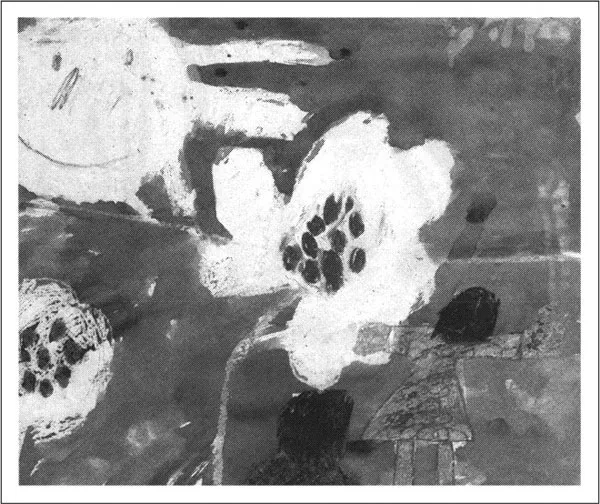
Figure 1.1 Looking at the Sunflowers. Crayon and paint by an eight year old. Size: 60 ∞ 45 cm
Teaching art is one of the perks of being a primary school teacher. It brings delight to the children and adults alike, enabling them to celebrate ingenuity, inventiveness, and creativity through the making and viewing of works of art. We write at a time of uncertainty about the role of art and arts education in the primary sector, so it is with some ambivalence that we open this chapter by quoting at length one of the most powerful statements we have read in support of the arts in schools, from a recent OFSTED publication.
… the most persuasive argument for an education in the arts concerns the benefits of attainment in the arts for its own sake.
• The arts … are intrinsic components of human culture, heritage and creativity. They mirror the whole repertoire of human experience, and are worthy of study in their own right. It is difficult to imagine a world without arts, with no drawing, music or painting for example. Few, if any, cultures are without these elements.
• The arts are a response to our thirst for knowledge, insight and revelation. They give people opportunities to explore their feelings, come into contact with the spiritual, increase their knowledge, develop their skills, and articulate and realise their aspirations. They provide ways of knowing, representing, presenting, interpreting and symbolising, and a context for appreciating and valuing.
• Contact with the arts requires the abilities to question, explore, collaborate, and extend and develop one’s ideas, and the ideas of others. The creation of art requires a sense of structure, discipline, rigour, and a positive response to challenge.
(OFSTED 1998)
Making art actively supports intellectual, social and emotional development, while offering opportunities to develop essential skills, knowledge and understanding that apply across the curriculum. Some aspects of cognitive development and understanding cannot be taught except through the arts, and of these, some are only accessible within the visual arts. As primary teachers, we need to be reminded that art education is concerned with essential elements of thinking and learning:
• first-hand, practical, sensory experiences;
• developing, processing and representing ideas;
• responding to problems;
• developing critical, visual awareness;
• refining practical skills in the use and control of materials and equipment;
• investigation, exploration and discovery;
• study of the ideas, processes and products of other artists;
• developing personal and individual modes of expression;
• observing and scrutinising in detail.
A major contribution to thinking about art education was, and remains, what is commonly referred to as The Gulbenkian Report, from which this statement comes:
We see the arts making vital contributions to children’s education in six main areas:
• in developing the full variety of human intelligence;
• in developing the ability for creative thought and action;
• in the education of feeling and sensibility;
• in the exploration of values;
• in understanding cultural change and difference;
• in developing physical and perceptual skills.
(Calouste-Gulbenkian Foundation 1982)
Children usually enjoy art activities; they learn more productively when motivated, enthused and suitably challenged by an area of the curriculum that they respond to positively, and teachers should encourage them to:
• express ideas, observations and feelings with confidence;
• make choices about the media and tools to suit the task and match their preferred mode of working;
• understand the processes and techniques of particular media;
• develop an appreciation of art and the work of artists.
While art can, on occasion, prove relaxing, the real satisfaction comes from actively responding to challenge. In the best taught art sessions, there is sometimes little talk, and almost no off-task talk. Children are focused and absorbed, if the teacher has framed the task in such a way that they are confident, but never under-stimulated.
The National Curriculum describes Art and Design with its own values, aims and outcomes, achieved through the Attainment Target: Knowledge, Skills and Understanding.
The visual and tactile elements of art and design are referred to as requirements to be taught at each Key Stage. For ease of reference, these have been summarised and defined at the end of this chapter, and are referred to in each medium-specific chapter. While streamlining and cross-curricular planning is an established aim in effectively managing the demands of the primary school curriculum, art teaching should be considered in its own right as well as in conjunction with other curricular areas.
However, this is not to say that art exists in a vacuum (for its own sake) as though it didn’t by its very nature feed off life and, just as important, nourish it. Indeed, art can have a part to play in the Viking topic, or any other element of the curriculum which we might choose to use as an example, but it must be used positively, integrally, and not merely as an afterthought.
(Sedgwick and Sedgwick 1993)
PLANNING FOR ART
Art needs to be planned as a discrete subject, although it may also complement learning in other disciplines, as this list of the characteristics of good art teaching demonstrates:
• a sequence of lessons is thoroughly planned;
• classroom assistants share the planning of lessons and understand the learning objectives;
• resources are well organised, and materials and equipment are accessible when needed;
• lessons are targeted on teaching specific skills;
• the purpose of the lesson is fully explained to the pupils;
• the introduction is supported by well-chosen visual resources;
• the teacher demonstrates a practical technique confidently;
• pupils receive focused support from the teacher and classroom assistants;
• individual, group and class discussion of the work helps in its assessment;
• the teacher evaluates and monitors both the process and outcomes of the lesson so that planning for progression can be systematic;
• the quality of display does justice to the high standards of pupils’ work, and provides both a learning resource and an assessment tool.
(OFSTED 1998)
Art needs distinctive documentation to support planning and classroom work, such as the school’s policy documents and curriculum statements. The specialist curriculum leader has a duty to share personal interests, knowledge and skills with colleagues, to select appropriate materials and consumable resources, to keep up to date with relevant research, identify ways of enhancing and promoting art within the school, and keep in touch with local and national arts organisations and galleries. The class teacher should:
| a) | have a clear grasp of the educational role of the arts, an understanding of how children learn through the arts, and a knowledge of the different stages of the child’s aesthetic development; |
| b) | be personally interested in and familiar with at least one or two art forms; |
| c) | be confident in encouraging creative work across the whole range of the arts; |
| d) | be able to recognise and evaluate the artistic quality in children’s work. |
(NCC Arts in Schools Project Team 1989)
Class teachers need to examine the context in which the teaching takes place, with particular reference to:
• the requirements of the National Curriculum;
• the school’s art policy documents;
• the school’s overall planning policy;
• available resources, materials and equipment, and storage;
• organisation and arrangement of available space in and outside the classroom;
• the size of the class or group and its dynamics;
• the age, abilities, interests and enthusiasms of the children;
• the teacher’s own skills, interests and enthusiasms;
• the teacher’s preferred style of classroom management.
The interrelationship of practical work and ‘critical studies’ (as defined in the Attainment Targets prior to Curriculum 2000), has proved problematic for some teachers whose knowledge and understanding of art and artists is, they feel, limited and insubstantial. Separate planning helps. For example, children working on painting, within a topic on the sea, might look at artists such as Hokusai, Turner, and portraits of sea-farers, videos and photographs of the sea in different moods, observe water at first hand through play and draw on personal experiences through family photographs, postcards and movies. Such research also informs history, geography and English, speaking and listening, reading and writing, as well as art. But within art sessions, work focuses on teaching art. The notion of ‘input and output’ may be helpful. Input consists of:
• the work of artists in the medium or media the children have as their current focus through displays, books, videos and CD Roms;
• the subject matter, related to the current topic, including books, video, photographs, and artists’ work in d...
Table of contents
- Cover
- Title Page
- Copyright Page
- Contents
- Preface
- Acknowledgments
- 1 Introducing Art and Design Education
- 2 Drawing
- 3 Painting
- 4 Printmaking
- 5 Computer Art and Design
- 6 Photography
- 7 Bookmaking
- 8 Collage
- 9 Sculpture and Box Modelling
- 10 Modelling
- 11 Puppets and Masks
- 12 Clay
- 13 Fabrics and Thread
- 14 Developing a Context for Learning
- Appendix: Artists and their Work
- Bibliography
- Index
Trusted by 375,005 students
Access to over 1.5 million titles for a fair monthly price.
Study more efficiently using our study tools.
Frequently asked questions
Yes, you can cancel anytime from the Subscription tab in your account settings on the Perlego website. Your subscription will stay active until the end of your current billing period. Learn how to cancel your subscription
No, books cannot be downloaded as external files, such as PDFs, for use outside of Perlego. However, you can download books within the Perlego app for offline reading on mobile or tablet. Learn how to download books offline
Perlego offers two plans: Essential and Complete
- Essential is ideal for learners and professionals who enjoy exploring a wide range of subjects. Access the Essential Library with 800,000+ trusted titles and best-sellers across business, personal growth, and the humanities. Includes unlimited reading time and Standard Read Aloud voice.
- Complete: Perfect for advanced learners and researchers needing full, unrestricted access. Unlock 1.5M+ books across hundreds of subjects, including academic and specialized titles. The Complete Plan also includes advanced features like Premium Read Aloud and Research Assistant.
We are an online textbook subscription service, where you can get access to an entire online library for less than the price of a single book per month. With over 1.5 million books across 990+ topics, we’ve got you covered! Learn about our mission
Look out for the read-aloud symbol on your next book to see if you can listen to it. The read-aloud tool reads text aloud for you, highlighting the text as it is being read. You can pause it, speed it up and slow it down. Learn more about Read Aloud
Yes! You can use the Perlego app on both iOS and Android devices to read anytime, anywhere — even offline. Perfect for commutes or when you’re on the go.
Please note we cannot support devices running on iOS 13 and Android 7 or earlier. Learn more about using the app
Please note we cannot support devices running on iOS 13 and Android 7 or earlier. Learn more about using the app
Yes, you can access Teaching Art & Design in the Primary School by Gloria Callaway,Abigail Leach,Mary Kear in PDF and/or ePUB format, as well as other popular books in Education & Education General. We have over 1.5 million books available in our catalogue for you to explore.