eBook - ePub
The M.E.Sharpe Library of Franklin D.Roosevelt Studies: v. 1
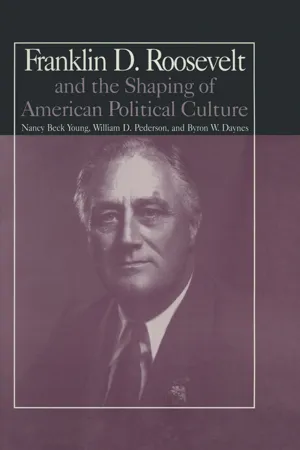
Franklin D.Roosevelt and the Shaping of American Political Culture
- 212 pages
- English
- ePUB (mobile friendly)
- Available on iOS & Android
eBook - ePub
The M.E.Sharpe Library of Franklin D.Roosevelt Studies: v. 1
Franklin D.Roosevelt and the Shaping of American Political Culture
About this book
Although Roosevelt had no single plan to alter Congress's role, the incremental changes adopted during the New Deal transformed Congress. Examining the immediate reactions of groups in Congress and beyond, and the long-term effects, this study offers insights into a key period in US politics.
Information
I
FDR
1
The Popular Iconography of FDR
No American president was more concerned about how he was portrayed than Franklin Delano Roosevelt. He shrouded himself in dozens of disguises, including Sphinx, Father, Doctor and Captain of the Ship of State. One main theme was consistent. FDR invariably represented himself, and was portrayed by others, as hale, hearty, optimistic, and healthy, his most brilliant disguise. That image of vigor makes ironic the debate over the depiction of Roosevelt in his memorial statues in Washington, DC, and raises complex issues about the portrayal of the best-known but most enigmatic president of the twentieth century. Should his physical disability be featured or hidden?1
This controversy is one of the many expressions of the iconographic complexity of the 32nd president of the United States. Hundreds of thousands of material artifacts—not only memorial statues, but also paintings, political buttons, toys, and utilitarian objects—have presented the president in varied ways for the past sixty years. The U.S. government has enshrined FDR’s likeness on the fifty-dollar savings bond, postage stamps, and, of course, the ubiquitous Roosevelt dime. Symbols relating to FDR have also abounded in speeches, cartoons, and other printed matter. This essay introduces some of the myriad images of FDR both in the historical literature and in surviving examples of FDR memorabilia, and suggests how their construction has contributed to the enduring reputation of Roosevelt in the collective memory of the nation.
Material objects related to presidents and their campaigns have existed since the beginning of the republic, but especially since about the 1880s, when participation in electoral politics became relatively high. The existence of utilitarian objects representing the virtues (or flaws) of a politician, according to the Museum of American Political Life, “suggests] the public’s wide-spread involvement in the presidential selection process.”2 Presidential campaign objects also represent the increasing commodification of the electoral process, as well as the growing consumer culture in the United States. By the late nineteenth century, political parties began to run their campaigns much like businesses, using advertising and the image of the candidate as tools of campaign strategy.3 Moreover, for a few presidents whose reputations were shaped by such national emergencies as war or martyrdom, public veneration led not only to perpetuating their names through children, highways, schools, bridges, and museums, but also to the crafting of iconographic items displayed in the homes of ordinary citizens. These included political textiles (such as banners and pennants), campaign ceramics (such as commemorative china and glassware), lapel pieces, political paper, clothing, novelties, and games. One scholar suggested that such political Americana provides an invaluable personal and material link between the public and those who have been elected to office.4
No president generated as many iconographic objects as did Franklin Delano Roosevelt. Because of the length of his term in office, his unprecedented four astonishing campaigns, objects like political buttons and posters, coins and medals, busts, wall plaques, and paintings exist by the thousands, but so do such mundane items as matchboxes, trays, drums, bottles, dishes, cups, neckties, license plates, pillowcases, figural clocks, toys, and dolls. These artifacts often identify a singular achievement. One bust, for example, is entitled “Our “New Deal’ President”; sets of china memorialize specific treaties or election victories; a figural clock presents FDR behind a bar observing a festive party celebrating the end of prohibition. These varied objects were produced both during FDR’s lifetime and in the years immediately after his death.
Material artifacts relating to FDR are preserved in several places. These include organizations that collect national political memorabilia, such as the Smithsonian Institution; the Roosevelt Presidential Library and Franklin and Eleanor Roosevelt Institute in Hyde Park, New York, and individual or smaller collections, including that of the Center for New Deal Studies at Roosevelt University in Chicago. At Roosevelt University, the FDR artifact holdings are dominated by the collection of Joseph M. Jacobs, a Chicago labor lawyer. Jacobs amassed a huge 4,000—item collection of memorabilia relating to FDR, including such personal items as cigarette holders, shot glasses, and playing cards. This collection is considered the largest private FDR memorabilia collection in the world.5 Many of the objects in the collection were produced commercially for souvenir or political purposes, but some are handmade, rare, or unique. A similar but smaller collection of memorabilia, the Lowery Collection, was donated to the University in 1996 by the Roosevelt Institute.
Shortly after FDR’s death in 1945, Jacobs began to collect the kind of items that were, he said, “icons” of FDR produced or displayed by ordinary Americans. He wanted to see the varied ways in which FDR was portrayed or venerated in the American home.6 Jacobs was as interested in seeing the third or fourth copy or reworking of a painting or bust as he was in securing the original artifact. This collection is therefore a fascinating resource for understanding how Americans commemorated FDR both before and after his death, and offers a way to supplement the more conventional use of print material for the interpretation of American political culture.
For a rare few venerated presidents, powerful symbols have emerged to express popular and simplistic conceptions of their place in American history. These images help to both create a mythology of American leadership and maintain a collective memory of the presidency. Although these memories change over time, for these special presidents, their ranking at the top of the list of American presidents seems secure. According to one historian:
Each of the three centuries since the founding of the American republic has produced a president whom the public reveres as an irreproachable paragon of leadership. The eighteenth century gave the nation George Washington, the … Father of his Country…. The nineteenth century witnessed the emergence of Abraham Lincoln … Great Emancipator. … The twentieth century has seen the elevation of Franklin Delano Roosevelt, Doctor New Deal and Doctor Win-the-War, his county’s leader in the best and worst of times.7
Historians have consistently ranked Roosevelt as one of the greatest presidents of the United States along with George Washington and Abraham Lincoln. But this elevated ranking began in his own time, as seen in commercial items associating Roosevelt with a pantheon of exemplary presidents. A typical example is a cardboard fan held in the Center for New Deal Studies, which advertises Edinger’s Bakery in Philadelphia. Dated 1933, this object portrays a painting of FDR seated in front of a radio microphone on one side, surrounded by the approving visages of six previous “great” presidents, including Andrew Jackson, Abraham Lincoln, Theodore Roosevelt, Woodrow Wilson, Thomas Jefferson, and George Washington. On the back of the fan, the text suggests that this “president of all the people” has already (by 1933) been placed “on a par with great Presidents of the past. He stands today as a symbol of America, of the fighting, courageous, gallant America built by our leaders of the past.” There are also trays, dishware, and other items portraying FDR not only with past presidents, but with world leaders such as Winston Churchill.8 That FDR assumes this stature seems appropriate, for he was deeply aware of his reputation in American history.
Roosevelt often quoted Oliver Wendell Holmes: “We live by symbols.” He was a crafty manipulator of the symbolic image of past presidents, particularly of Abraham Lincoln. Just as Ronald Reagan later ignored political party lines to appropriate FDR for his own, so FDR did the same in shrewdly appropriating the mantle of the Republican Lincoln. In his speeches, Roosevelt often quoted Lincoln; he made a well-publicized visit to the log cabin where Lincoln allegedly was born, and in 1935 on Lincoln’s birthday, he “made a public display of meeting with the only surviving man who had guarded Lincoln’s body when it lay in state” a century earlier.9 That in the 1980s and 1990s FDR’s memory was freely evoked by politicians of both parties—from the Democrat Senator Edward Kennedy on the one hand to the Republican House Speaker Newt Gingrich on the other—suggests that his function as a historical symbol, like that of Abraham Lincoln, remained powerful long after his lifetime.10
There is not yet a comprehensive study of portraits of FDR, but a multiplicity of images exist in memorabilia collections. Very few photographs or artifacts depict the president’s physical disability. Many portraits, representations, and objects instead show an optimistic man clearly in control. Even the caricatures emphasize a strong jaw, often clenched around a cigarette, good humor, a man clearly in command. Caricatures were created not only in posters and buttons, but also in items like bottletops, dolls, smoking pipes, and even the cloth arm patches worn by FDR’s personal airplane pilots. The latter is particularly rich in symbolism. A “Mr. Peanut” icon with FDR’s aristocratic face wears a top hat and monocle, and leans on a cane, though the bottom half of the body is configured into a bomb. FDR’s beloved dog Fala hovers in the clouds above. Some of the representations, however, take on more specific iconographic or metaphoric meanings to suggest strength, power, and mastery. At least four such images appear in the memorabilia of FDR: Roosevelt as Sphinx, Father, Doctor, and Captain. Although we suggest interpretations to fit these images, we are aware that—appropriately—sometimes an image of FDR can be perceived in more than one way.
FDR as Sphinx
“The Sphinx” is a good example of a focused representation of FDR that has a historical context and survived well after FDR’s death in the shape of souvenir iconography linking the president to a powerful and ancient symbol. There exists in the Center for New Deal Studies a miniature reproduction of a papier-maché caricature of FDR now held at the FDR Library in Hyde Park. The original is over seven feet tall and built in the shape of a pyramid. It portrays FDR’s smiling face, teeth gripping a cigarette in a sphinxlike caricature. This sphinx was created by James D. Preston of Washington, DC, and was first displayed in December 1939 at the annual winter dinner of the Gridiron Club, the organization of White House press correspondents.
According to FDR Library notes, Roosevelt at this time was sometimes referred to as “The Sphinx” because he refused to say if he would seek nomination in 1940 for an unprecedented third term as president. The reproduction was sold at one time at the FDR Library museum shop. The imagery is also used in political cartoons, such as the example by Ross Lewis of the Milwaukee Journal that pictured FDR as a sphinx giving such “cryptic answers to third term queries” as “abracadabra.”11 Although not a particularly widely used image of Roosevelt, this is an interesting symbol suggesting the enigmatic and shifting nature of the president. The popularity of the sphinx artifact long after memories of the third campaign dimmed also evidences that the image of FDR as an enigma remained potent for decades.
FDR as Father
A second image of FDR is that of Father. In 1932, when FDR told listeners in Detroit that “six million children do not have enough to eat,” critics called his programs “paternalistic.” His simple reply: “All right; I am a father.”12 The Jacobs Collection holds a remarkable portrait of FDR, which can be interpreted as Father of the New Deal. In this WPA-like painting, almost cartoonish in style and signed by a “J.M. Robinson,” a strong and vigorous FDR (standing on his two legs!) holds a blueprint or plan in his hand. He is surrounded by adoring Americans of many kinds: farmers, the elderly, working men and women, children, the sick, the blind, immigrants, soldiers, the African American domestic servant and Pullman porter. Looming in the background are planes and ships of the American military. Because the soldiers are dressed in the style of World War I, it appears that this undated painting was crafted sometime during the 1930s. Clearly, the president is in control and in a paternalistic position of protection and leadership of this family of citizens.
FDR as Doctor
The portrait just referred to might also be interpreted as Doctor of the New Deal—the kindly old-fashioned family physician healing the sick. A common representation of FDR during his lifetime (but apparently not so much thereafter) was as a doctor: either Doctor New Deal or Doctor Winthe-War. This symbolism of FDR as a healer was consciously crafted by the president himself. Medical metaphors came into frequent use in presidential press conferences as well as in political cartoons. One example can be seen in a cartoon by C. K. Berryman, published in the Washington Star in December 1943, and captioned “There’s an Odd Family Resemblance Among the Doctors.” Dr. New Deal stands by the ailing John Q. Public; on the bedside table are potions and bottles of various welfare remedies. Dr. Win-the-War strides into the sickroom to further tend the patient, while Dr. Fourth Term hovers behind in the doorway.13
In printed material, the term “Doctor Roosevelt,” “Old Doctor Roosevelt,” “Doctor Win-the-War,” and “Dr. Brain Trust” are much used, although this imagery does not proliferate in the artifacts. Nevertheless, this iconography is part of the larger picture of FDR. A doctor has mastery over illness, and, possibly as a victim of polio, FDR’s attempt to doctor himself and others translated into efforts to heal the nation economically and militarily. His remarkable success ...
Table of contents
- Cover
- Title
- Copyright
- TABLE OF CONTENTS
- Introduction and Summary
- Part One: FDR
- Part Two: Art, Architecture, and Music of the 1930s
- Part Three: Popular Culture
- Cultural Chronology
- Biographical Digest
- List of Contributors
- Index
Trusted by 375,005 students
Access to over 1.5 million titles for a fair monthly price.
Study more efficiently using our study tools.
Frequently asked questions
Yes, you can cancel anytime from the Subscription tab in your account settings on the Perlego website. Your subscription will stay active until the end of your current billing period. Learn how to cancel your subscription
No, books cannot be downloaded as external files, such as PDFs, for use outside of Perlego. However, you can download books within the Perlego app for offline reading on mobile or tablet. Learn how to download books offline
Perlego offers two plans: Essential and Complete
- Essential is ideal for learners and professionals who enjoy exploring a wide range of subjects. Access the Essential Library with 800,000+ trusted titles and best-sellers across business, personal growth, and the humanities. Includes unlimited reading time and Standard Read Aloud voice.
- Complete: Perfect for advanced learners and researchers needing full, unrestricted access. Unlock 1.5M+ books across hundreds of subjects, including academic and specialized titles. The Complete Plan also includes advanced features like Premium Read Aloud and Research Assistant.
We are an online textbook subscription service, where you can get access to an entire online library for less than the price of a single book per month. With over 1.5 million books across 990+ topics, we’ve got you covered! Learn about our mission
Look out for the read-aloud symbol on your next book to see if you can listen to it. The read-aloud tool reads text aloud for you, highlighting the text as it is being read. You can pause it, speed it up and slow it down. Learn more about Read Aloud
Yes! You can use the Perlego app on both iOS and Android devices to read anytime, anywhere — even offline. Perfect for commutes or when you’re on the go.
Please note we cannot support devices running on iOS 13 and Android 7 or earlier. Learn more about using the app
Please note we cannot support devices running on iOS 13 and Android 7 or earlier. Learn more about using the app
Yes, you can access The M.E.Sharpe Library of Franklin D.Roosevelt Studies: v. 1 by Nancy Beck Young,William D. Pederson,Byron W. Daynes,NancyBeck Young in PDF and/or ePUB format, as well as other popular books in Politics & International Relations & North American History. We have over 1.5 million books available in our catalogue for you to explore.