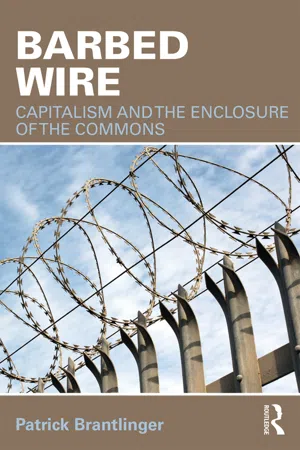
A call to transform the way we think about property, this book examines how capitalism has from its origins sought to enclose or privatize the commons, or land and other forms of property that had been viewed as communally owned, and argues that neoliberal economic policies and the corporate takeovers of urban spaces, prisons, schools, the mass media, farms, and natural resources have failed to serve the public interest. A study of corporate globalization and the continuation of empire after the era of political decolonization, it begins with the fencing of the West starting in the 1870s, and moves to examine recent phenomena such as urbanization, mass incarceration, financialization, and the treatment of people as commodities in the context of the longue durée of land enclosures, empire, and capitalism. Highlighting the threatened elimination of the public domain as a result of corporate efforts to privatize public utilities, prisons, schools, forests, seeds, and just about everything else that can yield a profit, Barbed Wire: Capitalism and the Enclosure of the Commons asks what it would mean if, instead of either private or public property, our most fundamental conception of property were communal. Would a redefinition of property from a community perspective lead us beyond the military-industrial complex?
- 170 pages
- English
- ePUB (mobile friendly)
- Available on iOS & Android
eBook - ePub
About this book
Information
p.1
1
MODERN FENCING
“All this Americanising and mechanising has been for the purpose of overthrowing the past. And now look at America, tangled in her own barbed wire, and mastered by her own machines.”
— D. H. Lawrence
From Greenville to Mad Art
Driving by the federal prison outside Greenville, Illinois, I started thinking about barbed wire and other modes of enclosure. The Greenville lockup is surrounded by barbed wire, topped by its perfection, spirals of concertina or razor wire. It occurred to me that the entire history of capitalism could be written in terms of enclosures, with prisons as an extreme version. I recalled Michel Foucault’s account in Discipline and Punish of the rise of the penitentiary and “the carceral society.” Perhaps I was also remembering Vijay Prashad’s comment in Fat Cats and Running Dogs that “the story of Enron . . . is the tale of the Second Enclosure Movement, and follows from the earlier movement to enclose land with barbed wire and other fencing” (7).
In college, I had studied the first enclosure movement that began centuries before the invention and first manufacturing of barbed wire in the 1870s. Throughout Europe starting in the late Middle Ages, aristocrats and other wealthy landowners enclosed large areas that had previously been viewed as “commons” and relied on by the peasantry for pastures, crops, wood, and foraging. The old term “enclosure” is today often used as a synonym for privatization, as when corporations take over property or processes that had before been public or communal.
p.2
As I passed by Greenville, I was on my way to visit my younger son, a musician who lives in St. Louis and whose income derives mainly from managing Mad Art. It is a funky gallery, event space, and barbecue joint in a former police station owned by an ex-policeman. Mad Art still has the original jail cells, where tourists can have lunch during visits to the historic Soulard neighborhood or to the Anheuser-Busch brewery across the street. During my trip, Greenville prison and Mad Art bookended my musings about modes of enclosure. My son and his friend, the ex-policeman, have named the barbecue eatery in Mad Art “The Capitalist Pig.” Their pulled pork sandwich is quite delicious. As for actual capitalist pigs, they have become far too powerful, and they are gaining ground—which still often means enclosing ground—at a great rate. As most Americans know, our democratic institutions are being bought up lock, stock, and barrel—that is, enclosed or privatized—by what Bernie Sanders calls “the billionaire class.” It is no secret that, since World War II, the US has become a plutocracy. Witness the 2016 election of Donald Trump and his selections for his cabinet, also corporate billionaires.
Greenville is a federal prison, but the private prison industry is huge and growing. Further, private companies provide many of the services inside the Greenville “Correctional Institution” (just how much “correction“ is occurring inside it is questionable). Because of the “prison-industrial complex” and the failed “war on drugs,” the US, “land of the free,” has the highest incarceration rate of any country in the world. Nearly 2.5 million people are currently locked up in places such as Greenville prison. More than half of those incarcerated are African Americans and Latinos, a manifestation of what Michelle Alexander calls “the new Jim Crow.” Another manifestation is the recent media spectacle of the shootings of unarmed black men, boys, and sometimes women by the police, such as the murder of Michael Brown in Ferguson, Missouri, about five miles from Mad Art. The Black Lives Matter movement, protesting police brutality and the shootings of African Americans, is also protesting the officially authorized violence responsible for mass incarceration.
Just as it was once profitable to kidnap and enslave Africans, so it is profitable for private prison corporations to incarcerate as many prisoners as possible, no matter what their race may be. Caging people was and is big business. Prisons, of course, aren’t the only institutions that are increasingly being privatized by corporations. So are educational institutions: as state legislatures underfund public schools, the charter school movement mushrooms.1 Public universities such as the one where I taught for 38 years, Indiana University, have seen their support from state revenues dwindle from about 50 percent of their budgets in 1970 to around 15 percent or lower today. Privatizing city water systems represents only a fraction of the escalating “water wars” around the world, with large corporations draining entire lakes and aquifers to profit from them. Following the invasion of Iraq in 2003, private military outfits such as CACI, DynCorp, and Blackwater became collectively the largest occupying force after the U.S. military. Also, about 80 percent of the U.S. government’s intelligence operations have been outsourced to private corporations such as Booz Allen Hamilton, the company that employed Edward Snowden. And on and on. Is there any business or activity or parcel of the world that cannot be privatized or enclosed by some corporation or other?
p.3
Enclosing the commons was the main version of “primitive accumulation,” which Marx saw as the starting point for capitalist development. “The capital-relation,” Marx wrote, emerges through “the process which divorces the worker from the ownership of the conditions of his own labour,” or in other words which “frees” workers from the most basic means of subsistence, the land, and turns them into “wage-labourers” (Capital 1: 874). Once the peasantry had been cleared off the land, it became privately owned fields for crops or pastures, or sometimes deer parks for the pleasure of the wealthy. The early enclosure movement, a major development in the evolution of private property, and which often met with resistance such as Kett’s Rebellion in Norfolk, England, in 1549, lasted for several centuries. Marx adds that “by about 1750 the [English] yeomanry had disappeared, and so, by the last decade of the eighteenth century, had the last trace of the common land of the agricultural labourer” (Capital 1: 883). But the enclosure of land did not end in 1750 in England or anywhere else. The rapacious desire for more land was a major factor in the formation of the European empires starting in the Renaissance. Early corporations such as the British East India Company spurred imperial expansion. And today corporations continue to buy up enormous parcels of land around the world.
If the first term in Marx’s phrase “primitive accumulation” is interpreted to mean early, that is inaccurate: capitalist “accumulation by dispossession” is still going on, big time (Harvey, The New Imperialism 137–182). Look at the fights over the Keystone XL and Dakota Access pipelines, or over fracking, or over harvesting timber in the Hoosier National Forest near my hometown (Bloomington, Indiana), among countless instances. Or consider how the big agricultural corporations such as Cargill and Monsanto have been devouring small farms everywhere. According to Alexander Ross, “the land grabs that have taken place around the world since 2009 would encompass the entire Western United States” (Grabbing Back 20).
The main reasons for the current corporate attempts to acquire land are for large-scale agriculture and for resource extraction (oil and gas drilling, mining, forestry). In an article also entitled “Global Land Grab,” Terry Allen reports that “some 2 billion people in the developing world depend on 500 million smallholder farms for their livelihoods. . . . But with spectacular speed, patchworks of plots that used to support local populations through subsistence farming and grazing are being amalgamated into massive industrial plantations” (15). The smallholders are being evicted, usually with very little or no compensation. So the old story of the enclosure of land continues. Just as during the earliest enclosures of land, so now, David Korten declares, millions of “small-scale producers—farmers and artisans—who once were the backbone of poor but stable communities are being uprooted and transformed into landless migrant laborers, separated from family and place” (The Great Turning 29). This is evident in many formerly flourishing country towns in the US and Canada that are now deserted, or nearly so. It is also evident on street corners in major American cities, where migrant workers—documented or not—wait patiently for someone to hire them for a day or perhaps a few days to do some gardening or painting or roofing. It is not hard to figure out why they have come to be uprooted and in desperate need of work.
p.4
Marx’s treatment of primitive accumulation, David Harvey points out, “reveals a wide range of processes”:
These include the commodification and privatization of land and the forceful expulsion of peasant populations; the conversion of various forms of property rights (common, collective, state, etc.) into exclusive private property rights; [and] the suppression of rights to the commons . . .
(The New Imperialism 145)
Today, under the aegis of neoliberal economics, capitalism’s goal is to privatize or enclose as much as possible, the entire planet and even beyond, if some amount of profit can be made by doing so.2 In Capitalism: A Ghost Story, Arundhati Roy calls this the “era of the Privatization of Everything.” She proceeds to excoriate corporations and the wealthy for grabbing up as much land as possible:
All over the world, weak, corrupt local governments have helped Wall Street brokers, agribusiness corporations, and Chinese billionaires to amass huge tracts of land. (Of course this entails commandeering water too.) In India the land of millions of people is being acquired and handed over to private corporations . . .
(11–12)
Roy recounts how the Indian government (which is supposedly a democracy), in collaboration with corporations and the very wealthy, is violently evicting entire communities to make way for gigantic industrial zones. As the poor are displaced from their homes and their land, she says, they are told it is all about economic growth and the jobs such growth will create. But “the connection between GDP growth and jobs is a myth” (12). In India, since independence, a new middle class has emerged along with a handful of billionaires, but the impoverishment of the vast majority keeps pace and then some with economic development.
Orthodox economics seldom addresses enclosure or “the dispossession of commoners as market forces seize control of common resources, often with the active collusion of government” (Bollier, Think Like a Commoner 40). In his first book on the topic, Silent Theft, David Bollier declares that “we are living in the midst of a massive business-led enclosure movement” (6). He notes that “the American commons,” or what American citizens “collectively own,” include “tangible assets such as public forests and minerals, intangible wealth such as copyrights and patents, critical infrastructure such as the Internet and government research, and cultural resources such as the broadcast airwaves and public spaces” (3). On many fronts, and for many reasons that add up to money, government at all levels has been willing to cede to corporate interests what had previously been within its purview, part of what Bollier calls our “commonwealth.”
p.5
Such enclosures of the commons are aided by a Washington officialdom increasingly captive to business and indifferent to ordinary citizens; a journalism profession that has grown soft now that it competes with entertainment and marketing; and the dominion of market culture over our civic identities.
(Bollier, Silent Theft 3)
Especially after the 2010 Citizens United decision by the Supreme Court, more and more Americans are waking up to the fact that we are now governed by corporations and plutocrats, serviced by the swarms of lobbyists who infest the corridors of power in Washington, and kowtowed to by our elected politicians (see Clements; Hartmann).
Much of the impetus behind privatization or the recent enclosure movement is supported by the widespread belief that government is generally wasteful and inefficient, if not altogether corrupt, while private businesses are much more efficient and cost-effective. This belief has been proven false many times over, and yet it remains the dominant view in many circles. Was the Enron pyramid scam an aberration, or was it typical of corporate practices? The banks and mortgage lenders whose criminal behavior tanked the economy in 2007–2008 revealed that Enron was not an aberration. The “too big to fail” banks were bailed out by the federal government using taxpayers’ money. They have sometimes been fined millions of dollars for their misdeeds, as was Wells Fargo in 2016, but since 2008 no major banker or CEO has wound up in prison for thefts or scams amounting to billions of dollars. And of course, the more government agencies such as the EPA or HUD are underfunded, the less effective they become. We are asked by the powers that be to recognize ongoing privatization as progress, but it is difficult to see how wrecking the environment and reducing everyone’s prosperity and access to public goods amounts to progress.
In the early going in Europe, the defenders of the enclosure movement viewed it as improving estates and modernizing agriculture—that is, as progress. Its opponents, however, recognized its human costs: many of the dispossessed peasants became landless farmworkers, frequently “rackrented” by their landlords, or else they migrated to towns and cities where, during the late 1700s and early 1800s, they often joined the ranks of the mushrooming industrial proletariat. “The dispossessed [peasant] tenant,” writes Stephen Marglin:
the meaning of his existence eroded as his economic, political, and social ties to the land and to his fellows eroded, became the modern wage worker, remaining on the land at the sufferance of his master. From there it was a short social and psychological step . . . into the ‘reserve army’ that constituted the labor force for England’s industrialization.3
(87)
Modern cages
Greenville prison and the jail cells in Mad Art point to the great contradiction between America “land of the free” and the stark fact of mass incarceration. And if enclosing or imprisoning 2.5 million people weren’t bad enough, what about Abu-Ghraib, Guantanamo, and the “black sites” overseas to which the CIA has been “rendering” alleged terrorists so they can be thrown in dungeons and tortured? This is not the America kids learn about in school. Yet it seems all too characteristic of capitalist modernity and now postmodernity: prosperity for many, but poverty, hardship, and sometimes even torture for the vast majority. Long before Foucault analyzed the rise of “the carceral society,” Max Weber famously warned that industrial capitalism was turning the modern world into “an iron cage”:
p.6
No one knows who will live in this cage in the future, or whether at the end of this tremendous development entirely new prophets will arise, or there will be a great rebirth of old ...
Table of contents
- Cover Page
- Barbed Wire: Capitalism and the Enclosure of the Commons
- Title
- Copyright
- Dedication
- Contents
- Acknowledgments
- Introduction
- 1 Modern Fencing
- 2 Urban spaces
- 3 Caging People: From Schools to Prisons
- 4 Thinking Inside the Box
- 5 Corporations as Greed Machines
- 6 Globalization and Empire
- 7 Manufacturing Disposable People
- 8 The Real Tragedy of the Commons
- 9 What is to be Done?
- Bibliography
- Index
Trusted by 375,005 students
Access to over 1.5 million titles for a fair monthly price.
Study more efficiently using our study tools.
Frequently asked questions
Yes, you can cancel anytime from the Subscription tab in your account settings on the Perlego website. Your subscription will stay active until the end of your current billing period. Learn how to cancel your subscription
No, books cannot be downloaded as external files, such as PDFs, for use outside of Perlego. However, you can download books within the Perlego app for offline reading on mobile or tablet. Learn how to download books offline
Perlego offers two plans: Essential and Complete
- Essential is ideal for learners and professionals who enjoy exploring a wide range of subjects. Access the Essential Library with 800,000+ trusted titles and best-sellers across business, personal growth, and the humanities. Includes unlimited reading time and Standard Read Aloud voice.
- Complete: Perfect for advanced learners and researchers needing full, unrestricted access. Unlock 1.5M+ books across hundreds of subjects, including academic and specialized titles. The Complete Plan also includes advanced features like Premium Read Aloud and Research Assistant.
We are an online textbook subscription service, where you can get access to an entire online library for less than the price of a single book per month. With over 1.5 million books across 990+ topics, we’ve got you covered! Learn about our mission
Look out for the read-aloud symbol on your next book to see if you can listen to it. The read-aloud tool reads text aloud for you, highlighting the text as it is being read. You can pause it, speed it up and slow it down. Learn more about Read Aloud
Yes! You can use the Perlego app on both iOS and Android devices to read anytime, anywhere — even offline. Perfect for commutes or when you’re on the go.
Please note we cannot support devices running on iOS 13 and Android 7 or earlier. Learn more about using the app
Please note we cannot support devices running on iOS 13 and Android 7 or earlier. Learn more about using the app
Yes, you can access Barbed Wire by Patrick Brantlinger in PDF and/or ePUB format, as well as other popular books in Économie & Histoire économique. We have over 1.5 million books available in our catalogue for you to explore.