eBook - ePub
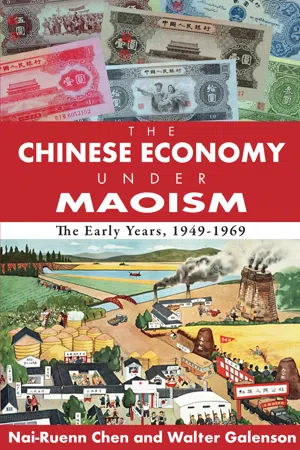
The Chinese Economy Under Maoism
The Early Years, 1949-1969
- 260 pages
- English
- ePUB (mobile friendly)
- Available on iOS & Android
eBook - ePub
About this book
Over sixty years have elapsed since the Communists gained control of the Chinese mainland. The years between 1949 and 1969 were a time of constant change and periodic cataclysm-the initial purges, the Great Leap Forward, and the Cultural Revolution-all bound up with the Communist conception of how to move the country into modernity in the shortest possible time. The Chinese Economy under Maoism summarizes and evaluates the economic consequences of the Communist path to development in a concise, factual presentation that can be readily comprehended by non-economists. The authors review the major features of the Chinese economy prior to the Communist takeover and discuss the policies, performance, and problems of the individual sectors of the Chinese economy during its initial years under Communism. Included in their review are industry, agriculture, foreign trade, resource allocation, population, employment, and living standards. A concluding chapter summarizes Chinese economic growth and presents a discussion of future policy alternatives and an optimum economic policy for China. Based on important findings of Western scholars, with many original interpretations by the authors, this material is presented from a developmental point of view. Since it was originally published in 1972, sections of the book devoted to comparative studies of progress in India and the former Soviet regime will be of particular interest now. Free of technical language and providing insights into the economy of one of the most important countries in the world, this book will be useful not only to economists but to a broad range of sinologists, political scientists, sociologists, and historians interested in the path of revolution.
Index
- Africa, 44, 139, 199, 213
- Agricultural Bank of China, 125
- Agriculture, 2-10, 86, 87-126, 146, 184, 216-217, 222, 223, 224
- capital in, 5, 9, 46, 87, 120, 121, 122
- collectivization of, 34, 36, 37, 39, 41-42, 91, 97, 105-106, 119, 124, 129, 144, 149, 150, 151, 165 See also Collectives
- development, 12, 34, 48, 87, 92, 104-124
- and economic growth, 88-97
- implements in, 97, 109, 123, 124, 125, 148, 149, 150, 227
- income in, 5, 7, 8, 9, 89, 152, 154
- and industry, 87, 88, 95-96, 98, 125, 153
- investment in, 7, 9-10, 34, 38-40, 48, 92, 106, 121, 125, 135, 152, 183, 215, 225
- labor force in, See Labor force, agricultural
- mechanization of, 88, 101, 109, 118, 119, 122, 123
- multiple cropping, 8, 11, 106, 107, 109
- output (productivity), 7, 10, 33, 41-42, 47, 87-95, 97-107, 109, 113, 118, 119, 123, 125, 147, 151, 152, 153, 156, 159, 181, 190, 202, 217, 219, 225, 226, 227
- planning, 93, 151, 158,...
Table of contents
- Cover Page
- Title Page
- Copyright Page
- Contents
- Preface
- ONE The Economic Heritage
- TWO Alternative Paths to Economic DevelopmentPreface
- THREE Development of the Industrial Sector
- FOUR Agriculture
- FIVE Population and Employment
- SIX The Control and Allocation of Resources
- SEVEN Conditions of Life and Labor
- EIGHT Foreign Economic Relations
- NINE Prospects for the Chinese Economy
- Bibliography
- Index
Trusted by 375,005 students
Access to over 1.5 million titles for a fair monthly price.
Study more efficiently using our study tools.
Frequently asked questions
Yes, you can cancel anytime from the Subscription tab in your account settings on the Perlego website. Your subscription will stay active until the end of your current billing period. Learn how to cancel your subscription
No, books cannot be downloaded as external files, such as PDFs, for use outside of Perlego. However, you can download books within the Perlego app for offline reading on mobile or tablet. Learn how to download books offline
Perlego offers two plans: Essential and Complete
- Essential is ideal for learners and professionals who enjoy exploring a wide range of subjects. Access the Essential Library with 800,000+ trusted titles and best-sellers across business, personal growth, and the humanities. Includes unlimited reading time and Standard Read Aloud voice.
- Complete: Perfect for advanced learners and researchers needing full, unrestricted access. Unlock 1.5M+ books across hundreds of subjects, including academic and specialized titles. The Complete Plan also includes advanced features like Premium Read Aloud and Research Assistant.
We are an online textbook subscription service, where you can get access to an entire online library for less than the price of a single book per month. With over 1.5 million books across 990+ topics, we’ve got you covered! Learn about our mission
Look out for the read-aloud symbol on your next book to see if you can listen to it. The read-aloud tool reads text aloud for you, highlighting the text as it is being read. You can pause it, speed it up and slow it down. Learn more about Read Aloud
Yes! You can use the Perlego app on both iOS and Android devices to read anytime, anywhere — even offline. Perfect for commutes or when you’re on the go.
Please note we cannot support devices running on iOS 13 and Android 7 or earlier. Learn more about using the app
Please note we cannot support devices running on iOS 13 and Android 7 or earlier. Learn more about using the app
Yes, you can access The Chinese Economy Under Maoism by Andrew M. Greeley,Walter Galenson in PDF and/or ePUB format, as well as other popular books in Economics & Development Economics. We have over 1.5 million books available in our catalogue for you to explore.