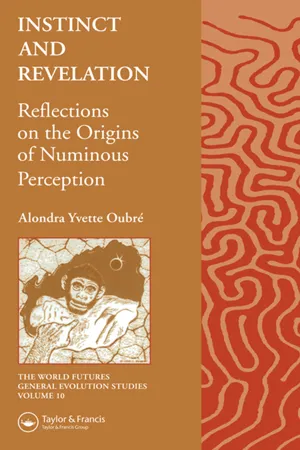
Instinct and Revelation revolves around the hypothesis that ritual behavior and imaginative awareness in early hominids may have helped to spawn the evolution of the human brain and human consciousness. Using an integral perspective comparable with systems theory, the book carefully interweaves fact and theory from physical and cultural anthropology, psychobiology and the brain sciences, psychology, and to a lesser degree, eastern philosophy. This book breaks from tradition by discussing from a primarily anthropological perspective the origin of human consciousness within a philosophical framework that embraces precepts from human evolution, evolutionary psychology, the neurosciences, biocultural anthropology, and cultural symbolic anthropology.
- 320 pages
- English
- ePUB (mobile friendly)
- Available on iOS & Android
eBook - ePub
About this book
Information
1:
The Dawn of Consciousness, Culture, and the Numinous Mind
… the visible world is part of a more spiritual universe from which it draws its chief significance…. That union or harmonious relation with that higher universe is our true end….
William James
Anthropologists, experts on the science of human evolution and human culture, have never quite agreed on exactly what it means to be human. There is not yet a clear consensus over the specific cognitive and behavioral traits that distinguish humans from other animals. The discord surrounding this issue has become especially evident in the proliferative literature on human biology and behavior, human evolution, consciousness studies, human rights, and, more recently, animal rights.1 At best, there is a vague notion that humans differ from other animals because they have created culture — a matrix of shared ideas, beliefs, and values epitomized in the capacity for open-ended spoken language and for self-reflection.
Human beings possess the unique capacity for self-recognition, a trait indicative not only of highly refined perceptual awareness, but even more significantly of apperception — or awareness of one’s own awareness.2 Consciousness, from the vantage point of psychobiology, describes the means by which information is processed by the sensory systems — be it through vision, audition, somatovisceral (body) sensation, and, in the case of most non-human vertebrates, olfaction (smell). From the perspective of the neurosciences, consciousness pertains to the perceptual and behavioral manifestations of parallel and serial associative processes occurring within the frontal, temporal, and parietal areas of the brain. By integrating multimodal sources of sensory-motor information, these areas permit enormous flexibility in behavior as opposed to rigid, instinctual action. Indeed, the refinement of mammalian consciousness is so delicately interwoven with the evolution of a suprasensory system that consciousness can be considered to be but a projection by the physical machinery of the brain. Because it enables one to construct a real world from sensory-data creations of time and space, consciousness represents in crude biological terms the end-product of processes regulated by the sensory and motor systems that comprise the brain.3
Consciousness is a phenomenon that most (or hopefully most) individuals grasp intuitively at least. Certain behaviors characterized as human-like presumably differentiate our species from other animals, including our closest primate kin — the great apes. Nonetheless, aside from the concrete example of spoken language, the qualities that make our species peculiarly human are not always so readily defined. One clue to fathoming the nature of human consciousness, however, may lie in the realization that the development of the human individual, or ontogeny, and the evolution of the human species, or phylogeny, are the end result of both biology and culture. In contrast to other vertebrate species, humans are products of nature and nurture. Biology and culture have interacted, not as isolated phenomena, but as an integral force, a biocultural imperative of sorts, that has shaped the emergence of the human lineage.
Comparative studies on animal behavior reveal that consciousness (which to some degree is a function of intelligence, or cognitive capacity) correlates with the complexities of social, creative, and novel behaviors found in both humans and non-human animals. Indeed, the intelligence (or behavioral capacity) of an animal serves as the source of its motivation to act. Intelligence, therefore, is tantamount to the perception that mediates an animals interactions with the outside world.4 An implicit assumption in this monograph, an assumption based on findings in neurobiology, is that human intelligence involves a profound integration of an inner with an outer world. This book has as one of its central themes the notion that some of the overshadowed dimensions of the inner world of the human psyche — dimensions which have nurtured the evolution of human intelligence — warrant serious scientific scrutiny.
The hominid brain increased three-fold over the last two million years, a remarkable rate of growth compared to the rate of brain expansion in other primate lineages. It is not clear, however, whether the emergence of human consciousness resulted from punctuated — that is, catalytic and precipitous — events or whether it unfolded as an evenly paced, graduated phenomenon over the last two million years.5 What is apparent though is that at whatever point the origin of human-like consciousness is placed on a time-scale, that starting point ultimately becomes somewhat arbitrary. Certain primatologists, for instance, assert that chimpanzees possess a rudimentary consciousness, and perhaps even a self-awareness, the evolution of which, long preceding human consciousness, possibly set the neurobiological template for the expansion of human mentation. Paleoanthropologists, by contrast, differ among themselves as to whether or not authentic human-like mentation commenced with the emergence of Homo habilis, Homo erectus, or archaic Homo sapiens.6
Lay persons sometimes claim that when they glance into a monkeys eyes, or even a dog’s or cat’s eyes, they perceive subjectively at least some sort of visceral, non-verbal communication occurring between them and the animal. Like primates, cats and dogs have forward-placed eyes, and sometimes their behavior is sufficiently idiosyncratic to render the facade of being individualistic. And certainly monkeys, in a typically primate fashion, often act capricious, vivacious, and playful. Yet, to the trained observer of animal behavior — the ethologist and primatologist — neither a cat or a dog or perhaps even a monkey possesses an authentically discernible self-consciousness. In other words, according to most zoologists, non-human animals do not actually project a definitive persona of the “me” or the “self” during their interactions with other animals, whether of their own or different species. Yet, in contrast to other non-human animals, chimpanzees seem to possess some sort of elementary self-awareness.
Although there are numerous pitfalls with the validity of the mirror test, a chimpanzee appears to recognize itself in the mirror as “self.” Squirrel monkeys, on the other hand, despite the fact that they can recognize other individual members of their social group, respond to their own mirror images with confusion and without a perceptible sense of self-recognition. Monkeys, like non-primate animals, generally misinterpret their own mirror images as representations of other individuals within their species, but not as their own “self.”7 (And while dogs and cats sometimes respond to their mirror images with a semblance of self-recognition, these species lack the repertoire of communicative, child-rearing, and other complex social behaviors that set apart primates, especially humans and apes, from most other animals.)
Even though consciousness seems to be the pivotal feature that differentiates humans from other species, this amorphous quality, in variable degrees, may be present in other living species, especially in human-kinds closest living relatives, the great apes. If consciousness pervades the animal kingdom (and admittedly to assume so is to limit oneself to a “zoocentric” perspective), and if it is especially evident in higher primates, then can it accurately be viewed as a mental phenomenon? Unlike purely intellectual cognition, consciousness pertains to a general faculty of awareness that incorporates a variety of sensory modes which include but are not confined to mentation, affect or emotion, and somatovisceral awareness. While intelligence to some degree provides a reasonable facsimile for consciousness, in its classical description, intelligence refers to mental cognitive processes.8 Other facets of consciousness, be they rudimentary sensory perception or even numinous (that is, mystical) reflection, do not fall under the rubric of mentalistic, or intellectual, perception.
Some anthropologists, conforming to their anthropocentric, or human-centered professional training, reserve the term consciousness exclusively for humans. Certain psychologists, traditional ethologists, zoologists, and even theologians, on the other hand, maintain that consciousness permeates all, or at least much, of the animal kingdom. A few zoologists borrow one rendition or another of evolutionary neuro-biologist Harry Jerisons definition of intelligence as an overarching label appropriate for a hierarchy of modes of consciousness found throughout the animal kingdom. Jerison calls intelligence the faculty to create an “inner perceptual world composed of constructs of the outer world.” Presumably, the more complex ones inner world, the greater is his capacity for codifying relationships — that is, for comparing people, places, and concepts.9 This faculty for comparative or relational thought is called ratiocination, a term which will be used throughout this book. This type of mentation is especially salient to the discussion at hand because human intelligence is in large measure a function of abstraction and ratiocination.
In the intellectual history of Western culture, inquiries into the origins of consciousness and intelligence have long intrigued anthropologists and students of human evolution, as well as brain scientists, psychologists, and educators. The fossil record of the human lineage, however, is sparse, revealing at best only occasional glimpses into a fading and partially conjectural paleontological scenario of primate ancestors and proto-humans. Scientific understanding of human evolution thus is limited and far from conclusive. Even sparser are clues to the forces that shaped the evolution of hominid intelligence, including the expansion of the human brain as well as the evolution of human behavior and culture. Although brains do not fossilize, the skull caps (or endocasts) of early human ancestors — such as Australopithecus, Homo habilis, and Homo erectus — furnish at best only suggestive rather than unequivocal impressions of the brains once housed by the crania of these ancient human ancestors.
Experts in biological anthropology have advanced numerous hypothetical scenarios to describe the early events, particularly hunting and food-gathering, believed to have triggered the rapid enlargement of the proto-human brain beginning about two million years ago. But these hypotheses so lack concrete proof that as one peruses the literature in human evolution, one often is left to ponder whether one is reading science fiction, fictive science, or, in fact, biological anthropology. The study of human evolution — at least insofar as it lies within the rational canons of the conventional wisdom of paleoanthropology, human genetics, primatology, archeology, and molecular anthropology — is rather fragile, imprecise, and conjectural. As an academic discipline, human evolution is defined by a corpus of speculative discourses and often fanciful scenarios based perhaps as much on imaginative reconstruction as on solid factual evidence. Physical anthropology in particular and evolutionary biology in general are fraught with gross limitations in what they can and cannot reveal about the circumstances surrounding not only the evolution of the entire human lineage, but also the emergence of modern humans.
Nevertheless, a few major tenets in the broad field of human evolutionary studies have been reasonably well established. Molecular and biochemical studies conducted over the last twenty years have demonstrated quantitatively that humans and chimpanzees share over 98% of their DNA.10 By systematically comparing the amino acid molecules of proteins, and more recently, by comparing the homology of actual DNA sequences from related species (such as humans, chimpanzees, and gorillas), molecular anthropologists have been able to compute just how far back in time these species diverged from one another — that is, how long ago they shared a common ape-hominid ancestor.11 And by converting the molecular distance, or the number of DNA mutations between species, scientists can calculate an approximate rate, in geological terms, for the time at which each species branched off from its common ancestor. The validity of calculations made using such a “molecular clock” is subject to debate, however, and the method is not without controversy. But for a growing number of evolutionary biologists deeply entrenched in the wisdom of molecular evolution, their emergent data have given a new voice to humanity’s origins according to the “molecular gospel.”12 Despite some conflict between fossil evidence and molecular data, paleoanthropologists and molecular anthropologists now generally concur on the proposition that humans and chimpanzees shared a common ancestor which probably lived in Africa about six million years ago.13 Between four and five million years ago, Australopithecus, a genus of mosaic hominids, part ape-like and part human-like, to which Donald Johansons famous “Lucy” belongs, descended from the ape-hominid common ancestor, a primate which eventually gave rise to the extant great apes and modern humans.14
Although the geological frame of reference poses significant constraints on the study of human evolution, fossil and archeological evidence indicates that Australopithecus later descendant, Homo erectus — a species which survived an impressive one and one-half million years — made significant strides on the path toward becoming human. Emerging in Africa about 1.8 million years ago, Homo erectus existed as Advanced Homo erectus (also known as archaic Homo sapiens until about 400.000 or 300,000 years ago both in Africa and in temperate regions of the Old World. Homo erectus inhabited diverse geographical locales such as Africa, China, Indonesia, and in its later phases of existence, perhaps Europe. By about 400,000 years ago this proto-human species began to be replaced by a successor, a somewhat transitional type of hominid called archaic Homo sapiens. Shortly thereafter — as early as 120.000 years ago (and possibly as long ago as 200,000 years before present) — the first anatomically modern humans appeared in Africa, the Middle East, or, as recent findings imply, possibly in Asia.15
While the location and date of origin of modern Homo sapiens remains unresolved, experts agree that Homo erectus’ predecessor, Homo habilis, which lived between 2.3 and 1.8 million years ago, manufactured crude tools, creating an industry called the Oldowan. Physical anthropologists suspect that the later species of australopithecines (which became extinct about 1.3 million years ago) probably did not manufacture their own tools but instead relied on instruments fashioned by the relatively more advanced but contemporaneous Homo habilis. However, questions about the mental ingenuity of late australopithecine groups have yet to be adequately answered. Until recently, some specialists had maintained that Paranthropus boisei (originally classified as Australopithecus boisei), one of the later Australopithecine species, possessed a brain of adequate size — and more importantly, it is hypothesized, of sufificient neuronal organization — to make its own crude choppers. Archeological findings derived from the fossil record of subsequent epochs in human evolution indicate that Homo erectus learned to use fire, to develop an advanced tool industry known as Acheulean, and to manufacture tents, shelters, and clothing.16 With such accomplishments to its credit, Homo erectus indeed qualifies as a likely candidate for the first hominid to possess a consciousness that arguably can be called more human-like than ape-like.
Anthropologists can ascertain very little about its behavior, but they speculate that Homo erectus possessed some form of proto-language. Its language, however, was not as elaborated or open-ended in its symbolic content as is contemporary human speech. Indeed, one of the major hypotheses of this book, an idea elaborated in Chapter Five, is that Homo erectus may have used collective, synchronized vocalizations — that is, vocal calls uttered in unison — that served both cognitive and communicative functions. Synchronized vocal calls, the neuro-biology of which involves some of the same areas of the brain used in the vocalizations made by certain species of monkeys, could have represented a kind of primitive group “chanting.” Synchronized vocalizations would have intensified the utilization of certain parts of the brain associated with acoustical sensitivity and rhythmic motor activity. Chanting, as such, might have served as a novel behavioral strategy which in terms of biological adaptation could have selected for neural reorganization. Perhaps chanting provided a strategic impetus for nature to select for, or retain, randomly initiated anatomical changes in the organization of the primate brain. These changes eventually could have facilitated the ability of advanced primates to make synchronized vocal calls.
Combined with other selection pressures, chanting could have promoted refinement of electrochemical and anatomical pathways cour...
Table of contents
- Cover
- Title
- Copyright
- Dedication
- Contents
- Introduction to the Series
- Foreword
- Acknowledgments
- Introduction
- 1 The Dawn of Consciousness, Culture, and the Numinous Mind
- 2 The Hominid Journey: An Odyssey Through Human Evolution
- 3 The Hominid Brain: The Emergence of the “Two Pound Universe”
- 4 The Numinous Mind in Evolutionary Perspective
- 5 The Nectar of Chant: The Vocal Path to Encephalization
- Glossary
- Chapter Notes
- References
- Appendix
- Index
Trusted by 375,005 students
Access to over 1.5 million titles for a fair monthly price.
Study more efficiently using our study tools.
Frequently asked questions
Yes, you can cancel anytime from the Subscription tab in your account settings on the Perlego website. Your subscription will stay active until the end of your current billing period. Learn how to cancel your subscription
No, books cannot be downloaded as external files, such as PDFs, for use outside of Perlego. However, you can download books within the Perlego app for offline reading on mobile or tablet. Learn how to download books offline
Perlego offers two plans: Essential and Complete
- Essential is ideal for learners and professionals who enjoy exploring a wide range of subjects. Access the Essential Library with 800,000+ trusted titles and best-sellers across business, personal growth, and the humanities. Includes unlimited reading time and Standard Read Aloud voice.
- Complete: Perfect for advanced learners and researchers needing full, unrestricted access. Unlock 1.5M+ books across hundreds of subjects, including academic and specialized titles. The Complete Plan also includes advanced features like Premium Read Aloud and Research Assistant.
We are an online textbook subscription service, where you can get access to an entire online library for less than the price of a single book per month. With over 1.5 million books across 990+ topics, we’ve got you covered! Learn about our mission
Look out for the read-aloud symbol on your next book to see if you can listen to it. The read-aloud tool reads text aloud for you, highlighting the text as it is being read. You can pause it, speed it up and slow it down. Learn more about Read Aloud
Yes! You can use the Perlego app on both iOS and Android devices to read anytime, anywhere — even offline. Perfect for commutes or when you’re on the go.
Please note we cannot support devices running on iOS 13 and Android 7 or earlier. Learn more about using the app
Please note we cannot support devices running on iOS 13 and Android 7 or earlier. Learn more about using the app
Yes, you can access Instinct and Revelation by Alondra Oubre in PDF and/or ePUB format, as well as other popular books in Social Sciences & Politics. We have over 1.5 million books available in our catalogue for you to explore.