eBook - ePub
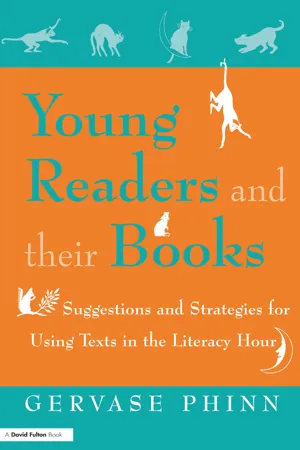
Young Readers and Their Books
Suggestions and Strategies for Using Texts in the Literacy Hour
- 139 pages
- English
- ePUB (mobile friendly)
- Available on iOS & Android
eBook - ePub
Young Readers and Their Books
Suggestions and Strategies for Using Texts in the Literacy Hour
About this book
First Published in 2000. This book offers teachers a useful and very readable text to help them select stories, poetry and non-fiction material for the primary classroom, with ideas on how to teach them. Appropriate selection criteria are discussed and suggestions are given about keeping up with a range of available texts. There is a comprehensive guide to the whole range of books appropriate for use in the Literacy Hour. Part 2 gives practical approaches, tried and tested in primary classrooms, which reflect the guidance contained in The National Curriculum Programmes of Study for English and The National Literacy Strategy. Gervase Phinn has rare gifts as a teacher, speaker, storyteller and writer, all of which skills comes together in the authoring of this book.
Information
Part I
Treasure
Opening the covers of a book
Is like lifting the lid of a treasure chest.
Look inside and you will find
Golden stories and glittering characters.
Is like lifting the lid of a treasure chest.
Look inside and you will find
Golden stories and glittering characters.
Some are given a map to show them where X marks the spot,
Some are given the precious key to open up the lock,
Some are helped to lift the heavy lid,
But for some it will remain a buried treasure.
Some are given the precious key to open up the lock,
Some are helped to lift the heavy lid,
But for some it will remain a buried treasure.
Gervase Phinn
Chapter 1
Choosing Books for Children
What are needed are beginning texts that fascinate children and convince them that reading is delightful and helps one to gain a better understanding of oneself and others - in short, of the world we live in and how to live in it. To achieve this, primary texts should stimulate and enrich the child’s imagination, as fairy tales do, and should develop the child’s literary sensitivities, as good poems are apt to do. The texts should also present the child with literary images of the world, of nature and of man, as these have been created by great writers.
(Bettelheim and Zelan 1982)
There cannot be a teacher in the country who would not subscribe to this view or who would dispute the recommendations contained in the National Curriculum and in the National Literacy Strategy:
Teaching should cover a range of rich and stimulating texts and should ensure that pupils regularly hear stories, told or read aloud, and hear and share poetry read by the teacher and each other… Reading should include picture books, nursery rhymes, poems, folk tales, myths, legends and other literature. Both boys and girls should experience a wide range of children’s literature.
(DES 1989)
In the early stages, pupils should have a carefully balanced programme of guided reading from books of graded difficulty, matched to their independent reading levels. These guided reading books should have a cumulative vocabulary, sensible grammatical structure and a lively and interesting content. Through shared reading, pupils should also be given a rich experience of more challenging texts.
(DfEE 1998b)
Teachers know that to become as successful a reader as Helen, children have to be familiar with and use a range of strategies to understand the text and need the support and encouragement of sensitive and enthusiastic adults to develop the love of books. They also know that the provision of a wide range of good quality texts is essential. These principles are at the heart of the National Curriculum and the National Literacy Strategy and have formed the basis for the successful teaching and encouragement of reading for many many years. But where does the teacher start? What books in particular should be presented to children? Which material is appropriate? What are the qualities of ‘a good book’?
Before selecting books for the young reader there are a number of questions one should ask:
- Is the book visually appealing and eye-catching? Picture books with bright, colourful and beautifully illustrated covers demand to be picked up and read.
- Is the subject appropriate to the children in terms of age and maturity? Does it avoid being moralistic, overly sentimental and patronising? Does it portray class, gender and culture in an unstereotypical way?
- Is the story worth telling? Does it read well aloud and bear a rereading? Is it entertaining and challenging? Does it contain some excitement and suspense? Does it kindle curiosity and imagination?
C. S. Lewis argued vehemently that:
No book is really worth reading at the age of ten which is not equally worth reading at the age of fifty - except of course information books. The only imaginative works we ought to grow out of are those which it would be better not to have read at all.
(Lewis in Meek 1977)
- Is the language appropriate, natural and meaningful? Does it encourage children to predict what will happen, to anticipate and become involved in the narrative? Is there a richness in the expression and an imaginative use of words? Does the writer make some demands on his or her readers in terms of language? Good books expose a child to language in its most complex and varied forms, presenting the thoughts, emotions and experiences of others in a vivid and dramatic way.Aesthetic properties of language are to be found more than anywhere in literature. Literature is nothing if not language formed in highly deliberate ways. From the earliest preschool stages of development, children are interested in forms of language. Wide reading, and as great an experience as possible of the best imaginative literature, are essential to the full development of an ear for language.(DES 1988a)
- Is the dialogue appropriate to the characters? Is it clear, authentic and understandable? Does it capture the rhythms of speech? Does it reflect the speech patterns of those for whom it is intended?
- Do the illustrations enhance the story, adding meaning to the words rather than detracting from them? Do the pictures link closely to the text? ‘All early reading material should be attractive not only in presentation but in content. The words and pictures should complement each other in such a way that the child needs to examine both with equal care.’ (DES 1975)
- Is the print clear, well-spaced and of an appropriate size?
- Are the characters rounded and convincing? Do they live and breath on the page, develop and grow in the reader’s mind? Can children readily identify with the characters and enter into their lives?
- Is the story by a real writer, not merely a book especially written to teach children to read? ‘Authors who genuinely want to write for children do not count the words in a sentence. They know instinctively where phrases start and stop because they shape narratives and incidents.’ (Meek 1982)
- Is the story of real interest to the teacher? Does she enjoy reading and rereading it, presenting it and discussing it with her children?
Recommended stories
Here are four good stories:
1. Amy Said by Martin Waddell, illustrated by Charlotte Voake (Reception/Year 1)
Martin Waddell has written many fine books for younger readers and all have enormous appeal. His stories are wonderfully warm and sympathetic and capture the imagination of children as well as enhancing their linguistic abilities. Amy Said is an original and compelling short story: funny, bright and full of happy life and movement. It has lively language, lots of repetition and a robust little character whose actions delight young children. Big sister Amy is an expert about what to do at Gran’s house and she gets her little brother into a whole lot of bother.
When Amy and I stayed with Gran,
I wanted to bounce on my bed
and Amy said I could.
I bounced a bit,
then a bit more,
then bit more.
Then I fell off the bed. And Amy said…
I wanted to bounce on my bed
and Amy said I could.
I bounced a bit,
then a bit more,
then bit more.
Then I fell off the bed. And Amy said…
There follows a series of lively escapades: swinging on Gran’s curtains, painting Gran’s walls green, picking Gran’s flowers, making a bike track in Gran’s garden, ending up with Amy falling SPLOSH in the mud. The story ends on a happy note.
Gran never gets cross!
She put us both in the bath and
the water was lovely and warm.
She put us both in the bath and
the water was lovely and warm.
Martin Waddell is an artist with a keen ear for the spoken word and his use of language is unparalleled. This story is guaranteed to make young children become completely absorbed and chuckle with delight.
A story that makes us laugh without malice is to be treasured…Comic writing both reflects and experiments with the familiar world and represents our reality; and comedy for children tends to be most effective when it is robust, springing from characters whose actions upset and embarrass convention and power. Children laugh most readily at comic writing which evokes a picture and sound, bringing antics and collisions alive in the theatre of the imagination.
(Jones and Buttrey 1970)
2. The Great Sharp Scissors by Philippa Pearce, from Lion at School and Other Stories Puffin (Years 2 and 3)
The Great Sharp Scissors by Philippa Pearce contains a fast-moving plot, rounded characters, a spareness in the prose and sharp, clear dialogue. The twelve page story is full of wit, wisdom and suspense and will captivate a young audience. It begins:
Once there was a boy called Tim who was often naughty. Then his mother used to say, ‘Tim!’ and his father shouted, ‘Tim!’ But his granny said, ‘Tim’s a good boy, really.’
The reader’s interest is immediately aroused. Tim resents being left alone while his mother visits his poorly Granny.
He scowled and stamped his foot. He was very angry.
Tim’s mother warns him not to let anyone into the house but when a strange man calls and offers to sell him a most remarkable pair of great sharp scissors which will cut anything, Tim cannot resist:
‘I’ll have them,’ said Tim.
With the great sharp scissors in his hand, he now has the opportunity to give vent to his feelings. He snip snaps the buttons off his father’s coat, he cuts the carpet into hundreds of little pieces, he chops the legs off the tables and chairs and the clashing blades slice though the clock on the mantelpiece.
By now Tim knew that the great sharp scissors would cut anything. They would cut through all the wooden doors and floors. They would cut through all the bricks of all the walls, until nothing was left. Nothing. Tim went and sat at the bottom step of the stairs and cried.
Fortunately, his second visitor, a strange woman who smiles kindly at him, exchanges the scissors for some special magic glue. When Tim’s mother arrives back from Granny’s, Tim has repaire...
Table of contents
- Cover Page
- Title Page
- Copyright Page
- Contents
- Acknowledgements
- Preface
- Introduction
- Part I Treasure
- Part II
- Bibliography
- Index
Trusted by 375,005 students
Access to over 1.5 million titles for a fair monthly price.
Study more efficiently using our study tools.
Frequently asked questions
Yes, you can cancel anytime from the Subscription tab in your account settings on the Perlego website. Your subscription will stay active until the end of your current billing period. Learn how to cancel your subscription
No, books cannot be downloaded as external files, such as PDFs, for use outside of Perlego. However, you can download books within the Perlego app for offline reading on mobile or tablet. Learn how to download books offline
Perlego offers two plans: Essential and Complete
- Essential is ideal for learners and professionals who enjoy exploring a wide range of subjects. Access the Essential Library with 800,000+ trusted titles and best-sellers across business, personal growth, and the humanities. Includes unlimited reading time and Standard Read Aloud voice.
- Complete: Perfect for advanced learners and researchers needing full, unrestricted access. Unlock 1.5M+ books across hundreds of subjects, including academic and specialized titles. The Complete Plan also includes advanced features like Premium Read Aloud and Research Assistant.
We are an online textbook subscription service, where you can get access to an entire online library for less than the price of a single book per month. With over 1.5 million books across 990+ topics, we’ve got you covered! Learn about our mission
Look out for the read-aloud symbol on your next book to see if you can listen to it. The read-aloud tool reads text aloud for you, highlighting the text as it is being read. You can pause it, speed it up and slow it down. Learn more about Read Aloud
Yes! You can use the Perlego app on both iOS and Android devices to read anytime, anywhere — even offline. Perfect for commutes or when you’re on the go.
Please note we cannot support devices running on iOS 13 and Android 7 or earlier. Learn more about using the app
Please note we cannot support devices running on iOS 13 and Android 7 or earlier. Learn more about using the app
Yes, you can access Young Readers and Their Books by Gervase Phinn in PDF and/or ePUB format, as well as other popular books in Education & Education General. We have over 1.5 million books available in our catalogue for you to explore.