eBook - ePub
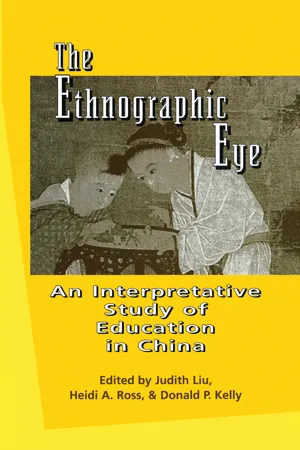
The Ethnographic Eye
Interpretive Studies of Education in China
- 212 pages
- English
- ePUB (mobile friendly)
- Available on iOS & Android
eBook - ePub
The Ethnographic Eye
Interpretive Studies of Education in China
About this book
First Published in 2000. This book, a collection of ethnographic studies of Chinese schooling, aims to take the reader into Chinese schools and provide a picture of students and teachers as actors who practice culture. The case studies also provide a means by which ethnography is explored as a central methodological focus and concern. This book explores the meaning of ethnography, both in describing Chinese schools and in the broader context of the defined purposes and practices of research. This self-reflexive approach to school ethnography in China includes issues of cultural translation and the connections between the process of ethnographic work, the emergence of a text, and the construction of a theory.
Information
Chapter 1
Introduction
A Discursion on Ethnography
This volume is somewhat Janus-faced. On the obverse, it deals with the merits of doing ethnographic research; on the reverse, it deals with education in China. Yet not all of the studies included in this volume used ethno-graphic research methods, nor do all the research cases included here involve studies of modem Chinese education. Needless to say, the ambivalent structuring of this work produces a conundrum: What is the value of a book that purports to use various ethnographic studies to shed light on Chinese schooling, when not all the chapters in it fit within this parameter?
The answer to this question rests on several points. First, this work makes clear that education entails more than the inculcation of facts per se. The very act of attending school places an individual within an institution that is designed to acculturate and socialize students to accept as valid the tenets of a specific culture and to fit unquestioningly into prescribed social roles. In the call for the development of national standards that is frequently voiced in the United States, this function of schooling is largely ignored; yet in China moral education is invariably considered to be an integral part of schooling. Educational research on China must always take this conception of schooling into account, particularly when Chinese education is viewed in light of the monumental cultural and social changes that have occurred since the implementation of market socialism.
Second, ethnographic methods are not always appropriate for conducting educational research. At the most basic level, employing ethnographic methods requires a knowledge of the language used by informants. If a researcher does not know the language (or is funded by an agency that wants easily compared statistical analyses), then the data to be analyzed must be “hard,” and consequently, the use of quantitative methods is more applicable to this situation. Even quantitative researchers, however, must have some awareness of the cultural and social settings they are going to encounter. After all, data produced in the absence of cultural and social contexts can provide little more than a general picture of a research setting. Ethnography’s value lies in providing detailed interpretations, while quantitative work’s value lies in producing numerical explanations.
Lastly, schooling is something we have all experienced and understand, and examining a foreign situation makes us more aware of the “hidden” curricular components that shaped our educations. Ability grouping and tracking procedures are not used solely to differentiate levels of academic skills; they have cultural and social outcomes as well. In many ways, these elements become more noticeable through comparative education because understanding another culture and society necessitates that we question concepts that normally go unquestioned. Asking “Why?” is at the heart of ethnographic research. Thus, in true ethno-graphic fashion, by looking at educational practices in China, we are given an opportunity to reflect back upon our own.
Serendipity
While Judith Liu interviewed women who had attended St. Hilda’s School for Girls in Wuhan, Heidi Ross studied the McTyeire School for Girls in Shanghai. Despite this similarity in research interests, their paths did not cross until they met as Luce Fellows during a seminar at the 1989 Henry Luce Foundation’s “History of Christianity in China” program held in Lawrence, Kansas. As it happened, not only had they both done ethnographic work on missionary girls’ schools in China but also both were interested in acculturation and socialization processes—Judith on moral education and Heidi on gender socialization—and both of them were fascinated by the ways in which external social and cultural forces shape people’s lives—Judith in the generalized form of “structures” and Heidi in the specific form of patriarchy. The serendipity of their meeting and then discovering the similarity of their ideological perspectives led Judith and Heidi to conclude that a volume dealing with various studies of Chinese schooling would be an excellent way to examine the applicability of doing ethnographic work on education in China. In this introduction, a theoretical discussion of ethnography as a methodological tool is offered, as well as a brief overview of each substantive chapter.
Ethnography
While ethnography is a process that entails the use of qualitative research methods—doing fieldwork and compiling fieldnotes—it is also a product: the written text that details one’s encounters with an “other.”1 In essence, an ethnography is a descriptive textual account of a researcher’s experiences in what are frequently unfamiliar cultural and social settings.
To paraphrase the work of Robert Sherman and Roman Webb (1988), ethnography (as opposed to other forms of qualitative research) should include five elements: four dealing with the ethnographic process, the fifth with the ethnographic product. First, what is being studied is context-bound. Therefore, ethnographers must immerse themselves in a culture to better perceive and understand the observed people and events. Second, the act of observation must not change the context. That is, the fieldwork must occur naturally and not be contrived. Third, the informants must believe they can speak freely and for themselves. Ethnographers, in other words, must not influence informants in ways such that the informants’ perception of reality might be altered. As such, a reflexive relationship between investigators and informants should evolve in which informants teach investigators about their cultural beliefs and social practices. Fourth, ethnographers must look at their interactions from a “systems perspective,” because any event, phenomenon, or person being studied is part of a complex web of meaning that is dependent solely upon its context. Finally, ethnographers must become cultural workers by finding coherence in what they have studied, find some insights, and re-present their insights to an audience in a written text.2
These five points idealize the ethnographic method, and some qualifications need to be added to them, especially if ethnographic work is being done in a culture other than one’s own. That is, a common ground exists between researchers and informants when ethnographic work is done in “familiar territory.” For example, while “American culture” is not as unified a category as the name would imply, one can still see a thread that holds Western society—not just American society—together. This thread is what Marshall Sahlins referred to as “La Pensee Bourgeoise,”3 or the near-doxic acceptance of the political economy of capitalist production as the organizing principle of Western society.4 What happens then, when a Western-educated and-trained ethnographer is engaged in studying a cultural and social system that represents a way of life distinctly different from that of the ethnographer? In this case, “[e]thnography is actively situated between powerful systems of meaning,”5 where the ethnographer must exhibit “a tolerance for ambiguity, multiplicity, contradiction, and instability.”6 Amid all these contingencies, however, is a belief that there exists a commonality between and among human social groups. This reflects the power and attraction of doing ethnographic work. The mysteriousness of the “other” becomes comprehensible and even familiar to us during ethnographic fieldwork. As James Clifford writes: “What one sees in a coherent ethnographic account, the imaged construct of the other, is connected in a continuous double structure with what one understands,”7
For a coherent ethnographic account to emerge, an ethnographer must, in turn, produce an ethnographic text—a distinct writing genre where the “scientific principle of participant observation [becomes] incorporated into a literary description of another culture and social order.”8 This fusion of the literary to the scientific within an ethnography marks its departure from travel or personal journal accounts of encounters with some distinct “other” that characterized anthropological work until the twentieth century.
Like travel accounts, the writing within an ethnography still entails the use of a personal narrative, but with a near-schizophrenic twist, because ethnographers must assume two frequently contradictory roles. Thus, when conducting ethnographic fieldwork, the role assigned to the author’s personal experiences (that is, being an active participant) frequently stands in opposition to the role assigned to science (namely, being an unbiased observer).9 The ethnographer must decide which role (active participant or detached observer) will assume the author(ity) for structuring the final ethnographic text. This role conflict has framed the theoretical debate that surrounds the meaning of doing ethnographic work today, and depending upon one’s ideological bent, it determines whether the final product will tend to be a classical, postmodern, feminist, or critical ethnography.
Classical Ethnography
One: Experiential Authority and the Explanation of Culture 10
As with any intellectual pursuit, views on the meaning (or purpose) of ethnographic work have changed over time. When Melford Spiro analyzed the changes in classical ethnography, he detected one element that has been constant: the notion of cultural relativism.11 From an anthropological perspective, looking at different cultures has entailed three types of cultural relativism: descriptive, normative, and epistemological.
The first, descriptive relativism, was based upon “the theory of cultural determinism.”12 That is, since cultures are constitutive of their social orders and of the psychological traits of their peoples, the differences between human groups are the consequences of their cultural variations. By cataloging these differences, early anthropologists believed that a “Science of Man” could be developed. Inherent within this view, however, is a belief that cultural development is teleological and that over time and through the inevitability of progress, all cultures would (and could) attain the cultured “sophistication” of the West. In this perspective, the participant side of being a participant-observer was more important because cultural knowledge came from personal interaction with the “other.”
Beginning in the 1930s, this perspective on anthropological investigation was seriously challenged. Anthropologists were still studying “primitive” peoples, but the ideological context that provided the direction for their studies was being radically transformed. First, disillusionment with the view that “material progress” is necessarily “progressive” was increasing. This disillusionment was sparked by a critical reassessment of the causes and consequences of World War I. Next, Woodrow Wilson’s idealistic call for a worldwide acceptance of the goal of national self-determination was going unheeded. And, finally, the presence of colonial powers in “underdeveloped” areas of the world was continuing, particularly in those areas that were inherently fascinating to ethnographers. The result was that anthropological fieldworkers began to question the contradiction between Western liberal ideals and how they actually were being applied in other parts of the world. The questioning of these cultural and social conditions, when conjoined with a growing faith in the value of the scientific method, combined to transform the ideological basis for anthropological fieldwork. To be considered of intellectual value, fieldwork now was seen as the purview of the scientifically trained, emotionally detached observer. From this perspective, the participant-observer method for doing ethnographic fieldwork changed from focusing on the participant to focusing on the observer, where the scientifically based objectivity in recording what the researcher had seen would result in an “unbiased” account.
Not surprisingly, this unbiased reporting of the lives of “primitive” peoples served as a critique of the West. According to George Marcus and Michael Fischer, the new, normative relativistic ethnography developed three broad critiques of the West: “They—primitive man—have retained a respect for nature, and we have lost it (the ecological eden); they have sustained close, intimate, satisfying communal lives, and we have lost this way of life (the experience of community); and they have retained a sense of the sacred in everyday life, and we have lost this (spiritual vision).”13
Accompanying these critiques of the West was a strong belief in the power of science to rationally and objectively arrive at the “truth.” As Michel de Certeau asserts, scientific discourse is “univocal”14 because it asserts that for any given situation there is one and only one acceptable meaning—the one regarded as true. As such, scientific language is an “artificial lan...
Table of contents
- Cover
- Title
- Copyright
- Contents
- Series Editor’s Foreword
- Chapter 1 Introduction: A Discursion on Ethnography
- Chapter 2 Understanding Basic Education Policies in China: An Ethnographic Approach
- Chapter 3 National Minority Regions: Studying School Discontinuation
- Chapter 4 Juvenile Delinquency and Reformatory Education in China: A Retrospective
- Chapter 5 Rural Chinese Education: Observing from the Margin
- Chapter 6 In the Moment—Discourses of Power, Narratives of Relationship: Framing Ethnography of Chinese Schooling, 1981-1997
- Chapter 7 Reconstructing the Past: Reminiscences of Missionary School Days
- Chapter 8 Conclusion
- Contributors
- Index
Trusted by 375,005 students
Access to over 1.5 million titles for a fair monthly price.
Study more efficiently using our study tools.
Frequently asked questions
Yes, you can cancel anytime from the Subscription tab in your account settings on the Perlego website. Your subscription will stay active until the end of your current billing period. Learn how to cancel your subscription
No, books cannot be downloaded as external files, such as PDFs, for use outside of Perlego. However, you can download books within the Perlego app for offline reading on mobile or tablet. Learn how to download books offline
Perlego offers two plans: Essential and Complete
- Essential is ideal for learners and professionals who enjoy exploring a wide range of subjects. Access the Essential Library with 800,000+ trusted titles and best-sellers across business, personal growth, and the humanities. Includes unlimited reading time and Standard Read Aloud voice.
- Complete: Perfect for advanced learners and researchers needing full, unrestricted access. Unlock 1.5M+ books across hundreds of subjects, including academic and specialized titles. The Complete Plan also includes advanced features like Premium Read Aloud and Research Assistant.
We are an online textbook subscription service, where you can get access to an entire online library for less than the price of a single book per month. With over 1.5 million books across 990+ topics, we’ve got you covered! Learn about our mission
Look out for the read-aloud symbol on your next book to see if you can listen to it. The read-aloud tool reads text aloud for you, highlighting the text as it is being read. You can pause it, speed it up and slow it down. Learn more about Read Aloud
Yes! You can use the Perlego app on both iOS and Android devices to read anytime, anywhere — even offline. Perfect for commutes or when you’re on the go.
Please note we cannot support devices running on iOS 13 and Android 7 or earlier. Learn more about using the app
Please note we cannot support devices running on iOS 13 and Android 7 or earlier. Learn more about using the app
Yes, you can access The Ethnographic Eye by Heidi Ross,Judith Liu, Heidi Ross,Judith Liu,Donald P. Kelly in PDF and/or ePUB format, as well as other popular books in Education & Education General. We have over 1.5 million books available in our catalogue for you to explore.