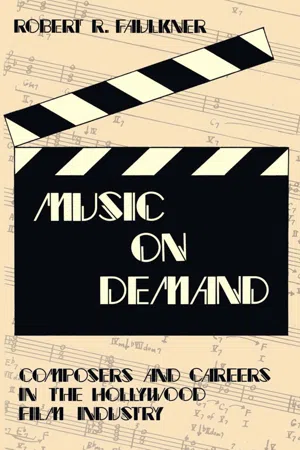
eBook - ePub
Music on Demand
Composers and Careers in the Hollywood Film Industry
- 281 pages
- English
- ePUB (mobile friendly)
- Available on iOS & Android
eBook - ePub
Music on Demand
Composers and Careers in the Hollywood Film Industry
About this book
In this remarkable study, Robert R. Faulkner shows that the Hollywood film industry, like most work communities, is dominated by a highly productive and visible elite who exercise major influence on the control of available resources, career chances, and access to opportunity. Faulkner traces a network of connections that bind together filmmakers (employers) and composers (employees) and reveals how work is allocated among composers and the division of labor within the Hollywood film community, using statistical analysis and highly revealing personal interviews. One of the very first empirical studies in the ""new economic sociology,"" Music on Demand shows the dynamics of markets constituted by the interaction between buyers and artistic talent (the producers and directors of feature films) and the sellers of artistic talent (the composers of film scores).Faulkner's interviews with those composers considered to be elite and those on the industry's periphery reveal how they perceive their careers, how they define commercial artistic success, and how they establish, or try to establish, those vital connections with filmmakers. Now available in paperback, this pioneering study will be of compelling interest to researchers in culture studies as well as readers interested in learning more about this little-known world.
Information
1.
CREDITS AND CAREERS
An Introduction
An Introduction
You can take Hollywood for granted like I did, or you can dismiss it with the contempt we reserve for what we don’t understand. It can be understood too, but only dimly and in flashes.
—Cecelia Brady in F. Scott Fitzgerald’s The Last Tycoon
He had written . . . five novels and was the hottest thing in Hollywood and New York. It is not remarkable to be the hottest thing in either city—the hottest kid changes for each winter season.
—Lillian Heilman writing of Dashiell Hammett
No one hums the cinematography to the last Bertolucci movie.
—David Shire, freelance composer
You either have credits, or you don’t have credits.
—F. Scott Fitzgerald on Hollywood, 1937
This study began as little more than an investigation of the dilemmas and contradictions of commercial work in the motion picture and television film industry. I was interested in the work roles of composers in this mass culture industry, a business loosely organized along craft lines where the conflicts between professionals in the technical area and entrepreneurs in the business managerial sector were ongoing. I assumed that, as with other professions, there was a more or less coherent set of common values and assumptions embodied in this work community. I also assumed that networks of social relations organized and differentiated freelance labor. I suspected that freelancers depended on their connections to filmmakers and, additionally, that they experienced problems in their art and craft to the degree that their clients—employers of expertise and controllers of projects—failed to exhibit in reality the ideal held by composers.
I kept track of the projects that tied composers and filmmakers together; I interviewed dozens of major film composers, and started to discover recurrent patterns of accommodative adjustments between employees and employers. Gradually, curiosity about the larger social organization of freelance activity, particularly the networks of collective action and the careers of its participants, become dominant. Why did so few have their names on so many films? Was there a pattern in the ties or business interlocks between composers and filmmakers? Was the occupational structure a relatively fluid one, and how many people in Hollywood experience anything resembling an unfolding sequence of feature film assignments? If credits were so crucial, as everyone was telling me—How were they distributed? What was the relationship between productivity, recognition, and rewards?
These were by no means the only worthwhile issues that might have been raised but I thought they were of fundamental importance and had not been given the serious attention they deserved. Since the details of career development, especially the ways in which career lines took their shape from the exigencies peculiar to the making of movies, were understood “only dimly and in flashes,” I tried to find out more about them. And since, as I soon discovered, these things had not yet been clarified in any comprehensive fashion, either by film critics or observers of the Hollywood scene, or even by social scientists writing on the entertainment industries, I decided that there was a need for a more substantial description and analysis of social organization and career development in today’s film business than had yet been presented in print.
In the seventies there was an enormous outpouring of film criticism and writing, analyzing and explaining the careers of major film directors, top screenwriters, big-name cinematographers, highly successful producers and, of course, actresses and actors in this industry. This literature was useful for an anecdotal portrait of one part of Hollywood. But critics and other observers gave only a partial picture of the organization of credits and connections, and those who occasionally addressed these issues never found the appropriate sources and methods. Their sights were typically fixed on the major deals, the top-grossing films, and the most visible contributors. They produced perceptive studies of the careers of leading Hollywood figures, but tended to neglect underlying social processes. So in addition to the information about the celebrities at the center of the business, I needed to know about the condition and experiences of the minor contributors on the periphery, including the interdependencies between freelancers and filmmakers across various levels of productivity.
It appeared to me that Scott Fitzgerald’s and Lillian Heilman’s comments were indeed typical of the views held by many in the film business today, by the successful and the unsuccessful alike. Their phrases suggested that getting credits and acquiring visible credentials and work experiences is the only way to survive in the industry. Thus, I started to turn attention toward the macroorganizational level, toward a collection of information about who gets what films, who is recurrently cooperating with whom on these projects, with what commercial success, and whether the composer, screenwriter, director, or cinematographer experienced anything resembling an unfolding sequence of projects within a given period. I began to develop data files of all films and their personnel, an activity that made me an avid reader of Daily Variety and The Hollywood Reporter. I also began to speculate about who was currently in or out of favor with shifting climates of Hollywood opinion.
Scholarship from the social science disciplines, sociology in particular, should and did cut through to some essentials of industry organization, but conventional sociological definitions of “occupational mobility,” “status attainment,” or “work careers” appeared to lead to conventional analysis of work systems. The literature was largely directed toward the origins and destination of samples or cohorts of members of the labor force.1 The literature ignored a crucial dimension of social organizations: the degree to which productions can be a joint effort between employers and employees, and the resultant networks of collective action. It was unclear from scholarship on mobility that business transactions, the basic stuff of industry, are sets of activities and relations in a market, and that multiple transactions over time join sellers of skill, talent, and expertise to buyers and their projects. Although there was extensive literature on occupational and industrial macrostructures and on how to define and conceptualize occupational career, there were few notions available to link the two issues coherently, focusing on an industry as a network of transactions.2
Continuing interviews suggested that the freelance Hollywood scene is a bunch of tangible film composers, with various track records and accomplishments, attracting to themselves and their work a population of buyers. Each film project is a separate piece of business whose ultimate purpose is profit from sale to a mass market of audiences. The internal market of business transactions, linking freelancers and filmmakers, is more important to me. This internal labor market is the primary mechanism for organizing the factors of production and decisions of freelancers and filmmakers as economic agents. The film industry is not a static structure, but rather a shifting set of business transactions constituted for the film project and dissolved after completion of the work. It was a business subject to high rates of reconstruction; highly sensitive to the sucess of individual film projects and their makers; a business in which highly expensive entertainment commodities were produced and sent out into a volatile market of potential audiences; a business in which there was much confusion about cause—the unique film production—and effect — its commercial success or failure; a business in which freelance specialists had to be part artists, part technicians, part diplomats, and part dramatic actors or actresses in selling themselves to nervous and powerful filmmakers.
At best, the film business as “an industry” was a nominal kind of classification, a misguided summary of a loosely organized, but nevertheless related, set of persons including producers, directors, screenwriters, cinematographers, electricians, production designers, art directors, unit production managers, film editors, music editors, stunt coordinators, composers, performing musicians, animators, distributors, exhibitors, and others. The single film project was the point at which all these craftsmen, technicians, and businessmen got their act together, as it were. There were major film companies in this “industry.” But these film companies today are basically corporations that finance and distribute motion pictures. There was once a time when they actually made all the pictures as well, and sometimes still do. But more the rule now is for a company—United Artists, Universal, Columbia, Warner Brothers, Twentieth Century-Fox—to work on a contract-by-contract basis with smaller producing outfits and individual producers for films it distributes. The company charges for financing and providing facilities and services. Without this “distribution deal,” filmmakers would be at a loss for widespread dissemination of their projects.
The position of the composer resembles more closely the freelance professional’s than the salaried employee’s. His work and career are organized along craft rather than bureaucratic lines.3 He competes in a marketplace for projects and in a network for access to the owners and controllers of those projects. It was immediately apparent that access breeds success, so there is continual pressure toward monopolization of work. There is a restless seeking of access to the material means for exercising one’s expertise and craft. Composers showed deep interest in how to become recognized and visible to potential employers because of the pressure to push one’s image and credentials deeper into the industry’s culture. Projects are the material means for making these social announcements about one’s ability and identity. Here are their expressed career concerns as gathered from extensive interviews.
First, there is general agreement that the industry is competitive. Everyone talks about who is getting what, who is working with whom and with what effect. The competition is naked and frequently raw, and a composer must accept the fact that his assignments define his place or position in the division of labor. Frequent expressions of frustration and annoyance over delayed inclusion into the busy center of work and pressing concern about getting onto the right freelance “plateau” or into the right “league,” as members call it, all point to the subjective effects of work allocation.
Second, assignments are valued by the extent to which they expand connections and increase visibility. A composer wants film and television assignments which will enlarge his share of responsibility, and so his chances for association with a successful film project or television series, and then, more money, business ties, and credits.
Third, there is the common sentiment that one must grow professionally, move toward increasing expertise. Self-interest centers on whether freelance assignments enlarge or contract chances for personal development in a given direction, for experienced selves, and for becoming more skilled as a composer. There are frequent expressions about being “locked” into an unchal lenging television series, not “getting the better films in town,” or “losing touch” with the talents that brought one into the business in the first place.
The situation is even more complicated for first-timers because employers see them as high risks and high risks, say many producers, are harder to take these days. With a sketchy or unproven track record with, say, a single credited project, many composers have limited access to more assignments. Such composers, and there are many, do not represent anything like “a discovery” to filmmakers, but rather a liability: their industry output has been tested and, to date, they are found comparatively wanting.
Finally, a concern with career development is sometimes seen as merely avoiding many of the negative and degrading features of film work. A composer can suddenly find himself engaged in lines of business ties to producers and projects requiring the adoption of skills and attitudes that constitute a liability for moving onward and upward. It is well recognized that in work worlds the occupancy of some assignments results in overspecialization or continually working within the same narrow genre, writing the same cues over and over again. Moreover, one becomes publicly known by others as the composer who writes those cues over and over, and the negative label has consequences as potential employers may turn to other, more attractive, candidates. Thus the acquisition of some credits and connections may not open up access to important points of industry activity. A career line may then become narrowed by specialization and damaged by the typecasting and negative reactions of others who have the resources to make their judgments felt as a force directed toward composers.
Additionally, freelancing is a dynamic activity and creates risks for everyone involved. There is no such thing as a sure-fire hit. The basic ingredients that make a box-office sensation are poorly understood, if at all. Consequently, there is continual pressure for freelancers and filmmakers alike to handle uncertainties surrounding credits, connections, and industry identities. The expressed concerns are about building ties with various filmmakers, recurrent “bread and butter” accounts with one or two producers on whom they depend for work. Freelancing demands many nonrecurrent or one-shot connections with producers. A “spreading of accounts” is a way of hedging bets. “A name” is a way of gaining favor and visibility in the wider circles of the business, of expanding a composer’s credibility to multiple filmmakers.
A composer’s position in the market affects his perception of the problems. Those with sagging productivity lines complain about filmmakers chasing after fads and fashions in hiring composers. They grumble about how employers “don’t need us, but we need them.” Busy freelancers are concerned about better work, more pretigious assignments where their musical talents could be utilized. They want the freedom to turn down undesirable projects and producers and complain about working too much. Such are their elegant dilemmas. Productivity is not without its advantages, in both material and artistic terms.
“The Industry” as a Loose Aggregate of Business Units
After two summers of field work and fifty interviews with film composers at different stages of their careers, I was intrigued by the shifts and turns among these freelancers, their colleagues, and employers. I was still interested in the personal and professional dilemmas of commercial work, but curiosity about job distribution, the sharpness of the division of labor into major and minor contributors drew me toward a different perspective. Why were productivity, recognition, and rewards so closely linked?
If I was to study the film industry as a segmented organization of activity, I had to develop my own means to do it because neither film writing nor sociology had done so. I needed a perspective which would permit me to understand each segment individually, each segment’s relation to the networks of collective action, and the organization of work as a whole. In other words, the means for studying Hollywood had to be receptive to the multiplicity of effort in the film business and the unifying organization. Each film project involved producers, directors, a composer selected by these filmmakers, numerous support personnel, and a Hollywood distribution company to release the film; each project was a complicated and separate business in itself. The film’s review in one of the film industry’s trade papers, such as Daily Variety or The Hollywood Reporter was something of an event, if not for the entire industry, certainly for the people who contributed to making the movie. This suggested another baseline for the case study of composers in the 1970s and 1980s: film credits as “events,” a source of information that could complement the interviewing of informants and respond...
Table of contents
- Cover
- Half Title
- Title Page
- Copyright Page
- Dedication
- Table of Contents
- List of Tables and Figures
- Foreword
- Preface
- Acknowledgments
- Chapter 1. Credits and Careers: An Introduction
- Chapter 2. Starting Lines: Entry Points and the Web of Colleague Affiliations
- Chapter 3. Up from Sprinkler Drain
- Chapter 4. No Musical Revolutions: Some Prompt Effects of Commercial Conventions
- Chapter 5. A Small Army: Career Mobility and Precariousness in the Middle Area
- Chapter 6. Symbolic Interaction
- Chapter 7. Dual Interests: Opposing Tendencies and the Positive Aspects of Conflict
- Chapter 8. Centrality in a Freelance Social Structure: Career Performances and Professional Networks
- Chapter 9. The Chosen Few: Selectivity and Career as Retrospective Success
- Chapter 10. Big Hollywood, Little Hollywood
- Index
Trusted by 375,005 students
Access to over 1.5 million titles for a fair monthly price.
Study more efficiently using our study tools.
Frequently asked questions
Yes, you can cancel anytime from the Subscription tab in your account settings on the Perlego website. Your subscription will stay active until the end of your current billing period. Learn how to cancel your subscription
No, books cannot be downloaded as external files, such as PDFs, for use outside of Perlego. However, you can download books within the Perlego app for offline reading on mobile or tablet. Learn how to download books offline
Perlego offers two plans: Essential and Complete
- Essential is ideal for learners and professionals who enjoy exploring a wide range of subjects. Access the Essential Library with 800,000+ trusted titles and best-sellers across business, personal growth, and the humanities. Includes unlimited reading time and Standard Read Aloud voice.
- Complete: Perfect for advanced learners and researchers needing full, unrestricted access. Unlock 1.5M+ books across hundreds of subjects, including academic and specialized titles. The Complete Plan also includes advanced features like Premium Read Aloud and Research Assistant.
We are an online textbook subscription service, where you can get access to an entire online library for less than the price of a single book per month. With over 1.5 million books across 990+ topics, we’ve got you covered! Learn about our mission
Look out for the read-aloud symbol on your next book to see if you can listen to it. The read-aloud tool reads text aloud for you, highlighting the text as it is being read. You can pause it, speed it up and slow it down. Learn more about Read Aloud
Yes! You can use the Perlego app on both iOS and Android devices to read anytime, anywhere — even offline. Perfect for commutes or when you’re on the go.
Please note we cannot support devices running on iOS 13 and Android 7 or earlier. Learn more about using the app
Please note we cannot support devices running on iOS 13 and Android 7 or earlier. Learn more about using the app
Yes, you can access Music on Demand by Shmuel N. Eisenstadt, Robert R. Faulkner, Shmuel N. Eisenstadt,Robert R. Faulkner, Shmuel N. Eisenstadt in PDF and/or ePUB format, as well as other popular books in Media & Performing Arts & Music & Business. We have over 1.5 million books available in our catalogue for you to explore.