- 21 pages
- English
- ePUB (mobile friendly)
- Available on iOS & Android
eBook - ePub
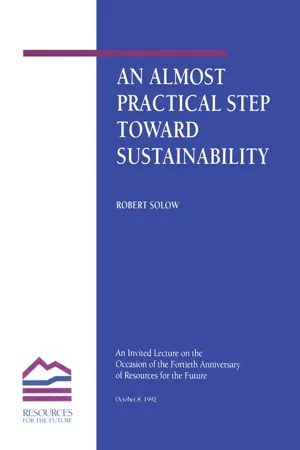
An Almost Practical Step Toward Sustainability
About this book
Nobel Laureate Robert Solow explores how changes in social accounting practice could contribute to more rational debate and action in crafting economic and environmental policy. A thoughtful work about the wise use of society's natural resources, intergenerational equity, and the translation of ideas about sustainability into real policy.
AN ALMOST PRACTICAL STEP TOWARD SUSTAINABILITY
You may be relieved to know that this talk will not be a harangue about the intrinsic incompatibility of economic growth and concern for the natural environment. Nor will it be a plea for the strict conservation of nonrenewable resources, even if that were to mean dramatic reductions in production and consumption. On the other hand, neither will you hear mindless wish fulfillment about how ingenuity and enterprise can be counted on to save us from the consequences of consuming too much and preserving too little, as they have always done in the past.
Actually, the argument I want to make seems to be particularly appropriate on the occasion of the fortieth anniversary of Resources for the Future; it is precisely about resources for the future. And it is even more appropriate for a research organization: I hope to show how some fairly interesting pure economic theory can offer a hint—though only a hint—about a possible improvement in the way we talk about and think about our economy in relation to its endowment of natural resources. The theoretical insight that I will present suggests a potentially important line of empirical research and a possible guideline for long-term economic policy. Then I will make a naive leap and suggest that, if we talked about the economy in a more sensible and accurate way, we might actually be better able to conduct a rational policy in practice with respect to natural and environmental resources. That is probably foolishness, but I hope you will find it a disarming sort of foolishness.
PREVIEWING THE ARGUMENTS
It will be useful if I tell you in advance where the argument is leading. It is a commonplace thought that the national income and product accounts, as currently laid out, give a misleading picture of the value of a nation’s economic activity to the people concerned. The conventional totals, gross domestic product (GDP) or gross national product (GNP) or national income, are not so bad for studying fluctuations in employment or analyzing the demand for goods and services. When it comes to measuring the economy’s contribution to the well-being of the country’s inhabitants, however, the conventional measures are incomplete. The most obvious omission is the depreciation of fixed capital assets. If two economies produce the same real GDP but one of them does so wastefully by wearing out half of its stock of plant and equipment while the other does so thriftily and holds depreciation to 10 percent of its stock of capital, it is pretty obvious which one is doing a better job for its citizens. Of course the national income accounts have always recognized this point, and they construct net aggregates, like net national product (NNP), to give an appropriate answer. Depreciation of fixed capital may be badly measured, and the error affects net product, but the effort is made.
There is a “right” way to charge the economy for the consumption of its resource endowment and for the degradation or improvement of environmental assets, and those measurements play a central role in the only logically sound approach to the issue of sustainability that I know.
The same principle should hold for stocks of nonrenewable resources and for environmental assets like clean air and water. Suppose two economies produce the same real net national product, with due allowance for depreciation of fixed capital, but one of them is wasteful of natural resources and casually allows its environment to deteriorate, while the other conserves resources and preserves the natural environment. In such a case we have no trouble seeing that the first is providing less amply for its citizens than the second. So far, however, the proper adjustments needed to measure the stocks and flows of our natural resources and environmental assets are not being made in the published national accounts. (The United Nations has been working in this direction for some years, so the situation may change, although only with respect to environmental accounting.) The nature of this problem has been understood for some time, and individual scholars, beginning with William D. Nordhaus and James Tobin in 1972, have made occasional passes at estimating the required corrections.
That is hardly news. The additional insight that I want to explain is that there is a “right” way to make that correction—not perhaps the easiest or most direct way, but the way that properly charges the economy for the consumption of its resource endowment. The same principle can be extended to define the right adjustment that must be made to allow for the degradation or improvement of environmental assets in the course of a year’s economic activity The properly adjusted net national product would give a more meani...
Table of contents
- Cover
- Title Page
- Copyright Page
- Table of Contents
- INTRODUCTORY REMARKS
- AN ALMOST PRACTICAL STEP TOWARD SUSTAINABILITY
Trusted by 375,005 students
Access to over 1.5 million titles for a fair monthly price.
Study more efficiently using our study tools.
Frequently asked questions
Yes, you can cancel anytime from the Subscription tab in your account settings on the Perlego website. Your subscription will stay active until the end of your current billing period. Learn how to cancel your subscription
No, books cannot be downloaded as external files, such as PDFs, for use outside of Perlego. However, you can download books within the Perlego app for offline reading on mobile or tablet. Learn how to download books offline
Perlego offers two plans: Essential and Complete
- Essential is ideal for learners and professionals who enjoy exploring a wide range of subjects. Access the Essential Library with 800,000+ trusted titles and best-sellers across business, personal growth, and the humanities. Includes unlimited reading time and Standard Read Aloud voice.
- Complete: Perfect for advanced learners and researchers needing full, unrestricted access. Unlock 1.5M+ books across hundreds of subjects, including academic and specialized titles. The Complete Plan also includes advanced features like Premium Read Aloud and Research Assistant.
We are an online textbook subscription service, where you can get access to an entire online library for less than the price of a single book per month. With over 1.5 million books across 990+ topics, we’ve got you covered! Learn about our mission
Look out for the read-aloud symbol on your next book to see if you can listen to it. The read-aloud tool reads text aloud for you, highlighting the text as it is being read. You can pause it, speed it up and slow it down. Learn more about Read Aloud
Yes! You can use the Perlego app on both iOS and Android devices to read anytime, anywhere — even offline. Perfect for commutes or when you’re on the go.
Please note we cannot support devices running on iOS 13 and Android 7 or earlier. Learn more about using the app
Please note we cannot support devices running on iOS 13 and Android 7 or earlier. Learn more about using the app
Yes, you can access An Almost Practical Step Toward Sustainability by Robert M. Solow in PDF and/or ePUB format, as well as other popular books in Economics & Business General. We have over 1.5 million books available in our catalogue for you to explore.