This volume is a pioneering effort to examine the social, demographic, and economic changes that befell the Jewish communities of Central Europe after the dissolution of the Habsburg Empire. It consists of studies researched and written especially for this volume by historians, sociologists, and economists, all specialists in modern Central European Jewish affairs. The era of national rivalry, economic crises, and political confusion between the two World Wars has been preceded by a pre-World War I epoch of Jewish emancipation and assimilation. During that period, Jewish minorities had been harbored from violent anti-Semitism by the Empire, and they became torchbearers of industrialization and modernization. This common destiny encouraged certain common characteristics in the three major components of the Empire, Austria, Hungary, and the Czech territories, despite the very different origins of the well over one million Jews in those three lands. The disintegration of the Habsburg Empire created three small, economically marginal national states, inimical to each other and at liberty to create their own policies toward Jews in accord with the preferences of their respective ruling classes. Active and openly discriminatory anti-Semitic measures resulted in Austria and Hungary. The only liberal heir country of the Empire was Czechoslovakia, although simmering anti-Semitism and below surface discrimination were widespread in Slovakia. While one might have expected Jewish communities to return to their pre-World War I tendencies to go their independent ways after the introduction of these policies, social and economic patterns which had evolved in the Habsburg era persisted until the Anschluss in Austria, German occupation in Czechoslovakia, and World War II in Hungary. Studies in this volume attest to continuing similarities among the three Jewish communities, testifying to the depth of the Empire's long lasting impact on the behavior of Jews in Central Euro
- 485 pages
- English
- ePUB (mobile friendly)
- Available on iOS & Android
eBook - ePub
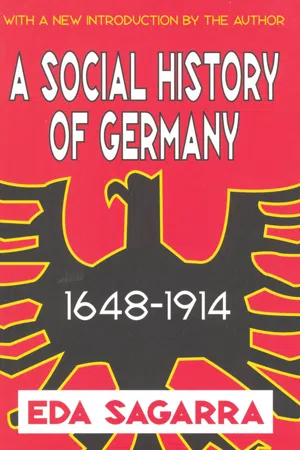
A Social History of Germany, 1648-1914

Part I: 1648–1806
From the end of the Thirty Years War to the fall of the Holy Roman Empire
Introduction to Part I Germany and the Thirty Years War
In the last, most barbarous phase of the war (1618–48), the Swedish ambassador to the Netherlands, German-born Ludwig Camerarius, wrote to a friend in Nuremberg : ‘Happy are they who in this wretched time are already asleep in the Lord.’1 It was a sentiment expressed frequently by his countrymen in those years, in poetry and letters, in diary entries and funeral orations. For unlike the wars of the twentieth century (apart from 1944–5), the Thirty Years War was fought almost wholly on the territory of the Holy Roman Empire. As a result, in the war theatres along the main transit routes, a whole generation of Germans had grown to manhood knowing nothing else but fighting, pillaging and burning. The damage done to life and property made this war the most destructive in Germany’s history before the mid twentieth century. Thus a traveller making his way from Pomerania in the northeast during the late 1640s, across Mecklenburg, turning southwards through Brandenburg, Magdeburg and Thuringia, and then on to the Palatinate and Swabia in the south, would have found countless numbers of devastated villages, seen towns which had been sacked not once, but three and four times, the surviving inhabitants reduced in some cases to cannibalism.2 In all these areas the total loss in population has been estimated as at least 40-60 per cent, and in some districts to have been as high as 70 per cent. Yet it would have been possible in the same years to travel north-west from Vienna, avoiding central Bohemia, through Upper and Lower Saxony, across Bremen into Holstein, and see little evidence of the war apart from the region around Leipzig and Magdeburg. For the war had been selective in its targets. The populations of neutral Switzerland, and of Austria, the Tyrol, Holstein and Frisia, had changed little between 1618 and 1648. It was said that during these years not a single foreign soldier had crossed the frontiers of the territory of Oldenburg, in the north-west, where the ruler, Count Anton Günther, was able to increase the prosperity and revenues of his realm from his famous stud farm. Hamburg too went unscathed, a fact it owed to the wise foresight of the city fathers in preparing adequate defences. Further east, the thriving corn markets in mid century Danzig, Königsberg and Thorn contrasted sharply with conditions elsewhere in the Empire, where fighting and plague threatened to turn the land, in Camerarius’s phrase, into ‘an Arabian desert’.3
In general it was the same areas which bore the brunt of the war, of battle and marauding soldiers, the burghers being pillaged if they refused, getting into hopeless debt if they complied with the invaders’ demands. As if to emphasize the injustice of life, those areas around the main transit routes which suffered most in the war also experienced the worst of the plague epidemics in the 1630s and 1640s. It was the plague, and the starvation in its wake, which was the real cause of drastic population loss. Thus in Leutkirch, a free imperial town in Württemberg, the parson reported the deaths of 413 adults and 269 children; in the Lutheran community only thirty-seven couples and nineteen children survived among his parishioners; in the Catholic parish of Leutkirch barely 100 survived out of a former total of 1500.4 Such figures are not uncommon for the worst-affected areas.
Population statistics from this period are of course only approximate. In the seventeenth century it was usual but not obligatory to keep parish registers. However, it was common in wartime for the parish priest or vicar to lead his flock to the safety of the forest for weeks or even months in face of danger, and in such cases records were not kept up. Tax returns, such as the Reichstürkensteuer levied since the sixteenth century for the defence of the Empire against the Turk, are helpful, but fragmentary. Some princes, such as the Austrian ruler, did take a census of their subjects in the years after the war ; others, notably the ecclesiastical princes, were mindful of the Lord’s disapproval of King David’s efforts to record the number of his subjects and refrained from the attempt.5 How unreliable a local census could be is illustrated by the reaction of the Zwickau town council in 1655 to an enquiry from Dresden for tax purposes: ‘It ought to be borne in mind, that if we return the rolls and the numbers of men as high, it might turn out as it did with the poll tax; but if we return too few, His Highness the Elector might populate this place with strangers.’ The vicar of Langhennersdorf in 1658 was more succinct: ‘were more for certain reasons not returned,’6
Modern scholars are more or less in agreement that Germany lost some 40 per cent of its rural and 33 per cent of its urban population in consequence of war and epidemics. Although such figures are substantially lower than those given by earlier historians, and although we no longer share their view that the war and its consequences impoverished the German people economically and culturally for the next 150 years, it remains true that the years 1618-48 brought about far-reaching changes in the political and social structure of the country. Politically, the most significant effect of the peace settlement of Westphalia, the treaties which finally ended the war, was the emergence of over 300 states, owing little more than nominal allegiance to the Holy Roman Emperor. None was strong enough to provide political or economic leadership, while the archaic framework within which the member states operated made the conduct of business on a national scale, such as the levying of taxes for defence, slow and wearisome. German states in the subsequent hundred years or so were often not more than a negative factor in the calculations of foreign powers: thus the French paid subsidies to Bavaria and other states to prevent the establishment of Austrian hegemony in south Germany. Yet although cumbersome and often ineffective in its working, the conglomeration of member states known as the Holy Roman Empire was a genuine federation. Certainly, the war and its consequences greatly strengthened the power of the territorial princes and led directly to absolutist forms of government in most German states, but it nevertheless remains true that some provincial and even municipal liberties survived longer in Germany than in countries such as France or England.
Germany recovered slowly from the war, remaining a poor country until the nineteenth century. The basis of life remained agricultural, and despite some revival of trade, the land provided the chief source of princely revenue. It was on the land too that the privileged status of the aristocracy in the political and social organization of the territories in post-war Germany was based. Its position of eminence was to be consolidated in the course of the second half of the seventeenth century and contrasted sharply with the general symptoms of decay which many observers had regarded as characteristic of that class in the century before the outbreak of the Thirty Years War. Fortune, so frequently evoked in baroque literature, thus demonstrated yet again her fickle nature. For the privileged status of the landed nobility in the service of the prince in seventeenth and eighteenth century Germany was won at the cost of the very social group which in the sixteenth century had appeared likely to succeed as the new governing class, that of the educated and prosperous burghers. It was on the basis of the decay of the commercial classes, the decline of the towns, on the poverty and political defeat of the old estates by a number of able princes that the political and social order characteristic of the age of absolutism was consolidated.
The devastation wrought by the war years led to far-reaching changes in the social structure of Germany generally. The decay of large areas of farmland, much of which had not been cultivated for years, caused changes in the social stratification of the peasantry, and in certain areas, notably the north and east, in the system of land tenure. A diminished demand for food after the war, due to a decline in urban population, caused the bottom to fall out of the grain market and placed an intolerable burden on farmers. In Munich, Augsburg and Würzburg in 1669-73 the price of rye was barely a quarter of what it had been at the beginning of the war. Unable to pay debts incurred in the war or to meet current dues, peasants still had to find wages for hired hands. ‘Now indeed it is better to be a farmhand than a master’, complained a peasant in a pamphlet entitled The Golden Age (1652) : ‘The poor sorry farmer can no longer make sense of his accounts, except to know that while the work and the cost involved entitle him to 6 gulden a measure of corn, he is often forced to throw it away for but three and a half, simply to pay the threshers.’7 Many farmers were forced to acknowledge their declining position in the social scale by marrying their daughters to farmhands and day labourers, or even to sell out and seek work themselves as hired hands.
In south and west Germany the war years accelerated a development already well advanced by the early seventeenth century, namely the disintegration of the old manorial system. However, immigration to the devastated regions from Switzerland, Austria and other lands unaffected by fighting, kept the ratio of peasant to noble ownership much as it had been before the war. Moreover, in Bavaria, by contrast with Prussia, neither the largest landowner, the church, nor the Elector was interested in giving the local nobility the kind of tacit support in subduing the peasantry which the Junkers received from their ruler. In the very different conditions prevailing along the Baltic littoral, the Thirty Years War greatly accelerated changes in the social structure of the landed population, which had been in train since late medieval times. The economic basis of the East Elbian landowners was the grain export trade, and for some time past, enterprising noblemen had been trying to increase their holdings at the cost of the peasant farmer, and to extend their powers over the peasants living in their lands. The sharp fall in grain prices in mid seventeenth century Germany provided an incentive to those who could do so both to increase the services and rents of the peasantry and to counteract the acute shortage of labour by tying the actual cultivator of the land as close as possible to the soil. The landlords either seized deserted peasant property or offered impoverished farmers protection and stock in return for part surrender of their land. In subsequent decades the numbers of peasant farmers declined all over the north-east, while the number of day labourers grew. By 1746 in Beeskow-Storkow in the Mark Brandenburg there were 429 peasants where there had been 814 before the Thirty Years War, but 828 landless labourers where formerly there had been only 172.8 The prince often gave tacit support to the landowners in their measures. Thus in the Neumark (Brandenburg) robot or servile labour dues became obligatory for the whole life of the individual peasant: in 1685 it was laid down that if subjects ran away and did not return within four weeks, their names were to be written on the gallows : if caught they would be executed or condemned to life imprisonment. The landlords here, as in Lusatia and Mecklenburg, were able to extend their power over the peasantry because the territorial rulers required their nobility’s aid in the restoration of the region, and were prepared to concede them patrimonial rights in return for this support. In name these peasants were not serfs; unlike their fellows in Pomerania they could marry and make wills but they could not leave without permission of the lord, and in fact were or became his bondsmen. With increasing obligations the peasants had too little time to cultivate what land still remained to them and were rarely in a position to sell corn; hence their dependence, particularly in bad years, on their landlord.
This development had social and economic (as well as political) consequences which were very enduring. In large areas of northern and eastern Germany urban life was insignificant; even villages were rare in parts of East Elbia. The social system of a dominant landowning class and a depressed peasantry, once established, was difficult to modify. The lack of alternative sources of wealth from commerce reinforced the determination of the ruling stratum to preserve long into the modern age the social organization created under absolutism. Moreover, when demand for food increased with the rise of the east German rural population in the eighteenth century, the rigidity of outlook characteristic of the way of life and the lack of investment capital proved hostile to innovation on the land and ultimately to increased production. However, before about the early nineteenth century, opposition to change was less the product of conscious conservatism on the part of the ruling class than the provinciality of their way of life, the lack of cosmopolitan culture in the region and the lack of facilities for travel and education in the outside world: neither the rulers nor the ruled could envisage as possible an economic and social system or a way of life different from that which they and their fathers and grandfathers had known. In East Elbia, in marked contrast with certain regions of Austria, Bavaria and Switzerland in the early modern period, peasant unrest was rare.
Turning from the land to urban life in mid seventeenth century Germany, it is clear that, by comparison with the peasants, town dwellers suffered less in the war. However, all over Germany, with some few exceptions, the period between the end of the Thirty Years War and the end of the Holy Roman Empire is characterized by the stagnation of urban life and culture. The toll taken by epidemics, especially the plague, was very high indeed in many towns. But the war did not actually cause the decline; since the last decades of the sixteenth century, the so-called price revolution and the continued devaluation of currency, coupled with the gradual movement of trade routes away from central Europe to the west, had already had a serious effect on urban life in Germany. The Hanseatic League, despite efforts to revive it, and despite the prosperity of individual members, was moribund; the Netherlands had supplanted it in political influence and economic power long before 1648. The long-term effects of the Great War and the peace settlement were to destroy finally the political power of the urban bourgeoisie in all but isolated cases.
Yet although the depredations of the war had been far greater on the land than in the towns, land recovered in time in a way trade and commerce did not. If commerce, crafts and manufacture flourished at all in subsequent decades, it was – apart from Hamburg and one or two more towns – in the princely residences or through the active encouragement of the territorial ruler. The two most impressive urban centres of the late seventeenth century, Karlsruhe and Mannheim, were princely foundations, created in the minds of architects engaged by the ruler for that purpose, and built to specification for the further glory of the prince. The political and economic power of the towns had rested on their gold; now the majority of them were bankrupt. Towns which had been the glory of late medieval Germany – Augsburg, Lübeck and Nuremberg, Cologne and Magdeburg – never recovered their former status, though the work of physical restoration, as in the case of Magdeburg which had been razed in a famous siege in 1631, was already completed within a generation and a half after the peace; some remained in provincial obscurity until the nineteenth century. A well-connected young burgher, contemplating his future career in 1650, would therefore have been much less likely to consider seeking his fortune in commerce than he would have been half a century earlier. Instead he might study law, often at university in Italy or the Netherlands, and then enter the service of a prince.
In subsequent decades his example would be followed by many noblemen’s sons. Gradually the privileged status of the nobility was demonstrated in this sphere also, as the senior posts in government service of both major and minor German states became the exclusive provenance of scions of the nobility – and seemed likely to remain so. The enthusiastic response, among burgher circles, to Schiller’s Kabale und Liebe (1782) owed much to the way in which he made the effective debarring of middle class talents from responsible posts the object of criticism and ridicule. In the seventeenth century and early eighteenth century it was unusual to remain at one court for all one’s life. The mobility of princely servants was dictated by the fact that payment, usually in kind, was uncertain and pensions were arbitrary. This was to change in the course of the eighteenth century; they were then paid salaries and gradually became the officials of their own sovereign prince. The growing power of the executive which took place between the mid seventeenth century and late eighteenth century, and the consequent bureaucratization of life, created a hierarchy of official posts...
Table of contents
- Cover
- Title Page
- Copyright Page
- Dedication
- Contents
- Introduction to the Transaction edition
- Part I: 1648–1806 From the end of the Thirty Years War to the fall of the Holy Roman Empire
- Introduction to Part I Germany and the Thirty Years War
- Part II: 1806–1914
- Introduction to Part II
- Section I The authorities
- Section 2 ‘Bildung und Besitz’: Education and property
- Section 3 Rural life and its problems
- Section 4 Lower orders: manual workers
- Section 5 The other half
- Notes
- Suggestions for further reading
- Index
Trusted by 375,005 students
Access to over 1.5 million titles for a fair monthly price.
Study more efficiently using our study tools.
Frequently asked questions
Yes, you can cancel anytime from the Subscription tab in your account settings on the Perlego website. Your subscription will stay active until the end of your current billing period. Learn how to cancel your subscription
No, books cannot be downloaded as external files, such as PDFs, for use outside of Perlego. However, you can download books within the Perlego app for offline reading on mobile or tablet. Learn how to download books offline
Perlego offers two plans: Essential and Complete
- Essential is ideal for learners and professionals who enjoy exploring a wide range of subjects. Access the Essential Library with 800,000+ trusted titles and best-sellers across business, personal growth, and the humanities. Includes unlimited reading time and Standard Read Aloud voice.
- Complete: Perfect for advanced learners and researchers needing full, unrestricted access. Unlock 1.5M+ books across hundreds of subjects, including academic and specialized titles. The Complete Plan also includes advanced features like Premium Read Aloud and Research Assistant.
We are an online textbook subscription service, where you can get access to an entire online library for less than the price of a single book per month. With over 1.5 million books across 990+ topics, we’ve got you covered! Learn about our mission
Look out for the read-aloud symbol on your next book to see if you can listen to it. The read-aloud tool reads text aloud for you, highlighting the text as it is being read. You can pause it, speed it up and slow it down. Learn more about Read Aloud
Yes! You can use the Perlego app on both iOS and Android devices to read anytime, anywhere — even offline. Perfect for commutes or when you’re on the go.
Please note we cannot support devices running on iOS 13 and Android 7 or earlier. Learn more about using the app
Please note we cannot support devices running on iOS 13 and Android 7 or earlier. Learn more about using the app
Yes, you can access A Social History of Germany, 1648-1914 by Eda Sagarra in PDF and/or ePUB format, as well as other popular books in History & German History. We have over 1.5 million books available in our catalogue for you to explore.