- 261 pages
- English
- ePUB (mobile friendly)
- Available on iOS & Android
eBook - ePub
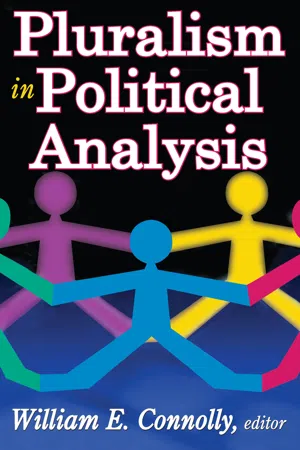
Pluralism in Political Analysis
About this book
The theory of democratic pluralism has long provided the dominant ideal and description of politics in industrial societies with competing party systems. The purpose of this classic collection, including some of the leading theorists of the late 1960s, is to subject this theory to systematic scrutiny. The authors examine the work of such pluralists as Robert Dahl, David Truman, Adolf Berle, Arthur Bentley, Joseph Schumpeter, and Walter Lippmann, as well as of such critics of pluralist theory as C. Wright Mills, Herbert Marcuse, Henry Kariel, and Grant McConnell.Voicing the respective points of view of science, economics, philosophy, and psychology, the authors converge in their agreement that the conventional, pluralist interpretation of contemporary politics requires significant revision. The views of these diverse critics coalesce into the outline of what they see as a more enlightened political ideal and a more relevant descriptive theory. This collective portrait offers a provocatively new interpretative framework for the understanding of the politics of contemporary industrial society.Connolly includes a sophisticated discussion of such concepts as power, decision-making, politics, and interest groups and devotes considerable attention to the need to promote positive change, particularly where the pluralist system shows bias against certain segments of society as well as against some dimensions of social life affecting everyone's existence in the society. Intended for use in Comparative Government, Contemporary Political Theory, Political Parties and Pressure Groups, and advanced courses in American Government, this volume remains a challenging resource for those dealing with the nature and possible change of the organization of contemporary democratic society.
Information
I: The Critique of Pluralist Theory
1: The Challenge to Pluralist Theory
WILLIAM E. CONNOLLY
THE CLASSICAL THEORY OF PLURALISM
Pluralism has long provided the dominant description and ideal of American politics. As description, it portrays the system as a balance of power among overlapping economic, religious, ethnic, and geographical groupings. Each “group” has some voice in shaping socially binding decisions; each constrains and is constrained through the processes of mutual group adjustment; and all major groups share a broad system of beliefs and values which encourages conflict to proceed within established channels and allows initial disagreements to dissolve into compromise solutions.
As ideal, the system is celebrated not because it performs any single function perfectly, but because it is said to promote, more effectively than any other known alternative, a plurality of laudable private and public ends. Pluralist politics combines, it is said, the best features from the individualistic liberalism of a John Locke, the social conservatism of an Edmund Burke, and the participatory democracy of a Jean-Jacques Rousseau.
The individual’s active involvement in group life enables him to develop the language, deliberative powers, and sense of purpose which make up a fully developed personality. His access to a multiplicity of groups promotes a diversity of experience and interests and enables him to reach alternative power centers if some unit of government or society constrains him.
Society as a whole also benefits from pluralism. The system of multiple group pressures provides reasonable assurance that most important problems and grievances will be channeled to governmental arenas for debate and resolution. The involvement of individuals in politics through group association gives most citizens a stake in the society and helps to generate the loyalties needed to maintain a stable regime with the minimum of coercion. Stability is further promoted, in the long run, because public policy outcomes tend to reflect the distribution (balance) of power among groups in the society. Yet, the theory goes, innovation and change are also possible in pluralist politics. New groups, created perhaps by changes in economic processes or population distribution, can articulate new perspectives and preferences which will eventually seep into the balancing process, affecting the shape of political conflicts and the direction of issue resolution.
In short, pluralism has been justified as a system which develops individual capacities, protects individual rights and freedoms, identifies important social problems, and promotes a politics of incremental change while maintaining a long-term stability based on consent.1
THE LEGACY OF TOCQUEVILLE
The intellectual roots of pluralist theory reach back to Aristotle. But James Madison and, especially, Alexis de Tocqueville have provided the intellectual springboards from which many contemporary thinkers have constructed their own formulations.2 Tocqueville, in describing and justifying American society of the nineteenth century, was careful to stipulate basic preconditions to the successful operation of pluralist politics. Some of these conditions persist today, for example, the universal suffrage, the competing parties, and the independent judiciary that Tocqueville celebrated. There are, however, notable discontinuities between many other conditions he specified and their contemporary equivalents. My purpose here is to ask to what extent twentieth-century society approximates the conditions for an ideal of pluralism formulated a century ago.3
A viable pluralism, Tocqueville believed, encourages among its citizens a widespread participation in politics “which originates in the lowest classes . . . and extends successively to all ranks of society.” Such widespread involvement is necessary because “no one will ever believe that a liberal, wise, and energetic government can ever spring from the suffrages of a subservient people.”4 Students of twentieth-century politics, however, are unanimous in concluding that only a small minority of citizens, mostly from upper socioeconomic-educational brackets, participate actively in the political parties and interest groups of contemporary politics.
We need not remind contemporary readers that Tocqueville saw the “voluntary association” as a key agency for developing personality, protecting liberties, and channeling grievances to government. But the emergence of the large-scale, hierarchical organization has significantly altered the character of the voluntary association. It is at least questionable whether this contemporary institution serves as a medium for personality development. It advances the claims of some of its members more forcefully than it does those of others; and the individual’s dependence on the structure within which he works may inhibit his opportunities to seek support from other units in times of stress. Moreover, the increased size and formalization required to make the “voluntary association” effective in contemporary politics alter the relationship between members and leaders envisaged by the classical ideal of pluralism. As C. Wright Mills has noted: “Voluntary associations have become larger to the extent that they have become effective; and to just that extent they have become inaccessible to the individual who would shape by discussion the politics of the organization to which he belongs.”5
The old middle class, whose economic independence and work life encouraged its members to form and participate actively in civil and political associations, is increasingly displaced today by the dependent white collar class. The work life of this new (and allegedly still middle) class resembles that of Tocqueville’s “workman” in many respects; it is doubtful whether, on Tocqueville’s assumptions, such a work life will foster the breadth of mind needed for responsible citizenship.
When a workman is increasingly and exclusively engaged in the fabrication of one thing, he ultimately does his work with singular dexterity; but, at the same time, he loses the general faculty of applying his mind to the direction of his work. He every day becomes more adroit and less industrious. In proportion as the principle of the division of labor is more extensively applied the workman becomes more weak, more narrow minded, and more dependent. The art advances, the artisan recedes.6
Tocqueville viewed the American frontier as a safety valve for social tensions which could ease the pressure on the balancing process and minimize temptations to supplement the politics of consent with a policy of suppression against discontented minorities. He also viewed the country’s relative isolation from foreign concerns as a central factor allowing the system of “decentralized administration” to mute and tame the power of “central government.” But the frontier has disappeared today; and the combination of deep involvement in world politics with national problems of economy management, transportation, communication, poverty, urban slums, and ghetto riots has produced a tightening and enlarging of political and administrative processes. Even from Tocqueville’s perspective, the stakes of politics are higher today; the earlier safety valves are largely defunct; the contemporary means for the explicit and implicit intimidation of disadvantaged minorities are enhanced.
Tocqueville saw a widely dispersed and locally owned “press” as the most “powerful weapon within every man’s reach which the weakest and loneliest of them all may use.”7 But such a press has been replaced today by centralized “media” remote from the individual and certainly more accessible to the privileged and the organized than to the “weakest and loneliest.”
We can no longer say with easy confidence that “the American republics use no standing armies to intimidate a discontented minority; but as no minority has as yet been reduced to declare open war, the necessity of an army has not been felt.”8 And we might try to refute, but we can no longer consider irrelevant, Tocqueville’s view of the probable relationship between a large military establishment and government:
All men of military genius are fond of centralization, which increases their strength; and all men of centralizing genius are fond of war, which compels nations to combine all their powers in the hands of the government. Thus the democratic tendency which leads men unceasingly to multiply the privileges of the state, and to circumscribe the rights of private persons, is much more rapid and constant amongst those democratic nations which are exposed by their position to great and frequent wars, than amongst all others.9
If these structural changes have undermined some of the conditions specified by Tocqueville for the politics of pluralism, perhaps expanded educational opportunities and other new arrangements promote the needed conditions today; perhaps continuities in the electoral and judicial systems, more important in effect than the changes noted in the social and international context of politics, ensure that political pluralism remains fundamentally intact; or perhaps Tocqueville simply misread some of the most significant conditions of pluralism. Perhaps. On the other hand, in our eagerness to fit the comforting doctrine of an earlier period to the present system we might be prone to underplay the adverse ramifications of a new social structure and world environment; we might too easily assume that functions performed by old institutions in old contexts are still performed by those institutions in their new settings; we might quietly forget some of the functions celebrated in the classical ideal of pluralism and thereby fail to take full account of groups, concerns, and ideals which are not well served by the contemporary balancing process.
Tocqueville clearly realized that institutional evolution could undermine the politics of pluralism. His greatest fear, of course, was the emergence of “majority tyranny.” Nevertheless, even while writing well before the period of rapid industrial growth in the United States, he could still point to that minority group which showed the greatest potential to gain ascendancy in the balancing process of the future:
I am of the opinion, upon the whole, that the manufacturing aristocracy which is growing up under our eyes is one of the harshest which ever existed in the world; but, at the same time, it is one of the most confined and least dangerous. Nevertheless, the friends of democracy should keep their...
Table of contents
- Cover Page
- Title Page
- Copyright Page
- Table of Contents
- Preface
- I The Critique of Pluralist Theory
- II Toward a New Diagnosis
- III Standards and Strategies of Change
- Selected Bibliography
- Index
Trusted by 375,005 students
Access to over 1.5 million titles for a fair monthly price.
Study more efficiently using our study tools.
Frequently asked questions
Yes, you can cancel anytime from the Subscription tab in your account settings on the Perlego website. Your subscription will stay active until the end of your current billing period. Learn how to cancel your subscription
No, books cannot be downloaded as external files, such as PDFs, for use outside of Perlego. However, you can download books within the Perlego app for offline reading on mobile or tablet. Learn how to download books offline
We are an online textbook subscription service, where you can get access to an entire online library for less than the price of a single book per month. With over 1.5 million books across 990+ topics, we’ve got you covered! Learn about our mission
Look out for the read-aloud symbol on your next book to see if you can listen to it. The read-aloud tool reads text aloud for you, highlighting the text as it is being read. You can pause it, speed it up and slow it down. Learn more about Read Aloud
Yes! You can use the Perlego app on both iOS and Android devices to read anytime, anywhere — even offline. Perfect for commutes or when you’re on the go.
Please note we cannot support devices running on iOS 13 and Android 7 or earlier. Learn more about using the app
Please note we cannot support devices running on iOS 13 and Android 7 or earlier. Learn more about using the app
Yes, you can access Pluralism in Political Analysis by William Connolly,Francis A. O'Connell in PDF and/or ePUB format, as well as other popular books in Politics & International Relations & Democracy. We have over 1.5 million books available in our catalogue for you to explore.