- 370 pages
- English
- ePUB (mobile friendly)
- Available on iOS & Android
eBook - ePub
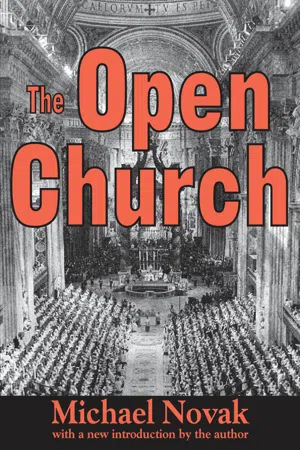
The Open Church
About this book
Michael Novak's eyewitness report on the second and pivotal session of Vatican II in 1964 vividly inter weaves pageantry, politics, and theology. An unusually well-informed lay intellectual, who had earned a theological degree just before the Council, Novak applauded the purposes of Pope John XXIII and his successor Paul VI-"to throw open the windows of the church." In this report, he coined the classic description of the foes of the reforms at Vatican II as the party of "nonhistorical orthodoxy," emphasizing the eternal and unchanging, neglecting history and contingency. The author recounts many moments of high drama-Pope Paul VI's opening speech, the vote on the collegiality of bishops, the plea of Cardinal Bea on behalf of the chapter on Jews, and Bishop De Smedt's defense of religious freedom. His colorful chapter on the American bishops in 1964 serves as a fascinating benchmark, as do his many insights into the new role of the laity. His final chapter is a moving tribute to the Open Church engaging the contemporary world, and his new introduction brings this report up to date. This work will be of compelling interest to those interested in the post-conciliar fall of Communism, under the great John Paul II-who took his name from his two predecessors at Vatican II. The winner of the million-dollar Templeton Prize for Progress in Religion (1994), Michael Novak is a theologian, author, and former U.S. ambassador. He currently holds the George Frederick Jewett Chair in Religion and Public Policy at the American Enterprise Institute in Washington, D.C. where he is director of social and political studies. His writings have appeared in every major Western language, and in Chinese, Bengali, Korean, and Japanese. Also available from Transaction are his Catholic Social Thought and Liberal Institutions, The Experience of Nothingness, The Guns of Lattimer, Unmeltable Ethnics, Belief and Unbelief, and Choosing Presidents.
Information
Part 1 John and Paul
1 Pope John's Session, 1962
I
POPE JOHN'S SESSION, and his encyclicals, brought about a change in principle and mood. At the highest position of the Church, down through the majority of the Council of Bishops, the idea of reform had taken hold. The chief point for reform was in the area of liberty: liberty to study, liberty to discuss, liberty to differ, liberty to converse with all other men. How could the Church of Christ ever have lost liberty? But it had. The wave of enthusiasm and relief that swept the Church and the world were because of the return of liberty, and at the return of Catholics into the midst of the human race, out of their defensive isolation.
Those who live in the forefront of modern civilization at first felt pessimism concerning the Second Vatican Council, to be convened in Rome on October 11, 1962. In Rome, in the summer heat, the work of the preparatory commissions had come to an end—in summary form, the proposals from sources all over the world made a book of 2,060 pages, and the reports filled 15 projected volumes. The 103-member central commission, unquestionably the most powerful institutional force to spring into being for the Council, had sifted and coordinated this vast accumulation of material.
No council in the Roman Catholic Church's history—there had been twenty previous ones—had been so well prepared. Unlike past councils, no secular powers bid to interfere with it, and no princes or kings or heads of state were to be in attendance; the wall between Church and State worked both ways now. Unlike past councils, this one was not called to meet any one crucial decision or immediate social-religious upheavals. The degree of psychological freedom, therefore, and the hope of constructive gain had never been so great. Why then the pessimism?
In the first place, several misunderstandings engendered impossible hopes. "Ecumenical" is an old word, whose traditional reference is not to the union of Protestant, Orthodox, and Catholic Christians, but rather to the gathering of all the Catholic bishops of the world. The contemporary Council was not, therefore, "ecumenical" in the usual sense. Indeed, as the months went by (and despite the herculean efforts of men like Cardinal Bea, president of the Secretariat for Christian Unity), the theme of union with Protestants and Orthodox seemed to have taken an increasingly remote place in preparatory discussions. No doubt Pope John himself, in a fallible moment, so to speak, gave rise to these false hopes by his initial ambiguous use of "ecumenical"; and no doubt he was among those who wished the hopes were not false ones.
A second impossible hope was that renewal of the Church might come by some dramatic action, some whisk of a wand, or sweeping legislative fiat. The life of the spirit has its own laws: if the Church is to be renewed, it cannot be merely by better organization, by modernizing its techniques. No means of mass-producing saints is conceivable. Nor is there any simple solution to a thousand modern dilemmas, like corporate responsibility, nuclear diplomacy, or the tendency of the mass media to degenerate to the lowest moral and aesthetic denominator. No group of men, whether prelates or ministers of state, is going to resolve contemporary dilemmas by meeting to discuss them.
But an additional problem was that some members of the Roman Curia—that civil service of the Church—had been at least suspicious of, if not hostile to, the Council from its inception. Pope John startled Rome by his impromptu announcement of the Council in January, 1959; it seems fortunate that the bolt came from the blue, or it might have been stayed. It is difficult to get this matter clear because of traditional Latin secrecy. But secrecy breeds gossip—no city in the world breeds as much as Rome—and many take revenge upon secrecy by broad jests and parables. In a number of Roman stories in the summer of 1962, one heard the accent of truth.
One of these said that Pope John, walking in the Vatican, told a worker: "Here, I'm in command; but I do what others want." Another (almost certainly not authentic as to fact) told that each time a curial cardinal asked for a delay in convening the Council—if Pope John died before its start, it might well never be held—the good Pope moved the date up another month. A third story capped the sequence by turning a proverb into fact: the Curia saw it couldn't defeat the Council and so decided to join it. Nearly every preparatory commission was headed by a curial cardinal, and the stamp of the Curia was strong on the matter prepared for discussion. Most of the preparatory schemata, in fact, were later rejected by the Council as unsuitable even as bases for discussion.
But it is clear that Pope John knew how to work with the Curia and maintain its good will—an effort Pius XII in his later years did not deign to make. Pope John consulted the Curia; he saw its members regularly; he filled its vacancies immediately. (He said from the beginning he would be a peaceful Pope, working by benevolence, not force.) Furthermore, the Curia itself is not a monolith. Many of its members, especially those who have had opportunities to work abroad, are far from the stereotype which some others fill so well. Cardinal Agagianian has spoken warmly of the perspective visits to America have given him; Cardinals Bea and Cicognani and others are thoughtful and open men. Pope John significantly reserved to himself all final powers of decision concerning the agenda. He presided over the Central Commission, and when he was not present appointed various cardinals—no single one—to take his place.
The Curia, although it makes the administrative wheels of the Church go round, is not the Church. It is a career service, organizational, jealous of its tasks and its traditions. The introduction of non-career men into high posts demoralizes those in the ranks. Granted sincere devotion to the Church, ambition makes the Curia run; ambition is the ecclesiastical lust. Moreover, for many priests from poverty-stricken areas of Italy, the Curia is a place where money is available; every papal bull, every favor, that passes through the hands of a clerk has its price—in the Italian fashion. In the United States, for example (prices vary), the office that forwards the papal bull which creates a monsignor receives $280.
The great weakness of the Curia is its limited intellectual horizon. Italy—and Spain—have not participated in the intellectual and cultural revolutions of the North. Industrialization, pluralism, self-critical individual conscience, democracy, and above all the idea of law for the sake of (not against) freedom—these are not yet part of the Italian experience. The Italian cleric refuses to concede that progress rests with the Northern countries; in his view, the Church remains the glory of civilization, all else is a step backward or apart. One reads frequently in L'Osservatore Romano of recognition "by all the world" of the splendors of the Church. (VOsservatore is a highly rhetorical paper; in this, it reminds one of Pravda; its triumphalism is extraordinary.) The Italian cleric refuses to concede that his own flock is largely ignorant, with a childish, immature faith. "We have not failed to preach the Gospel," Cardinal Valerio Valeri once retorted, bristling, in response to such a suggestion. The Italian cleric uses the rhetoric of "progress," "bring up to date," "adaptation," but he does not share the experience of what Americans, for example, mean by these words.
A Vatican official to whom I spoke in 1962 expressed the complacent optimism of the VOsservatore; but as I left his office and walked in the hot, clear Italian sun, I began to see that "optimism" depends on what you're hoping for. "Revolution, swift change, no," he said, waving a finger. "But changes in an organization so that, who knows? in a hundred years . . ." (By "changes in organization" his tone suggested "slight adjustments.") "No thanks, Monsignore," I thought in the sun, "that's very pessimistic."
Besides the figure of Pope John himself, however, there were resources in the Church to prevent the trivialization of the Council. Countless more non-Italians than ever before had been flying in and out of Rome for three years. Whereas in 1870 seven hundred bishops took part in Vatican Council I, between three and four times that number descended on Rome in 1962. In St. Peter's, the microphone gave them equal voice, no matter where they sat. Cardinal Alfrink of Utrecht had already suggested before the first session, that the Central Commission be continued as a permanent international body of the Church. The Curia had a good reason to be afraid.
One could expect the French, German, and Lowlands bishops to speak as vigorously as is their wont. Cardinal Feltin of Paris had, that summer, abolished the cassock as the street wear of his priests, and ordered black or gray suits worn in its place. The indefatigable Cardinal Bea had given thousands of talks and interviews and written countless letters the three previous years in the cause of Christian unity. Cardinal Léger of Montreal had appointed a conference of laymen to prepare free and critical suggestions for the Council. Some among the German hierarchy had long championed liturgical reform, the vernacular, and the admission of converted Protestant ministers, who are married, to priestly orders.
Many American bishops were handicapped by comparative lack of facility in Latin, but some, like Archbishop Cody of New Orleans (Archbishop Rummers aggressive new coadjutor), were masters of the tongue. In the past, American bishops had been exceedingly tender with the Curia, even subservient, much to the distress of the hard-pressed French and Germans. The closest in number to the Italian hierarchy (240 to 440), their decisions in this Council were going to be exceedingly weighty. It was, in fact, the hundreds of bishops who listened to the give-and-take of argument, and then voted as seemed best to them, who later controlled the Council.
There was a great deal of room, then, for—as Catholics put it—the Holy Spirit to direct the Second Vatican Council. Who would speak first? Which arguments would find the most impressive champions? At what moments and to what effect would Pope John speak up to give a new turn to the discussions? What unknown bishop, vigorous of mind and speech, wOuld reverse a prevailing mood? Councils have always been dramatic in the past, for the weight of their decisions is felt for centuries. But because this was the first truly universal Council, with members in large numbers from many continents other than Europe, the drama was unsurpassed: a critical point had been reached.
Men had "increased and multiplied, and possessed the earth"; the Gospels had been "preached to all nations/' What is at stake in the Second Vatican Council is the universalization of the Church. It is not what the press was to report from day to day—the cryptic press releases that non-professional priests in the press office prepared during the first session: the Latinized phrases—that are to be significant at the end of this century. What will endure are the fissures in the prevailing self-conception of the Church—rooted in Roman law, tied to Latin traditions, limited publicly to Italian-Spanish intellectual experience.
Pierre Teilhard de Chardin, Jesuit author of The Phenomenon of Man, against whose works the (curial) Holy Office issued a mild but firm warning in August, 1962, called this process the breakthrough into the "noosphere"—men thinking not as Italians, or Americans, or French, but as men. Pope John's sudden proclamation of a worldwide Council lifted the Roman Catholic Church closer to that breakthrough in fact (that which it has always claimed in theory) than would have seemed possible for generations.
From the blue the proclamation came—while he was at prayer, Pope John thought of it, and turned in his subsequent sermon to announce it. What the Christian world waited to see was how deeply, even if very quietly, the lightning was going to shake the existing walls, so that a newer Jerusalem might be begun again—that endless beginning again which is the task of the Church in history.
II
Cracks did appear in the centuries-old walls of curial power at the first session. Though the dismantling is still to be done, the old edifice was condemned. The Council opened on October 11 under hardly promising skies; but winds of liberation and optimism were blowing when it closed on December 8. Three years before, Pope John had said the Council was called "to let fresh air into the Church," and many sniffed the sharp scent of change. But no one expected the success of the Council to be so complete. Theologians like Hans Küng and Karl Rahner, who before the Council bore the odor of heresy (to curial nostrils at least), became the lights of Rome, lecturing to the Council Fathers of one national delegation after another. The party of reform, fearful and pessimistic as it assembled in the Curia's own city, came, saw, and conquered. Who indeed could have imagined the extent of their great success, even three months before?
The Curia, civil service of the Church and executive arm of the Pope, quickly learned to respect the Council. It had taken charge of the preparations and confidently set its own stamp on them. That stamp was largely Latin in character; not deeply rooted in the study of the history of the People of God: not scriptural, not patristic. That stamp represented, rather, a peculiarly ahistorical, categorizing analysis which marked Scholasticism in its decadence, whose contemporary analogue seems to be linguistic analysis in philosophy. Such methods produce some good: clear notions, for example; but much of the sweep of life has to be ignored to make them work.
Even to those who hoped a great deal from Pope John, the outlook was not good. Pope John was not the free man a Pope might seem to be in theory; he could get no more results than men by their free obedience would yield him; he was forced time and again to yield to the recalcitrance of those around him. In his famous opening address on October 11, he called them "prophets of doom." He seemed at the start of the Council unwilling to buck the Curia directly but his splendid address made his sentiments clear enough: he called for a pastoral, not a polemical or an academic, Council and he voiced every large theme dear to the reformers. Then he retired to his chambers and left the Council in the hands of the twenty-seven hundred Fathers, his few early interventions seeming to favor first the reforming, then the Latin party. It was as though he were not sure which way power would incline—which way, therefore, he would later have to live with.
Three dramatic turning points determined the outcome. The first took only twenty minutes of the first general meeting. When a list of committee chairmen, prepared by the Curia, was presented for automatic approval, first Cardinal Liénart of France, seconded by Cardinal Frings of Cologne, who was speaking for Cardinals Doepfner of Munich and Koenig of Vienna (hence for all the Germans), asked for a recess in order to discuss the candidates. After their first surprise, the assembled twenty-seven hundred Fathers broke into slowly thunderous applause. No vote was needed. They adjourned for aggiornamento: to draw up their own lists. Suddenly, dramatically, effective institutional power in Roman Catholicism had swung from the Curia to the Council of Bishops. For the first time in their episcopal lives (the last Council was in 1869), many of the bishops felt in their fingertips, so to speak, a surge of the power they were ordained to exercise. They began to be conscious of themselves as a Council: as a college succeeding the College of Apostles. In a stroke, Roman Catholicism was put on all twelves again, after having inclined for centuries in a single direction: curial Rome.
It is difficult to discuss the next two turning points without a warning. It is somehow necessary to talk about "parties" at the Council, and the American press regularly used the descriptions "liberal" and "conservative" to designate these parties—as if good Democrats should sympathize with the reforming churchmen, and Goldwater Republicans find natural alliances with the party of Ottaviani. The National Review was doctrinaire enough, in fact, to carry an article by Evelyn Waugh called "The Same Again Please: A Layman's Hopes of the Vatican Council/' Waugh urged the preservation of the customary level of mediocrity, on the grounds that it reduced meddling and favored individualism. (The essay ought to be a required reference for insight into the spiritual malaise of Waugh's protagonists.) Moreover, the right-wing press of Italy—II Tempo, 11 Borghese—regularly and cynically exploited the news of the Council, to support the positions of the Curia, that "last bastion of freedom in Italy and in the world," as they called it. The financial and political interests of the Italian right wing depend upon an intransigent Church—-it is not the Church they care about.
There is, then, a carryover—human nature—between politics and religion. But the differences between politics and religion prohibit the simple transference of the language of one to the realities of the other. A Council Father did not register as a member of a party; the political structure of his homeland often had no relation to his theological convictions; the confrontation between the two parties was not programmatic. The issue was one of esprit, of habit of mind, of purpose; we shall try to clarify it more exactly in Chapter 5. For now it suffices to say that the issue was whether to continue in the trajectory of the late Middle Ages and the Council of Trent, or to set contemporary sights.
The second turning point occurred on November 21 in the discussions on the sources of Revelation. After a badly worded question was put to the floor, the reforming party fell short of a two-thirds vote to send back to committee the schema presented by Cardinal Ottaviani's preparatory commission. Not many days earlier, the reformers had wisely established a precedent for this vote by a seemingly unnecessary vote on the schema on the liturgy; but now they seemed to have failed. On the next day, however, on the grounds that a schema displeas...
Table of contents
- Cover Page
- Half Title
- Title Page
- Copyright Page
- Dedication
- Acknowledgments
- Introduction to the Transaction Edition
- Introduction
- Part 1 John and Paul
- 1 Pope John's Session, 1962
- 2 The Presence of Pope John
- 3 The Church After John: Pope Paul VI
- 4 The Talk to The Curia
- 5 The School of Fear
- Part 2 A Place for Prophecy
- 6 The Pope's Opening Address
- 7 The People of God
- 8 The Co-Responsibility of Bishops
- 9 Latin or Universal?
- 10 The Layman
- 11 The Charismatic Church
- 12 Holiness: The Doldrums
- 13 Politics and the Blessed Virgin Mary
- 14 The Prisoner of the Vatican
- 15 October 30
- 16 The Indispensable Reform
- 17 The Most Dramatic Day: The Holy Office
- 18 The Problems of the Management
- 19 The Issues That Concern the World
- 20 United for Unity
- 21 The Bitter End
- 22 The New City
- Part 3 The Bishops of the United States
- 23 The Bishops of the United States
- Part 4 The Open Church
- 24 The Open Church
Trusted by 375,005 students
Access to over 1.5 million titles for a fair monthly price.
Study more efficiently using our study tools.
Frequently asked questions
Yes, you can cancel anytime from the Subscription tab in your account settings on the Perlego website. Your subscription will stay active until the end of your current billing period. Learn how to cancel your subscription
No, books cannot be downloaded as external files, such as PDFs, for use outside of Perlego. However, you can download books within the Perlego app for offline reading on mobile or tablet. Learn how to download books offline
We are an online textbook subscription service, where you can get access to an entire online library for less than the price of a single book per month. With over 1.5 million books across 990+ topics, we’ve got you covered! Learn about our mission
Look out for the read-aloud symbol on your next book to see if you can listen to it. The read-aloud tool reads text aloud for you, highlighting the text as it is being read. You can pause it, speed it up and slow it down. Learn more about Read Aloud
Yes! You can use the Perlego app on both iOS and Android devices to read anytime, anywhere — even offline. Perfect for commutes or when you’re on the go.
Please note we cannot support devices running on iOS 13 and Android 7 or earlier. Learn more about using the app
Please note we cannot support devices running on iOS 13 and Android 7 or earlier. Learn more about using the app
Yes, you can access The Open Church by Michael Novak in PDF and/or ePUB format, as well as other popular books in Theology & Religion & Philosophy History & Theory. We have over 1.5 million books available in our catalogue for you to explore.