- 232 pages
- English
- ePUB (mobile friendly)
- Available on iOS & Android
eBook - ePub
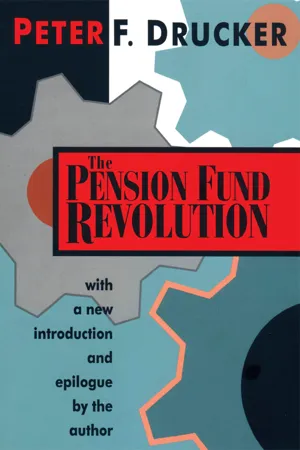
The Pension Fund Revolution
About this book
In The Pension Fund Revolution, originally published nearly two decades ago under the title The Unseen Revolution, Drucker reports that institutional investors, especially pension funds, have become the controlling owners of America's large companies, the country's only capitalists. He maintains that the shift began in 1952 with the establishment of the first modern pension fund by General Motors. By 1960 it had become so obvious that a group of young men decided to found a stock-exchange firm catering exclusively to these new investors. Ten years later this firm (Donaldson, Lufkin & Jenrette) became the most successful, and one of the biggest, Wall Street firms.Drucker's argument, that through pension funds ownership of the means of production had become socialized without becoming nationalized, was unacceptable to the conventional wisdom of the country in the 1970s. Even less acceptable was the second theme of the book: the aging of America. Among the predictions made by Drucker in The Pension Fund Revolution are: that a major health care issue would be longevity; that pensions and social security would be central to American economy and society; that the retirement age would have to be extended; and that altogether American politics would increasingly be dominated by middle-class issues and the values of elderly people.While readers of the original edition found these conclusions hard to accept, Drucker's work has proven to be prescient. In the new epilogue, Drucker discusses how the increasing dominance of pension funds represents one of the most startling power shifts in economic history, and he examines their present-day Impact. The Pension Fund Revolution is now considered a classic text regarding the effects of pension fund ownership on the governance of the American corporation and on the structure of the American economy altogether. The reissuing of this book is more timely now than ever. It provides a w
1. The Revolution No One Noticed
The Attainment of Pension Fund Socialism
If "socialism" is defined as "ownership of the means of production by the workers"—and this is both the orthodox and the only rigorous definition—then the United States is the first truly "Socialist" country.
Through their pension funds, employees of American business today own at least 25 percent of its equity capital, which is more than enough for control. The pension funds of the self-employed, of the public employees, and of school and college teachers own at least another 10 percent, giving the workers of America ownership of more than one-third of the equity capital of American business. Within another ten years the pension funds will inevitably increase their holdings, and by 1985 (probably sooner), they will own at least 50—if not 60—percent of equity capital. Ten years later, or well before the turn of the century, their holding should exceed around two-thirds of the equity capital (that is, the common shares) plus a major portion—perhaps 40 percent—of the debt capital (bonds, debentures, and notes) of the American economy. Inflation can only speed up this process.
Even more important especially for Socialist theory, the largest employee pension funds, those of the 1,000-1,300 biggest companies plus the 35 industry-wide funds (those of the college teachers and the teamsters for instance) already own control* of practically every single one of the 1,000 largest industrial corporations in America. This includes control of companies with sales well below $100 million, by today's standards at best fair-sized companies, if not actually small; the pension funds also control the fifty largest companies in each of the "non-industrial" groups, that is, in banking, insurance, retail, communications, and transportation.† These are what Socialist theory calls the "command positions" of the economy; whoever controls them is in command of the rest.
Indeed, aside from farming, a larger sector of the American economy is owned today by the American worker through his investment agent, the pension fund, than Allende in Chile had brought under government ownership to make Chile a "Socialist country," than Castro's Cuba has actually nationalized, or than had been nationalized in Hungary or Poland at the height of Stalinism.
In terms of Socialist theory, the employees of America are the only true "owners" of the means of production. Through their pension funds they are the only true "capitalists" around, owning, controlling, and directing the country's "capital fund." The "means of production," that is, the American economy—again with agriculture the only important exception—is being run for the benefit of the country's employees. Profits increasingly become retirement pensions, that is, "deferred compensation" of the employees. There is no "surplus value"; business revenue goes into the "wage fund."
Other countries have been moving in similar directions. The first charge on big business in Japan is job and income security for its employees. This is what "lifetime employment" means in terms of economic structure. If employees cannot be fired except when a business is bankrupt, then maintaining employee jobs and employee income must be the overriding demand on business management; job security rather than profit becomes the firm's objective and the test of management performance. But there is no trace in the Japanese system of "employee ownership," let alone of ownership and control of the nation's "capital fund" by either the employees or their trustees.*
At the opposite end of the spectrum of modern economies is Yugoslavia. There the workers or their representatives control the enterprise in which they are employed, elect its management, serve as a review board for that management, and can remove individual managers (though they cannot abolish management, the management function, or even management positions). Yet the workers have no say whatever about the formation, supply, or allocation of capital, which remains a tightly controlled state monopoly. Yugoslav workers, unlike Japanese workers, manage the means of production. But they do not control them, nor are the means of production run for their benefit. On the contrary, the state exacts a very heavy "cost of capital"; what Marxists call "surplus value" accrues to a "state capitalist fund" rather than to the "wage fund," The workers get bonuses if the company does well. If it does poorly, on the other hand, they lose their jobs and have no guaranteed pension bought for them out of past company revenues.
Only in the United States do the employees both own and get the profits, in the form of pensions, as part of wage income. Only in the United States are the employees through their pension funds also becoming the legal owners, the suppliers of capital, and the controlling force in the capital market.
In terms of nineteenth-century political economy—and especially Marxist theory—-Yugoslavia is "state capitalism" rather than a form of "socialism," though its capitalism is tempered by a high degree of local worker autonomy and worker responsibility. Japan is a "finance capitalism," with privately owned and independently managed banks making the ultimate capital-allocation decisions, though this is a finance capitalism subject to stringent safeguards on workers' jobs and workers' income. The United States alone, in terms of economic structure, has made the final step to a genuine "socialism," in which (to use Marxist terminology) "labor" as the "source of all value" receives the "full fruits of the productive process."
In other words, without consciously trying, the United States has "socialized" the economy but not "nationalized" it. America still sees herself, and is seen elsewhere, as "capitalist"; but if terms like "socialism" or "capitalism" have any meaning at all, the American system has actually become the "decentralized market socialism" which all the Marxist church fathers, saints, and apostles before Lenin had been preaching and promising, from Engels to Bebel and Kautsky, from Viktor Adler to Rosa Luxemburg, Jaurès, and Eugene Debs.
Socialism came to America neither through the ballot box nor through the class struggle let alone a revolutionary uprising, neither as a result of "expropriating the expropriators" nor through a "crisis" brought on by the "contradictions of capitalism." Indeed, it was brought about by the most unlikely revolutionary of them all—the chief executive officer of America's largest manufacturing company, General Motors. Twenty-six years ago, in April 1950, Charles Wilson, then GM's president, proposed the establishment of a pension fund for GM workers to the United Automobile Workers Union. The UAW was at first far from enthusiastic, even though by that time pensions had become a priority demand of the American union movement. The union leaders saw clearly that Wilson's proposal aimed at making the pension system the business of the private sector. And the UAW—in common with most American unions—was in those years deeply committed to governmental social security. Wilson's proposal gave the union no role whatever in administering the General Motors pension fund. Instead, the company was to be responsible for the fund, which would be entrusted to professional "asset managers."
The union feared, with good reason as subsequent events have proven, that the pension fund would strengthen management and make the union members more dependent on it. Wilson's major innovation was a pension fund investing in the "American economy"—in other words, the free-enterprise system. And while this made financial sense to the union leaders, their strong preference until then had been for pension funds invested in government securities, that is, in the public sector. The union leadership was greatly concerned lest a company-financed and company-managed private pension plan— negotiated with the union and incorporated into the collective bargaining agreement—would open up a conflict within the union membership between older workers, interested in the largest possible pension payments, and younger workers, interested primarily in the cash in their weekly pay envelope. Above all, the union realized that one of the main reasons behind Wilson's proposal was a desire to blunt union militancy by making visible the workers' stake in company profits and company success. (One of the stalwarts in the GM department of the UAW proposed at that time, in all seriousness, that the union should lodge an unfair labor practices complaint against Wilson, since his pension proposal could have no purpose except to undermine the union.) But Wilson's offer was too tempting, especially to the rapidly growing number of older workers in the UAW. And so, in October 1950, the GM Pension Fund began to operate.
Employee pension funds in American industry go back to the Civil War, if not beyond it. By 1950, there were some 2,000 in operation. One of them, that of the Bell Telephone System, was already very large and is still bigger than that of any other company and of most governmental units. Employee pension plans, therefore, were far from being a novelty at the time. Nor was the idea of making the pension plan part of the labor contract particularly startling. Indeed, a few months before Wilson announced his proposal the Supreme Court had ruled, in a case involving the Inland Steel Company, that employers had to bargain about pensions with their unions. And the Internal Revenue Service had much earlier decided to treat business contributions to employee pension plans as legitimate and deductible expenses for tax purposes.
Wilson's timing was influenced by these developments. But he had been planning his proposal for a very long while and was only waiting for the propitious moment, when events would make his associates in GM management willing to support such "heretical" ideas. Indeed, he first mentioned to me his conviction that workers had to have a company-financed pension plan in a conversation in the spring of 1944, toward the end of World War II. Even then he had obviously given a good deal of time and thought to the subject, and wanted to know my reaction to a number of carefully thought-out alternatives. He probably worked out his final plan soon after the end of World War II, four or five years before he offered it to the union.
Both because of its innovative approach and its timing, the GM plan had totally unprecedented impact. Within one year after its inception, 8,000 new plans had been written —four times as many as had been set up in the 100 years before. Every single one of the new plans copied GM's one radical innovation, which has since been written into most of the older company plans as well. The GM plan was to be an "investment trust"; it was to invest in the capital market, and especially in equities. Practically all earlier plans had been "annuity" plans, to be invested in standard life-insurance investments such as government bonds, mortgages, and other fixed-interest-bearing instruments. The Bell System fund, for instance, had for decades been invested exclusively in U.S. Government bonds earning minimal interest.
Wilson rejected this for several reasons. He considered it financially unsound, indeed impossible, for a pension system embracing more than a small group of workers to be based on debt obligations alone. This, he thought, would either place an unbearable debt burden on the country and its industry, or force interest rates down so low as to cut drastically into workers' pension expectations. A broad-based pension plan had to "invest in America"—in her productive assets and her capacity to produce and to grow.
But Wilson also came to reject the strongly advocated alternative to an annuity plan: a plan investing workers' pension fund monies in the company they worked for. Wilson genuinely believed in creating employee ownership of American business. Yet the traditional proposal—which incidentally Wilson's colleagues in GM top management strongly favored—struck him as financially unsound and incompatible with the workers' needs and interests. "The pension fund that puts its assets into buying the shares of the employing company puts all the worker's eggs into one basket," he argued. And the fewer eggs one has, the more careful one must be with them. Investing the worker's main savings in the business that employs him may be "industrial democracy," but it is financial irresponsibility. The employee already has a big stake in the company that employs him: his job. The job is the financial present. To put the employee's financial future, his pension claim, into the same "basket" violates all principles of sound investment.
Furthermore, it is financially dishonest. Under the guise of looking after the employee, the employee's wage—for pension money is "deferred wage"—is used to finance the "boss," the employing company. While masquerading as "industrial democracy" it is, in effect, a subsidy to the employing company and a crutch to its management. No matter how poorly it performs, it has a ready pool of capital at its disposal to bail it out (as twenty-five years after Wilson, in 1975, the pension funds of New York City employees were used to bail out their employer, New York City, and its incompetent and irresponsible management). Above all, as Wilson pointed out, to use employee pension money to invest in the employing company would make sure that few employees would ever get a pension. Over a period of thirty or forty years—the time needed to build up a decent pension—the great majority of existing companies and industries go downhill; indeed, in a forty-year period more than half of all businesses, large and small, disappear altogether. Where, Wilson asked, would the anthracite coal miners be under "industrial democracy"? Theirs had been the most profitable American industry as recently as 1925, only to vanish fifteen years later.
Anyone in the United States making this point, especially around 1950, was immediately told to look at the Sears Roebuck profit-sharing pension fund, which since its inception in 1916 had invested almost entirely in Sears Roebuck stock and had done so well that long-serving rank-and-file workers, janitors in a store for instance, retired in the forties and fifties as wealthy men. Wilson had a ready answer: a chart showing how the employees of other major American retail companies doing well in 1916 would have fared had their employers then adopted the same plan as Sears. More than half of the leading retailers of 1916 had disappeared by 1950, thirty-five years later—a good many of them even before the depression. And the surviving companies, including such well-known names as Montgomery Ward, J. C. Penney, or the A. & P., had done so poorly on average that employees dependent for their pensions on funds invested in these companies would, in 1950, have had to retire with little or no retirement income. The outcome would have been the same had the Ford Motor Company in the years of its meteoric rise before World War I adopted a profit-sharing pension plan to be invested in Ford Company stock, as Henry Ford once thought of doing before he was persuaded instead to triple the minimum wage to $5 a day in 1913-14. By the time the first Ford workers had reached retirement, their pension claims would have been nearly worthless; for by the mid-twenties, despite a booming automobile market, the Ford Motor Company had ceased to be profitable and had entered a rapid decline that was not reversed until twenty years later, after World War II. And it is anything but certain that Sears employees going to work for the company now, in the mid-seventies, will fare anywhere near as well when they reach retirement age as their predecessors who joined the company fifty years ago.
Wilson thus rejected a pension plan tied to the fortunes of the employee's own company. Such a plan may make the employees "owners"; but it also means that they cannot count on a pension and, indeed, that half of them will get no pension. It is far less an "employee benefit plan" than an "employer" or "management" benefit plan. Equally, he rejected an "annuity" plan as fundamentally unworkable. Pension claims are claims to future income; but if everyone is under a pension plan—an outcome Wilson fully expected —the burden of such a mountain of fixed obligations becomes unbearable. Pension plans had to be based on ownership in productive resources rather than on debt claims against them. And such ownership had to be in the country's productive capacity rather than in a particular company, and to be managed professionally and flexibly, as "investment," which could be drawn out from a company or industry with poor prospects and put where prospects were best for earnings and capital gains. Whether Wilson knew it or not, this conclusion committed the United States to pension fund socialism.
In any case, Wilson prevailed. His four basic rules for pension fund investment—professional independent management of corporate pension funds as "investment funds"; minimal or no investment in the company for which the employee works; no investment in any company in excess of 5 percent of the company's total capital; and no investment in any company of more than 10 percent or so of the total assets of the pension fund—were finally written into the country's laws in the 1974 Pension Reform Act.*
A NOTE ON TERMS: In discussing pensions and pension funds, five terms are commonly used: (1) Vesting. This means that the participating employee, usually after a number of years (with ten years the maximum for private pension plans under ERISA) acquires a "vested interest" in a pension payable when he reaches retirement age, i.e., sixty-five or, in some plans, sixty. He cannot draw out the money until then, borrow against it or, as a rule, assign or sell his interest. But if he reaches retirement age he is assured of a pension even if he quits, is laid off, or stops contributing for any reason. The term that corresponds to "vesting" in ordinary life insurance is "the paid-up value" of an insurance policy. (2) Funding. This means building up actuarially adequate reserves, based on actuarial assumptions on life expectancy of the participants, on interest rates, and on future pension levels. In insurance terms, these are the "policy reserves." (3) Past-service liabilities. This is the funding obligation for the pension claims of employees who were already on the payroll when the pension fund started, and who under most contracts are entitled to a full pension even though, of course, nothing was paid into the fund for them in earlier years. Every increase in pension benefits— because wages go up, for instance—creates a new set of "past-service liabilities" for employees already on the payroll which, under ERISA, have to be "funded" over a period of years. (4) Death benefits are the amounts payable— under many, though by no means all, private pension contracts—to the employee's heirs should he die before he begins to draw his pensi...
Table of contents
- Cover
- Half Title
- Title
- Copyright
- Contents
- Introduction to the Transaction Edition
- 1. The Revolution No One Noticed
- 2. Pension Fund Socialism: The Problems of Success
- 3. Social Institutions and Social Issues Under Pension Fund Socialism
- 4. The Political Lessons and Political Issues of Pension Fund Socialism
- 5. New Alignments in American Politics
- 1995 Epilogue: The Governance of Corporations
- Index
Trusted by 375,005 students
Access to over 1.5 million titles for a fair monthly price.
Study more efficiently using our study tools.
Frequently asked questions
Yes, you can cancel anytime from the Subscription tab in your account settings on the Perlego website. Your subscription will stay active until the end of your current billing period. Learn how to cancel your subscription
No, books cannot be downloaded as external files, such as PDFs, for use outside of Perlego. However, you can download books within the Perlego app for offline reading on mobile or tablet. Learn how to download books offline
Perlego offers two plans: Essential and Complete
- Essential is ideal for learners and professionals who enjoy exploring a wide range of subjects. Access the Essential Library with 800,000+ trusted titles and best-sellers across business, personal growth, and the humanities. Includes unlimited reading time and Standard Read Aloud voice.
- Complete: Perfect for advanced learners and researchers needing full, unrestricted access. Unlock 1.5M+ books across hundreds of subjects, including academic and specialized titles. The Complete Plan also includes advanced features like Premium Read Aloud and Research Assistant.
We are an online textbook subscription service, where you can get access to an entire online library for less than the price of a single book per month. With over 1.5 million books across 990+ topics, we’ve got you covered! Learn about our mission
Look out for the read-aloud symbol on your next book to see if you can listen to it. The read-aloud tool reads text aloud for you, highlighting the text as it is being read. You can pause it, speed it up and slow it down. Learn more about Read Aloud
Yes! You can use the Perlego app on both iOS and Android devices to read anytime, anywhere — even offline. Perfect for commutes or when you’re on the go.
Please note we cannot support devices running on iOS 13 and Android 7 or earlier. Learn more about using the app
Please note we cannot support devices running on iOS 13 and Android 7 or earlier. Learn more about using the app
Yes, you can access The Pension Fund Revolution by Peter F. Drucker,Peter Drucker, Peter Drucker in PDF and/or ePUB format, as well as other popular books in Business & Corporate Governance. We have over 1.5 million books available in our catalogue for you to explore.