![]()
1
ESSAYS 1981-1994
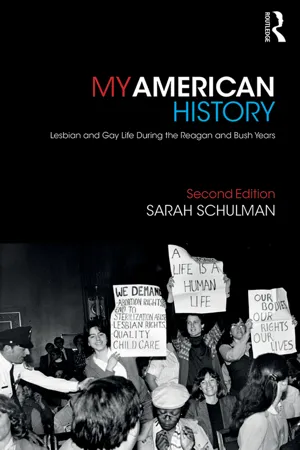
History My American History My American
![]()
FEAR AND LOATHING ON THE HALLELUJAH TRIAL
Excerpted from an address at the Conference of Women in Economic and Political Crisis at the New School for Social Research, January 1981
Now that the shock of Ronald Reagan’s ascent to power has reverberated across the land, progressive people have a lot of work ahead if we are to understand and then defeat the new right coalitions that brought him to office. Acting on a number of different fronts, the new right is not a monolith but rather a collection of diverse reactionary movements with a wide variance of agenda.
Take for example the National Right-to-Life Party, the electoral wing of the anti-abortion movement. This year marked their first foray into legislative races in which they endorsed fifty candidates, sixteen of whom were victorious. Right-to-Life may be the largest grass-roots, single-issue political force in the nation. Their sole goal is the passage of the Human Life Amendment to the Constitution which would outlaw abortion in all cases.
The Right To Life applies to all human beings irrespective of age, health, function or condition of dependency including the unborn offspring at every stage of their biological development.
Their strategy is to pass this amendment via state-by-state ratification or by convening a constitutional convention on the issue. Nineteen states have already called for a “con-con” on abortion.
Right-to-Life is rigorously single issue and devout about their version of anti-abortion politics. Here in New York State, 26,000 people decided that Ronald Reagan was not anti-abortion enough for them. Instead they cast their presidential ballots for Ellen McCormick, the RTL candidate. This move was partially a reaction to Reagan’s selection of George Bush as his running mate. Bush has gone on record as opposing a constitutional amendment against abortion but recently changed his position in the name of party unity.
RTL’s views are so extreme that even the most virulent antiabortion politicians avoid their full agenda. For example, even Henry Hyde of Illinois, sponsor of the amendment to end Medicaid funding for abortion, disagreed with RTL’s opposition to abortion in cases of rape and incest. In 1975 their president, Dr. Carolyn Gerster wrote
By allowing abortion for rape we would be abandoning the only principle by which we can resist abortion on demand.
She claimed that the number of women impregnated during rape was minimal due to such factors as “increasing numbers of rapists with vasectomies.” Gerster continued in this vein citing experiments conducted by the Third Reich “proving” that women’s fertility is affected by trauma. She cites “research” conducted by Nazi scientists who sent ovulating women into mock gas chambers. Many failed to ovulate during their next cycle. Gerster also argues that unwanted pregnancies resulting from rape can be eliminated with DES (the “morning after pill”), a synthetic hormone known to be carcinogenic.
On the other side of the right-wing coin are a bunch of hardcore politicos with a much more opportunistic attitude towards their own quest for power. One of their most visible leaders is Terry Dolan, head of NCPAC (National Conservative Political Action Committee). A former Young Republican, Dolan’s organization is responsible for the infamous “hit-list” which contributed to the surprise defeat of a number of liberal senators last November. NCPAC’s first substantial victory was the election of Gordon Humphreys as the Republican senator from New Hampshire. Humphreys, a former airline pilot, had rarely voted in any election before his own.
Another figure in the movement is Paul Weyrich, who is responsible for bringing beer magnate Joseph Coors into new right circles. Coors has been funding the movement since 1971, and, with Weyrich, co-founded the Committee for the Survival of a Free Congress, one of the top ten spenders in political action committees (PACs) for 1980. Their first victory was the election of Orrin Hatch to the Senate from Utah in 1977.
Howard Phillips, the token Jew of the Moral Majority and head of the Conservative Caucus, went to Harvard where he was student body president. He favors a return to biblical law and told a Washington newspaper that he didn’t understand why women need to own property or vote.
Phillips and Richard Viguerie, editor of Conservative Digest and direct-mail king, both got their training in Young Americans for Freedom, a right-wing youth corps founded in 1960 by William Buckley as a protest against Rockefeller liberalism. Later, as a fundraiser for George Wallace, he used his now famous direct-mail solicitation method and raised a then unheard of six million dollars. George McGovern wanted Viguerie to work on his 1972 presidential bid, but Viguerie, being more principled than McGovern, refused. He now maintains a staff of 300 nonunion employees and a computerized mailing list of over twenty-five million names. His clients include Conservative Books for Christian Leaders, No Amnesty for Deserters, National Rifle Association, and Gun Owners of America. In 1971 his associates started an organization called Friends of the FBI to express support for J. Edgar Hoover. They got Efrem Zimbalist, Jr., star of the TV series The FBI, to sign a fundraising letter which netted close to $400,000. Over half went to operating expenses. In 1977 he raised funds for the Children’s Relief Fund, a program of the Korean Cultural and Freedom Foundation—part of the worldwide operation of Reverend Sun Myung Moon. His magazine has proposed Phyllis Schlafly (president of STOP-ERA) for the Supreme Court and argues that abortion should be illegal in cases of incest because “women participate voluntarily in incest.” Conservative Digest runs full page ads for Krugerrands.
This gang of four and more are worried that Reagan will leave behind the “moral agenda” that they represent and carry out his presidency primarily on a traditionally conservative economic platform. “Main Street won the election,” says Howard Phillips, “but Wall Street is running the country.” Jerry Falwell told US News and World Report that, “If Mister Reagan turns out to be like all the other presidents we’ve had lately, our people are so committed, they wouldn’t hesitate to turn against him and find another candidate in 1984.” In this scenario, Reagan comes out looking like a moderate and, therefore, more credible.
The divisions between old time Republicans and the new right may have a lot to do with class. The new right hates big business, international corporations, and the families that run them as much as they hate labor unions. The right-wing coalition is a fragile joining of both sides of the conservative track. The factions appear in the public imagination as a wedding between Lester Maddox and William Buckley. Can the marriage survive beyond the ceremony?
According to the New York Times, a 1980 study by the Connecticut Mutual Life Insurance Company showed that religious commitment, more than age, race, sex, education, geography, political conviction, or income level, determined how people respond to a wide variety of questions on moral and political issues. Religious respondents were primarily interested in abortion, homosexuality, national defense, and women’s rights. Approximately forty-five million Americans believe that God loves them.
Commentary
Here, as a rather cocky twenty-three year old, I imagined that simply by understanding the origins of the new right we would be able to defeat them. Their political genealogies showed them to be the same old thing—that crazy bunch of religious fanatics that my generation had never taken seriously. Even with Reagan freshly inaugurated, the idea of an anti-abortion political party still seemed absurd. Still, the left spent the next decade chasing after the right trying to imitate all their best tactics. What we couldn’t bring ourselves to face, however, was that it did not all boil down to good mailing lists, but rather that we were unable to stand by our most radical and dramatic demands in the way that they stood by theirs. The most bizarre aspects of their program often became law while we watered down our visions until we ended up without a clearly articulated platform. It was the capitulation to fear that cleared the pathway for the American right in the eighties more than any computer program. In this speech at the New School I think I chose to quote from their most extreme positions as a way of mocking them. Yet, at the same time it reveals now what I could not understand then—that their “single-issue” veneer actually contained a longhand detailed agenda about the social role of women which depended on the maintenance of such institutions as rape at its core. Twelve years later the confrontation between Anita Hill and Supreme Court nominee Clarence Thomas would be the fulfillment of the oppositional relationship between anti-abortionism and women’s right to challenge sexual harassment.
An interesting sidebar has to do with Terry Dolan, one of the masterminds of the right-wing offensive. He was known to be gay among the Washington fag elite and actually frequented gay bars. But in these days before a concept like outing was even imaginable, gay people never thought to blow his cover. Ironically, he ended up dying of AIDS early on in the epidemic.
![]()
AN OPEN LETTER
Womanews,
November 1981
by Stephanie Roth and Sarah Schulman
As right-wing forces in this country gain strength and control over our lives and more people begin to organize to fight the attacks, lesbian feminists have to make some difficult decisions about how to proceed as a movement. While we must join with others we must also retain our vision of a world where women’s lives truly matter and where the fight for control of our lives is understood to be central to any politics claiming to be progressive.
In the past year progressive groups and coalitions have been mobilizing people to become involved in fighting the right. Because the women’s movement had been consistently active and often successful in organizing women to take their own lives and oppression seriously, many groups recognize that they need to include us in their organizing.
Clearly lesbians and feminists share much common ground with other progressive forces. But in deciding to work together we have to ask what the terms of the relationship should be. For us to join with other sectors of the progressive movement without having our issues and perspectives subsumed by theirs, there must be a substantial change in both their analysis and their practice of integrating feminist perspectives into their work.
One of us recently attended a meeting of ACARP (Ad Hoc Coalition Against the Reagan Program) a loose coalition of various progressive groups. The original draft of their platform had no mention of any aspect of lesbian or gay rights. Nor did it mention child care, sterilization policy, or any issue of violence against women even though Reagan is cutting funds for battered women’s and children’s programs. Later, at the same meeting, a representative of the left group Line of March said that the attacks on gays and lesbians are coming from the new right, not the White House and are therefore not an appropriate focus for an anti-Reagan coalition.
Since Reagan’s inauguration, liberal feminist groups have also taken giant leaps to the right. Betty Friedan wrote in the New York Times that women should disassociate themselves from the movements for abortion and lesbian rights in order to win the ERA (the Equal Rights Amendment to the Constitution). On a national level NOW (National Organization for Women) has conducted a large, expensive campaign for the ERA to the exclusion of other rights that women are fighting for. ERA “Walk-a-thons” have featured such hosts as Betty Ford and Maureen Reagan. National NOW’s support for the drafting of women and for the appointment of Sandra Day O’Connor to the Supreme Court further reveals their move to the right.
We fear that unless progressive movements can challenge compulsory heterosexuality and recognize lesbianism as a positive choice for women our issues will be rendered secondary and peripheral.
Commentary
For the rest of 1982, the left scrambled to find some kind of unified approach to action. For those of us who had been active in the feminist movement in pre-Reagan America, the newly re-surfaced left seemed like a real dinosaur, and a dangerous one at that. Having been essentially inactive since the Vietnam War, they were far behind social movements organized by women and by lesbians and gays. As is clear from this concerned plea many wanted to pick up where they had left off almost a decade before.
For the first time I found myself having to make decisions about giving up portions of my own sense of self in order to work with people who could not or would not accept women or gay people or both as fully human. So many of our efforts to construct lives outside traditional female roles involved not allowing women’s lives to be made secondary to men’s lives. That was a broadly understood fact of feminism at the time, even though it was not included in the media depiction of the movement. But almost no other social grouping was able to see us as multidimensionally as it saw itself. So, to demand full reciprocity meant to demand the impossible. It was a decision that we made differently each time, trying out a variety of rationales as the political situation steadily worsened.
Participating in the political movements of the day inherently meant— at some point—stepping back from our full vision of feminism. It was a personally debilitating choice that many of us were not prepared to make, choosing to demobilize instead. Quite a shocking change for someone like me who had come out in the seventies when feminism and gay liberation were the two most vibrant contributions to American radicalism.
As a girl educated under the Cold War, and a second generation American, I was still raised with the old fashioned concept of progress—that things got better, and society became more free, over time. To be twenty-three and suddenly be plunged into a dramatic detour from this tidy myth, was shocking. It became ever so much more so as things deteriorated steadily throughout my entire twenties and early thirties. As a teenager I had watched rapid changes for women and for lesbians and gays. To suddenly be stuck in rooms with men and straight women who had never even noticed these changes was shattering. Reagan’s election didn’t create them, but it did create a situation in which I had to deal with them and their arrogance. That was the level of desperation we felt in those early years.
I have to laugh at how shocked I was at the ignorance of the left and also at what radical demands Stephanie and I posited as “the bottom line.” By 1992 “compulsory heterosexuality” and “lesbianism as a positive choice for women” would be replaced with begging the government to tell people how to use condoms and a desperate attempt to salvage even the most restrictive abortion laws. The political losses were so great that threats to the most basic sexual rights of heterosexuals (seemingly resolved in the sixties) now obliterated complex understandings of lesbian existence. The latter seemed to be dependent on certain social assumptions about heterosexuality in order to be understood.
It is a telling sign of the times that when an activist lesbian movement did re-emerge, it was focused on resisting the right and winning basic freedoms. And even in the midst of the reactionary nature vs. nurture debates, our community could not articulate a radical re-conceptualization of how to understand the origins and meaning of lesbian life.
![]()
TENSIONS RUN HIGH AS REPRODUCTIVE RIGHTS ACTIVISTS FORM COALITIONS
off our backs,
January 1982
For the first time since Roe v Wade, there is a national network of radical reproductive rights organizations. Yet, differences in analysis and approach were evident at the annual conference of the Reproductive Rights National Network (R2N2). The conference, which was wheelchair accessible, interpreted for the hearing impaired and provided child care, was something like a family reunion with all the familiarity and unavoidable tensions. But that did not minimize the accomplishment of bringing together seventy organizations on the common principles of birth control, abortion rights, an end to population control, and lesbian rights.
Marlene Fried (Massachusetts Childbearing Rights Association and Solidarity: A ...