eBook - ePub
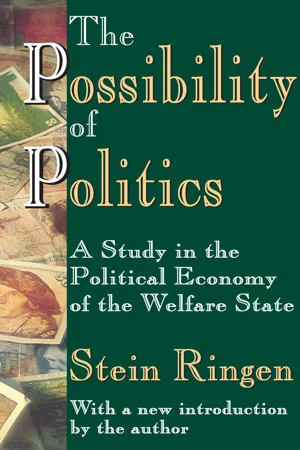
The Possibility of Politics
A Study in the Political Economy of the Welfare State
- 351 pages
- English
- ePUB (mobile friendly)
- Available on iOS & Android
eBook - ePub
About this book
The Possibility of Politics explores the power of political reform, specifically reform of the modern welfare state. Can reform be effective if limited to cautious and piecemeal interventions that avoid radicalism and revolution? Can it also avoid unwanted consequences? Will the welfare state survive in the future?Stein Ringen views the welfare state as a large-scale experiment in political reform. To ask if the welfare state works is to ask if political reform is possible at all. By its nature, the welfare state is reform on a grand scale, for it attempts to change the circumstances individuals and families live under without changing and disrupting society itself. But is it realistic to believe a population can get together, set goals and then try to meet these goals through collective actions, specifically public policies, without causing unintended consequences and destroying the state in the process? The welfare state attempts, idealistically, to redistribute welfare without reshaping the economic processes that cause inequities in the first place. Ringen considers how well redistribution has met the test in terms of political legitimacy, its intended effects on poverty and inequality, as well as its undesired and unintended effects on economic efficiency and the quality of private life. Ultimately, does the welfare state work? Further, is the welfare state a good thing?In considering these questions, The Possibility of Politics should be of particular value to academics and advanced students interested in political theory, public economics, social administration, and political sociology.Stein Ringen is professor of sociology and social policy at Oxford University and a Fellow of Green College. He teaches social and political theory and research methodology for graduates in social policy, sociology, politics, economic and social history and other subjects.
1
The Strategy of Redistribution
The welfare state is an experiment in politics. It is an attempt to bring the distribution of welfare in the population under the control of deliberate political action. We can now speak of this attempt as an experiment since it is no longer merely an idea but has been tried in real life, and since it has been tried we can judge its results. This is what the present book is about. I want to establish from recent experience whether the welfare state works.
The Experiment
Men and women who have pondered over the nature of human coexistence have sometimes believed or hoped that our societies could be so wisely arranged that if we were only free individually to pursue our own good, we would together inadvertently create an environment which would encourage each of us to act so as to advance the common good. From this they have concluded that the authority of the state in economic matters should be limited to protecting the market against monopolizations and to balance market imperfections. This was the dominant theory of the state during the age of liberalism in the nineteenth century and the beginning of this century.
Other theoreticians and ideologists have believed that free markets, far from being to the benefit of all, result in chaos, inefficiency, and unfairness. There is no such thing, they have said, as a common good which exists in itself but at best only a common interest which must be worked out explicitly through a process of agreement and which must be protected and advanced by a central authority. Instead of setting their trust in the invisible hand of the market, they have advocated the method of politics, whereby central planning rather than self-regulation is used for the co-ordination of economic activity and far-reaching authority to regulate markets and redistribute income is entrusted in the state.1
In the advanced industrial democracies, as well as in other systems, we have during this century more and more come to rely on the method of politics,2 as can be witnessed by economic policies, social policies, labour market policies, environmental policies, regional policies, industrial policies, incomes policies, housing policies, consumer policies, family policies, and so on endlessly; and by public planning, the growth of central and local government budgets and bureaucracies, and ever more penetrating regulations; by the tendency of individuals, groups, organizations and businesses to take their case to government whenever they are in difficulty. In particular the crises of the 1920s and 1930s, the ‘Keynesian revolution’ in economic theory, and the experiences of the Second World War led to a new faith in government. During the last three or four decades, the balance between markets and politics has shifted strongly in favour of politics. The post-war period can be regarded as a Large-Scale Experiment of trying out in practice the theory of using politics to protect and promote the common interest. The welfare state is part of this endeavour. With a considerable over-simplification we can say that the experiment consists of economic policy for the management of the problem of production and social policy for the management of the problem of distribution.
Today, we are in the midst of a Grand Debate over how successful the experiment has been. Half a century ago, there was intense disagreement about the wisdom of launching it on a grand scale. Then, for a time, while the method of politics was being tried, the mood was apprehensive. Now that we start to see the results, there is again a sharply divided controversy over just what these results show. There are some who see this controversy as a sign of ‘crisis’ in the political system. This is a little odd. The markets vs. politics issue is at least two centuries old. The only thing that is new today is that we can now discuss these matters on the basis of experience. I choose to see the Grand Debate as an exercise in self-criticism. Critical evaluation is part of any serious experiment. The time has come to take stock of what has been achieved. We have wanted to gain control over the material circumstances of our lives. For this purpose we have entrusted vast authority in government and let the state develop into a machine of enormous power. Public politics are no invention of the twentieth century, but the democratic state with its contemporary extensive power is a new phenomenon. We have created this state to use it for our benefit; we are now asking if it has turned out as intended or if our creation has grown into a Franken-steinian monster that we no longer control and that may turn against us. This is a troublesome question. But it would have been more troublesome had it not been asked.
The present book aims to contribute to the Grand Debate over the experiment in politics. I have picked out for closer scrutiny only one part of the larger experiment, the welfare state, but will thereby inevitably comment also on the experiment as such. To attempt to answer the question ‘Does the welfare state work?’, is indirectly to say something about the larger question ‘Is politics possible?’. And if it were not that I already have more than a reasonable share of broad questions on my plate I might have been tempted to add, ‘Is democracy possible?’3
Definition
There are about as many definitions of ‘welfare state’ as there are members of the growing profession of writers about the welfare state, and not only are their definitions many in number, they are also different in kind. The welfare state is sometimes a political sector (for example, the ‘social sector’ as distinguished from the ‘economic sector’), sometimes a kind of government (for example, a government which has been given a high degree of responsibility for the welfare of the population), sometimes a kind of socio-economic system (for example, a system with a dominant public sector), and sometimes even a kind of society or civilization, in which case the terms welfare state and welfare society tend to become confused.4 As a concept, welfare state is at the very least ambiguous and perhaps more to be reckoned as a slogan. Richard Titmuss, for one, recognized this when he set the term within quotation-marks in the title of his now classic Essays on the ‘Welfare State’, first published in 1958, and thereby inaugurated what has become a solid tradition of using the term as a catch-word or heading under which selected policies are discussed. I shall follow suit and use the term welfare state in a restricted meaning to describe a specific set of policies in a limited set of nations.
Means
Governments can use several types of policies to influence the distribution of welfare. Policies which have distributional consequences can be classified according to whether they are introduced early or late in the distributive process. Redistributive policies are used towards the end of the distributive process to modify primary distributions or to repair damage or compensate dis-welfares which have arisen in earlier stages of the process. These policies aim, for example, to redistribute market income after the market has done its job. Income maintenance belongs to this category: for example, old age pensions, sickness insurance, and unemployment compensation. Health care is to a large extent a matter of treating illness or injury after it has occurred. Progressive taxation is intended to reduce income inequalities after they have arisen. Food subsidies are used to adjust a price structure which is considered to be problematic from a welfare point of view.
Regulatory policies are used in the earlier parts of the distributive process to regulate mechanisms which might otherwise result in inequalities, damage, or dis-welfares. These policies are introduced to influence the distribution of market income or other primary distributions or to prevent problems from arising in the first place. One of the goals of incomes policy has been to influence the distribution of pre-tax/transfer income, for instance through special measures to prevent the use of very low wages. An objective of employment policy is obviously the prevention of unemployment, and a wide range of health policies are preventive more than they are curative. Consumer protection is intended to keep damaging products away from the market, and family policies to avert later problems which might be caused by childhood deprivation. Environmental protection is very much a question of preventing problems which might be caused by polluted or dangerous environments.5
The welfare state concept used in this study is limited to redistributive policies and does not include regulatory policies. More precisely, this is a study of the effects of transfers and taxes, with special reference to progressive income taxes and household transfers in the form of cash income maintenance, consumer subsidies, and free or subsidized services. This I call the strategy of redistribution. The policies of this strategy are, for simplicity and convenience, sometimes referred to as redistributive policies and sometimes as social policies. The idea of the welfare state is to distribute again, by way of politics, what has already once been distributed in the market.
An alternative approach could have been to include all policies which have or might have distributional effects. That might have been relevant since many policies which are not considered here—labour market policies, environmental policies, and regional policies, to mention a few—can clearly have considerable distributional effects, perhaps stronger effects than the policies which are considered. The reason for choosing a more limited use of the concept is that this reflects a vision, as simple as it is bold, which has been one of the most important inspirations for the development of social policies to their present scope. The vision in question can be expressed thus: yes, we need policies to promote social goals; no, these policies should not change the nature of our societies. This exceedingly optimistic outlook rests on a theory which goes back to John Stuart Mill’s distinction, in Principles of Political Economy (1848), between the laws of production, which he considered to be natural and technological, and the laws of distribution, which he considered to be ‘social’. A practical application of this theory has been taken to be that economic goals should be influenced by one set of policies and social goals by another set, and that social policies should be introduced late in the process so as not to interfere with the mechanisms of production. Among modern theorists, Richard Titmuss in particular has argued for the separation of economic and social policies and the potential of the strategy of redistribution.6 Although few today might be willing to subscribe uncritically to the separation of social laws from economic laws and although no state lives according to this learning, the theory remains immensely influential. It is politically attractive because it promises equality without radically affecting the system of production, ownership, and power; and it is pragmatically attractive because it promises equality without inefficiency. This is the theory which has found its practical manifestation in the modern welfare state. Social policy is not and has hardly ever been seen as an instrument to tame the forces of the market, but is primarily a way of modifying some of the effects of these forces.
This analysis, concentrating on the strategy of redistribution, is not a full analysis of the problem of distribution. I shall not attempt to explain the distribution of welfare, but only to find out how it is influenced by social policies. Nor is this a full analysis of the distributive effects of all policies or of the potential for creating equality by political means. I shall analyse only the effects of redistributive policies. It is a study of one among several possible political strategies; a strategy through which it is attempted to promote equality without regulating the basic processes which generate inequality. The object of this study is the power of the strategy of redistribution.
The limitation of the welfare state concept to include only redistribution gives a more precise meaning to the concept of politics as considered here. The welfare state is an experiment in politics but not in any kind of politics; it is an experiment in reform. The essence of reformism, I think, is that, for fear of intolerable side-effects, limitations are imposed on the use of means, even to the extent of excluding a wide range of means which are recognized as effective in relation to given goals. This, of course, gives rise to a debate about the possibility of reform. Can we achieve what we want if we a priori deprive ourselves of the freedom to use the most effective means, or is reformism merely the refuge of the timid who cannot stomach action and a trap of political paralysis? Is the idea of politics without side-effects at all realistic, or is it a form of escapism for those who will not see that even careful reform gradually escalates to powerful interventions which do more harm than good?
Exactly where to set the dividing line between reform and more drastic or revolutionary approaches is a matter for much debate, but some political strategies are clearly more reformist than others. The strategy of redistribution, being limited to policies which are introduced after the fact with no intention of regulating underlying economic processes, is a case of pure reform. On a more general level, then, the object of the study is the power of political reform.
Goals
The immediate goal of redistributive policies is equality (or fairness or some degree of equality or fairness) in the distribution of available goods and unavoidable burdens (however the concepts of equality or fairness are interpreted in the political culture of the society in question). The welfare state is aimed to make the distribution of welfare more egalitarian or fair than it is assumed it would have been in the absence of social policies.
That equality is a goal in the welfare state we know from what politicians say, from what we can read in policy documents,7 and from the existence of policies that cannot be understood independently of some redistributive intention. The clearest example of the latter is the progressive income tax which has been a common feature in the tax systems of the industrial nations.
The sincerity of the goal of equality can be and often is questioned, but this is not necessarily to question the existence of the goal in itself. Equality is a controversial principle, clear enough, but those who support an ideology of equality have managed at least to get it established as one among several goals of public policy. Whether policies are enacted which in fact generate equality is a different question. It might be, for example, that those who are opposed to equality have seen themselves forced to accept the principle in the formulation of goals but have still been able to prevent effective means from being taken into use. Policy goals have a life of their own. We cannot argue as if the only goals that are real are those which are followed up by effective means. If we for a moment disregard completely the question of what means are implemented and look only at the intention which has been formulated through the political process, i...
Table of contents
- Cover
- Title Page
- Copyright Page
- Contents
- Introduction to the Transaction Edition
- Preface
- Acknowledgments
- 1 The Strategy of Redistribution
- 2 Issues
- 3 Legitimacy
- 4 Governability
- 5 Efficiency
- 6 Activity
- 7 Poverty
- 8 Equality
- 9 The Power of Reform
- Appendices
- Bibliography
- Index
Trusted by 375,005 students
Access to over 1.5 million titles for a fair monthly price.
Study more efficiently using our study tools.
Frequently asked questions
Yes, you can cancel anytime from the Subscription tab in your account settings on the Perlego website. Your subscription will stay active until the end of your current billing period. Learn how to cancel your subscription
No, books cannot be downloaded as external files, such as PDFs, for use outside of Perlego. However, you can download books within the Perlego app for offline reading on mobile or tablet. Learn how to download books offline
Perlego offers two plans: Essential and Complete
- Essential is ideal for learners and professionals who enjoy exploring a wide range of subjects. Access the Essential Library with 800,000+ trusted titles and best-sellers across business, personal growth, and the humanities. Includes unlimited reading time and Standard Read Aloud voice.
- Complete: Perfect for advanced learners and researchers needing full, unrestricted access. Unlock 1.5M+ books across hundreds of subjects, including academic and specialized titles. The Complete Plan also includes advanced features like Premium Read Aloud and Research Assistant.
We are an online textbook subscription service, where you can get access to an entire online library for less than the price of a single book per month. With over 1.5 million books across 990+ topics, we’ve got you covered! Learn about our mission
Look out for the read-aloud symbol on your next book to see if you can listen to it. The read-aloud tool reads text aloud for you, highlighting the text as it is being read. You can pause it, speed it up and slow it down. Learn more about Read Aloud
Yes! You can use the Perlego app on both iOS and Android devices to read anytime, anywhere — even offline. Perfect for commutes or when you’re on the go.
Please note we cannot support devices running on iOS 13 and Android 7 or earlier. Learn more about using the app
Please note we cannot support devices running on iOS 13 and Android 7 or earlier. Learn more about using the app
Yes, you can access The Possibility of Politics by Stein Ringen in PDF and/or ePUB format, as well as other popular books in Economics & Political Economy. We have over 1.5 million books available in our catalogue for you to explore.