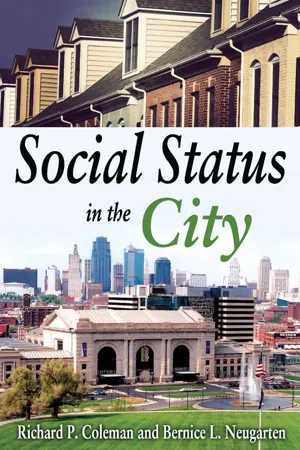
"Social Status in the City presents a scientific method for measuring social status in urban settings - the Index of Urban Status (IUS). The authors show how the index and the concepts of status on which it is based were derived by describing the procedures used in studying the social structure of a particular Midwestern city. Richard P. Coleman modified the IUS when he was employed in commerce research studies of social class phenomena in American cities.A social class is a group of people who are judged by members of the community as equal to one another in social prestige. They are believed to be either superior or inferior in prestige and acceptability to other groups who constitute the social classes that are below or above them. By this definition, Yankee City, Deep South, Jonesville, Kansas City - and presumably every community in the U.S. - can all be described as having social class systems. This book is a case study aimed at larger theoretical importance.The study should be considered in the context of sociology's concerns with problems of urban stratification, the characteristics of various social class groups, and the ways these groups change over time. In this context, the book makes a contribution to social science methods as well as observation. The authors have followed in the tradition of W. Lloyd Warner and others who have attempted to understand the status structures of whole communities. This classic volume has brilliantly stood the test of time."
Kansas Citians at middle and high status levels liked to believe that a spirit of social democracy prevailed in their city and that all people of merit had a chance to rise to the top. More realistically, those at or near the top of the social ladder stated it as a rule that “the better a family’s total qualifications and connections, the higher it ranks.” By qualifications they meant intelligence, charm, cultural level, civic contribution, and breeding as well as occupational success. By connections they meant occupational associations or ties of kinship or friendship which produced social advantage.
Two beliefs pervaded the discussion of status at the upper levels. One belief was that membership in one of the country club crowds constituted the final criterion of status; the other was that position at the top levels was determined through a social-free-for-all wherein no single factor such as wealth or lineage could be definitive. (“Social-free-for-all” was the title of a pictorial essay on the social life of Kansas City which appeared in Life magazine in March, 1954; the phrase became immediately popular in Kansas City.)
Kansas Citians were convinced that the distinction between old families and new was less important at the top levels of their community than in older cities of the South and East. As one prominent citizen put it:
In the last forty years there has been very little snobbery here concerning the nouveau riche versus the blueblood. I think Kansas City has reflected the spirit of democracy far more than other cities. Of course, you’ll hear people make fun of some newly wealthy family’s overly obvious efforts to climb the social ladder, but I think you will find that our very highest levels represent a wedding between the old families and what some people call “the aristocracy of the greenbacks.” The First Jackson Country Club is that way: it has almost all the old guard bluebloods, and then it has the most popular and well-respected families who have earned their wealth in the present generation —the “greenbacks,” so to speak.
Kansas Citians did not automatically credit old families with social superiority, perhaps because such families were of several types. One, often referred to as prairie aristocrats, consisted of “rather plain people who got here first and have always had a lot of money, but have never been too socially conscious and hence have not been accepted into the highest social circles.” A second type, said to be concentrated at the First Jackson Country Club, were families described as having “charm and culture—they have always had a flair for Society with a capital S.” The latter families were considered old guard Kansas City, whether or not they had been wealthy or prominent as long as the prairie aristocrats.
Furthermore it was said, “In Kansas City an old family name is absolutely meaningless unless attached to a sizable amount of money.” Frequently the men and women of Kansas City’s higher echelons proudly stated that their city was not like others in the United States where “you can be poor as church mice and still rate high socially, as long as you had the right grandparents.” It was generally understood that many old families were no longer well-off and that such families, if without enough money to operate successfully, had not remained in the forefront of the Society scene. Operating successfully meant maintaining a country club membership, or at least a downtown club membership, entertaining enough to meet social obligations, sending children to private schools and Eastern colleges, and giving time, if not money, to civic causes.
At the same time, a charitable attitude was maintained toward new wealth. A common phrase was: “Nobody holds it against a man that he’s just recently made his money, as long as he’s a good Joe.” Very few of Kansas City’s leading families could trace their wealth back as far as the Civil War—a short time compared to the East and South. Kansas Citians applied the phrase old families to any who had acquired their wealth before the stock market crash and even to the offspring of men who had established their prominence more recently. Finally, the exodus of many leading families of earlier eras—a phenomenon commonly lamented among Kansas City’s old guard—helped diminish the distinction between old and new families.
Upper Class Strata
Intensive study of attitudes and interaction patterns among the upper strata revealed four major levels, two within the Capital S Society bracket and two in the non-Capital S bracket. In turn, within each of the two major levels subsumed under capital s society were two layers of cliques. At the top of this finely graded system were about twenty families of greatest prominence and social power in the city—pinnacle people, as it were.
Of Kansas City’s 360,000 adults, forty-five men and women were seen as “reigning over High Society.” Several of the city’s greatest fortunes which had passed into the second or third generation were represented among these men and women. Their names were the ones most impressive to the average Kansas Citian—they represented the city’s great banks, the leading department stores, the real estate fortunes memorialized in street names, and the largest manufacturing firms. The most prominent among this group were the Galbraiths, nine men and women plus their spouses.
The Galbraith fortune had originally been made in lumber, but more recently the family business had branched out to include banks, downtown real estate, and manufacturing enterprises. The Galbraith family first became identified with Capital S Society in the 1920s. During the Depression, when other fortunes crumbled theirs grew, and they gained admission into the First Jackson Country Club. During World War II they moved up to the top level, and as the third generation entered adulthood, the family came to dominate the pinnacle position. One reason often cited for their leadership was that they were thought to display a minimum of snobbishness. As one pinnacle woman put it, “The Galbraiths are always fair, socially speaking.”
The men of the pinnacle group, who ranged in age from the early twenties up to the eighties, were represented on the board of directors of Kansas City’s six most important banks—usually two or three per bank—and also in the directorships of all the city’s utility companies and of every leading manufacturing, insurance, or transportation firm. There were at least five men and women from this pinnacle group serving as trustees of each major cultural institution: the university, the art gallery, the art institute, and the symphony. And as many were counted in the leadership of the Chamber of Commerce, American Royal, Starlight Theater, and other organizations devoted to civic promotion. A majority of the men were listed in Who’s Who in America of 1955.
The women of this group were similarly prominent. One, the widow of Kansas City’s wealthiest grain broker, was renowned throughout the Midwest as an art collector and donor to galleries; another, a daughter of the founder of Kansas City’s finest department store, was a nationally known horsewoman whose stables had produced Kentucky Derby winners; a third was the daughter of a former United States cabinet member and had herself been a Democratic Party committeewoman from Missouri, a regent of the University of Missouri, and national president of the Junior League.
The pinnacle people were not necessarily the most personally popular members of the First Jackson Country Club. But the combination of their wealth, reputation, and personal achievement placed them in a special category, and an extra measure of deference was shown them. For the most part these people worked hard at serving the community. There was, however, one small clique among them who were more social than serious.
Level I Society: In addition to the pinnacle people, about five hundred other men and women ranked in the top level of Capital S Society in Kansas City in 1954–55. Many of these people were related to each other, and there were several families who were represented by three generations. Thus, fewer than one hundred different family names were represented in this group.
An example was the Sheldon family, who traced their prominence in Kansas City back to pre-Civil War days. In 1866 Alexander Price Sheldon, who had been a captain in the Confederate army, came to Kansas City to start a hardware wholesaling business. Shortly after he arrived, he married Eliza Holmes, daughter of a pioneer landholder for whom one of Kansas City’s downtown streets was named. With Eliza’s inheritance as one of his assets, Alexander Sheldon built his company into a position of considerable importance. Alexander and Eliza Sheldon had two children. Their son Prescott went to the University of Virginia, where the captain had been enrolled. Upon graduation he married Caroline Richey, a Kansas City society belle of the early 1890s. When the First Jackson Country Club was founded, Prescott and his wife became charter members. Alexander and Eliza’s daughter Cynthia was sent to Baltimore for her finishing education at a fashionable seminary for young ladies. She married Arthur Shartel Wood, whose family had founded one of Kansas City’s great banks.
In 1954, each of the families named above—Holmes, Richey, Wood, and Sheldon—was represented in the top level status group at the First Jackson Country Club. The Sheldon name was represented by two of Prescott’s sons, William and Price, who were president and secretary-treasurer of Sheldon Hardware. The Sheldon Hardware company had not grown much through the years, and the Sheldon brothers were not especially wealthy men. The older brother’s annual income was assumed by people who knew him to be somewhere between fifty and sixty thousand dollars, and the younger brother’s, in the vicinity of forty thousand dollars. Such incomes, while not great, were adequate for maintaining status in Kansas City Society’s top tier, although in a slightly circumscribed manner.
The Sheldon brothers and their wives were, in different ways, typical of many top level First Jackson families. William Sheldon had once served as president of the club and was on the board of directors for the Kansas City Art Institute and the Young Men’s Christian Association. He was thought of as a civic leader. Price Sheldon spent much time playing golf or tennis at the Club. He was not involved in any major civic activity, although he was usually on the men’s board at St. Bartholomew Episcopal church. Both men were members of the Quadrangle Club downtown, for both, following family tradition, had attended The University of Virginia.
Both the Sheldon wives were sustaining members of the Kansas City Junior League. Mrs. Price Sheldon was considered one of the real workers among Kansas City’s civic committeewomen, but Mrs. William Sheldon was a more retiring type whose favorite activities were gardening and attending meetings of the Art Gallery Garden Club, a group composed of thirty women from the top level.
The Sheldons were often named by Kansas Citians as “good examples of what’s left of old guard Kansas City.” In their long history of affiliation with the First Jackson Country Club, they were the exception, not the rule; indeed, of the 120 middle-aged couples holding Level I status in 1954, only twenty could trace family membership back to the founding of the Club in the 1890s. The Sheldons were also exceptional in that all of them, wives and husbands, had grown up in Kansas City.
In certain respects, Andrew and Helen Bradshaw were more typical of top-level First Jackson people than the Sheldons. Helen was a third-generation Kansas Citian, but her husband grew up in Columbia, Missouri, where his father was president of the University of Missouri.
Bradshaw came to Kansas City in 1923 to join one of Kansas City”s “fine old law firms.” Two years later he married Helen Holton, whose family had been respected as prairie aristocrats in Kansas City ever since 1855, when her grandfather founded a bank. By 1954, Bradshaw had become one of Kansas City’s most highly respected lawyers. The income from his law practice and his wife’s inheritance provided the Bradshaws with “close to one hundred thousand dollars a year,” an income that was well above average for top level families.
Members of the First Jackson spoke of Bradshaw as “one of the best-loved men in Kansas City Society.” He had been on the First Jackson’s board of directors for ten years. He was a trustee of Mercy Hospital, director of the Red Cross, president of the City Housing Authority, trustee of the University of Kansas City, and governor of the Kansas City Historical Museum. Mrs. Bradshaw was very popular with other women of the top level, but not at all active in civic or church groups.
Located four blocks from Ward Parkway in a neighborhood considered the “real center of old aristocracy,” the Bradshaws’ home was an ample ten room Tudor style dwelling, easily classified as a mansion in Kansas City terms. It was not, however, one of the city’s true showpieces.
The education of the Bradshaws’ children was halfway typical for top-level young people. Their son attended the University of Missouri, in deference to his father’s conviction that “a young man is better off going to college in the area where he’s going to earn his living.” Their daughter had gone to Vassar, married a Yale man, and resided in Manhattan.
Many Level I families, like the Bradshaws, had achieves either social or geographic ascent into this status in their own lifetime. Several, like Helen Bradshaw, had made the transition from being prairie aristocrats into old guard. Another large number of husbands and wives, like Andrew Bradshaw, were descended from families who had been part of the pioneer elite of smaller Kansas or Missouri cities (cities which a hundred years earlier had been as important as Kansas City but had long since ceased to grow). The top level also included families who had transferred their high status to Kansas City from other parts of the United States.
(Not all families who came to Kansas City with Social Register listings in other cities were accepted into the First Jackson Country Club, or even into the third or fourth levels of Kansas City’s’ upper class. The position of such families was determined by their popularity, the husband’s business or professional achievement, and other credentials.)
Every middle-aged Level I family in Kansas City in 1955 could claim social prominence through husband or wife for at least one preceding generation, either in Kansas City or elsewhere. Inas-much as less than half were born into the very top level, however, it can be said that even at this level a social-free-for-all operated, with important limitations. In the final analysis, a family history of high status, while essential for top-level acceptance, was not sufficient. Ongoing achievement or personal attractiveness was necessary in addition to proper family background.
Level I families were distinguishable on the basis of other factors in addition to lineage. They were also (on the average) wealthier, more often civic leaders, more often educated at prestigious institutions, and more socially proper in their church memberships than families at other levels. It is probably also true that they were perceived as physically more attractive—the men more handsome, the women more beautiful than the people lower down the social ladder. The top-level families exercised leadership primarily by virtue of social rank and function. They were noted for being “the crowd that runs the social life of this city—things like the Jewel Ball and the Junior League”; they were less important in the political and governmental arena than was the leadership clique at the Tavern and Trail Club or the Missouri Establishment group of Level II.
Level II: There were 490 married couples and 210 single men and women ...
Table of contents
Cover
Half Title
Title Page
Copyright Page
Table of Contents
Preface
One: Studying an Urban Status Structure
Two: Social Classes
Three: Nationwide Status Structure
A. Brief Economic History of Kansas City
B. The Study Populations
C. Social Characteristics of People at or Near the Top
Bibliography
Index
Trusted by 375,005 students
Access to over 1.5 million titles for a fair monthly price.
Study more efficiently using our study tools.
Frequently asked questions
Yes, you can cancel anytime from the Subscription tab in your account settings on the Perlego website. Your subscription will stay active until the end of your current billing period. Learn how to cancel your subscription
No, books cannot be downloaded as external files, such as PDFs, for use outside of Perlego. However, you can download books within the Perlego app for offline reading on mobile or tablet. Learn how to download books offline
Perlego offers two plans: Essential and Complete
Essential is ideal for learners and professionals who enjoy exploring a wide range of subjects. Access the Essential Library with 800,000+ trusted titles and best-sellers across business, personal growth, and the humanities. Includes unlimited reading time and Standard Read Aloud voice.
Complete: Perfect for advanced learners and researchers needing full, unrestricted access. Unlock 1.5M+ books across hundreds of subjects, including academic and specialized titles. The Complete Plan also includes advanced features like Premium Read Aloud and Research Assistant.
Both plans are available with monthly, semester, or annual billing cycles.
We are an online textbook subscription service, where you can get access to an entire online library for less than the price of a single book per month. With over 1.5 million books across 990+ topics, we’ve got you covered! Learn about our mission
Look out for the read-aloud symbol on your next book to see if you can listen to it. The read-aloud tool reads text aloud for you, highlighting the text as it is being read. You can pause it, speed it up and slow it down. Learn more about Read Aloud
Yes! You can use the Perlego app on both iOS and Android devices to read anytime, anywhere — even offline. Perfect for commutes or when you’re on the go. Please note we cannot support devices running on iOS 13 and Android 7 or earlier. Learn more about using the app
Yes, you can access Social Status in the City by Bernice Neugarten in PDF and/or ePUB format, as well as other popular books in Social Sciences & Social Classes & Economic Disparity. We have over 1.5 million books available in our catalogue for you to explore.