1
Present as History
Is it Utopian to suggest that the more fully and widely the implications [ofgenocide] are faced, the better the chance of recognizing and limiting, perhaps even of forestalling, similar aberrations in the future?
— Norman cohn1
THERE ARE ESSENTIALLY TWO STRATEGIES THAT AUTHORS ADOPT IN DEALING with their earlier work. Perhaps the most common is to let that work stand for what it was and is—warts and all. The reasoning is that it is vanity to tamper with what one first presents to a professional public; and anyhow, changes ex post facto simply muddle whatever clarity there was in a work offered to an earlier generation. This might be called a monolithic approach to one's past efforts. An alternative approach is to argue that a book, article, or monograph is inevitably imperfect and hence subject to the iron law of decay and irrelevance, or at least less relevance. In this scenario, the author's task is not to hide past warts but to remove them in light of present researches and experiences. That this may lead to further changes in the future is implied in such a view. This might be called the evolutionary, or to be less charitable, error laden approach to one's past efforts.
My own strong preference is for the second approach. Indeed, I hold that the ultimate vanity is to think that writings aimed for a contemporary audience have the same value as a Bible. It might be argued that even the Hebrew and Christian Testaments were revised and refurbished over time—not only in style but also in details. As long as an author lives, then the books that he or she writes are also alive; or at least, they ought to be. A book is a multilayered dialogue: between author and reader; between author and other writers on the subject; and not least, between the past and present of the author.
In the case of genocide and state power, the tremendous increase in the volume of studies now available in contrast to twenty years ago would in itself justify a serious reexamination of the subject. For during these two decades, we have seen the development of massive encyclopedias and bibliographies on genocide and the Holocaust in particular; the emergence of more than a hundred national and local resource centers for the production and dissemination of educational materials; new publications such as Holocaust and Genocide Studies, History and Memory, and Dimensions: A Journal of Holocaust Studies; film and television specials depicting the Holocaust such as Schindlern List; and most recently, major museums documenting the Holocaust and other genocides of the twentieth century.
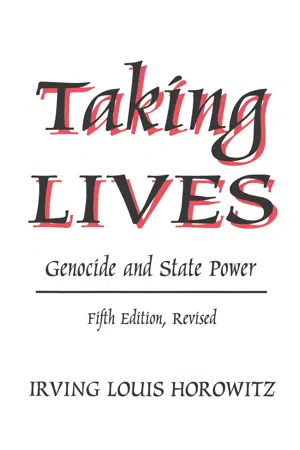
Such a tremendous outpouring of effort and achievement makes the task of producing a new edition of an older book both simpler and more complex at the same time. One can take for granted a level of awareness on the part of the reader that was not the case in an earlier period. At the same time, the need to factor in such developments in one's own efforts is a daunting task. Under the circumstances, I hasten to note that what has been altered and augmented from the fourth to the fifth edition of Taking Lives is not the broad outlines or general theory of what was first presented more than twenty years ago under quite different circumstances; but rather circumstances in which we now find ourselves. The reconfigura-tion of global political and military forces under the weight of the collapse of European communism has a great impact on how genocide itself is now understood. This factor, coupled with the explosion of information on genocide as such, has permitted a far greater in-depth treatment of the subject than was possible even a brief two decades ago.
More strongly than ever, I believe that the best way to deal with the awful truths of genocide is through an analysis of state power and social systems, rather than through analyses such as the earlier psychiatric or biographic accounts of the perpetrator and the victim of genocide. Indeed, over the years I have become concerned that genocide not be turned into the sentimentality of victimology. It is not that personal and behavioral levels are irrelevant — they most certainly do factor into any accounting; rather, it is that the task of the social scientist is to apply a specific, grounded, objective, and heuristic analysis. It is not my wish to preempt the work style of others nor to claim undue primacy of discovery; such vain efforts would be contemptible given the colossal sobriety of the subject matter; worse, they would be impossible given the continuing assaults on human dignity that take place with a frightening regularity through the final decade of the twentieth century.
But one does need to reflect on these new currents of analysis and to factor them into one's own frame of reference. For example, earlier editions of Taking Lives gave scant attention to issues of individual life taking, such as guided death under medical sponsorship or supervision. This is not for lack of interest or for lack of a position on the matter of eugenics. Rather, the new conditions allow for implementation of what was earlier viewed as only abstract and theoretical. This much we owe to the single-minded impetus of Dr. Jack Kevorkian and his followers.
My essential view is that society should be extremely cautious in invoking a "Kevorkian standard" with respect to assisted suicide. There are three elements to be considered: first that bodily pain may indicate the need for possible treat ment to cure illness and not simply something unwarranted, somthing simply to be curbed; second, that a "Kevorkian standard" presumes that the termination of life is somehow a favor to the suffering patient; and finally, that this approach to personal suffering can so easily slip over into visions of euthanasia as the means to everything from population management to ethnic cleansing. In short, the rights and obligations of states to its citizens are entirely relevant — but these are essentially to protect and prolong, rather than take and destroy, human life.
I would be falsely modest to claim that the work done by others on genocide and state power — duly noted in this new edition — have simply made my efforts irrelevant or superseded my line of analysis. I do not believe that to be the case. I do view my own general scaffolding of the problem of genocide correct as it was initially offered and revised during the late 1970s. The political and social contexts in which policies sanctioning genocide are developed have been and remain central. For the question of life taking is no less an issue of power, of those who command the resources and organizations that make possible the arbitrary termination of human existence in mass and in individual cases. Still, I also feel keenly the need to enter into dialogue with newer approaches and methods of research and to determine for myself what is relevant and what is superfluous or even erroneous in these alternative ways of examining crimes against humanity at colossal levels. The reader in turn can determine for himself or herself the soundness of that which is presented anew in this edition.
It is a commonplace saying that an author spends a lifetime writing the same book — under a series of different titles. This may not always be the case. Sometimes the same author divides his time and energies writing two books on different themes during one lifetime. In any event, looking back upon four decades of writing in the social sciences, it is plain to me that the subject of life and death has been a constant companion, if not a steady compunction.
In the mid-1950s I emphasized problems of war and peace, especially the variety of twentieth-century doctrines on the subject. The Idea of War and Peace in Contemporary Social and Philosophical Theory came out at a time when Europe and the United States were recovering from World War II. The West was very much in the throes of worries about nuclear devices. Sad to say, the heavy emphasis of positivism in the postwar era tended to reject analysis of such worldly matters; positivism preferred to think of science as a linguistic entity apart from the technologies that it made possible.
By the mid-1960s, the situation had altered dramatically. The entrance of the United States in the Vietnam War had a bracing impact on social theory. Confronting unconventional forms of struggle led to a sharp rise in models of conflict that were based on game theory, in decision theory that was rooted in policy-related interests, and in a belief that technology, far from being irrelevant, actually preempted science in any broad sense of framing hypotheses and discovering regularities in the way the world works. In this climate, I produced The War Game, which was in tune with the spirit of the decade; but alas, I turned out to be seriously out of tune with the war-game technocrats who determined policy in the major powers.
The next decade, the 1970s, was noteworthy for a growing pessimism, a deepening sense not only that war was a pandemic feature of the twentieth century but that even in the absence of a nuclear holocaust, peace remained remote. Low-intensity conflicts, international terrorism, holocausts in Cambodia, Nigeria, and on a smaller scale throughout the Third World, changed the consideration of conflict from the transparent issues related to war and peace to the essential issues of death-making and life-giving forces in the structure of societies and states. It was in this context that I wrote the first edition of Taking Lives (initially called Genocide and State Power, which was incorporated into the subtitle of later editions).
Clearly, few developments took place in the 1980s to create a hopeful climate on the theory or practice of the arbitrary termination of lives. For while by the close of the decade the Communist system had largely dissolved, at least in Europe, democracy did not break out all over the totalitarian world. Instead, we had the specter of mini-wars based on ethnic factors, nationalist rivalries, and tribal claims. No single area of the world and no single race could lay claim to uniquely expressing the well of resentment or bitterness in the new political configuration. At least we learned that the end of one variety of totalitarianism did not signify the beginning of the new millennium.
Perhaps it is a personal admission rather than a public fact, but I sense a growing sense of weariness with pacific solutions to complex problems. For while world war may be more remote than it has ever been since the defeat of fascism and the defeat of communism, world peace is also more remote than civilized peoples and nations would have hoped or imagined. The displacement of class by race, or international ambitions by nationalist claims, hardly qualifies the present moment as resolving problems of the century or, for that matter, of the millennium.
My work during the 1980s in part focused on this fragmentation, not just with several new editions of Taking Lives but also with smaller efforts to understand what had taken place in Cuba, in Armenia, and in the world of the Jews. At the same time, the situation in the 1990s compels us to reconsider categories long discarded by many social scientists. I have in mind especially notions of civilization and culture — big categories covering large chunks of the world that show marked patterns of similarity across national, ethnic, and parochial rivalries.
Along with changing patterns of emphasis grounded in individual decades is the steady, unrelenting rise of awareness that the first half of the century — especially the era of Hitler and the Holocaust-represented a defining moment in the history of the human race and not just a transitional phenomenon that one could bury in the rubble of a Berlin bunker. Taking Lives in each of its editions attempted to take stock of contemporary events, but increasingly, with each passing edition, an awareness grew that deep tragedies are sparked by long waves of social disintegration and state intervention.
More than a decade has passed between the publication of the third, augmented edition and of this new fourth edition of Taking Lives. During that time a great deal has happened — if not to improve the state of the human condition as such, then certainly to improve the state of our understanding of processes and structures that, far from being ad hoc comings and goings, represented pandemic networks embracing many people and systems. This new edition includes four new chapters and some modest supplements to the eleven chapters in the third edition. I have tried to avoid repeating what others have recently accomplished and to emphasize those areas that remain very much in need of further examination.
I have never felt a greater sense of solidarity among a large network of scholars drawn from the social and historical sciences and now joined once again by philosophical and ethical enquiry of the most serious sort. That eases my tasks greatly. I do not need to repeat what others have done, except to indicate in a new chapter some of the trends and tendencies that have emerged in the present period.
But the rise of professionalism in genocide studies, or if one prefers the older formulation, war and peace studies, creates problems of its own. One must avoid a clinical response to the massive death and destruction of innocent people. Professionalism necessitates a certain surgical approach — the way physicians approach an AIDS epidemic or an outbreak of cholera — but it should not become a method for isolating the expert from the public. This is easier said than done. The risks of abstracted empiricism remain a steady reminder that aca demie life often removes us from the feeling of pain and suffering that accompanies mass death.
At the same time, professionalism also carries the seeds of politicization — of the assumption that the study of state power is the same as the condemnation of sovereignty as such, or worse, the notion that every struggle in the world is between my rights and their wrongs. Again, this is easier to say than do. In the midst of the battle, the capacity to distinguish genocide from mere conflict — a civil war, a tribal conflict, a difference between groups that involves low-level violence and few deaths but grief of all other sorts — is a huge challenge, one not always well met or managed by the researchers in the truly dismal science of genocide.
And finally, there is a need to maintain a sense of the subject — to avoid subdividing it into ecocide, politicide, regicide, or all other forms of nasty and brutish human behavior. To do this, however tempting and however easy it is to demonstrate cleverness by reference to Hobbes' Leviathan, is especially dangerous for researchers on the theme of death. The master tendency of the century — the arbitrary and willful taking of massive numbers of innocent lives by states and tyrants, deserves to retain a special place of dishonor in the affairs of our century.
I cannot rightly say how well I have understood, much less synthesized, a vast literature, or how ably I have avoided traps and pitfalls described in these brief remarks. It is for the reader to assess my success in this agonizing enterprise. But at least the reader will have a sense of the guideposts that will enable such a determination to be made with fairness and, above all, in a way that does not minimize the tasks ahead or the tragedies left behind us in the wake of this most glorious and catastrophic century of our millennium.
I count it as a blessing that Taking Lives has generated continuous and strong readership over time. It is a further blessing that I am able to see my blend of new and old appear in print as a result of the extraordinary efforts of my colleagues at Transaction. Much of my life has been spent studying places and peoples like Armenia and Armenians, Cuba and Cubans, and Israel and Jews. In doing so, I have come to understand that important ideas do not so much depend on the size as on the soul of the nation and people under examination. In consequence, insight and outlook are neither diminished nor enhanced by the size of the field; only by the quality of the values and interests of the writer or scholar.
Taking Lives remains no less close to my heart than head. Given autobiographical — that is, who I am, what I am, and why I am — as well as analytical elements, this could hardly be otherwise. Writing at its best is a private, painful experience rendered meaningful by its public outreach. And when the subject is nothing short of the arbitrary termination of innocent lives by a collectivity called the state, the size of the chore is magnified. So I can only close this chapter by reminding one and all of what I noted at the close of the original edition of Taking Lives: The last laugh is always had by the living, by the survivors. They carry the culture and the tradition that denies to the dark destroyers any quarter, any victory, any joy, and any future. And so, far from viewing my work in this area as a grim necessity, I prefer to think of it as an ironic reply to such necessities.