The premise of this book is that our environmental dilemmas are products of biological and sociocultural evolution, and that through an understanding of evolution we can reframe debates of thought and action. The purpose is to explain the wide variety of environmental worldviews, their origins, commonalities, points of contention, and their implications for the modern environmental movement.
In three parts covering the origins, evolution and future of environmentalism, it offers instructors and students a framework on which to map theory, case studies and classical literature. It is shown that environmentalism can be described in terms of six human values—utility, stability, equity, beauty, sanctity, and morality—and that these are deeply rooted in our biological and cultural origins. In building this case the book draws upon ecology, philosophy, psychology, history, biology, economics, spirituality, and aesthetics, but rather than consider these all independently it integrates them to craft a mosaic narrative of our species and its home. From our evolutionary origins a story emerges; it is the story of humankind, how we have come to threaten our own existence, and why we seem to have such difficulty in acting together to ensure our common future. Understanding our environmental problems in evolutionary terms gives us a way forward. It suggests an environmentalism in which material views of human life include spirituality, in which our anthropocentric behaviors incorporate ecological function, and in which environmental problems are addressed by the intentional relation of humans to the nonhuman world and to one another. Aimed at students taking courses in environmental studies, the book brings clarity to a complex and, at times, confusing array of ideas and concepts of environmentalism.
• Environmental thought considers our responsibilities toward other people and the nonhuman world.
• Responsibility thinking was a focal point of many scholars of the Enlightenment.
• Different perspectives on the nature of our responsibilities provide a conflicted foundation for modern environmentalism.
I sometimes pose a question to my students: what is the greatest environmental disaster ever to occur on planet Earth? The Chernobyl accident is a common response, as are major oil spills like the Exxon Valdez and Deepwater Horizon. Some suggest war-related activity, like the use of atomic weapons in Hiroshima and Nagasaki. These are all major environmental and human tragedies, to be sure. But then I ask them to consider Chicxulub—the area of the Yucatan peninsula in Mexico where an asteroid collided with Earth some 66 million years ago, effectively ending the reign of the dinosaurs. Or how about the great oxygen increase of two to three billion years ago, during which photosynthetic organisms evolved and began to oxygenate our atmosphere, killing unknowable numbers of oxygen-intolerant organisms? Shouldn’t we count these among Earth’s greatest environmental disasters? For the most part, my students reject these events as environmental catastrophes. Why? Because, they usually say, these were natural events. They were not our fault and did not harm our species. In fact, both events played a role in paving the way for human life as we know it today. An environmental disaster, my students seem to think, is something that dramatically impacts human life, and particularly something that was caused by humans. Whether you agree with the logic or not, the message is clear: it is difficult for some people to conceive of an environmentalism that does not prioritize our own species.
This is an example of an environmental worldview that is particularly prevalent in modern western thought. If I were to poll other people in other places or other times I may well hear an alternative perspective. In some cultures, for example, elements of nature are believed to have agency. An environmental catastrophe in this context may involve the clashing forces of the universe, quite apart from human action. It’s not that either perspective is wrong. They are simply different ways of conceptualizing the human place in the cosmos.
The first section of this book is a presentation and organization of many different environmental worldviews. If we are to better understand environmentalism, this is an important first step. Cultural perspectives influence the priorities and behaviors of individual people, and competing worldviews can lead to conflicted priorities and behaviors. The purpose of this chapter is to explore some of the fundamental ideas that define and confound the modern environmental movement in the western world.
Responsibility thinking
If we accept—for the sake of argument—my students’ notion that environmental disasters revolve around human prospects, then surely the Black Death must be counted among the greatest. The Great Mortality, as it was known at the time (it would not be called the Black Death until nearly 300 years later), killed roughly one-third of the human population of Europe, North Africa, and the Middle East from 1347–1350, and it recurred throughout the ensuing century. The causes, though still debated, are generally thought to be a combination of natural and anthropogenic factors. Major climate changes of the Little Ice Age hit Eurasia around 1300. In Europe, this took the form of torrential rains, floods, cold summers, and harsh winters. Crops failed repeatedly, resulting in malnutrition that weakened the immune systems of children born during that time. Meanwhile the steppes of Asia became drier and colder, driving rodents from their natural habitats to seek food among human travelers and settlements. Conditions were filthy everywhere, with garbage and excrement providing habitat for rats, rats providing habitat for fleas, and fleas harboring Yersinia pestis: the bacterium that causes the plague. The result was human suffering and death on a terrible scale (Kelly, 2005).
Our knowledge is in hindsight, of course. At the time, no one understood infectious disease, nor the human immune system, nor the life cycle of the flea, nor the relationship of climate change to agriculture. Consequently no one at the time understood this as an environmental problem. It was instead widely seen as a spiritual problem, and many innocent people were blamed and murdered for the sins that had supposedly invited God’s wrath (Kelly, 2005: 12–23). Much later, after the Enlightenment and the scientific revolution, scholars would begin to understand the reasons for the plague. Rationalism and science are sometimes blamed for environmental problems, but in this case rational science, had it been known in medieval times, could have mitigated, if not prevented, the tragedy. As it happened, neither victims nor survivors of the plague had any knowledge of its source or mode of transmission. Consequently, they had no means of averting disaster.
Today, the Black Death can be considered a major environmental disaster, but as it occurred it did not give rise to environmentalism. Why not? The lack of a scientific understanding of the natural world is certainly part of the answer, as are the constraints of communication, the deficiencies of infrastructure, and the absence of socio-political mechanisms for change. These deficiencies began to be overcome as humanity emerged from the Middle Ages. Science and logic began to be applied to the workings of nature, and the human condition began to be scrutinized through the lens of rational philosophy. These new ways of understanding people and their environment would eventually sow the seeds for modern concerns of environmental quality and human equity.
In this chapter I trace the development of two ideas that together form the basis of modern western environmentalism in all its disparate forms. The first is the idea that humans should consider their environmental surroundings in their actions—that we have a responsibility toward the nonhuman world. This includes the contested notions that places can have spiritual value, that animals have intrinsic worth and should have rights, and that there is a proper state of nature and therefore a proper relationship between human and nonhuman. The second idea is about our responsibility toward one another: that humans have, or ought to have, certain universal rights and freedoms, that these include, or should include, fair access to ecological goods and services, and that individuals should consider the consequences of their actions for others. Together, these ideologies of responsibility have been central to the development of modern civilization. In their emergence, we can see the foundations of western environmentalism.
Where and when did such “responsibility” thinking begin? This is an unanswerable question, of course, but we may speculate that such thoughts are nearly as old as thought itself. Some of the oldest surviving written texts concern human social responsibility, often in conjunction with natural resource use. Responsibility in thought and speech, lost forever, certainly predates written record. I will make the case later in this book that such thinking is an ancient part of our evolutionary heritage. While we can never know, we have good reason to believe that some of the first human interactions revolved—and evolved—around a sense of responsibility.
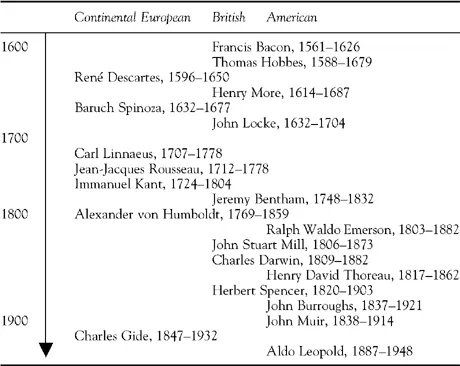
Responsibility thinking provides a foundation on which the principles of environmentalism depend. I propose, then, that an effort to better understand western environmentalism should start with some philosophical ideas that have shaped the western world. For these purposes, early modern Europe is an excellent place to begin (Box 1.1). It is in this era—roughly speaking, the 17th through 19th centuries—that we see the Enlightenment, the scientific revolution, and the beginnings of industrialization, mechanization, and urbanization that would lead to some of the first expressions of environmental concern. We also see in this period a spiritual reaction to materialism and a blossoming romantic view of the natural world, even as mechanization drove invention, production, degradation, and pollution to new heights (and depths). New ideas of a mechanistic universe led some to ponder the human role on Earth and the human relationship with nature. Central to this debate were questions of rights and values: whether nonhuman life has value beyond the ways in which it serves humans, and whether ethical considerations should be extended to other species, to nonliving entities, and to natural systems. At the same time, enlightened thinkers were writing and speaking about human rights, moral obligations, and equity. These are questions of how people ought to behave toward one another. The juxtaposition of these ideas set the stage for the environmental movement of the following centuries.
Box 1.1 Selected scholars of responsibility thinking, 1600–1950
What follows, then, is a brief trip through some foundational ideas of the modern western world. Beginning with mechanistic, materialistic, and utilitarian worldviews that advanced industrialization, I will then turn to spiritual and romanticized concepts of nature and the Darwinian science that simultaneously enabled and challenged them. Finally, I will consider early thoughts on property ownership, class stratification, and social responsibility.
Mechanism and materialism
A fundamental question of the human relationship with nature is whether humans are distinct from or part of the nonhuman world. This is a question of perspective, and a changing perspective was one of the many remarkable features of the Enlightenment. Perspective is informed by culture, and the dominant culture of early modern Europe was Judeo-Christian spiritualism. Christianity had by then held Europe in its unquestionable grasp for a millennium, but for much of that time it looked in many ways like the paganism it had supplanted. Slowly, Christian churches replaced temples, Christian holy days subsumed pagan festivals, and saints replaced pagan gods (Manchester, 1992: 10–15). A thousand years of enforced doctrine has a way of shaping worldviews, and the Europe that staggered out of the dark ages was of a different mindset than the one that had entered. In contrast to earlier animistic traditions, in which spirits were thought to pervade the nonhuman world and humans alike, Christianity set humans apart from nature. Humans were the special creation of God, given power over nature to subdue it and to make it productive. Since the realm of God is not of this world, and since humans were made in God’s image to seek His realm, the Christian was seen to be above nature, not of it. Human separation from nature is thus divine providence (Kaufman, 2003: 38).
Naturally, not everyone accepts this line of reasoning. Even if one accepts it, it does not necessarily follow that Christianity is therefore to blame for the environmental problems of the modern world. Nor does it mean that a pagan Europe would have been any more judicious in its use of the world’s resources. What is clear is that Christianity enabled philosophical and scientific arguments for human superiority over the nonhuman world. Its domination of early modern thought is surely one of the reasons that the scientific and industrial revolutions occurred first in Europe.
Among the most important scientific worldviews of the age was the conceptualization of the universe as a machine with regular, predictable, and quantifiable properties. Mechanistic ideas were not new. In fact, they had pervaded the European world since the time of Archimedes (c.287 BCE–c.212 BCE). The universe and its components, in this view, follow fundamental principles and motions, and from these principles mechanical devices can be derived and constructed (de Solla Price, 1964: 15). In this way the world came to be seen by some as a great apparatus, created by God and operated by man. The Italian friar Thomas Aquinas (1225–1274) applied this notion to animals, stating in his Summa theologica (Aquinas, 1485) that the motions of animals were without soul or reason and therefore machine-like. The Aquinan conception of animals, along with the Copernican solar system, the physics of Galileo, and the physiology of William Harvey seemed to confirm what the French polymath René Descartes (1596–1650) later concluded about the natural world: that it is, in the words of a biographer, “sheer mechanism and nothing else” (Crombie, 1959: 160). Animals, in Cartesian logic, lack the ability to speak, reason, and feel pain as humans do. Therefore only humans are conscious—a quality that elevates them above nature. What this meant to Descartes is that the nonhuman world is devoid of the spiritual soul that humans possess (Harrison, 1992: 223).
In our modern world of ultra-specialization, Descartes’ intellectual reach can be hard to fathom. A groundbreaking mathematician and inventor of analytical geometry, he was also a champion of rational science, an optical physicist, human physiologist, and briefly a soldier. All of this was accomplished with a penchant for spending long hours lying in bed, just thinking (a habit I intend to adopt myself). He was also known to partake in a bit of carousing and gambling, causing his father to remark at one point that he was “not good for anything but to be bound in buckskin” (Crombie, 1959: 166). Fathers can be hard to please. But it is Cartesian philosophy that is most central to this discussion. While he lived and died long before anyone spoke of an environmental ethic, Descartes is an important figure in the conceptualization of environmentalism. Driven as he was by a mechanistic view of the universe, he is credited—or cursed—with the introduction of two different philosophical dualisms into western thought. The first is that the human mind is separate from the body, and the second is that humans are separate from nature (Crombie, 1959; Nash, 1989: 18).
Descartes did not infer from the mechanistic worldview that nonhuman organisms, lacking a human soul, were therefore available for exploitation. However, many of his followers—called mechanici by the 18th century—took this step and reached the rational conclusion that nature was available for the taking without ethical concern (Lange, 1877: 242; Harrison, 1992: 220). The Englishman Francis Bacon (1561–1626), for example, felt that science and management would allow humans to properly exert authority over other living things, which God had created for human dominion. Cartesian and Baconian philosophy did much to advance the mechanistic worldview in their time, and the effects are still readily apparent today (Worster, 1994: 30, 106).
Even so, Descartes the mechanist was not a wholesale materialist (Worster, 1994: 40). Materialism—the philosophy that nothing exists but matter and energy—would have precluded a spiritual world, and this was a journey that few mechanists of the day were willing to take. Rather, their world was one of individual parts set in motion by a benevolent God for the benefit and industry of humans. But mechanism can lead one down a slippery path to thoughts that perhaps there is no ghost in the machine after all.1 European materialists have explored this path for centuries, at least as far back as the atomists and Epicureans of ancient Greece. Democritus (c.460 BCE–c.370 BCE), for example, is credited with an atomic theory of the universe that bears a striking resemblance to modern Newtonian physics. It held that changes in matter are due to combination and separation of atoms, and that nothing exists but atoms and empty space. Even the soul, for Democritus, consisted only of atoms that enabled life (Lange, 1877).
Some 2,000 years later this assertion was still difficult for many to accept. But where Descartes backed away from equating consciousness with matter, others were game to venture (Lange, 1877: 246). To Bacon, for example, there was no such thing as immaterial substance. Baconian philosophy thus called the vital energy of the soul into question. The Dutch philosopher Baruch Spinoza (1632–1677) similarly diverged from Descartes on some important points. He went so far as to state that consciousness and matter are of the same substance. This was a refutation of Cartesian mind–body dualism; it was the equation of the spiritual with the material. As such it negated the need for theism and, among other of his thoughts and writings, won Spinoza the label of heretic. He was certainly dismissive of scripture. A contemporary noted of Spinoza that “the New Testament, the Koran and the fables of Aesop would have the same weight according to him” (Borch, 1996 [1661]). Spinoza was summarily excommunicated from the Church in 1656 (Klever, 1996).
Spinoza’s philosophy is an interesting case, for in it we can see the beginnings of two modern contradictory viewpoints. On the one hand, we can imagine the perspective of the materialist being linked to the commodification of nature. If the vital spirit of living things is an illusion, if all living things are instead made of the same substance as nonliving things, then w...
Table of contents
Cover
Half Title
Title Page
Copyright Page
Table of Contents
List of boxes
Preface
Acknowledgements
Introduction
Part 1 Foundations, dimensions, and perspectives
Part 2 Evolutionary context
Part 3 Environmentalism evolving
Index
Trusted by 375,005 students
Access to over 1.5 million titles for a fair monthly price.
Study more efficiently using our study tools.
Frequently asked questions
Yes, you can cancel anytime from the Subscription tab in your account settings on the Perlego website. Your subscription will stay active until the end of your current billing period. Learn how to cancel your subscription
No, books cannot be downloaded as external files, such as PDFs, for use outside of Perlego. However, you can download books within the Perlego app for offline reading on mobile or tablet. Learn how to download books offline
Perlego offers two plans: Essential and Complete
Essential is ideal for learners and professionals who enjoy exploring a wide range of subjects. Access the Essential Library with 800,000+ trusted titles and best-sellers across business, personal growth, and the humanities. Includes unlimited reading time and Standard Read Aloud voice.
Complete: Perfect for advanced learners and researchers needing full, unrestricted access. Unlock 1.5M+ books across hundreds of subjects, including academic and specialized titles. The Complete Plan also includes advanced features like Premium Read Aloud and Research Assistant.
Both plans are available with monthly, semester, or annual billing cycles.
We are an online textbook subscription service, where you can get access to an entire online library for less than the price of a single book per month. With over 1.5 million books across 990+ topics, we’ve got you covered! Learn about our mission
Look out for the read-aloud symbol on your next book to see if you can listen to it. The read-aloud tool reads text aloud for you, highlighting the text as it is being read. You can pause it, speed it up and slow it down. Learn more about Read Aloud
Yes! You can use the Perlego app on both iOS and Android devices to read anytime, anywhere — even offline. Perfect for commutes or when you’re on the go. Please note we cannot support devices running on iOS 13 and Android 7 or earlier. Learn more about using the app
Yes, you can access Environmentalism: An Evolutionary Approach by Douglas Spieles in PDF and/or ePUB format, as well as other popular books in Biological Sciences & Ecology. We have over 1.5 million books available in our catalogue for you to explore.