eBook - ePub
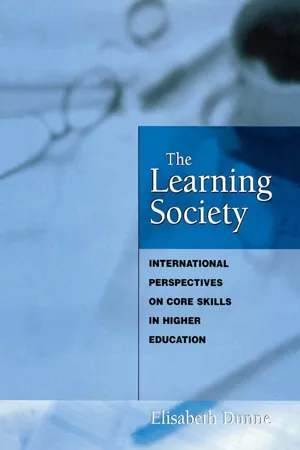
The Learning Society
International Perspectives on Core Skills in Higher Education
- 228 pages
- English
- ePUB (mobile friendly)
- Available on iOS & Android
eBook - ePub
About this book
This text provides perspectives in British and international interpretations of a learning society and what the roles of core skills are. The book covers what should be happening in theory and what is happening in practice and develops a critical awareness of the issues.
Information
PART 1
SKILLS FOR A LEARNING SOCIETY: WHO WANTS WHAT FROM HIGHER EDUCATION?
Chapter 1
Introduction
The first seven chapters provide the background to the rest of the book, highlighting requirements for core skills in a variety of contexts.
Chapter 2 provides an introductory overview of the area of core skills and the concept of a learning society. It is mainly set in the context of the UK, but shows that the issues and practice are of international concern. It is suggested that, alongside radical structural changes, there has been a powerful movement towards a reconceptualization of higher education. The purposes and practices of the past have been challenged and undermined in an agenda that requires higher education to serve as a preparation for employment.
Chapter 3, ‘Perceptions of the importance of skills for employment’, by June Harwood, David Harwood and Kate Lamble, provides evidence of the kinds of perspective outlined in Chapter 2. It serves as an example of the relationship of general government and employer demands for skills to the reality of one specific community. The chapter outlines the findings from three large-scale surveys centred on the University of Plymouth, its present students, its past students and employers of its graduates. These surveys explored how much importance students attach to the skills and abilities increasingly seen by employers as necessary for employment, and how well they perceived these skills to have been encouraged and developed within their higher education programmes. The enquiry was continued within the context of the Faculty of Science. It allowed the examination of graduate and employer views on ways of enhancing the relevance of the chemistry, environmental science and geological science programmes to meet the needs of the workplace.
Chapter 4 reinforces that, as outlined in Chapter 2, there have been similar considerations and pressures impacting on higher education in Australia. Ken Sinclair, in ‘The transition of graduates from universities to the workplace’, describes how there have been a number of influential reports addressing the question of competencies needed for effective workplace participation (Finn Report, 1991, Mayer Report, 1992). The skills under consideration have many similarities with the British approaches. In the Mayer Report, seven key competencies were identified, collecting, analysing and organizing information; communicating ideas and information; planning and organizing activities; working with others and in teams; using mathematical ideas and techniques; solving problems and using technology. The reports have fuelled a lively debate, but have also been influential in finding application at the school and post-school levels of education. The results of a series of surveys are described, the findings of which have very similar outcomes to those outlined in Chapter 3.
The prior chapters have focused on countries where traditional cultural characterizations and a clear national identity have become somewhat submerged within a multicultural society. However, similar moves towards the conceptualization of core skills can be seen within European countries that have, and are determined to maintain, a more clear-cut national identity. This can be seen within the next three chapters. In ‘New approaches in the Danish education system’ Chapter 5, Peter Bacher reviews an educational system that has traditionally been premised on very different grounds to those of much of the rest of the world, and which has often been a source of interest to outsiders. The system has always been highly decentralized; many different educational offerings, provided through very small units, take care of a particular educational speciality. It is an educational system which, until the present, has changed slowly. Yet pressures are being brought to bear on this system, too, and review suggests that debate is being fuelled by concerns similar to those of Britain and Australia. The current trend is that, on the one hand, educational institutions are gaining more autonomy; on the other hand, the State is intervening more and more. Parallel to these trends, there is an ongoing spirited discussion on: ‘what are core skills?’ This discussion can be regarded as a battle between two paradigms: that of the tradional and that of the labour market.
The context of the chapters so far has been one of comparative affluence. This is not so for the last two chapters in Part 1. Lithuania is a small country in a state of considerable turmoil as the new democracy attempts to find its feet. Chapter 6 argues that a core skill for Lithuanians must be the ability to use a foreign language. The learning or developing of a foreign language is often encouraged within higher education and many students, through Erasmus and other international programmes, attend courses at foreign universities or take up offers of work placements. Lists of core skills from a variety of sources have included foreign language learning, although this seems to be an area that is readily abandoned. There is also much rhetoric, often promoted in employer brochures, about the ‘global workplace’ and the need for foreign languages. However, Lithuania perhaps has a more pressing incentive than many other countries to promote foreign language learning. In Chapter 6, ‘English language as a key to open society’, Ligija Kaminskiene outlines emphatically the need for the learning of an international language – preferably English – by all those who will shape the future of that country both educationally and economically. It is argued that without a facility in English at the national level, wider growth in education will be hampered, knowledge will remain restricted and international relationships will founder. For each learning individual, a core prerequisite will need to be a language for the purposes of opening up further avenues of learning, and for contact with the world beyond Lithuania.
Zoran Jelene in Chapter 7 (‘slovenia – The Learning Country: how to reach the pre-set strategic goal’) briefly outlines how a small country has taken up the kind of national commitment called for in the preceding chapter, but in relation to the concept of ‘lifelong learning’. It suggests that in the last few years, lifelong learning has been acknowledged as a world movement. However, the concept will only have an impact when it is accepted as part of every country's national policy, and even more so when it becomes indispensable for every learning community, every learning organization and every individual. This chapter is not specifically an account of higher education, but outlines an interdisciplinary long-term developmental project to include all aspects of education: ‘Slovenia – the Learning Country’. Its basic elements are the elaborating and adopting of a national strategy for lifelong learning. The chapter suggests that adult education is the area of education that performs the leading role in the development of a learning society, through appropriate national programmes, through selected developmental projects and through the development of a suitable network of providers and sources of learning. However, despite optimism for change in Slovenia, the route to progress is long and hard. It is argued that concepts and strategies have to belong to a regulated national policy on learning – beginning in schools and continuing provision throughout life. Without national commitment, there can be no certainty that this will happen.
Chapter 2
Change in higher education: a learning society and the role of core skills
Introduction
Over the past decade, higher education in Britain has been undergoing a period of intense reconceptualization and change. The rapidity and extent of restructuring in the system has had an effect on all aspects of university life. Much change has been premised on enthusiastically pursued and democratic principles, widening access to education and promoting a more diverse society of learners. The Government-engineered, wide-scale expansion of the late 1980s and early 1990s led to a broadening of the student population which now includes many more ‘mature’ students, more women and increasing numbers studying on a part-time basis. Expansion has also been accompanied by movement towards credit-based programmes and modularization, both of which offer flexibility of choice, and of time and duration of participation in higher education. There is a positive expectation that students will become flexible, autonomous learners who can select their personal pathways from what is on offer and who will develop the skills of lifelong learning.
Alongside, there have been pressures on institutions for greater accountability in the use of public funds and demands for the assessment of quality. Further pressures have been exerted by the need to compete for funding and for students, with tensions arising between the former polytechnics, or ‘new’ universities, and the ‘old’. At the same time, students have been encouraged to take a more consumerist view of their education and this approach is likely to persist, given the increasing financial burdens imposed on them.
Traditional teaching methods, as well as a traditional curriculum and the role of knowledge within this, are being challenged. Academics are being expected to pay more attention to their teaching in order to satisfy demands for quality and to cope with the larger, more diverse student group, who exhibit a range of different expectations and learning styles. Academics are also being asked to address the assumed needs of society in the next century. Further, there has been a widespread shift of emphasis on ‘who’ should have the most influential voice in shaping the curriculum of higher education. There is pressure, often from those outside higher education and in particular from employer groups, to provide graduates who are well-equipped to cope with the demands of the world of work. It is in this context that the issue of core skills becomes important. It is also...
Table of contents
- Cover
- Title Page
- Copyright Page
- Table of Contents
- List of figures
- List of tables
- List of contributors
- Preface
- Part 1: Skills for a Learning Society: Who Wants What From Higher Education?
- Part 2: Strategies for Teaching and Learning – Issues and Theory
- Part 3: Strategies for Teaching and Learning – in Practice
- References
- Index
Trusted by 375,005 students
Access to over 1.5 million titles for a fair monthly price.
Study more efficiently using our study tools.
Frequently asked questions
Yes, you can cancel anytime from the Subscription tab in your account settings on the Perlego website. Your subscription will stay active until the end of your current billing period. Learn how to cancel your subscription
No, books cannot be downloaded as external files, such as PDFs, for use outside of Perlego. However, you can download books within the Perlego app for offline reading on mobile or tablet. Learn how to download books offline
Perlego offers two plans: Essential and Complete
- Essential is ideal for learners and professionals who enjoy exploring a wide range of subjects. Access the Essential Library with 800,000+ trusted titles and best-sellers across business, personal growth, and the humanities. Includes unlimited reading time and Standard Read Aloud voice.
- Complete: Perfect for advanced learners and researchers needing full, unrestricted access. Unlock 1.5M+ books across hundreds of subjects, including academic and specialized titles. The Complete Plan also includes advanced features like Premium Read Aloud and Research Assistant.
We are an online textbook subscription service, where you can get access to an entire online library for less than the price of a single book per month. With over 1.5 million books across 990+ topics, we’ve got you covered! Learn about our mission
Look out for the read-aloud symbol on your next book to see if you can listen to it. The read-aloud tool reads text aloud for you, highlighting the text as it is being read. You can pause it, speed it up and slow it down. Learn more about Read Aloud
Yes! You can use the Perlego app on both iOS and Android devices to read anytime, anywhere — even offline. Perfect for commutes or when you’re on the go.
Please note we cannot support devices running on iOS 13 and Android 7 or earlier. Learn more about using the app
Please note we cannot support devices running on iOS 13 and Android 7 or earlier. Learn more about using the app
Yes, you can access The Learning Society by Elisabeth Dunne in PDF and/or ePUB format, as well as other popular books in Education & Education General. We have over 1.5 million books available in our catalogue for you to explore.