The recently introduced Performance Management (PM) arrangements for headteachers and teachers will replace the existing appraisal systems for schools in England. The introduction of PM places a significant responsibility upon governors strategically, and upon senior and middle managers operationally.
This is a manual for middle managers and head teachers in secondary schools. It offers support and guidance on the new performance management legislation, the practical issues surrounding its introduction and strategies for successful implementation.
The book will include sections on how to integrate PM into the school's other management processes, what roles and responsibilities need to be carried out, and managing the performance of teachers and headteachers. It will also cover the appraisal cycle, setting objectives, classroom observation, and selecting and appointing team leaders. The book also discussed auditing, monitoring, evaluating and reporting.
eBook - ePub
Performance Management for School Improvement
A Practical Guide for Secondary Schools
- 96 pages
- English
- ePUB (mobile friendly)
- Available on iOS & Android
eBook - ePub
About this book
Information
Chapter 1
Performance management
Background
In September 2000 the Department for Education and Employment (DfEE) introduced a statutory system of performance management for all teachers and head teachers in England. The Education (School Teacher Appraisal) (England) Regulations 20001 replaced the earlier appraisal regulations (DES 1991) and have required schools to review their existing arrangements for monitoring and appraisal and to agree a new performance management policy.
The intention behind the introduction of performance management is for schools to demonstrate commitment to:
develop all teachers effectively to ensure job satisfaction, high levels of expertise and progression of staff in their chosen profession.
(Performance Management in Schools, DfEE April 2000a: 1)
The Government’s belief is that where schools and teachers have clear expectations about what pupils should achieve, there is a greater likelihood that standards will rise. The Government views performance management as a means of assisting schools by supporting teachers in their work and helping them improve their skills and capabilities. This is why it has made performance management such a key feature of its Green Paper proposals.
The Green Paper
The Government’s Green Paper Teachers: Meeting the Challenge of Change (DfEE 1998) proposed an interlocking set of reforms to strengthen the teaching profession through:
• better leadership;
• better rewards;
• better training; and
• better support.
One of the central proposals was that performance management should help to:
• develop a stronger link between teachers’ work and the school’s development plan;
• encourage regular and more meaningful discussion between teachers and those colleagues who were best acquainted with their work; and
• provide a framework within which teachers could consider their career and professional development.
Performance management, introduced with sensitivity and managed effectively, supports teachers in meeting the needs of pupils and in raising standards. According to the DfEE, there are two major beneficiaries of performance management:
PUPILS | TEACHERS |
… because their teachers will have a better idea of what their pupils can achieve with the right kind of support and encouragement. | … because their performance will be judged on a regular and systematic basis and there will be opportunities for them to discuss their work and development with their team leaders. |
However, there are also benefits for the school as a whole. Performance management has the potential to:
• add clarification to the school’s aims and objectives;
• coordinate teachers’ development priorities with those of the school and its subject areas;
• contribute an injection of energy into the school through the formulation of improvement objectives;
• bring about a closer match between individuals’ capabilities and the school’s role specifications;
• ensure greater clarity regarding staff responsibilities;
• encourage team building and a wider exchange of ideas;
• encourage more effective communication;
• enhance school ethos; and
• promote better focused professional development opportunities.
Integration of performance management with complementary processes
To be effective, performance management should be set in the context of other complementary management processes that exist within the school, i.e. integrated into the way the school is managed and linked with other key processes. Figure 1.1 illustrates some of the key integration opportunities.
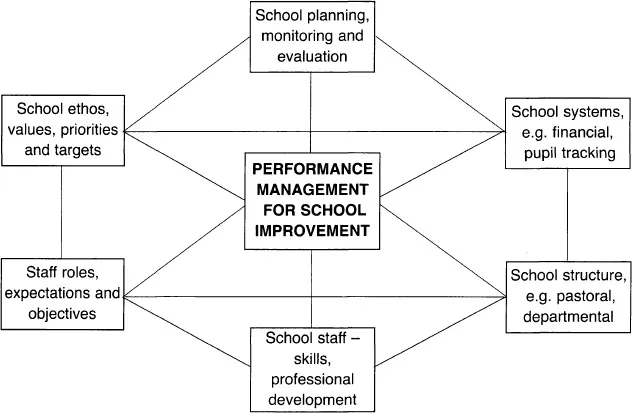
Figure 1.1: Integration of performance management with other key processes
It makes little sense for performance management to proceed without close reference to the school’s plans for development, which themselves should be set against the background of the LEA’s Education Development Plan, other local initiatives such as Excellence in Cities, national priorities and recommendations made following OFSTED inspection. Successful integration involves aligning:
• the school’s strategic plans and goals with individual and team objectives;
• the values and capabilities of the school with the values and capabilities achieved by individual teachers; and
• other performance management strategies with other ‘people’ strategies, such as valuing, rewarding and developing.
Performance management policy
The DfEE requires schools to have an agreed, written performance management policy. Such a policy is intended to ensure that members of the school community understand:
• what performance management is intended to achieve;
• how performance management works within their school; and
• what their responsibilities and rights are within the process.
The policy should be fair, treat all teachers consistently and be simple to operate and implement… The policy should encourage teachers to share good practice and build upon a shared understanding of teaching skills.
(Performance Management in Schools, DfEE April 2000a: 4)
Minimally, the school’s policy should set out its:
• commitment to agree, monitor and review objectives with every teacher;
• annual timetable clearly linked to the school planning cycle and arrangements to monitor progress and improvement; and
• standard documentation for use by all teachers at the school.
The DfEE has provided schools with a model policy (DfEE 2000) designed to help them apply the regulations rigorously and consistently. The DfEE’s model policy contains elements that are strongly recommended (R) and others that are statutory (S) and therefore must be included without amendment. Figure 1.2 provides schools with an audit framework for gauging the extent to which their own performance management policy meets the requirements of the DfEE model:
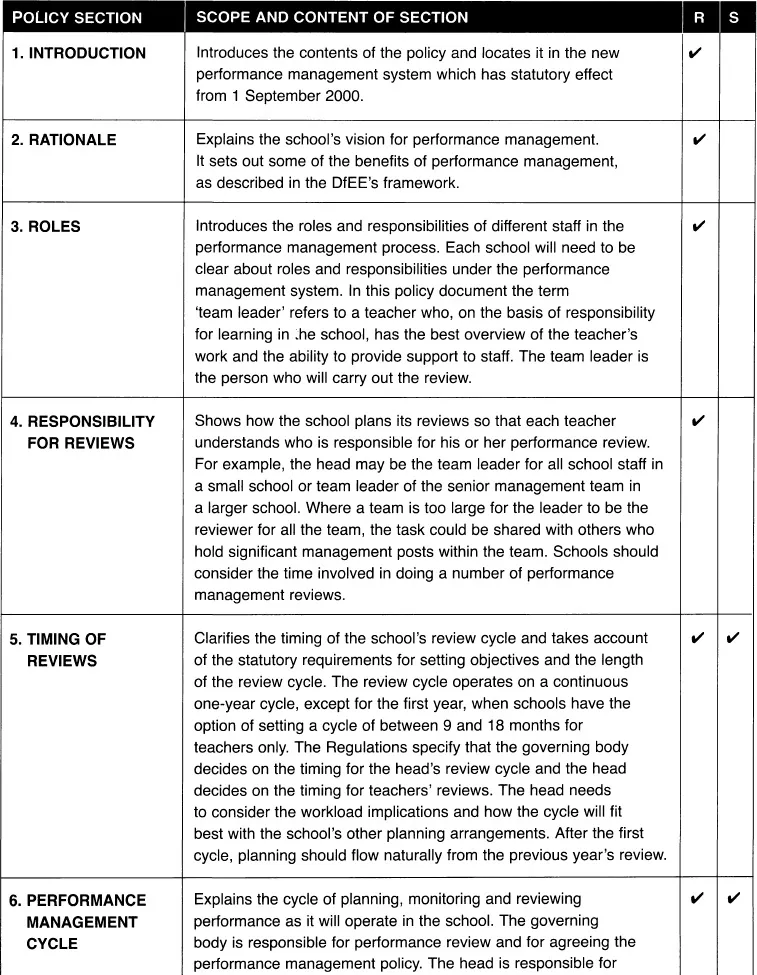
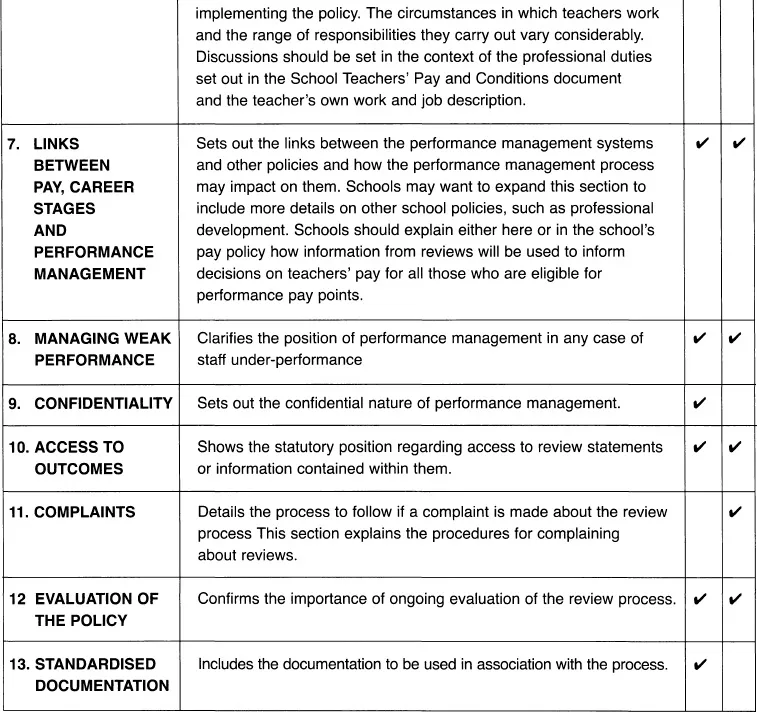
Figure 1.2: Performance management policy audit framework
The performance management cycle
The length of the DfEE’s performance review cycle is intended to be one year, although head teachers are permitted to re...
Table of contents
- Cover
- Half Title
- Title Page
- Copyright Page
- Table of Contents
- Acknowledgements
- Introduction
- 1 Performance management
- 2 The performance management cycle: planning stage
- 3 The performance management cycle: monitoring stage
- 4 The performance management cycle: review stage
- 5 Coordinating, monitoring and evaluating the school’s arrangements for performance management
- References
- Index
Trusted by 375,005 students
Access to over 1.5 million titles for a fair monthly price.
Study more efficiently using our study tools.
Frequently asked questions
Yes, you can cancel anytime from the Subscription tab in your account settings on the Perlego website. Your subscription will stay active until the end of your current billing period. Learn how to cancel your subscription
No, books cannot be downloaded as external files, such as PDFs, for use outside of Perlego. However, you can download books within the Perlego app for offline reading on mobile or tablet. Learn how to download books offline
Perlego offers two plans: Essential and Complete
- Essential is ideal for learners and professionals who enjoy exploring a wide range of subjects. Access the Essential Library with 800,000+ trusted titles and best-sellers across business, personal growth, and the humanities. Includes unlimited reading time and Standard Read Aloud voice.
- Complete: Perfect for advanced learners and researchers needing full, unrestricted access. Unlock 1.5M+ books across hundreds of subjects, including academic and specialized titles. The Complete Plan also includes advanced features like Premium Read Aloud and Research Assistant.
We are an online textbook subscription service, where you can get access to an entire online library for less than the price of a single book per month. With over 1.5 million books across 990+ topics, we’ve got you covered! Learn about our mission
Look out for the read-aloud symbol on your next book to see if you can listen to it. The read-aloud tool reads text aloud for you, highlighting the text as it is being read. You can pause it, speed it up and slow it down. Learn more about Read Aloud
Yes! You can use the Perlego app on both iOS and Android devices to read anytime, anywhere — even offline. Perfect for commutes or when you’re on the go.
Please note we cannot support devices running on iOS 13 and Android 7 or earlier. Learn more about using the app
Please note we cannot support devices running on iOS 13 and Android 7 or earlier. Learn more about using the app
Yes, you can access Performance Management for School Improvement by Jeff Jones in PDF and/or ePUB format, as well as other popular books in Education & Education General. We have over 1.5 million books available in our catalogue for you to explore.