- 240 pages
- English
- ePUB (mobile friendly)
- Available on iOS & Android
eBook - ePub
About this book
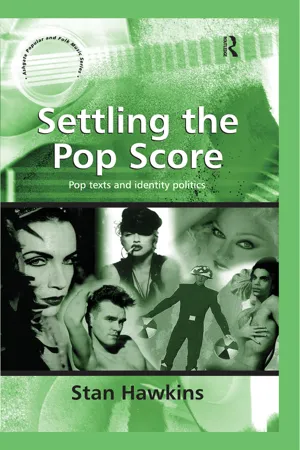
The analysis of popular music forces us to rethink the assumptions that underpin our approaches to the study of Western music. Not least, it brings to the fore an idea that many musicologists still find uncomfortable - that commercial production and consumption can be aligned with artistic authenticity. Reading pop texts takes place through dialogue on many levels, which, as Stan Hawkins argues, deals with how musical events are shaped by personal alliances between the artist and the recipient. The need for a critical approach to evaluating popular music lies at the heart of this book. Hawkins explores the relationships that exist between music, spectatorship and aesthetics through a series of case studies of pop artists from the 1980s and 1990s. Madonna, Morrissey, Annie Lennox, the Pet Shop Boys and Prince represent the diversity of cultures, identities and sexualities that characterised the start of the MTV boom. Through the interpretation of aspects of the compositional design and musical structures of songs by these pop artists, Hawkins suggests ways in which stylistic and technical elements of the music relate to identity formation and its political motivations. Settling the Pop Score examines the role of irony and empathy, the question of gender, race and sexuality, and the relevance of textual analysis to the study of popular music. Interpreting pop music within the framework of musicology, Hawkins helps us to understand the pleasure so many people derive from these songs.
Information
Chapter 1
Settling the Pop Score . . .
Introduction
Reading pop texts is about rethinking the musical assumptions that engender the analytic approaches to Western music. Recently, numerous frameworks for accommodating the analysis of pop within musicology have been forthcoming, as musicologists engaged in popular music scholarship1 have set out to demonstrate how music-theoretical approaches need to be modified to accommodate music produced by the media. The historical causes for these recent changes have been debated extensively, and generally speaking are linked to problems involving our music education traditions. Philip Brett has insisted that the acquisition of musical skills traditionally takes place in Western music institutions through a 'tacit understanding of the superiority' of the musical canon through which 'the "masterwork" ideology is first and most effectively instilled' (1994: 14). A sense of musical abstraction is experienced at the outset through harmony courses and ear training programmes where music students are confronted with analysing and setting four-part chorale settings of J.S. Bach. Seldom aware of the social or historical backgrounds to these harmonic arrangements, the music student learns the rules of technical correctness, and so the way is paved towards a working understanding of formal construction and ideological supposition.
Yet, paradoxically, what most students enrolled on music degree programmes listen, dance and respond to in their spare time remains by and large well outside the lecture theatre and classroom. Few music curricula focus on the differences in performance practices from one music culture to the next. With the emphasis so often on abstraction, music analysis often renders musical meaning void of any social and emotional effects. Furthermore, far too often questions of meaning presume that the music speaks for itself.
Theoretically, the scientific objectivity afforded to the internal structures and architectonic levels of music can easily rule out the possibility of creative criticism.2 Yet, in spite of a general scepticism on the part of the critical scholar to the ideologically-laden scientific legitimisation of conventional approaches, there is a general recognition of the need to draw on aspects of music theory through reformulation. Certainly, reappropriations of formalistic views of music and a move towards creative hermeneutics (that renounce ideas of mastery) have begun to offer scholars new ways for approaching music analysis.3 The reader will note that throughout this book my use of the word analysing is interchangeable with the term reading, which I deliberately employ to designate a move between focusing on the structures of music alone and the broader contexts within which the music is located.
In a general sense, my aim is to address a number of tensions that arise out of music-analytical application by turning to a more hermeneutic position in my readings of pop texts from the 1980s and 1990s. To this end, I set out to concentrate on the music produced by artists of my generation born towards the end of the 1950s and early 1960s – indeed the first pop icons of the MTV boom, a period greatly impacted by the visual spectacle of the pop video. Accordingly, all the artists studied in this book are products of the MTV phenomenon in one way or another.
One central issue needs to be raised at this point, namely that which concerns what pop music is. Always shaped by social, political and cultural conditions, pop is about patterns in consumption and production. Seen in a historical light, some have declared that pop stylistically evolved out of what Simon Frith terms the total 'fragmentation of rock' at the end of the 1970s. In contrast to the early 1970s, when rock reached its height as an authentic mode of expression, pop music only really came to age in the 1980s when, as Frith recalls, it emerged for the first time as a 'term of praise'. In considering this from a sociological perspective, it is significant that research into 1980s pop was based on different premises from rock: 'The meaning of music was itself up for grabs and rock criticism no longer meant playing each new release in its tradition, describing its provenance, codifying sounds in terms of accustomed social codes' (Frith 1988: 5).
The issue here is that lineages of styles and genres transport with them sets of assumptions. This is rife in writings on popular music where descriptions and discussions promote and legitimise certain trends discriminately. In much music journalism, one finds a tendency to privilege one genre of music over the next. This commonly occurs on the basis of commercial production, which is seen to negate the authenticity (read: quality) of specific musical styles and trends (see Hamm 1995). Yet, there seems little worse than the poor arguments that attempt to negotiate the authenticity of one style at the expense of another
All too often the kind of thinking I am referring to encircles the intricate problematics of definition. Like the overarching categories of world music, pop-rock, folk, funk and jazz, pop, as a term in itself, is often applied loosely to refer to that broad expanse of music that has undergone industrialisation and commercialisation. Alone, the interchangeability of the terms 'rock' and 'pop' highlights the constraints of narratives that embrace countless definitions of popular music (Moore 1993). Of course the distinctions linked to categorisation are not only tied up in the degree of control that artists and fans have over their music, but also in the problems music critics have with clarification. A case in point, as Steven Feld has indicated, is Frith's employment of the word pop where 'what he [Frith] typically means is "rock" and, more specifically, the internationally marketed American-and western European-derived rock of the last thirty-five years' (Keil and Feld 1994: 261). Feld argues that processes of stylistic identification are linked to a range of debatable historical and cultural positions predicated upon complex and often contradictory debates surrounding the issue of what pop is.
Undoubtedly, the hurdle one faces in determining what pop actually signifies creates numerous sets of arguments and debates. One only needs to glance at the recent spate of textbooks on popular music to appreciate the full extent of this. From one perspective, Robert Burnett's call (1996) for a broader definition provides us with a helpful starting point. Fie insists that by reaching fans through its selection, pop music becomes self-defined: it is identifiable through the nature of its distribution, consumption and content. Yet, this alone is not enough to distinguish commercial pop from other music genres. Clearly, questions of production and consumption are strong reminders that categorisation through the authentication of one style over the next continually compounds the task of definition. The fact is that pop music is about shifting levels of styles, texts, genres and responses, and how these engender feelings. And, on a broader scale, what pop signifies is ultimately wrapped up in our readings of musical effect through the choice of language. But what about the question of defining pop styles?
Since identifying musical style can be positioned very differently from one individual to the next, there will always be limitations to our definitions. Whatever position one decides to take, however, musical styles are ideologically grounded in aesthetic preferences, and it is this that determines our tastes. Given this, the task of selecting methods for reading musical texts might be best directed towards what Philip Tagg has called for: an analysis that 'acts as a basis for understanding "what is being communicated" and "how" (1982: 65). Most importantly then, the task of interpreting pop is an interdisciplinary task that deals with the relationship between music and social mediation. It is one that includes taking into account the consideration of the sounds in their relation to us as individuals. And, thus, my purpose in this book is to explore the issue of what pop signifies in terms of its communicative function.
Grounding aesthetic and ideological values
Shifts in the world markets during the latter part of the twentieth century rapidly gave way to large-scale modes of production that profoundly affected the music industry. The result of all this was that pop music would confirm, resist and subvert dominant values within the context of the dominant Anglo-American market. In fact, the pleasures derived from experiencing music through the acts of dancing, concert-going and purchasing – not to forget the ongoing everyday wrangles over taste – would create the basis for social interaction and exchange of knowledge amongst entire generations of young people.
During the post-war period, rebellion and modernity were two interlinked concepts in shaping an ideology that quickly legitimised certain musical trends. For example, by the late 1970s, African American-influenced styles such as funk, soul and disco were more in demand than progressive rock and firmly embedded in a changing mainstream of popular music produced by artists such as George Clinton, James Brown, Isaac Hayes, and Sly and the Family Stone. But, entering the international scene from another direction, it was the music without conventional instrumentalists, indeed that which presented new forms of artistic virtuosity – the New Pop of the 1980s – which signalled the MTV shake-up in popular music.4
What forms the backdrop to the studies presented in this book is the significant period of development from 1983 onwards when music production became completely restructured. Described by Paul Théberge as a 'watershed in the history of popular music' (1997: 5), this era signified a moment of tremendous change in marketing and patterns of consumption. The advent of MIDI (Musical Instrument Digital Interface) and digital electronics ushered in a new generation of instruments and software important for expanding styles and concepts in production. For the musician and producer during this period, the sound possibilities arising from these new modes of technical reproduction would redefine compositional thinking.5 In this way, digital technology instantly became an inspiration for processing compositional ideas and approaching sounds and effects in new ways.
Notwithstanding the general challenges of tracing its stylistic developments, the analysis of pop music when situated within the discipline of musicology has not been without its problems. One reason for this is that traditional musicology has generally considered popular music to exist well outside its discipline, belonging more to the sociological domain (see Middleton 1990, 2000; Frith 1996).6 When the primary textual analysis of pop or rock texts is undertaken, there is easily a tendency to prioritise procedures aligned to traditional music analysis. Naturally, the results of such scholarship have sparked off much debate and controversy in the broader field of popular music studies. A good example of the causes for this is borne out by the recent spate of Schenkerian rock studies undertaken by North American musicologists, such as Walter Everett (2000), Lori Burns (2000), and John Covach (1998, 2000). Hardly radical in their formalist approaches to analysing the primary text, such studies have nevertheless succeeded in igniting debates around the approach to popular musicology (on both sides of the Atlantic). Indeed, Everett's bold assertion that most pop and rock music conforms to Schenkerian methods of tonal working seems the kind of proposition intended to evoke harsh retort. Yet, despite the general scepticism towards Everett's formalistic approaches, it is evident that all popular music scholars come to terms at some point with the practice of conventional analytic procedures, even if it is to reject them as a basis for structural analysis.
The problems surrounding approaches to popular musicology also offer an insight into assumptions still surrounding the question of aesthetic preference in the academy (Frith 1996; Cook 1998; McClary 2000). As a result of their own conventional predispositions, many music pedagogues continue to exist in a social vacuum worlds apart from the majority of their students and pupils. How music is experienced, enjoyed, or performed by the majority of young people studying music is seldom acknowledged or taken seriously. Let alone is it fully grasped that teaching with the use of pop examples might be a useful way for approaching music analysis through interrelated subjects. In his argument for teaching pop in the classroom, Andrew Goodwin has gone as far as proclaiming pop music as 'simply the best tool for teaching theory that one can imagine' (Goodwin 1997: 47). To a large extent this is borne out by my experience of teaching on undergraduate and postgraduate courses in popular music over the past 15 years, where an interdisciplinary approach to music has proven an invigorating vehicle for developing a critical approach to studying all musical genres through compositional techniques. Possibly the most defining quality of exploring pop texts and measuring their signification is, after all, in learning how to view things differently and critically. Like all forms of human expression, the musically popular seems to denote something truly remarkable, namely, that special event or moment in performance that alters our ways of sensing things and, thus, our identities in a contemporary social setting.
By the early 1980s, musicological research in popular music had started to increase, providing the necessary stimulus for generating a corpus of work in this field (Middleton 1990, 2000). This period also witnessed the launch of the international journal Popular Music, and the establishment of the International Association for the Study of Popular Music (IASPM) in 1981, which initially attracted more sociologists and cultural theorists than musicologists. Significantly, it was the interdisciplinary nature of the IASPM that would prove in later years to have a profound effect on the development of popular musicology. Though we cannot ignore the pioneering work of musicologists in the 1960s and 1970s, such as Charles Hamm and Wilfred Mellers,7 it was not until the next generation of musicologists – Richard Middleton, John Shepherd, Gino Stefani and Philip Tagg – that the way was paved for musicology to enter the field of popular music studies.
In a general sense, research into popular music during the early 1980s was influenced by the overarching meta-narratives of modernism that focused on class struggle, democratisation and the social conditions of the period (see Hamm 1995). If we frame this further, the Anglo-American media's influence in the 1980s was manifested through a boom in newspaper and magazine publishing – a result of Reaganite and Thatcherite free-market policies – which targeted the political objective to construct the nation through theories of the market. Curiously enough, it was under such social conditions that a style culture emerged with a generation of writers who understood little about social issues (see Frith and Savage 1997). Certainly, the effect of this was to ideologise educational authority to the point that the so-called experts were swiftly replaced by men and women 'whose cultural expertise [was] not measured by any scholarly credentials, but in straightforward tests of political correctness'. Modes of argument soon started changing in the 1980s as 'common sense' became a celebration of anti-intellectualism, and cultural studies emerged as a 'spawning ground for eighties style journalism' (Frith and Savage 1997: 12). In this light, it is not difficult to appreciate the reactions of modernist-oriented music departments to proposals of incorporating the popular and folk within general music courses.
Notably, it was during this same period that a number of musicologists within the academy began pushing for more critical approaches within music criticism. This move was greatly prompted by Joseph Kerman's hermeneutic position. In emphasising the link between music analysis and ideology, he claimed:
I do not think we will understand analysis and the important role it plays in today's music-academic scene on logical, intellectual, or purely technical grounds. We will need to understand something of its underlying ideology, and this in turn will require some consideration of its historical context [Kerman 1980: 314].
It has been widely acknowledged that Kerman's insight into the role of analysis denotes a special landmark in the discipline of musicology. In adopting a more critical approach, he insisted that enquiring into music in new, heuristic ways could provide a vastly increased analytical power for addressing a range of diverse genres and discourses. This clearly paved the ideological way forward for the eventual accommodation of popular music within the academy. In effect, Kerman succeeded in exposing the constrictions of formalist analysis (as applied to the canon) by challenging the idealism of aesthetics and stressing the need for further development in musicology.
This meant that by the end of the twentieth century the way had been cleared for what Hamm described as 'the first generation of writers whose awareness and consciousness has been shaped by the fragmented, nonhierarchical postmodern world' (1995: 37). For the first time the meta-narratives that had intellectualised music were now under scrutiny by those wishing to focus on the destabilising issues of deconstruction and différance. French post-structuralism quickly spawned a generation of writers keen to dismantle the truths and norms that had universalised Western musicological practice.8 Thus, by the 1990s poststructuralist approaches abounded in the academy as deconstructing aesthetic criticism meant that accommodating the Other could be accessed right across the humanities.9 For the popular musicologist then, music's autonomy could now be subjected to a hermeneutics of indeterminacy, which would provide exciting new ways of dealing with music criticism (Tagg 1982; Shepherd 1982; Small 1987; Middleton 1990; Moore 1993; Scott 2000).
Now a general problem commonly encountered in scholarly books on musicology is located in the tendency to focus more on the intricacies of theoretical debate than to attempt the interpretation of music. I have therefore endeavoured to redress this balance through a more pragmatic approach towards the question of application. Although I cannot deny the derivation of my analytic methods from the discipline of European-based musicology, my approach does seek to examin...
Table of contents
- Cover
- Half Title
- Dedication
- Title
- Copyright
- Contents
- General Editor's Preface
- List of Music Examples, Figures and Tables
- Preface and Acknowledgements
- 1 Settling the Pop Score ...
- 2 'I'll Never Be an Angel': Stories of Deception in Madonna's Music
- 3 Anti-rebel, Lonesome Boy: Morrissey in Crisis?
- 4 Annie Lennox's 'Money Can't Buy It': Masquerading Identity
- 5 'Call it Performance, Honey': The Pet Shop Boys
- 6 Subversive Musical Pleasures in 'The Artist (Again) Known as Prince'
- Bibliography
- Discography
- Index
Trusted by 375,005 students
Access to over 1.5 million titles for a fair monthly price.
Study more efficiently using our study tools.
Frequently asked questions
Yes, you can cancel anytime from the Subscription tab in your account settings on the Perlego website. Your subscription will stay active until the end of your current billing period. Learn how to cancel your subscription
No, books cannot be downloaded as external files, such as PDFs, for use outside of Perlego. However, you can download books within the Perlego app for offline reading on mobile or tablet. Learn how to download books offline
We are an online textbook subscription service, where you can get access to an entire online library for less than the price of a single book per month. With over 1.5 million books across 990+ topics, we’ve got you covered! Learn about our mission
Look out for the read-aloud symbol on your next book to see if you can listen to it. The read-aloud tool reads text aloud for you, highlighting the text as it is being read. You can pause it, speed it up and slow it down. Learn more about Read Aloud
Yes! You can use the Perlego app on both iOS and Android devices to read anytime, anywhere — even offline. Perfect for commutes or when you’re on the go.
Please note we cannot support devices running on iOS 13 and Android 7 or earlier. Learn more about using the app
Please note we cannot support devices running on iOS 13 and Android 7 or earlier. Learn more about using the app
Yes, you can access Settling the Pop Score by Stan Hawkins in PDF and/or ePUB format, as well as other popular books in Media & Performing Arts & Music. We have over 1.5 million books available in our catalogue for you to explore.