eBook - ePub
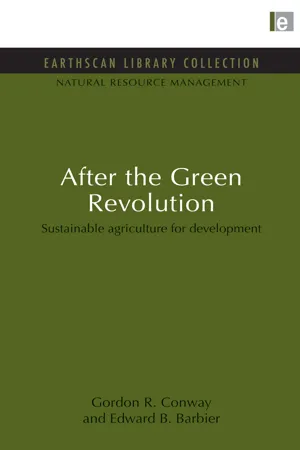
After the Green Revolution
Sustainable Agriculture for Development
- 210 pages
- English
- ePUB (mobile friendly)
- Available on iOS & Android
eBook - ePub
After the Green Revolution
Sustainable Agriculture for Development
About this book
'The Green Revolution' of the 60's and 70's produced immense gains in food cereal production in the Third World. But there are huge problems in the 'post-revolutionary' era: farmers with small or marginal holdings have benefited less than wealthier farmers; intensive mono-cropping has made production more susceptible to environmental stresses and shocks. Now there is evidence of diminishing returns from intensive and intensively chemical agricultural production. What is needed is a new approach, equally revolutionary, but different in its ideas and style. The authors set out what they mean by 'sustainable' agriculture in the new era and look at the effects of international economic restraints and of national policies on the kind of development they see as necessary. They chart a path for sustainable livelihoods for Third World farmers enmeshed by forces outside their control. They describe methods of evaluating and resolving the tough trade-offs all levels of intervention, from international trade down to the individual farm. This book cannot provide all the answers, but it does indicate what international conditions we need to be aware of, what national policies we need to advocate and what approaches at the local level we need to adopt to ensure the goal of agricultural sustainability. Originally published in 1990
1. Ideas of Development
Although the overall aim of post-war development has been, and continues to be, the alleviation of mass poverty and the improvement in living conditions for the world’s poorest populations, the strategy – and thus meaning – of economic development has undergone three important shifts over the post-war period.1
Economic growth
The first important phase, during the 1950s and early 1960s, equated economic development with economic growth, as defined by a sustained increase in real per capita gross national income.2 In many ways the policies advocated and implemented during this phase were successful. Growth rates and savings grew, as did industrial capacity, in much of the Third World. Between 1950 and 1975 growth in gross domestic product (GDP) per capita averaged 3.4% per annum for all developing countries (Table 1.1). But critics argued that such growth did not necessarily “trickle down” to the poorest. Indeed there was accumulating evidence in the Third World of growing numbers of people below an absolute poverty line, of increasing income disparities between rich and poor, and of continuing underemployment and unemployment.3 This realization led to two shifts in conventional, non-Marxist development thinking.
Growth with redistribution
The first shift – in the late 1960s and early 1970s – emphasized “growth with redistribution”.4 Economic growth was still the main objective, but the emphasis now was to be on growth that would improve the standard of living of the poorest income groups. Agriculture became the priority sector, since it had the potential to eliminate malnutrition and hunger, absorb surplus labour and boost foreign exchange earnings.5 Export-led growth was also promoted, so stimulating the growth of labour-intensive manufacturing and providing foreign markets for commercial agriculture.6
Basic needs
A more recent and radical shift in perspective was the “basic needs” approach. Sparked by the call for a “basic needs strategy” at the 1976 World Employment Conference of the International Labour Organization (ILO), this approach argued that absolute poverty cannot be reduced unless the essential needs of the poor – nutrition, health, water supply, shelter, sanitation and education – are met, together with the fulfilment of certain non-material, but also essential, needs of self-reliance, security and cultural identity. Just how many people lack such basic needs is difficult to determine, but one estimate puts the figure at over a billion (Table 1.2). The basic needs strategy recognizes that growth by itself – even egalitarian growth or redistribution from growth – does not guarantee that basic needs will be met.7 Instead, development policies must ensure these needs are met through increased supply of essential goods and services to the poor; through direct government intervention, if necessary, rather than relying on market forces. Moreover, this may have to entail some sacrifices in savings, productive investment and overall growth. The objective is a “new kind of economic growth”, enabling basic needs to “be achieved by redistributing resources within the social sectors and by a reorientation of growth, so that the deprived participate”.8
Table 1.1: Changes in gross domestic product (GDP) of developing countries, 1950-75
| GDP per caput (1974 US$) | Annual growth rate %p.a. | ||
| 1950 | 1975 | ||
| South Asia | 85 | 132 | 1.7 |
| Africa | 170 | 308 | 2.4 |
| Latin America | 495 | 944 | 2.6 |
| East Asia | 130 | 341 | 3.9 |
| China | 113 | 320 | 4.2 |
| Middle East | 460 | 1,660 | 5.2 |
| All developing countries | 160 | 375 | 3.4 |
Source: D. Morawetz, Twenty Five Years of Economic Development 1950-75 (Baltimore, 1977), p. 13.
Table 1.2: Developing country populations lacking basic needs
| 1974 | 1982 | |||
| Millions | % total population | Millions | % total population | |
| Latin America | 94 | 30.6 | 86 | 23.2 |
| Near Easta | 40 | 26.0 | 36 | 18.0 |
| Asiab | 759 | 53.0 | 788 | 60.0 |
| Tropical Africa | 205 | 67.6 | 210 | 54.0 |
| All developing countries | 1,098 | 56.0 | 1,120 | 47.0 |
Notes: aMiddle East and African oil exporters
bExcluding China
cProjections from 1974 data
Source: M J.D. Hopkins, “A global forecast of absolute poverty and employment”, International Labour Review, vol. 119, pp.565-79, 1980.
Sustainability
A concern for “sustainability” represents the most recent shift in development thinking.9 In common with the “basic needs” strategy, the emphasis is on improving the livelihoods of the poor. However, this approach additionally argues that lasting improvement cannot occur in Third World countries unless the strategies which are being formulated and implemented are environmentally and socially sustainable; that is they maintain and enhance the natural and human resources upon which development depends.
This requires, on the one hand, national policies, regulations and incentives to induce economic behaviour that is “environmentally rational”, i.e. that yields optimal benefits in both the short and long term from the world’s endowment of natural renewable resources:10 and on the other, development projects which are both ecologically sound and consistent with indigenous social values and institutions. To achieve this, it is argued, not only is local knowledge required but so is the full participation of the beneficiaries in the development process.
The green revolution
These shifts in overall development thinking have been mirrored by similar concerns within the somewhat narrower focus of agricultural development. Beginning in the 1950s there was an increasing preoccupation with the problem of feeding a rapidly growing world population. The goal of increasing per capita income was to be matched by rising per capita food production, and the means was the green revolution, largely funded by the international donor community and engineered by the International Agricultural Research Centres (IARCs). In essence it focused on three interrelated actions:
- breeding programmes for staple cereals that produced early maturing, day-length insensitive and high-yielding varieties (HYVs)
- the organization and distribution of packages of high pay-off inputs, such as fertilizers, pesticides and water regulation
- implementation of these technical innovations in the most favourable agroclimatic regions and for those classes of farmers with the best expectations of realizing the potential yields.11
Its impact in the Third World, particularly on wheat and rice production, has been phenomenal; between one-third and one-half of the rice areas in the developing world are planted with HYVs. In the eight Asian countries that produce*85 per cent of Asia’s rice (Bangladesh, Burma, China, India, Indonesia, Philippines, Sri Lanka and Thailand) HYVs add 27 million tonnes annually to production, fertilizers another 29 million tonnes and irrigation 34 million tonnes.12 Estimates of the contribution of new HYVs to increased wheat production in developing countries vary from 7 to 27 million tonnes.
Per capita food production in the developing countries has risen by 7% since the mid 1960s, with an increase of over 27% in Asia (Figure 1.1). Only in Africa has there been a decline.
Post green-revolution problems
These impressive results have been associated, though, with significant equity, stability and sustainability problems.13 For instance, while producers have widely adopted the new HYVs irrespective of farm size and tenure, factors such as soil quality, access to irrigation water, and other biophysical-agroclimatic conditions have been formidable barriers to adoption. Farmers without access to the better-endowed environments have tended not to benefit from the new technologies, which partly accounts for the relative lack of impact of the green revolution in Africa. But even under favourable conditions in Asia or Latin America, a significant gap persists between performance on the agricultural research station and ...
Table of contents
- Cover
- Title page
- Copyright page
- Table of Contents
- Acronyms and Abbreviations
- Preface
- Dedication page
- Introduction
- 1. Ideas of Development
- 2. Indicators of Agricultural Performance
- 3. International Constraints
- 4. National Policies
- 5. Farms and Livelihoods
- 6. Conclusions
- Appendix
- Index
Trusted by 375,005 students
Access to over 1.5 million titles for a fair monthly price.
Study more efficiently using our study tools.
Frequently asked questions
Yes, you can cancel anytime from the Subscription tab in your account settings on the Perlego website. Your subscription will stay active until the end of your current billing period. Learn how to cancel your subscription
No, books cannot be downloaded as external files, such as PDFs, for use outside of Perlego. However, you can download books within the Perlego app for offline reading on mobile or tablet. Learn how to download books offline
Perlego offers two plans: Essential and Complete
- Essential is ideal for learners and professionals who enjoy exploring a wide range of subjects. Access the Essential Library with 800,000+ trusted titles and best-sellers across business, personal growth, and the humanities. Includes unlimited reading time and Standard Read Aloud voice.
- Complete: Perfect for advanced learners and researchers needing full, unrestricted access. Unlock 1.5M+ books across hundreds of subjects, including academic and specialized titles. The Complete Plan also includes advanced features like Premium Read Aloud and Research Assistant.
We are an online textbook subscription service, where you can get access to an entire online library for less than the price of a single book per month. With over 1.5 million books across 990+ topics, we’ve got you covered! Learn about our mission
Look out for the read-aloud symbol on your next book to see if you can listen to it. The read-aloud tool reads text aloud for you, highlighting the text as it is being read. You can pause it, speed it up and slow it down. Learn more about Read Aloud
Yes! You can use the Perlego app on both iOS and Android devices to read anytime, anywhere — even offline. Perfect for commutes or when you’re on the go.
Please note we cannot support devices running on iOS 13 and Android 7 or earlier. Learn more about using the app
Please note we cannot support devices running on iOS 13 and Android 7 or earlier. Learn more about using the app
Yes, you can access After the Green Revolution by Gordon R. Conway,Edward B. Barbier in PDF and/or ePUB format, as well as other popular books in Law & Environmental Law. We have over 1.5 million books available in our catalogue for you to explore.