- 347 pages
- English
- ePUB (mobile friendly)
- Available on iOS & Android
eBook - ePub
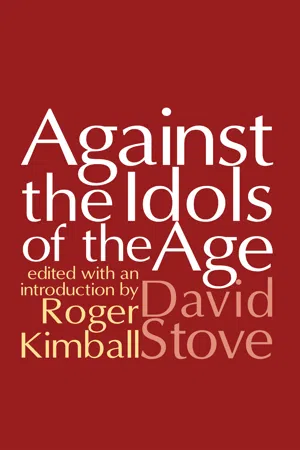
Against the Idols of the Age
About this book
Little known outside his native Australia, David Stove was one of the most illuminating and brilliant philo-sophical essayists of the postwar era. A fearless at-tacker of intellectual and cultural orthodoxies, Stove left powerful critiques of scientific irrationalism, Dar-winian theories of human behavior, and philosophi-cal idealism. He was also an occasional essayist of considerable charm and polemical snap. Stove's writ-ing is both rigorous and immensely readable. It is, in the words of Roger Kimball, "an invigorating blend of analytic lucidity, mordant humor, and an amount of common sense too great to be called 'common.'" Against the Idols of the Age brings together a repre-sentative selection of Stove's writing and is an ideal introduction to his work.The book opens with some of Stove's most impor-tant attacks on irrationalism in the philosophy of sci-ence. He exposes the roots of this fashionable attitude, tracing it through writers like Paul Feyerabend andThomas Kuhn to Karl Popper. Stove was a born controversialist, so it is not surpris-ing that when he turned his attention to contemporary affairs he said things that are politically incorrect. The topical essays that make up the second part of the book show Stove at his most withering and combative. Whether the subject is race, femi-nism, the Enlightenment, or the demand for "non-coercive philosophy," Stove is on the mark with a battery of impressive arguments expressed in sharp, uncompromis-ing prose. Against the Idols of the Age concludes with a generous sampling of his blistering attacks on Darwinism.David Stove's writings are an undiscovered treasure. Although readers may dis-agree with some of his opinions, they will find it difficult to dismiss his razor-sharp arguments. Against the Idols of the Age is the first book to make the full range of this important thinker available to the general reader.
Information
Part 1 The Cult of Irrationalism in Science
1 Cole Porter and Karl Popper: The Jazz Age in the Philosophy of Science
The world has gone mad to-day, And good's bad to-day ...
—Cole Porter, "Anything Goes"
Irrefutability is not a virtue of a theory, (as people often think) but a vice.
—Karl Popper, "Science: Conjectures and Refutations," in his Conjectures and Refutations: the Growth of Scientific Knowledge
I
IHAVE HEARD a Marxist "explain" Darwin's theory of sexual selection as being just a "reflection" of middle-class Victorian courtship practices. Nowadays, of course, this kind of thing is all the rage: I mean, pretending to explain the currency of a scientific theory, or a philosophy, by reference just to the historical circumstances of its origin, especially the "class-origins" of its propounder or adherents.
It is a stupid and discreditable business. To talk about Darwin as though he were some simple mechanical toy is discreditable, unless your mental powers happen to be much superior to his: a condition seldom satisfied by anyone, and never, one may safely say, by Marxists. In this particular case the business was so stupid as to be embarrassing, since it is well known that other middle-class Victorian naturalists, including some of the most Darwinian, denied the very existence of sexual selection. But the stupidity which is common to all such "explanations" is, of course, simply that of proceeding as though the merits of a theory—such things as truth, or probability, or explanatory power—could not possibly be among the reasons for its currency. Sometimes, of course, and to some extent, you do need to refer to social circumstances, in order to explain the currency or the origin of a theory. You are more likely to need to do so, obviously, the less merit the theory has. Lysenko's biology is a conspicuous case in science. And you are more likely to need to do so for a philosophy than for a scientific theory. Hegel's political philosophy is an obvious example. In either of these two instances, it would be absurd to deny that social circumstances had a great deal to do with the origin, and the currency, of the theory.
A similar instance is Sir Karl Popper's philosophy of science.
WE HAVE from Popper's own hand a brief but illuminating account of the social circumstances in which his philosophy was born.1 The place was Vienna, where Popper was a university student. The time was that great watershed of our century, the years immediately after the First World War. The social circumstances were—well, "the world turned upside down."
In Austria the defeat of the central powers brought about the overturning of authority in almost every form: political authority, moral and religious authority, financial authority. As the old structures dissolved almost overnight, Marxism, Anarchism, Freudianism, Dadaism—any -ism, so long as it promised a Great Reversal—competed, not only for the minds of the young, but for government. A bewildered bohemian, who had never controlled so much as a horse in his life, might wake to find the reins of office in his hands. Nor was the Austro-Hungarian empire the only one to crack up at this time. For the mind of the young Popper, the fall of another and far more soundly based empire was no less formative: I mean the Newtonian empire in physics. In art, Western Europe found that its anti-academy had become its academy "even in the twinkling of an eye." The galleries were suddenly full of the art of African societies formerly the most despised. Victorian architecture was all at once the object of a universal detestation, or rather horror. Black music began its long and excruciating revenge on the white man. The Jazz Age, in short, had arrived.
Cole Porter's words "Anything goes" are not quite right for this situation, though; for they suggest random change, or anarchy. He is nearer the mark with "day's night to-day," "good's bad today," and so on; for these words convey the idea of reversal rather than of random change. Of course it is often not easy to keep the two ideas separated in one's mind. Even the prophet Isaiah, when he says that "every valley shall be exalted, and every mountain and hill made low," is open to the suspicion of being not quite clear in his own mind as to whether he is promising us a plain, or only new mountains where valleys were before. Still, the two ideas really are distinct, and it is the idea of reversal, rather than that of random change, which is the key to the Jazz Age. It is also the key to Popper's philosophy of science.
THE DIFFERENCE between the propositions of science, on the one hand, and the speculations of philosophy, religion, and pseudoscience on the other, has always been felt strongly enough. But what exactly is the difference? According to longstanding philosophical tradition (as also according to common sense), the difference is that the propositions of science are verifiable. On this point even the Logical Positivists, who were certainly revolutionary enough in other respects (and who came to constitute Popper's main philosophical environment), agreed with everyone else. Very well then: Popper would say that the distinguishing mark of scientific propositions is that they are falsifiable.
The main stream of philosophy, at least since Bacon, had always maintained (and here again the Logical Positivists agreed) that the method of science is essentially inductive. We infer the future from the past, the unobserved (and perhaps unobservable) from what is observed, and in general the unknown from the known. Very well: Popper would maintain that we do not and cannot infer the unobserved from the observed; that in science we always infer the known from the unknown; that the method of science is entirely deductive.
Caution is of the essence of science, everyone used to say. So Popper said that audacity is of the essence of science, and that, of two theories equal in other respects, the bolder is the better.
Science was supposed to be distinguished from guesswork, and from everyday opinion, by the fact that its conclusions are certain, final, irrefutable. Newton's boast that he never meddled with hypotheses—"Hypotheses non fingo"—was supposed to express the scientific ideal. Well then, Popper would say that the conclusions of science are never more than guesswork, hypotheses, conjectures; that not meddling with hypotheses is an ideal impossible to achieve and pernicious even to aim at; and (as in the epigraph above) that irrefutability is not a virtue but a vice in a theory.
Conventional philosophy of science, in a more cautious variant, said that scientific conclusions are never actually certain, but have a vast preponderance of probability in their favor. So Popper said that no scientific conclusion can ever be probable; that no theory ever becomes even more probable, when evidence in its favor is discovered, than it was beforehand; and indeed that every scientific theory not only begins by being, but must always remain, infinitely improbable.
IT WOULD be easy to give still more examples, but the foregoing will probably suffice as a sample of central early-Popper opinions. In any case the reader, even if he was previously ignorant of Popperism, will by now have grasped its implicit rule, and can churn out other examples for himself, and for as long as that kind of thing amuses him. A Freudian might see, or imagine he sees, something more than adolescent revolt, something actually obsessive, in Popper's compulsion to reverse things. But at present I merely point out that the central parts of Popper's philosophy do all in fact exhibit this pattern. And I say nothing, here or elsewhere in this essay, about any part of Popper's philosophy which is either later or less central than the parts which have just been mentioned. My concern is only with central and early Popperism; for it was by that that "the West was won."
And won it was, with ridiculous ease. Indeed, the reception of a philosophy so congenial to the Jazz Age could never have been in doubt. Popper began to publish it in 1934, and his shocking reversals of received ideas were greedily taken up by an entire generation, almost faster than he could write them down. His own career flourished almost equally quickly. Having left Europe as a refugee a little before the Second World War, he was by the end of the war a Reader in, soon Professor of, Logic and Scientific Method at the University of London. By 1950 he was easily the most influential philosopher of science in the West. Thousands had undergone at his hands a "transvaluation of all values" which turned their inherited ideas of scientific virtues into vices, and vice versa: just as Cole Porter's song says.
Nor was it only philosophers who underwent the Popperite conversion experience. Far from it: a gospel so much in keeping with the spirit of the age could never have been confined to that tiny audience. Popper's philosophy of science reached almost the entire educated public. Most striking of all, it reached scientists themselves. Scientists almost always find what philosophers write about science either incomprehensible, or superficial, or ridiculous. But Popper's philosophy of science was modelled so closely on the history of science, and in particular on its twentieth-century history, that many scientists, on reading it, felt an agreeable "shock of recognition." Science as they knew it from the inside was far more like a series of "conjectures and refutations" than like that accumulation of certainties which was implied by the textbooks, and by old-fashioned histories of science. As a result, Popper's most ardent admirers came to include a number of Nobel prize winners in science, and even at the present day, if you scratch a scientist of middle age or older, you are almost certain to meet with a philosophy of science which consists of half-remembered scraps of Pop-perism (The idea that a theory is not scientific unless it is "refutable," is an especial favorite.) This is true fame, and other philosophers of science can only mournfully envy it.
Since 1950 Popper's fame has done nothing but increase. In philosophy he is now the acknowledged grand old man in Britain; the recipient of academic honors innumerable; a knight, a Companion of Honour, etc., etc. His pen has lost nothing of its former facility: if anything, the reverse. Gigantic volumes, interspersed with petits riens, still pour from his desk,2, and publishers, who know a good thing when they see it, will crawl over broken bottles to get their hands on them. No philosophical writer could possibly expect to arrive, in his own lifetime, at a situation more agreeable.
But that is only socially speaking. Intellectually speaking— that is, in the philosophy of science itself—the present situation must seem to Popper to be, as indeed it is, a "city of dreadful night." The reason is, that old story about Pandora's box, or the genie who refuses to go back into his bottle. It is one thing to start a revolution, in philosophy or anywhere else, and quite another to control it. The Jazz Age turned out to possess a hideous strength, which no one had foreseen, in philosophy as well as in music. And in the one case as in the other, the beginnings seem now to belong to an age of innocence almost inconceivably remote.
II
One of the few topics on which Popper did not see his way to a reversal of conventional opinions was mathematics. There, at least, the "accumulation-of-certainties" story seemed to be just plain right, and Popper had had to reconcile himself to agreeing, for once, with the Logical Positivists. In consequence, he had never had much to say about mathematics.
It was a bolt from the blue, therefore, though a very pleasant one, when one of his disciples appeared to extend the Popperite sway to this previously unconquered province. This was Imre Lakatos, who in 1963-4 published a long series of articles in which he documented, in microscopic detail, the vicissitudes which a particular geometrical proposition had undergone in the eighteenth and nineteenth centuries: vicissitudes of refutation, qualification, refutation again, re-interpretation, refutation yet again. . . .3 The effect of these articles was sensational at first. Mathematics, it turned out, was just as much a matter of "conjectures and refutations" as empirical science! It must have been music to Popper's ears. What master could resist an industrious apprentice who showed that he was even more right, or right over an even wider area, than he himself had realized? In 1969, when the time came for Popper to retire from the London chair, Lakatos got the job.
Yet his gift to Popper was but a Greek one after all, and might have been detected as such even at the time. The propositions of mathematics are of a fundamentally different nature from those of empirical science, and are known in a different way: so most philosophers have always believed, and so most of them found themselves still believing, when the initial impact of Lakatos's articles had worn off. If the history of mathematics is not basically different from the history of empirical science, then that only shows—this was the longer-term reaction, and was bound to be so—that history is one thing, and philosophy, whether of mathematical or empirical science, is quite another. Popper's critics had all along accused him, and with good cause, of drowning the philosophy in the history of science: of pretending to resolve questions of logical value by appealing to matters of historical fact. The sole long-term effect, therefore, of Lakatos's rash venture into mathematics was to add irresistible weight to this old criticism. It was the Sicilian Expedition of Popperism: intended to add a mighty new province to the empire, it fatally recoiled on the seat of empire itself.
Popper was not long in concluding that, both intellectually and personally, he had taken a viper to his bosom. Once safely installed in his chair, Lakatos turned his attention to empirical science, and did not leave his master's doctrine there undisturbed. He did not deny—no one has ever denied—the elementary asymmetry which Popper, with "a damnable iteration," had insisted upon: that while "All crows are black," say, cannot be verified by any number of black crows, a single crow of any other color suffices to falsify it. Lakatos merely insisted—and Popper was in no position to question the relevance of this—that in the history of actual science, such neat and decisive falsifications never in fact occur. Nor could they, Lakatos argued. Popper had said that Marxism, Freudianism, astrology, etc., are pseudosciences, because their central propositions are "unfalsifiable": that is, consistent with every report of an actual or possible observation. But then, Lakatos pointed out, Newtonian physics too is unfalsifiable in that sense; and so is every other typical scientific theory.
This is true, and it was "a very palpable hit." But it also left Lakatos with a daunting task, by way of reconstructing Pop-perite philosophy of science. For Lakatos, it must be understood, remained at bottom a loyal enough Popperite. (I do not mean loyal enough to satisfy Popper: no one is that.) He could never bring himself to question the basic tenets of the school, such as the worthlessness of induction. He was also resolved, again like Popper, to model his philosophy of science on the actual history of science; only he would be more faithful to history than Popper had been. Within these two Popperite constraints—fidelity to "hypothetico-deductivism" and to the history of science—Lakatos faced the task of distinguishing good science from bad: but even before that, and more urgently, he faced the task of distinguishing between science and non-science. For without this there would be, obviously, nothing to distinguish a Karl Popperish philosophy of science from a Cole Porterish one, according to which anything goes.
The result was Lakatos's theory of research programs. I will not enter into any details about this. When every allowance has been made for its author's early death, it must be said that, as an answer to either of the two questions which Lakatos had set himself, this theory is extraordinarily unconvincing. It does not appear to have convinced even Lakatos himself. To the question, "What distinguishes science from other things?," Popper had given an answer which, however wide of the mark, was at least definite. Lakatos's answer is hopelessly indefinite, or rather he gives no answer at all. The question is a philosophical one, but Lakatos, in his attempt to answer it, loses both himself and his readers in impenetrable thickets of detailed history of science. Worse still, he confesses that in some instances he has simply made up the historical details himself: a proceeding which manages to be scandalous and pointless at the same time.
Not that it would have mattered much anyway; for even while he wrote, Lakatos had been outflanked on the philosophical left by an historian of science far more formidable than himself. Thomas Kuhn is an American who made a great reputation by his early study of the Copernican revolution in astronomy. He was never a Popperite dévot. (Popperism is almost exclusively a, or...
Table of contents
- Cover Page
- Half title
- Title Page
- Copyright Page
- Who was David Stove? by Roger Kimball
- Part 1 The Cult of Irrationalism in Science
- 1 Cole Porter and Karl Popper: The Jazz Age in the Philosophy of Science
- 2 Sabotaging Logical Expressions
- 3 Paralytic Epistemology, Or the Soundless Scream
- Part 2 Idols Contemporary and Perennial
- 4 D'Holbach's Dream: The Central Claim of the Enlightenment
- 5 “Always apologize, always explain”: Robert Nozick’s War Wounds
- 6 The Intellectual Capacity of Women
- 7 Racial and Other Antagonisms
- 8 Idealism: A Victorian Horror-story (Fart Two)
- Part 3 Darwinian Fairytales
- 9 Darwinism's Dilemma
- 10 Where Darwin First Went Wrong About Man
- 11 Genetic Calvinism, or Demons and Dawkins
- 12 He Ain't Heavy, He's my Brother or, Altruism and Shared Genes
Trusted by 375,005 students
Access to over 1.5 million titles for a fair monthly price.
Study more efficiently using our study tools.
Frequently asked questions
Yes, you can cancel anytime from the Subscription tab in your account settings on the Perlego website. Your subscription will stay active until the end of your current billing period. Learn how to cancel your subscription
No, books cannot be downloaded as external files, such as PDFs, for use outside of Perlego. However, you can download books within the Perlego app for offline reading on mobile or tablet. Learn how to download books offline
Perlego offers two plans: Essential and Complete
- Essential is ideal for learners and professionals who enjoy exploring a wide range of subjects. Access the Essential Library with 800,000+ trusted titles and best-sellers across business, personal growth, and the humanities. Includes unlimited reading time and Standard Read Aloud voice.
- Complete: Perfect for advanced learners and researchers needing full, unrestricted access. Unlock 1.5M+ books across hundreds of subjects, including academic and specialized titles. The Complete Plan also includes advanced features like Premium Read Aloud and Research Assistant.
We are an online textbook subscription service, where you can get access to an entire online library for less than the price of a single book per month. With over 1.5 million books across 990+ topics, we’ve got you covered! Learn about our mission
Look out for the read-aloud symbol on your next book to see if you can listen to it. The read-aloud tool reads text aloud for you, highlighting the text as it is being read. You can pause it, speed it up and slow it down. Learn more about Read Aloud
Yes! You can use the Perlego app on both iOS and Android devices to read anytime, anywhere — even offline. Perfect for commutes or when you’re on the go.
Please note we cannot support devices running on iOS 13 and Android 7 or earlier. Learn more about using the app
Please note we cannot support devices running on iOS 13 and Android 7 or earlier. Learn more about using the app
Yes, you can access Against the Idols of the Age by David Stove in PDF and/or ePUB format, as well as other popular books in Philosophy & Epistemology in Philosophy. We have over 1.5 million books available in our catalogue for you to explore.