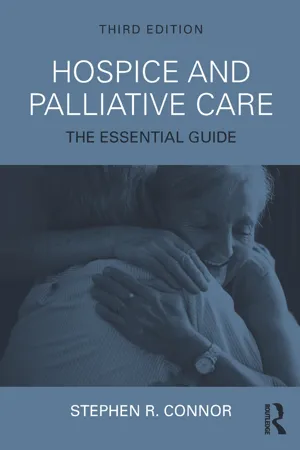
The third edition of Hospice and Palliative Care is the essential guide to the hospice and palliative care movement both within the United States and around the world. Chapters provide mental-health and medical professionals with a comprehensive overview of the hospice practice as well as discussions of challenges and the future direction of the hospice movement. Updates to the new edition include advances in spiritual assessment and care, treatment of prolonged and complicated grief, provision of interdisciplinary palliative care in limited-resource settings, significant discussion of assisted suicide, primary healthcare including oncology, and more. Staff and volunteers new to the field along with experienced care providers and those using hospice and palliative care services will find this essential reading.
- 290 pages
- English
- ePUB (mobile friendly)
- Available on iOS & Android
eBook - ePub
About this book
Information
CHAPTER 1
What Are Hospice and Palliative Care?
What is the meaning of the word hospice and the word palliative? Many believe a hospice is a place where people die. Others simply associate the word with death and feel uncomfortable. Those who have used hospice and palliative care think of them as caregiving in the finest tradition: care that is both competent and compassionate—care provided to people facing death by people unafraid to face death.
In truth, hospice and palliative care is this and much much more. The word hospice comes from the Latin word hospitium, meaning hospitality, and from the old French word hospes, or host. Webster’s defines hospice as a shelter or lodging for travelers, children, or the destitute, often maintained by a monastic order. Today, it is used to describe a program of care for individuals and their families facing a life-limiting illness. The National Hospice and Palliative Care Organization (NHPCO, 2000) describes hospice and palliative care thus:
Hospice provides support and care for persons in the last phases of an incurable disease so that they may live as fully and as comfortably as possible. Hospice recognizes that the dying process is a part of the normal process of living and focuses on enhancing the quality of remaining life. Hospice affirms life and neither hastens nor postpones death. Hospice exists in the hope and belief that through appropriate care, and the promotion of a caring community sensitive to their needs that individuals and their families may be free to attain a degree of satisfaction in preparation for death. Hospice recognizes that human growth and development can be a lifelong process. Hospice seeks to preserve and promote the inherent potential for growth within individuals and families during the last phase of life. Hospice offers palliative care for all individuals and their families without regard to age, gender, nationality, race, creed, sexual orientation, disability, diagnosis, availability of a primary caregiver, or ability to pay.
Hospice programs provide state-of-the-art palliative care and supportive services to individuals at the end of their lives, their family members, and significant others, 24 hours a day, seven days a week, in both the home and facility-based care settings. Physical, social, spiritual, and emotional care are provided by a clinically directed interdisciplinary team consisting of patients and their families, professionals, and volunteers during the:
1. last stages of an illness;
2. dying process; and
3. bereavement period.
The National Hospice and Palliative Care Organization (NHPCO) defines palliative care as treatment that enhances comfort and improves the quality of an individual’s life during the last phase of life. No specific therapy is excluded from consideration. The test of palliative care lies in the agreement between the individual, physician(s), primary caregiver, and the interdisciplinary team that the expected outcome is relief from distressing symptoms, the easing of pain, and enhancing the quality of life. The decision to intervene with active palliative care is based on an ability to meet stated goals rather than affect the underlying disease. An individual’s needs must continue to be assessed and all treatment options explored and evaluated in the context of the individual’s values and symptoms. The individual’s choices and decisions regarding care are paramount and must be followed at all times (p. iii).
The word palliative to describe care for the dying was originally used by Dr. Balfour Mount at the Royal Victoria Hospital in Montreal, Quebec in 1976. The word hospice in French is understood to mean “home for the destitute” and was seen as an unacceptable term in Francophone Quebec. The word palliate originates from the Greek and translates as “to cloak,” meaning that when we care for the dying, our interventions are meant to cloak or to prevent seeing or experiencing pain or other distressing symptoms.
The World Health Organization definition of palliative care for adults and for children (WHO, 1998) stresses that palliative care should start from the diagnosis of a life threatening illness:
WHO Definition of Palliative Care:
Palliative care is an approach that improves the quality of life of patients and their families facing the problem associated with life-threatening illness, through the prevention and relief of suffering by means of early identification and impeccable assessment and treatment of pain and other problems, physical, psychosocial and spiritual. Palliative care:• provides relief from pain and other distressing symptoms;• affirms life and regards dying as a normal process;• intends neither to hasten or postpone death;• integrates the psychological and spiritual aspects of patient care;• offers a support system to help patients live as actively as possible until death;• offers a support system to help the family cope during the patients illness and in their own bereavement;• uses a team approach to address the needs of patients and their families, including bereavement counselling, if indicated;• will enhance quality of life, and may also positively influence the course of illness;is applicable early in the course of illness, in conjunction with other therapies that are intended to prolong life, such as chemo therapy or radiation therapy, and includes those investigations needed to better understand and manage distressing clinical complications.
WHO Definition of Palliative Care for Children:
Palliative care for children represents a special, albeit closely related field to adult palliative care. WHO’s definition of palliative care appropriate for children and their families is as follows; the principles apply to other pediatric chronic disorders.• Palliative care for children is the active total care of the child’s body, mind and spirit, and also involves giving support to the family.• It begins when illness is diagnosed, and continues regardless of whether or not a child receives treatment directed at the disease.• Health providers must evaluate and alleviate a child’s physical, psychological, and social distress.• Effective palliative care requires a broad multidisciplinary approach that includes the family and makes use of available community resources; it can be successfully implemented even if resources are limited.• It can be provided in tertiary care facilities, in community health centres and even in children’s homes.
There has been much discussion about the need to improve these definitions particularly to clarify that there should not be a prognostic limitation to hospice or palliative care, that chronic as well as acute illness should be included, and that no treatments limitations should be applied.
THE HOSPICE PALLIATIVE CARE MOVEMENT
Why is there a hospice palliative care movement? Throughout the twentieth century, modern medicine has transformed the experience of dying from a part of daily life to a highly technological event. Before the widespread use of antibiotics following the Second World War, people died at a younger age and with less forewarning. Physicians could do little but visit and attend to the dying by relieving their suffering. People were less apt to be rushed to the hospital, and they convalesced at home with the help of their families.
After the Second World War, great advances were made in the science of medicine. Many pharmaceutical agents were developed to treat ill ness and infection, and techniques and equipment were invented to ward off the dying process. A seemingly unconscious goal was the elimination of death. Dying patients were not acknowledged. People died in institutions, not at home. They did not die; they “expired.” They had to be kept alive at all costs; to do less was a failure. The wife of one of my patients responded to a nurse, who wanted to discuss what to do when her husband “expired,” by saying, “If he is expired, can I get him renewed?”
Many health care professionals were frustrated in this climate. Many family members of the dying were angry at the way that care was depersonalized. Physicians, nurses, psychologists, and social workers were not trained to care for the dying. Most were uncomfortable with the notion. They tended to visit dying patients less often; unrealistic optimism led to a “conspiracy of silence,” where the family and medical staff knew the truth, but withheld it from the patient (Glaser & Strauss, 1965). There was a widespread belief that to tell a patient she or he was dying would cause harm and lead to premature demise. Patients were expected to follow physicians’ recommendations without question. If death occurred, it was an unintended event.
In this atmosphere of denial, many caregivers were dissatisfied. There had to be a better way to treat the dying. The United States and Western Europe in the 1970s were undergoing rapid social change. Most institutions were being challenged, and people were experimenting with new ways to solve old problems. Cancer patients were demanding more participation in treatment decisions, and support groups were being formed to give information and counseling. Those involved in treating dying patients began hearing about a new approach to care being used in the United Kingdom called hospice.
BRIEF HISTORY
It is generally held that the first hospices were established in the eleventh century by the Crusaders. Until that time, incurable patients were not admitted to places of healing. Their presence was viewed as a detriment to the healing process of others. The first hospices were places where travelers to and from the Holy Land were cared for and refreshed. Travelers as well as the sick and the dying were cared for. The Knights Hospitallers of St. John of Jerusalem founded a way station in Jerusalem for sick and weary pilgrims, but were forced by the Crusades to move on to Tyre, and then to Acre, and eventually to the island of Cyprus.
The Hospitallers were recognized by the pope as a military order in 1113 and gained support carrying pilgrims to and from the Holy Land. In 1309, they stormed Rhodes and held it for two centuries. It was here that they founded a hospice hospital that cared for the sick, for travelers, and for incurables. The knights developed a special tradition of caring for “our lords the sick and dying.” They were treated royally with great dignity and the finest foods, linens, and treatments the order could offer. The knights themselves, having taken a vow of poverty, dined on plainer fare and were under strict orders forbidding any mistreatment. Their spiritual foundations were nourished by their work tending to the sick and dying.
The hospice tradition of the Middle Ages passed into history. It was reborn in the seventeenth century through the efforts of St. Vincent de Paul, who founded the Sisters of Charity in Paris. The sisters opened a number of houses to care for orphans, the poor, the sick, and the dying. The Irish Sisters of Charity founded Our Lady’s Hospice for care of the dying in Dublin. In 1900, the Irish Sisters founded a convent in London’s East End. Their ministry included visiting the sick in their homes. In 1902, they founded St. Joseph’s Hospice for the dying poor in London. More than 50 years later, Cicely Saunders came to work there and developed her approaches to managing total pain and the total needs of dying patients. Her philosophy of using a team to treat the whole person has become the foundation for hospice care throughout the world.
Dame Saunders, who trained first as a nurse, then as a social worker, and finally as a physician, envisioned a center for excellence in care of the dying patient. This center included teaching and research facilities. In 1967, she opened St. Christopher’s Hospice outside London in Sydenham. As matriarch of the worldwide hospice movement, she inspired caregivers to carry on her mission of caring for the dying.
St. Christopher’s continues today to carry out its mission of caring for the neighboring communities and as a beacon for hospice development worldwide. The research and education center has continued to promote improvement in palliative care and to share knowledge of palliative care gained from 50 years of experience.
HOSPICE AND PALLIATIVE CARE IN NORTH AMERICA
Hospice first came to North America in 1971. Hospice Inc., in New Haven, Connecticut, was founded by Florence Wald, dean of nursing at Yale University, along with others. Wald was inspired by a lecture at Yale in 1963 given by Dame Saunders as part of a six-week tour of the U.S. Cicely Saunders was quickly developing a lot of contact Stateside and there were further visits in 1965 and 1966, before St. Christopher’s opened (Clark, 2001). A hospice home care service began in New Haven in 1973. By 1980, Hospice Inc. had opened a 44-bed inpatient facility in Branford, Connecticut, exclusively for the care of dying patients. In the mid-1970s, a small but committed hospice movement had begun to take shape throughout the United States and Canada. From Marin, Monterey, and Fresno in California to Tucson, Arizona; to Boonton, New Jersey; to Montreal, Quebec, Canada; and to St. Luke’s and Calvary Hospital in New York, various models of hospice care were being tested.
The National Hospice Organization was founded in 1978 and began holding annual educational conferences. The first national directory of hospices was published in 1978, and by 1980 there were 138 provider members listed. The U.S. hospice movement had a slant distinctly toward home care. Most Americans surveyed showed a preference for dying in their homes. There was a greater emphasis on use of volunteers and more focus on psychological preparation for death than in English hospices.
In the early years of the American hospice movement, reimbursement for hospice care was limited to payment for components of care such as acute hospitalization and home health agency services. In 1982, hospice care was added as a Medicare benefit. This benefit eventually encouraged tremendous growth in the number of patients served by hospices and brought some standardization to the types of services a hospice could deliver.
The most recent in-depth census data on hospices from the NHPCO revealed that in 2014 there were about 6,100 unique locations delivering hospice care. There were about 4,100 companies or organizations providing hospice care with around 2,000 satellite locations. Satellite locations are multiple locations operated by the same company. Given that there were a total of about 3,100 hospice locations in 1998, that is over 50 percen...
Table of contents
- Cover
- Half Title
- Title Page
- Copyright Page
- Dedication
- Table of Contents
- Preface
- Acknowledgments
- 1 What Are Hospice and Palliative Care?
- 2 The Interdisciplinary Team
- 3 Symptom Management and Physical Care
- 4 Psychosocial and Spiritual Care
- 5 Grief and Bereavement
- 6 Community, Public, and Professional Education
- 7 Hospice and Palliative Care Leadership
- 8 Hospice and Palliative Care in the U.S. Health Care System
- 9 How Palliative Care Is Unique in the Health Care System
- 10 How Good Are Hospice and Palliative Care?
- 11 A Right to Die?
- 12 Hospice and Palliative Care Around the World
- 13 The Future of Hospice and Palliative Care
- Appendix 1: Discussion Questions and Activities by Chapter (updated)
- Appendix 2: Organizational References (updated)
- References
- Index
Trusted by 375,005 students
Access to over 1.5 million titles for a fair monthly price.
Study more efficiently using our study tools.
Frequently asked questions
Yes, you can cancel anytime from the Subscription tab in your account settings on the Perlego website. Your subscription will stay active until the end of your current billing period. Learn how to cancel your subscription
No, books cannot be downloaded as external files, such as PDFs, for use outside of Perlego. However, you can download books within the Perlego app for offline reading on mobile or tablet. Learn how to download books offline
We are an online textbook subscription service, where you can get access to an entire online library for less than the price of a single book per month. With over 1.5 million books across 990+ topics, we’ve got you covered! Learn about our mission
Look out for the read-aloud symbol on your next book to see if you can listen to it. The read-aloud tool reads text aloud for you, highlighting the text as it is being read. You can pause it, speed it up and slow it down. Learn more about Read Aloud
Yes! You can use the Perlego app on both iOS and Android devices to read anytime, anywhere — even offline. Perfect for commutes or when you’re on the go.
Please note we cannot support devices running on iOS 13 and Android 7 or earlier. Learn more about using the app
Please note we cannot support devices running on iOS 13 and Android 7 or earlier. Learn more about using the app
Yes, you can access Hospice and Palliative Care by Stephen R. Connor in PDF and/or ePUB format, as well as other popular books in Medicine & Public Health, Administration & Care. We have over 1.5 million books available in our catalogue for you to explore.