eBook - ePub
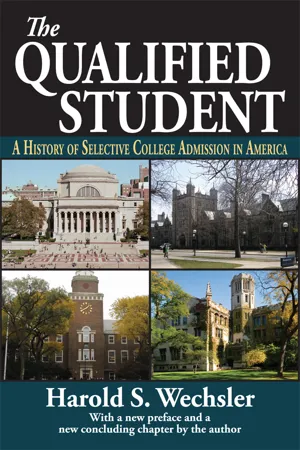
The Qualified Student
A History of Selective College Admission in America
- 422 pages
- English
- ePUB (mobile friendly)
- Available on iOS & Android
eBook - ePub
About this book
In The Qualified Student Harold S. Wechsler focuses on methods of student selection used by institutions of higher education in the United States. More specifically, he discusses the way that college and university reformers employed those methods to introduce higher education into a broader cross-section of America, by extending access to an increased number of students from nontraditional backgrounds. Implicit in much of this book is an underlying social and ethical question: How legitimate was and is higher education's regulation of social mobility? Public concern over colleges' and universities' practices became inevitable once they became regulators between social classes. The challenging of colleges' admissions policies in the courts augments similar concerns that have been present in legislatures for decades. The volume is divided into three main sections: Prerequisites, Columbia and the Selective Function, and Implications. It focuses mainly on four universities, The University of Michigan, Columbia University, the University of Chicago, and the City University of New York. Wechsler maintains that unlike other universities, these institutions were pacesetters; they did not adopt a new policy simply because some other college had already adopted it. A new introduction brings the book, originally published in 1977, up to date and demonstrates its continuing importance in today's academic world of selective admissions.
Information
Part I
Prerequisites
1
Admission to College and University
The Committee on Admissions of the college, after careful consideration of your application, regrets to inform you that it cannot offer you a place in our entering class next fall. … This year the number of qualified applicants far exceeded the number of places available in the Freshman Class, and it was inevitable that many students who were qualified for admission could not be accepted.
A typical rejection letter
The rejection letter is symbolic of higher education’s important role in contemporary society. The competition for higher education and the certification it brings is so keen that, as the letter implies, this college can be highly selective about whom it admits. Admissions officers and committees continually make decisions about the kinds of men and women who will occupy key positions in American society years hence.
Many modern rejection letters further imply that educational qualification is only one of several criteria employed in determining the composition of each entering class. Age, sex, geographic origin, race, religion, family background, personality, and participation in extracurricular activities are other criteria that have been or are considered relevant in determining the success of an application.
The mechanism of selective admission, in which admissions officers employ both academic and nonacademic criteria, evolved only after World War I. Throughout the nineteenth century and into the twentieth most American colleges admitted students on the basis of straightforward, published entrance requirements.1 All students who could demonstrate acceptable mastery of the requirements were admitted; those who just missed were admitted conditionally; those who fell far short were sent home.2 Students in this last category did not even receive the courtesy of a rejection letter; instead the names of admitted and rejected students were often posted on the college’s main door after all applicants completed their entrance examinations.
This book discusses how the modern rejection letter came to be written. The story begins at a time when most colleges were not at all selective in choosing their student bodies.
Admission to the Old Time College
Thirty or forty years ago historians who examined the development of American higher education during the first half of the nineteenth century emphasized its gradual response to the pressures of an egalitarian society and its eventual triumph over the legacy of aristocratic eighteenth century institutions. They examined modifications of an admittedly stale and prescribed undergraduate curriculum suggested by innovators such as Thomas Jefferson at the University of Virginia, Philip Lindsley at the University of Nashville, Eliphalet Nott at Union College, Henry Tappan at the University of Michigan, George Ticknor at Harvard College, and Francis Wayland of Brown University. Applauding advances such as the introduction of scientific courses parallel to the dominant classical course, these historians painted an essentially optimistic picture of increased congruence between college and society.3 Revisionist scholarship during the 1950s and 1960s seriously challenged this approach. Historians such as Richard Hofstadter emphasized the increased dominance of educational conservatives and argued that the typical old time college had in fact retrogressed from its eighteenth century predecessors. Its faults, Hofstadter said, did not result from its concentration on the classics per se, “for just such a curriculum had long contributed enormously to the rearing of the best minds in Western society.” According to Hofstadter, the real problem was “that it trained no good classicists, that it reduced the study of classics to grammar and linguistics, that it usually failed to convey the spirit of the cultures of antiquity, that it often failed, indeed, even to teach very much Latin.” Even more fundamentally, its problems stemmed not from the curriculum but from the instructional method. The recitation system, in which students memorized a text or translation while the instructor merely checked on the correctness of the student’s verbal regurgitation, “dulled the minds of students and blunted the edge of faculty scholarship; and such well-educated students as the colleges turned out were usually triumphs of the human spirit over bad methods.”4
Most recently, a third generation of historians has again reexamined the old time college and pronounced still another, but less clear-cut verdict. In examining data concerning student characteristics at several nineteenth century New England colleges, David F. Allmendinger, Jr. suggests that they may not have been the drab, isolated places previous historians thought they were. Many students mixed freely with members of the surrounding community, and the colleges themselves were closely integrated into their communities’ cultural and economic existence. In addition, Allmendinger attributes to these colleges important social functions—they provided an important alternative for socially mobile students who wanted neither to move west nor to remain on the farm.5
On several significant aspects of these colleges, however, representatives of the various historical schools can hardly disagree. First, the typical old time college was small. Richard Hofstadter commented that as late as 1839 Randolph-Macon’s 98 students typified the enrollment of the average
American college, while Kenyon and Waterville (later Colby), each with their 55 students, constituted the modal college. Dartmouth College’s 321 students made it the second largest American college, after Harvard.6 Next, the majority of these colleges had a strong religious ethos. In the mid-nineteenth century frequent evangelical revivals and town boosterism led to the rapid multiplication of institutions calling themselves colleges. Such schools did not intend to foster the growth of intellect; rather, they assured parents of a proximate institution that would inculcate a “safe” version of Christian dogma. A number of states established state universities, which sectarian interests denounced as “Godless” while they simultaneously attempted to control them.7 The typical eighteenth century college had been established on the principle of toleration, that is, “nondiscrimination against students and professors of various Protestant denominations [along with] preferment for the denomination of the college founders, that is, those who had founded and sponsored the college and who, more often than not, constituted a majority on the college’s governing board.”8 During the nineteenth century such institutions were gradually replaced by colleges that either supported the teachings of a single denomination or (eventually) espoused a secular rationale.
Third, most colleges were locally oriented. They served a constituency within a small radius and opportunities for college preparation were limited. Typically, a student studied for college either under a private instructor’s tutelage (a local minister or a graduate of the college might volunteer his services), or at a local academy. Such academies probably provided the “secondary” education for most of those nineteenth century Americans who obtained it. The quality and scope of their offerings varied widely. Some offered education little more advanced than that found at the neighboring common (primary) schools; others offered education more advanced than that of nearby “colleges.” Many gave professional and vocational courses, areas largely ignored by the colleges. Only a minority attempted to adjust their curricula to achieve articulation (linkages) with other educational institutions. However, this minority, along with the preparatory departments operated by many colleges, prepared many if not most of those who did attend the nineteenth century college.9 As the century progressed, public high schools assumed a greater share of the college preparatory function.10
The preparatory agent, whatever its form, “fitted” the student for the specific requirements of a local institution, thereby ignoring the difference in entrance requirements existing among most colleges at this time. If a student did not pass the exams of the college for which he had prepared, he could try again at some later date, request his tutor or academy to prepare him for the college of his second choice, seek out another instructor, or give up.
An example of this process may be found in the preparation of Horace Mann, the educational reformer, for admission to Brown early in the nineteenth century. For the youthful Mann, nearby Brown appeared to be a desirable alternative to the prospect of continued back-breaking farm life in his home town of Franklin, Massachusetts. Being alienated from his local minister who usually prepared Franklin boys for Brown’s entrance examinations, Mann attempted to master the required Greek and Latin classics on his own. After a year, he enlisted the help of an itinerant schoolmaster who coached him on the Latin sources and on the Greek Testament. The Reverend William Williams, a Baptist preacher in a neighboring town, instructed Mann in mathematics. Mann was one of dozens of boys Williams helped prepare for admission to his alma mater.11
Many colleges, especially those not blessed with neighboring preparatory agencies, established their own in the form of college preparatory departments. Such departments sometimes aroused faculty resentment on the grounds that they had been recruited to offer college level instruction. Their persistence can be attributed to their fulfillment of an important need. Proximity did not imply articulation; an academy may not have had the resources to prepare a small number of students for a nearby college, and may in fact have viewed itself as that college’s competitor. From the colleges’ point of view, it did not make sense to permit outside institutions to prepare students and thus to receive those students’ precious tuition dollars. Although most colleges phased out their preparatory departments by the end of the century, the need for tuition dollars had a continued effect on the mastery levels set for entrance.
Tuition was, in fact, the fourth and last important characteristic of the old time college. Tuition formed a large proportion of the college’s income, since private endowments and public appropriations usually proved highly inadequate. Because the incremental cost of educating an additional student was low relative to the fixed costs (salaries, building maintenance, etc.), the student body’s size had a direct bearing on the college’s financial solvency. Colleges competed with one another as well as with some academies for the students who wished advanced education. Thus, college presidents and boards of trustees determined tuition rates by balancing financial needs with the need to attract potential students away from competitors. Similarly, they determined the mastery level for college admission by balancing these needs with a desire to maintain a certain quality of education.12 To most nineteenth century college presidents, these comprised the main factors that seemed relevant to an admissions policy.
Just before the start of the fall semester, the prospective freshman of a typical old time college appeared at a stated time in the office of the college president. He would be questioned by the president and perhaps by some faculty members on his previous studies in Greek, Latin, and mathematics. The decision to admit a student with or without conditions or to reject him entirely was determined by the quality of his answers, the college’s financial picture, and not infrequently on the kindliness of a faculty member. Again Horace Mann’s example is instructive. In the fall of his twentieth year, Mann presented himself for examination before Brown’s president, Asa Messer. Messer, says Mann’s biographer Jonathan Messerli, “examined him on the Greek Testament, attempting to be helpful, choosing selections which Mann had most recently reviewed.” This completed, two faculty members joined them and requested Mann to translate selections from Vergil and Cicero. Finally Mann translated an English paragraph into correct Latin prose. After presenting letters attesting to his good moral character, Mann left the room. The young man’s impressive performance on the examinations and Brown’s unusual need for students in the aftermath of the War of 1812 prompted Messer to admit Mann to sophomore standing.13
One wonders whether these entrance examinations proved more or less traumatic than those given to late nineteenth century applicants. Gradually, as the colleges required additional subjects for admission, more and more of them switched to written entrance examinations. These may have been somewhat less formidable to the student than the battery of oral proficiency tests they replaced, but the relative impersonality of the newer system may very well have worked against many candidates, and the increase in required subjects meant that the ordeal was spread out over several days. Whatever their relative traumas, all nineteenth century college aspirants probably could have thought of many ways in which they would have rather spent their time.
The twentieth century practices of limiting enrollment to a fraction of the academically qualified candidates and of rejecting some students with superior academic qualifications in favor of others with more desirable nonacademic attributes were inconceivable to the old time college president. Such luxuries were reserved for the modern college and university.
Higher Education in a Changing Society
Many commentators have noted that most communities experience a major disruption in the course of their modernization. Although the terminology and even the definitions of the “before” and “after” stages vary (Tonnies’s Gemeinsc...
Table of contents
- Cover
- Half Title
- Title
- Copyright
- Dedication
- Contents
- Preface to the Transaction Edition
- Preface to the First Edition
- Acknowledgments
- Part I: Prerequisites
- Part II: Columbia and the Selective Function
- Part III: Implications
- Bibliography
- Index
Trusted by 375,005 students
Access to over 1.5 million titles for a fair monthly price.
Study more efficiently using our study tools.
Frequently asked questions
Yes, you can cancel anytime from the Subscription tab in your account settings on the Perlego website. Your subscription will stay active until the end of your current billing period. Learn how to cancel your subscription
No, books cannot be downloaded as external files, such as PDFs, for use outside of Perlego. However, you can download books within the Perlego app for offline reading on mobile or tablet. Learn how to download books offline
Perlego offers two plans: Essential and Complete
- Essential is ideal for learners and professionals who enjoy exploring a wide range of subjects. Access the Essential Library with 800,000+ trusted titles and best-sellers across business, personal growth, and the humanities. Includes unlimited reading time and Standard Read Aloud voice.
- Complete: Perfect for advanced learners and researchers needing full, unrestricted access. Unlock 1.5M+ books across hundreds of subjects, including academic and specialized titles. The Complete Plan also includes advanced features like Premium Read Aloud and Research Assistant.
We are an online textbook subscription service, where you can get access to an entire online library for less than the price of a single book per month. With over 1.5 million books across 990+ topics, we’ve got you covered! Learn about our mission
Look out for the read-aloud symbol on your next book to see if you can listen to it. The read-aloud tool reads text aloud for you, highlighting the text as it is being read. You can pause it, speed it up and slow it down. Learn more about Read Aloud
Yes! You can use the Perlego app on both iOS and Android devices to read anytime, anywhere — even offline. Perfect for commutes or when you’re on the go.
Please note we cannot support devices running on iOS 13 and Android 7 or earlier. Learn more about using the app
Please note we cannot support devices running on iOS 13 and Android 7 or earlier. Learn more about using the app
Yes, you can access The Qualified Student by Harold S. Wechsler in PDF and/or ePUB format, as well as other popular books in Education & Education General. We have over 1.5 million books available in our catalogue for you to explore.