eBook - ePub
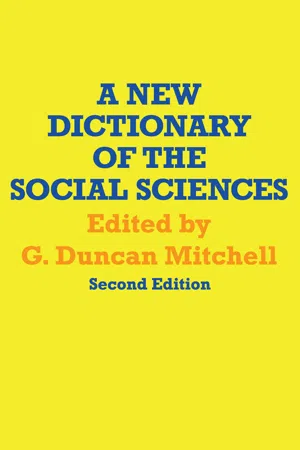
A New Dictionary of the Social Sciences
- 252 pages
- English
- ePUB (mobile friendly)
- Available on iOS & Android
eBook - ePub
A New Dictionary of the Social Sciences
About this book
Designed especially to meet the needs of beginners in all the social sciences, "A New Dictionary of the Social Sciences" follows its highly successful distinguished predecessor initially issued as "A Dictionary of Sociology" first published in 1968. Many of the entries have been revised and updated to keep abreast of the proliferation in the vocabulary of the social sciences. The volume remains on excellent single source for definitions in social research. The entries include social psychological terms, terms in social and cultural anthropology, terms common to political science, social administration and social work. In the choice of words, a generous definition of social science was employed, making the dictionary a very useful reference source for all beginners in the social sciences. Some terms are explained quite briefly while others are given lengthy treatment, according to the further assumptions that some sociological terms can imply. Thus, long entries are given on words, such as authority, consensus, phenomenology, role, social stratification, structuralism, whereas short and succinct entries suffice for words such, as agnate, eidos, or mores. A number of short biographical sketches are also included. The contributors are all scholars working in universities, predominantly in the United Kingdom and the United States. More than a glossary, "A New Dictionary of the Social Sciences" helps the student understand some of the theoretical considerations underlying the use of sociological terms, as well as something of their history, and therefore resembles an encyclopaedia in its scope and depth of information.
Information
S
sacrifice. W. Robertson Smith and E. E. Evans-Pritchard, in their writings on sacrifice, represent what appears to be two fundamentally opposed views. The former placed overwhelming emphasis on the commensality of the sacrificial meal; the latter relegates this meal to a place of peripheral significance, and he argues that sacrifice (which, like Robertson Smith, he sees as central to religion) must be understood in terms of the relationship between man and something which lies right outside his society. Both scholars, in fact, include religious beliefs and their social concomitants in their analyses. Neither attempt to pass off sacrifice as magic : when a person sacrifices for rain it is not expected that the act will, of itself, magically precipitate a cloud-burst, since what is implied by a failure of the rains is that the relationship between God and his people has been disturbed, and this is made manifest by some disruption in the natural order of man’s relationship to man and to nature. But since a disturbance in a mystical relationship has occurred it has social consequences, and since sacrifice is concerned with the restoration of mystical relationships, it is concerned with the relationships between human beings as well. When, therefore, a sacrifice takes place, it does something to social relationships, in the sense that participants gather together for a specific purpose. A life, in animal or symbolic form, is offered as a surrogate for an individual or a group, but in either case it is the concern of the group of participants, for an individual has no more freedom to wantonly offer a surrogate life than he has to end his own in suicide or to withdraw his membership by departure. Life belongs to a social group. The symbolically charged commensal meal demonstrates the rights of control a group exercises over its life. Ultimately, however, since all life comes from God, He must be included in the covenanted restoration and revitalization of the unity between man and man. In this way the unity of the social group is made effective, for the bond thus established is conceptually indissoluble. See E. E. Evans-Pritchard, Nuer Religion, 1956; G. B. Gray, Sacrifice in the Old Testament, 1925; H. Hubert and M. Mauss, Sacrifice: Its Nature and Function (trans.) 1964; A. Loisy, Essai Historique sur le Sacrifice, 1920; W. Robertson Smith, The Religion of the Semites, 1927.
E.L.P.
Saint-Simon, Claude Henri de Rouvroy, Comte de (1760-1825). French aristocrat, founder of socialism in France and writer, he suggested much that was later adopted by Auguste Comte. Their joint work, Plan of the Scientific Works Necessary for the Re-organisation of Society, 1822, gives a clear formulation of the purpose of sociology and states the law of the three stages of social development. His associations with medical scientists led him to entertain an organic theory of human society which proved to be a seminal idea in the nineteenth century. His interest in industrial development and social re-organization is manifest in his work L’Industrie, 1817, L’Organisateur, 1819, Du Système Industriel, 1821 and Catéchisme des Industrieis, 1923. But his most important book is Le Nouveau Christianisme, 1825, which is concerned with the cause of the poor and the role of religion in alleviating poverty. It was this book that led to his break with Comte. He believed passionately in progress, seeing it to depend on the advancement of science, the protection of the industrial class, and the maintenance of industrial organization.
He experienced wealth and poverty, a spell in prison and a broken marriage, and he once attempted suicide but only succeeded in wounding himself in one eye. Nevertheless, he abounded in ideas and enthusiasm. After his death some of his disciples, the Saint-Simonians, developed his ideas into a system of socialism but it was a variety quite different from its contemporary form.
G.D.M.
sampling. Sampling is the term used to denote the collection of information and the drawing of inferences about a population or universe from an examination of only part thereof, the sample. This method is widely used in social research, where it may be impracticable or prohibitively expensive to obtain information from every member of a population. By investigating only a section of the population specially skilled interviewers or enumerators could be used, and more attention given to the organization of the enquiry, so that the quality of the information collected may be higher than in a full-scale survey.
When a sample only is studied, there is always a chance that it may not be representative of the population from which it is drawn. But, provided the sample is selected by a probability method, in which each item of the population has a determinate chance of being selected, it is possible to assess quantitatively the risk of drawing a wrong conclusion. A sample so selected is called a random sample, one in which each item has an equal chance of selection is called a simple random sample. In the selection of such samples no latitude is left to the interviewer or investigator; he is presented with a list of persons selected and is not permitted to interview anyone else. Should it not be possible to make contact with the persons selected for the sample, or should they refuse to give the information, even after several recalls, the substitution of others is not normally permitted or, if permitted, definite procedures for selecting the substitutes are laid down. Such random or probability sampling is thus expensive in money and effort, compared with the method of quota sampling, still used by some market research agencies, where the selection of the sample is left to the interviewer, subject to certain constraints designed to bring about the resemblance of the sample to the population in certain known respects. Though cheaper, it is impossible to assess the reliability of such a sample, and it must be emphasized that resemblance between sample and population in respect of one characteristic does not guarantee resemblance in respect of the characteristic sampled for. For this reason, quota sampling is not now used in serious sociological research.
When a probability sample is selected it may be selected in a single process, or in several stages (multi-stage sampling). In each case, it is useful to have a sampling frame, i.e. a list of all the unite in a population arranged in some order. If all the items are numbered, a single stage simple random sample may be selected with the help of a table of random sampling numbers, i.e. a set of numbers in which all digits and combinations of digits appear with roughly equal frequency. The items corresponding to the numbers in the table will be selected for the sample. Where the list exists and is not numbered, quasi-random sampling is sometimes used, every nth item of the population being selected. This method must, however, be used with some care, for if there is a periodicity in the list with respect to the characteristic sampled for, randomness may be disturbed.
If it is known that a population may be divided into sub-groups or strata which vary between themselves with respect to the characteristic sampled for, it can be shown that an increase in accuracy may be obtained by taking a separate sample in each stratum. This method is known as stratified random sampling and different sampling fractions may be used in different strata. Another single-stage method of sample selection is cluster sampling. A population may be clustered, e.g. a group of individuals may live in a block of flats, and in this case, the inquiry may be conducted more efficiently by taking a sample of the clusters and investigating every individual in the cluster. Though the accuracy of the sample is reduced by this method, so also is the cost of collecting the information, as the interviewer will not have to spend so much time travelling from respondent to respondent, and the loss in accuracy may be more than made good by increasing the number of units investigated.
However, in most large-scale inquiries, and almost always when a population which is widely scattered is studied, some form of multi-stage sampling is used. In this method, a sample of first-stage units is selected and within these a further sample is chosen. Thus, the first-stage units may be local authorities or schools, and the second stage units may be households or schoolchildren. Here, again, the cost of collecting the information is reduced, as travelling time is reduced. More than two stages may be used in the sampling process, and the first stage units are sometimes selected with probability proportionate to their size. Multi-stage sampling may be combined with stratification, and very complex designs are sometimes used, depending both on the nature of the problem and on the sampling frame that is available.
To show how the degree of reliability of a sample may be assessed, we need to introduce the concept of the sampling distribution. Suppose we have a population of N items, of which a certain proportion p possess a given characteristic, say they own a private car. Out of this population a number of different samples of size n can be drawn, this number is very large, when n is small in relation to N. In each of these samples there will be a certain proportion of persons, who are car owners, and the frequency distribution of these proportions is called the sampling distribution of p, and the standard deviation of the distribution is called the standard error of p. It may be shown that for large values of n, say n 30, this distribution will tend towards the normal or Gaussian form, and that the standard error of p will be . Thus, in 95 per cent of all samples the proportion of car owners will lie in the range
The larger the value of the sample size n, the smaller the standard error. A little study of the formula will show that the sample size n is much more important in determining the size of the standard error, than the sampling fraction n/N, which shows the proportion of the sample to the total population. At first sight this leads to the surprising result that a sample of, say, 2,500 individuals has much the same reliability, whether it comes from a population of 100,000 individuals or one million. It is always the aim of an efficient sampling method to give maximum reliability at minimum cost, but it will be clear that any sampling design must achieve a compromise.
Sampling has been used for a considerable period of time, but properly controlled methods of sampling in social research only date from the beginning of this century. In England and Wales, Professor A. L. Bowley was one of the first investigators to use sampling methods in his five towns survey before the first world war. Since that time sampling methods have been applied in many branches of social investigation, in public opinion surveys, the assessment of social mobility, the study of performances in intelligence tests and similar fields. Recently, sampling has been used by official statisticians, the Family Census taken on behalf of the Royal Commission on Population in 1946 was taken by means of a 10 per cent sample, and the Census of Population in Great Britain in 1966 was taken on a sample basis. In the United States census of population, important supplementary information has been obtained on a sample basis, and a continuous survey of the Labour Force by means of samples is being undertaken. Indeed, it is likely that sampling will increasingly supplant full-scale investigations, and that the latter will in future take place only when they are required for administrative purposes. See A. Stuart, Basic Ideas of Scientific Sampling, 1962; W. G. Cochran, Sampling Techniques (2nd edition), 1963.
E.G.
sanction; social sanction. A sanction is a means of enforcing a rule or law and may be positive or negative, i.e. it may take the form of a reward or a punishment. As applied to a group or society the prefix social is commonly used. This itself reflects the use of the term in conjunction with discussion of social order and control, for it has been sociological practice, since W. G. Sumner’s Folkways, 1906, to classify social norms in terms of the kinds of sanctions imposed, or at least in terms of the severity of negative sanctions imposed to secure conformity. A. R. Radcliffe-Brown in a famous article on the term sanction in the Encyclopaedia of the Social Sciences, 1934, distinguished between diffused and organized sanctions. This does justice to the means of social control other than those incorporated in legal enactments and, moreover, also points to the importance of positive sanctions, i.e. signs of approval spontaneously displayed in social situations.
G.D.M.
savage. See BARBARIAN; BARBARISM.
scales; scalogram analysis. While there is considerable difference both in the type and the method of scale construction, they all require, in principle, that an individual responds with expressions of approval or disapproval, agreement or disagreement, to a set of carefully standardized statements or items. The pattern of responses provides a way of inferring the respondent’s attitude concerning the subject to which the scale items refer and also allows him to be assigned a score which represents his position along a quantitative scale.
In principle, the construction of a scale requires the selection of a set of items such that the acceptance or the rejection of one implies a different degree of favourability or unfavourability in attitude. For example, if we wish to measure attitudes towards war, then a scale to measure these attitudes might include the following items: ‘The benefits of war outweigh its attendant evils’, ‘Compulsory military training in all countries should be reduced but not eliminated’, ‘It is difficult to imagine any situation in which we should be justified in sanctioning or participating in another war’. (Items selected from D. D. Droba, A Scale for Measuring Attitude Toward War, 1930.) Obviously, any respondent who endorses the first item is at the pro-war end of the continuum, whereas one who endorses the last item is towards the anti-war end of the continuum; the respondent who endorses the second item is in an intermediate position. The scale could be refined further by the inclusion of items signifying finer grades of opinion with respect to war. It should be pointed out that scaling techniques need not be confined to the scaling of attitudes but, as Guttman points out, to ‘any problem involving the assigning of numerical values to qualitative observations in an attempt to evolve a single rank ordering’. See Louis Guttman, ‘The Basis for Scalogram Analysis’, in S. A. Stouffer et al., Studies in Social Psychology in World War II, vol. 4 (Measurement and Prediction), 1950.
Scalogram analysis is a technique for determining the scalability of a particular set of items or observations. The term derives from the parallelogram pattern of responses which data constituting a ‘perfect scale’ assume. See S. A. Stouffer, ‘An Overview of Scaling and Scale Theory’, in S. A. Stouffer et al, op. cit. See ATTITUDE.
J.A.H.
Schäffle, Albert (1831-1903). German economist and sociologist; he was influenced by Comte and Spencer. Bau und Leben des Sozialen Körpers, 1875–78, argues that the structure, life and organization of social bodies is analogous to that of biological bodies; he employed biological analogies, some of them doubtful, in the belief that this alone enables systematic classifications of social relations and social functions to be carried out. He regarded societies as the ultimate and most complex equilibrium of forces in the world; thus he made an important contribution to the beginnings of analysis in terms of a system. He emphasized the holistic approach to the study of the social organism. This work also deals with social psychology, political economy and political science. His posthumously published Outline of Sociology, 1906, abandoned biological analogies.
G.D.M.
Scheler, Max (1874-1928). German philosopher and sociologist, his thought was largely influenced by phenomenological method. His main contributions were in the fields of social psychology and ethics. Among his early work were essays, later translated into English under the titles The Nature of Sympathy (translated 1954), and Ressentiment (translated 1961). His later work was an attempt to establish a basis for objectivist values in an age given over to relativism and subjectivism. His later works are Schriften zur Soziologie und Weltanschauungslehre, 1923–4, and Probleme einer Soziologie des Wissens, 1924; a work published two years later further develops his thought: Die Wissenformen und die Gessellschaft. A product of the Imperial German academic world, he was deeply committed to the intellectual life, independently minded and oblivious of fashions. His value to sociologists li...
Table of contents
- Cover Page
- Title Page
- Copyright Page
- Contents
- Preface
- Contributors
- A
- B
- C
- D
- E
- F
- G
- H
- I
- J
- K
- L
- M
- N
- O
- P
- Q
- R
- S
- T
- U
- V
- W
- Z
Trusted by 375,005 students
Access to over 1.5 million titles for a fair monthly price.
Study more efficiently using our study tools.
Frequently asked questions
Yes, you can cancel anytime from the Subscription tab in your account settings on the Perlego website. Your subscription will stay active until the end of your current billing period. Learn how to cancel your subscription
No, books cannot be downloaded as external files, such as PDFs, for use outside of Perlego. However, you can download books within the Perlego app for offline reading on mobile or tablet. Learn how to download books offline
Perlego offers two plans: Essential and Complete
- Essential is ideal for learners and professionals who enjoy exploring a wide range of subjects. Access the Essential Library with 800,000+ trusted titles and best-sellers across business, personal growth, and the humanities. Includes unlimited reading time and Standard Read Aloud voice.
- Complete: Perfect for advanced learners and researchers needing full, unrestricted access. Unlock 1.5M+ books across hundreds of subjects, including academic and specialized titles. The Complete Plan also includes advanced features like Premium Read Aloud and Research Assistant.
We are an online textbook subscription service, where you can get access to an entire online library for less than the price of a single book per month. With over 1.5 million books across 990+ topics, we’ve got you covered! Learn about our mission
Look out for the read-aloud symbol on your next book to see if you can listen to it. The read-aloud tool reads text aloud for you, highlighting the text as it is being read. You can pause it, speed it up and slow it down. Learn more about Read Aloud
Yes! You can use the Perlego app on both iOS and Android devices to read anytime, anywhere — even offline. Perfect for commutes or when you’re on the go.
Please note we cannot support devices running on iOS 13 and Android 7 or earlier. Learn more about using the app
Please note we cannot support devices running on iOS 13 and Android 7 or earlier. Learn more about using the app
Yes, you can access A New Dictionary of the Social Sciences by G. Duncan Mitchell, G. Mitchell,G. Duncan Mitchell, G. Mitchell in PDF and/or ePUB format, as well as other popular books in Social Sciences & Social Science Research & Methodology. We have over 1.5 million books available in our catalogue for you to explore.