- 192 pages
- English
- ePUB (mobile friendly)
- Available on iOS & Android
eBook - ePub
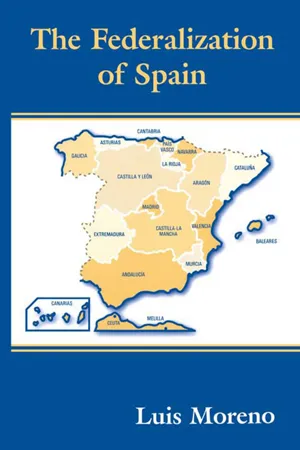
The Federalization of Spain
About this book
Traces the origins of the complex system of devolution and regional home rule that currently shapes and directs the Spanish political process.
Information
1
Concepts and Assumptions
In this Alice-in-Wonderland world in which nation usually means state, in which nation-state usually means multination state, in which nationalism usually means loyalty to the state, and in which ethnicity, primordialism, pluralism, tribalism, regionalism, communalism, parochialism, and subnationalism usually mean loyalty to the nation, it should come as no surprise that the nature of nationalism remains essentially unproved.(Walker Connor)1
There is no lack of popular confusion — also observable at academic level — in distinguishing and defining concepts such as race, ethnic group, federalism, identity, nation, nationalism, state, or power and territory. Theories related to these issues have frequently been limited to the discussion of the efficiency or inefficiency of state institutions in the provision of public services. Such partial treatment has minimized the comprehensive study of: (a) the development of modern states (state-formation, nation-building, mass democratization); (b) the intergovernmental relations within the boundaries of the polity; (c) the crisis in the legitimacy of the political institutions of the nation-state; and (d) the impact of globalization in ‘post-industrial’ states.
This book concentrates on analyses dealing with many of these concepts and notions. In order to articulate explanations for the understanding of the process of federalization in Spain it is crucial, as a preliminary step, to review those epistemological assumptions used as tools for the interpretation of the phenomena under observation.
Some plausible theories concerned with our area of analysis have been put forward by social scientists according to their particular perspectives: political science, sociology, economy, anthropology, history, public administration, or social psychology. As a result, the emphasis in their interpretations has been affected by the disciplines that they are most accustomed to handling: political actors and institutions, economic variables, psychological attitudes, historical trends and so forth. Commensurable explanations sought by researchers remain attached to the scope and nature of their own bodies of knowledge. The existence of a diversity of interpretations does not entail that the different theories are incompatible. In fact, social phenomena, far from being ‘coherent’ and ‘uniform’, are not only diverse but generally develop in mutually interdependent and interacting structures of a time-and-space nature.
One of the major obstacles for the understanding of ethnic phenomena has been the failed attempt by social scientists to develop a comprehensive explanatory theory. This task is associated with the development of a general theory of the cultural, psychological and social systems. In the absence of this, the best route to follow is that which facilitates the plausible construction of partial theories subject to factual verification.
Our analytical interest concentrates on those territories characterized by an emphasis on cultural and ethnic distinctiveness within plural societies in industrially advanced states. This analytical framework corresponds to Western multinational democracies such as, for example, Belgium, Canada or the United Kingdom. Political legitimacy in these countries rests primarily upon associative bases of a Gesellschaft type. According to the terminological differentiation made by Ferdinand Tönnies (1957), Gesellschaft bases are more ‘mechanistic’ and ‘impersonal’ than those corresponding to Gemeinschaft polities. The latter are more homogeneous ethnically (for example, Denmark or Germany), and their social nexus is anchored in an intuitive presupposition of a common ascendancy. As a case-study, Spain offers an interesting subject of research, from which some generalizations can be extrapolated and applied to other countries.
In this chapter key concepts and assumptions related to the general discussion of our case-study will be explored and defined with the purpose of providing a better understanding of subsequent explanations and interpretations.
POWER AND TERRITORY
Power can be defined as the means by which one party is able to make — actively or by default — another party do something according to the wishes of the former. Territory, on the other hand, is the arena where the exercise of power between different political interests and institutions takes place. Thus the distribution/dispersion of power can be observed from two distinct perspectives: who wields the power and where the power is located within a territory.
Two main different approaches or paradigms have been considered in the study of power: elitist and pluralist. While the first contends that power is concentrated, 2 the second argues that power is scattered among diverse individuals, groups or agencies, and that an ample range of interests exists within different policy-making processes.
Power is distributed in functional and territorial terms. Regarding the former, the emerging industrial state in the nineteenth century created diverse functional units to accomplish its main economic goals of expansion and accumulation. This progressive functional division of the state and growth of government brought about an increasing trend towards étatization: bureaucratization, judicialization and central planning. Following this emphasis on functionally distributed power, mainstream sociologists and political scientists have argued persistently that spatial differences do not count as much as other functional cleavages in the running of the modern state. Such approaches have impinged upon academic interpretations in a rather spurious manner.
In fact, power has an inherent territorial dimension. It cannot be abstracted from its geographical component. The development of the industrial state inevitably involved a reallocation of the spatial division of power. Since the industrial revolution, and due mainly to a marked increase in the volume and scope of government activity, power has been distributed progressively according to meaningful geographical criteria. As a consequence of this, the issues of dispersion-concentration, central-local relations, and state homogenization-regional diversity have become crucial both for the configurations of the state institutions and the social transformations which can take place within the state.
State formation and nation-building
According to Max Weber, the state embodies the legal order of a given territory and exercises the monopoly of the legitimate use of force.3 Inheritor of the ancient Greek concept of politeia (polity), the state in Europe was formed in various degrees and dynamics during the period from the twelfth to the eighteenth centuries. More concretely, the period 1485–1789 saw the building of most modern European nation-states, Spain being the first country to develop a modern state organization after 1492 (see Chapter 2, p. 37). According to Stein Rokkan, the second phase of nation-building, the subsequent processes of mass democratization and the construction of the welfare states completed the main four-phase process of political development in contemporary Europe (Flora et al, 1999).
As a result of these historical developments, two broad models of state configuration can be identified:
Unitary
(a)Sovereign political power is undivided and rests upon an organic core of governmental responsibilities.
(b)Executive, legislative and judiciary operate on a state basis with some delegation of administrative functions to sub-state agencies or bodies.
Plural
(a)Territorial power distribution is distributed by consent among the different layers of government.
(b)Central, meso and local government can implement policies according to their own jurisdictions.
The unitary-plural typology finds expression in two corresponding systems of government: (a) centralized, where the loci of decisionmaking are concentrated in one core; and (b) decentralized, with a dispersion of power throughout distinct layers of government. States can be broken down into a further categorization of models as follows:
(1)where the central government is called sovereign, the system is said to be centralized;
(2)where neither central nor meso-local units of governments is sovereign, the model can be labelled federal;
(3)where the meso-local units of governments are called sovereign, the system is said to be confederal.
However, these three ‘classical’ types have evolved and adapted themselves to changing scenarios that have somewhat blurred their original ‘yardsticks’ or defining traits. For instance, although nominally confederal, Switzerland can be considered as a federal republic since the inception of the 1848 Constitution after the Sonderbundeskrieg and, with this, the factual disappearance of the myth of the canton sovereignty. France has been cited regularly as the foremost example of a unitary and centralized system. Nonetheless, de-concentration has given way to the establishment of directly elected regional councils. Both Belgium and Canada were originally unitary countries that have transformed into formal federations within which some of their constituent parts have considered the possibility of secession.
The cases of Spain and the United Kingdom share some similarities as union- rather than nation-states. Their states developed in a peculiar manner, allowing degrees of autonomy of their constituent parts which were incorporated by means of treaty and agreement. While administrative centralization prevailed state-wide, the union structure entailed internal variations based on pre-union arrangements and rights (Rokkan and Urwin, 1983).
In these two European union-states, comprising minority nations and regions, the interrelationships between centre and periphery have been crucial in the structuring of their political cleavages and internal ethnoterritorial accommodation.
Centre and periphery
The centre-periphery relations of interdependence are of the utmost importance for the understanding of politics and policies in plural countries. Society has a centre, or central zone, that impinges in various ways upon those who live within the ecological domain in which the society exists. According to this ‘diffusionist’ approach, membership in the society is constituted by relationship to this central zone (Shils, 1975). Likewise, the centre is formed by a set of key decision-making powers that affect the relations of dominance and dependency, not only politically but also culturally and economically.
Centre-periphery relations, in any case, ought to be analysed from the double perspective of centralization and peripheral accentuation. Contemporary Spain offers a stark example of the noncongruence of political (Madrid) and economic (Barcelona) centres (Gourevitch, 1979), which highly conditioned the ambivalent action taken by nineteenthcentury nation-builders. Attempts to impose by force such programmes of centralized nation-building contributed to a further delegitimization of political unitarism and an accentuation of periphery’s distinctiveness (Diaz Lopez, 1985; Giner and Moreno, 1990).
Theories of ethnocentrism and internal colonialism have stressed those abilities of state cores to implement programmes of national assimilation over peripheral areas. William Graham Sumner (1940) coined ‘ethnocentrism’ as the technical term for a view of things in which one’s own group is the centre of everything, and all others are scaled down and rated with reference to it. Applied to territorial politics, ethnocentrism shows in the disregard displayed by the state core towards the economic development of the periphery.4
Internal colonialism is viewed as a structure of social relations based on domination and exploitation among culturally heterogeneous, distinct groups within the state (Gonzalez Casanova, 1965). According to the internal colonialism theory, the superordinate, or centre, seeks to stabilize and monopolize its advantage over the subordinate, or periphery, by means of policies aimed at the institutionalization of a stratification system which is labelled as a ‘cultural division of labour’, and which produces a reaction heightening cultural/ethnoterritorial distinctiveness in both core and periphery.5
Neither ethnocentrist nor internal colonial theses are applicable to the case of Spain. Among other reasons, it would be wrong to consider the capital Madrid as being repres...
Table of contents
- Cover
- Half Title
- THE CASS SERIES IN REGIONAL AND FEDERAL STUDIES
- Title Page
- Copyright Page
- Table of Contents
- List of Tables, Figures, Diagrams and Maps
- Series Editor's Preface
- Acknowledgements
- List of Abbreviations/Glossary
- Introduction
- 1 Concepts and Assumptions
- 2 The Development of the Spanish National State
- 3 The Mode of Relations within Decentralized Spain
- 4 The Federalizing Estado de las Autonomías
- Conclusion: Unity and Diversity in Spain
- Methodological Appendix
- References
- Index
Trusted by 375,005 students
Access to over 1.5 million titles for a fair monthly price.
Study more efficiently using our study tools.
Frequently asked questions
Yes, you can cancel anytime from the Subscription tab in your account settings on the Perlego website. Your subscription will stay active until the end of your current billing period. Learn how to cancel your subscription
No, books cannot be downloaded as external files, such as PDFs, for use outside of Perlego. However, you can download books within the Perlego app for offline reading on mobile or tablet. Learn how to download books offline
Perlego offers two plans: Essential and Complete
- Essential is ideal for learners and professionals who enjoy exploring a wide range of subjects. Access the Essential Library with 800,000+ trusted titles and best-sellers across business, personal growth, and the humanities. Includes unlimited reading time and Standard Read Aloud voice.
- Complete: Perfect for advanced learners and researchers needing full, unrestricted access. Unlock 1.5M+ books across hundreds of subjects, including academic and specialized titles. The Complete Plan also includes advanced features like Premium Read Aloud and Research Assistant.
We are an online textbook subscription service, where you can get access to an entire online library for less than the price of a single book per month. With over 1.5 million books across 990+ topics, we’ve got you covered! Learn about our mission
Look out for the read-aloud symbol on your next book to see if you can listen to it. The read-aloud tool reads text aloud for you, highlighting the text as it is being read. You can pause it, speed it up and slow it down. Learn more about Read Aloud
Yes! You can use the Perlego app on both iOS and Android devices to read anytime, anywhere — even offline. Perfect for commutes or when you’re on the go.
Please note we cannot support devices running on iOS 13 and Android 7 or earlier. Learn more about using the app
Please note we cannot support devices running on iOS 13 and Android 7 or earlier. Learn more about using the app
Yes, you can access The Federalization of Spain by Luis Moreno in PDF and/or ePUB format, as well as other popular books in Politics & International Relations & Comparative Politics. We have over 1.5 million books available in our catalogue for you to explore.