eBook - ePub
Secrets of Signals Intelligence During the Cold War
From Cold War to Globalization
- 368 pages
- English
- ePUB (mobile friendly)
- Available on iOS & Android
eBook - ePub
Secrets of Signals Intelligence During the Cold War
From Cold War to Globalization
About this book
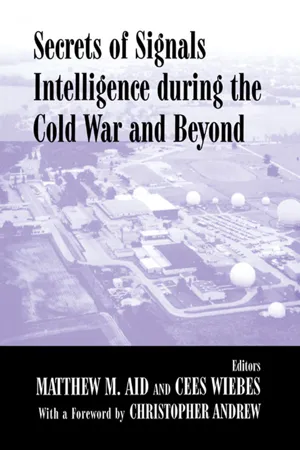
In recent years the importance of Signals Intelligence (Sigint) has become more prominent, especially the capabilities of reading and deciphering diplomatic, military and commercial communications of other nations. This work reveals the role of intercepting messages during the Cold War.
Information
1
Introduction: The Importance of Signals Intelligence in the Cold War
Today, our knowledge of about the role and importance of Signals Intelligence (Sigint) in the years after the end of World War II can only be described as an inventory of ignorance. The distinguished British historian Christopher Andrew has written that ‘The biggest gap in our knowledge of United States intelligence collection during the Cold War concerns the role of Sigint. No history of the Second World War nowadays fails to mention the role of the Anglo-American codebreakers in hastening victory over Germany and Japan. By contrast, most histories of the Cold War make no reference to Sigint at all.’1 By the same token, our lack of knowledge about role played by Sigint in countries outside the United States is deeper and even more profound.
Part of the problem stems from the heavy shroud of secrecy that has covered this immensely important subject for so long. Too many academics, researchers and journalists in the US, Europe and elsewhere still speak about the subject sotto voce, fearful of the strictures of the Official Secrets Act and similar laws that effectively bar public discussion of this subject. Another factor is that because of its technical nature, Sigint is an extremely difficult subject for the layman to understand, which has deterred academics and journalists from examining the subject in any depth, and what coverage there has been remains focused on the trials and tribulations of World War II.2
It is certainly true that Sigint lacks the glamour and sex appeal that surrounds the exploits and derring-do of secret agents, which have dominated the post-war literature on intelligence. One writer has put it thus: ‘For many, Sigint conjures up images of grey men eavesdropping on conversations, cracking codes, and installing large-dish antennas. Compared with human intelligence, Sigint can seem rather boring and, frankly, a little grubby.’3
Moreover, partisans of the more traditional art of Human Intelligence (Humint), have been less than kind to Sigint in the past. For years the authors of this study have been told horror stories about the failings of Sigint from past or present practitioners of Humint. Former CIA officials, seeking to enhance the reputation of the CIA’s clandestine service, have been particularly harsh in their public criticism of the National Security Agency (NSA) and other forms of technical intelligence gathering. In the best-selling novel Tinker, Tailor, Solder, Spy, George Smiley, John le Carré’s master spy, voiced the widely-held opinion of many Humint professionals about their more technically-oriented counterparts in the intelligence services, saying: ‘We all have our prejudices and radio men are mine. They’re a thoroughly tiresome lot in my experience, bad fieldmen and overstrung, and disgracefully unreliable when it comes down to doing the job.’4
As a result, for more than 50 years Sigint professionals around the world have been forced to fight in complete secrecy an uphill battle arguing the value of radio intelligence. Oftentimes, the adherents of Sigint lost these bureaucratic battles against the numerous and usually more powerful partisans of Humint. A former senior Indian intelligence officer recalled that ‘We dithered in creating an integrated set-up for signal interception... because of the pressures from our sprawling network of spies and human analysts, led by a technically illiterate bureaucracy.’5
And so, despite the latent prejudice and immense secrecy surrounding the subject, the question has been asked: why was Sigint so important during the Cold War? This contribution and the others that follow suggest that the history of post-World War II intelligence must be radically rewritten to take into account the important contributions made to the security of the United States and the nations of Western Europe by this arcane and difficult to understand intelligence discipline.
WHAT IS SIGNALS INTELLIGENCE?
An US Army publication defines Sigint as intelligence derived from the intercept, analysis, and parametric exploitation of foreign communications and non-communications radio-electronic emissions.6 An US Marine Corps manual defines Signals Intelligence (Sigint) as ‘intelligence gained by exploiting an adversary’s use of the electromagnetic spectrum with the aim of gaining undetected firsthand intelligence on the adversary’s intentions, dispositions, capabilities, and limitations’.7
Sigint is composed of three separate but interrelated intelligence collection techniques: communications intelligence (Comint), electronics intelligence (Elint), and foreign instrumentation signals intelligence (Fisint).8 Communications Intelligence (Comint) is intelligence information derived from the intercept and processing of voice, Morse code, radioteletype, facsimile, multichannel (or microwave radio relay), and video signals. Comint does not include the interception of unencrypted written communications (mail), the monitoring of foreign public media or propaganda broadcasts, the interception of communications obtained during counterintelligence investigations, or wartime censorship activities.9
For example, during the 1950s and 1960s NSA intercept operators around the world spent most of their time monitoring and transcribing radio traffic concerning the day-to-day routine activities at foreign military bases around the world, such as communications from airfield control towers or ground stations directing aircraft movements, the radio traffic of ground forces manoeuvring in the field, ship-to-ship and ship-to-shore naval radio traffic, foreign military and civilian weather broadcasts, and air-to-ground civilian airline communications.10 During the Cold War, a typical American Comint target was the routine activity at Soviet airfields in East Germany and elsewhere. NSA voice intercept operators monitored the early morning radio checks from the air base, followed by radio traffic among the control tower, the firing range controller, the taxi strip monitor, the bombing range controller, the weather station, the aerial intercept controller, the ground safety crews, and the radar operators. The intercept operators then tracked the routine training flights of the base’s combat aircraft as they practised aerial intercepts or bombing attacks at ranges near the airfield. This required listening to hours of mundane air-to-air and/or air-to-ground radio chatter, which in turn required further hours to transcribe and process every day.11
Electronics Intelligence (Elint) is concerned with the interception and analysis of emissions from foreign electronic devices. The most common Elint targets are the wide variety of radar systems used around the world for early warning, missile detection, ground control intercept, missile targeting, fighter target vectoring, and altitude determination.12 Through Elint, these radar systems can be identified by their function and type, their range and capabilities assessed, and their locations precisely fixed.13 This intelligence information is principally of interest to the military because, as a recently declassified US Air Force document put it: ‘By counting radars, specifying their precise location, determining their ranges, and evaluating their operational systems, analysts and engineers could develop countermeasures capable of jamming offensive surface-to-air missile radars and other defensive radars.14 Other Elint targets include navigation aids and radio beacons which provide geographic position information to ships, aircraft and other vehicles; air-to-air and air-to-ground identification signals, such as Identification, Friend or Foe (IFF) transponders, repeaters and interrogators; emissions from countermeasures equipment and radio jamming devices; radiation from missile guidance systems and artillery fuses; and emissions from meteorological devices, diathermy, radio heating, and research and development laboratories and field testing stations working on electronic devices.15
Fisint is defined as the collection and processing of emissions associated with the testing and operational deployment of aerospace, surface, and subsurface systems, which may have either military or civilian application. Fisint includes but is not limited to monitoring telemetry from ballistic missiles as well as manned and unmanned space vehicles, beaconry, electronic interrogators, tracking/fusing/arming/command systems, and video data links which relay data to a ground station concerning performance of space vehicles or weapons systems. As such, Fisint is the Sigint collection discipline primarily associated with the monitoring of foreign weapons research and development activities, including but not limited to ballistic missile testing.16
Finally, in the last decade Sigint has become deeply involved with a new kind of electronic communications medium: digital data communications signals, which refers to the transmission of vast amounts of digital data among and between computer systems and networks. A good example of the traffic passing along this medium is electronic bank transfer data. NSA and its English-speaking Sigint partners refer to data traffic by the covername ‘Proforma’.17
THE IMPORTANCE OF SIGINT
Since the dawn of time, all governments have wanted to know what their friends and allies were doing. In justifying the continuing need for the huge Russian radio intercept station at Lourdes, Cuba, in December 2000 the Russian newspaper Izvestia wrote that ‘Not a single state has yet been able to deny itself the temptation to learn more about other states (especially those it sees as rivals) than they would like to tell.’18 And that the easiest way to do this is to listen to the secret communications of foreign governments. The former head of the US Navy Communications Intelligence Organisation, Captain (later Vice Admiral) Joseph N. Wenger, wrote that ‘The ambition of every nation has been to develop unbreakable ciphers for its own use and to solve every cipher in use by its actual or potential enemies.’19
By its very nature, Sigint has certain intrinsic qualities, which make it a particularly effective intelligence-gathering tool.
The first is that Sigint is a passive intelligence collection technique that generally is conducted without the target’s knowledge. Moreover, Sigint collects information against communications targets that are oftentimes thousands of miles away, thus negating the need for the intercept sites to be near the targets being monitored. This means, generally speaking, that Sigint involves relatively little political or physical risk.20 There was one exception to this rule, however. This was the peripheral aerial and maritime reconnaissance missions conducted by all sides during the Cold War, which resulted in a number of reconnaissance platforms either being destroyed or captured. A total of 146 NSA military and civilian personnel were killed in the line of duty during the Cold War, 60 of whom were killed in Vietnam. The single worst loss ...
Table of contents
- Cover
- Title page
- Copyright page
- Contents
- Foreword
- List of Illustrations
- Preface
- Chapter 1. Introduction: The Importance of Signals Intelligence in the Cold War
- Chapter 2. The National Security Agency and the Cold War
- Chapter 3. GCHQ and Sigint in the Early Cold War 1945–70
- Chapter 4. Canada’s Communications Security Establishment from Cold War to Globalization
- Chapter 5. The Bundesnachrichtendienst, the Bundeswehr and Sigint in the Cold War and After
- Chapter 6. France, Sigint and the Cold War
- Chapter 7. Scandinavia, Sigint and the Cold War
- Chapter 8. Dutch Sigint during the Cold War, 1945–94
- Chapter 9. Dutch Sigint and the Conflict with Indonesia, 1950–62
- Chapter 10. Conclusions
- Abstracts
- About the Contributors
- Index
Trusted by 375,005 students
Access to over 1.5 million titles for a fair monthly price.
Study more efficiently using our study tools.
Frequently asked questions
Yes, you can cancel anytime from the Subscription tab in your account settings on the Perlego website. Your subscription will stay active until the end of your current billing period. Learn how to cancel your subscription
No, books cannot be downloaded as external files, such as PDFs, for use outside of Perlego. However, you can download books within the Perlego app for offline reading on mobile or tablet. Learn how to download books offline
Perlego offers two plans: Essential and Complete
- Essential is ideal for learners and professionals who enjoy exploring a wide range of subjects. Access the Essential Library with 800,000+ trusted titles and best-sellers across business, personal growth, and the humanities. Includes unlimited reading time and Standard Read Aloud voice.
- Complete: Perfect for advanced learners and researchers needing full, unrestricted access. Unlock 1.5M+ books across hundreds of subjects, including academic and specialized titles. The Complete Plan also includes advanced features like Premium Read Aloud and Research Assistant.
We are an online textbook subscription service, where you can get access to an entire online library for less than the price of a single book per month. With over 1.5 million books across 990+ topics, we’ve got you covered! Learn about our mission
Look out for the read-aloud symbol on your next book to see if you can listen to it. The read-aloud tool reads text aloud for you, highlighting the text as it is being read. You can pause it, speed it up and slow it down. Learn more about Read Aloud
Yes! You can use the Perlego app on both iOS and Android devices to read anytime, anywhere — even offline. Perfect for commutes or when you’re on the go.
Please note we cannot support devices running on iOS 13 and Android 7 or earlier. Learn more about using the app
Please note we cannot support devices running on iOS 13 and Android 7 or earlier. Learn more about using the app
Yes, you can access Secrets of Signals Intelligence During the Cold War by Matthew M. Aid, Cees Wiebes, Matthew M. Aid,Cees Wiebes in PDF and/or ePUB format, as well as other popular books in Psychology & Military & Maritime History. We have over 1.5 million books available in our catalogue for you to explore.