- 152 pages
- English
- ePUB (mobile friendly)
- Available on iOS & Android
eBook - ePub
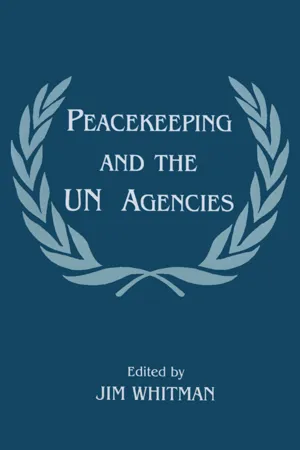
Peacekeeping and the UN Agencies
About this book
This book is a long overdue assessment of the role of the UN specialized Agencies in peacekeeping operations. Special emphasis is given to that most vexed category, 'complex emergencies', invloving entrapped or victimized civilian populations and a plethora of UN national military and NGO actors.While based on the full range of recent history, the contributions to this volume are forward looking and policy-oriented, bringing a hard edged practicality to complex and hitherto under-examined issues.
Information
The United Nations Development Programme: The Development of Peace?

This article studies the role of the United Nations Development Programme in peacebuilding. First, it examines the overall context in which UNDP operates, in particular the relationship between relief, rehabilitation and development in complex humanitarian emergencies. Second, it investigates UNDP’s history, including its gradual move into peacebuilding. Moreover, it reviews UNDP’s efforts at organizational renewal, as well as the consequences of current UN reform. Third, the article examines UNDP’s need for a more outward and forward looking strategy, focusing on local participation. It presents the conclusion that UNDP has through Sustainable Human Development and its renewal process taken some steps in the right direction, but that this is unfortunately not yet enough to ensure action and results at the field level.
The United Nations Development Programme is a development organization, not a peacekeeping organization. By definition, it did not play a huge role in first-generation peacekeeping, which essentially confined itself to diplomatically engendering a cessation of hostilities and the employment of a neutral, armed observer force.1 This has changed, in particular since the end of the Cold War. The rapidly rising number of violent conflicts, largely intra-state wars, has led to new forms of peacekeeping. This so-called second-generation peacekeeping encompasses more than just a neutral, military intervention; it also takes on rebuilding war-torn societies in the hope of preventing future conflict. This kind of peacekeeping, generally better seen as rebuilding with an essential security component,2 by necessity should incorporate a more long-term development perspective. A host of parties – local, (sub-)national, and international – and a wide range of activities – encompassing at the minimum demilitarization, humanitarian and emergency relief, political reconstruction, social reintegration and reconciliation, as well as economic (re)building3 – interact, and all require urgent, simultaneous action to prevent the recurrence of conflict.4
In principle, UNDP can in its function as a development organization and as a UN coordinating agency play a crucial role in peacebuilding and reconstruction. This article studies whether UNDP plays such a role and asks what the specific difficulties are in performing or attaining it.
UNDP’s Context: The Big, Bleak Picture
Many of the factors that constrain or hamper UNDP originate from its environment and its characteristics as a UN organization. The original UN establishment employed a clear division between its security tasks and its development – or broader social and economic – activities. UNDP clearly fell into the development category.
The end of the Cold War was thought to lead to new chances for a more active UN system, and UN involvement in war-torn societies thus grew rapidly. With the benefit of hindsight, one can distinguish four related challenges to which international actors and the UN had to respond. First, neither the international community nor the UN was prepared for action in intra-state wars. There was conceptual confusion and consequent uncertainty as to how to intervene. Second, a specific part of this confusion was addressed in the debate on the difficulties of linking relief, rehabilitation and development in the so-called continuum approach. Third, while the UN system was trying to come to grips with these challenges, the initial post Cold-War confidence in the UN subsided rather quickly. Fourth, the flows of ODA were decreasing.
The wars that erupted after the Cold War presented new, unexpected characteristics that were frequently ill-understood. Their intra-state character made it difficult to determine on which basis international actors could intervene in at least nominally sovereign states. Moreover, UN development cooperation was based on the premise of working with national governments. How to remain neutral in daily practice with the conflicting demands and territorial claims of various parties, varying from local NGOs and local communities to rebel groups, when the government is either absent, weak or illegitimate? What are actually legitimate claims and parties in a situation where the whole societal fabric is breaking down?5
Originally, many of the armed conflicts were dealt with primarily from a security perspective. Yet the emphasis on military interventions backfired to a large extent. First, massive military interventions – for example, in Somalia – failed to deliver results. In fact, local coping mechanisms were often destroyed and local needs were insufficiently recognized. Second, development actors were sidelined, while it soon appeared that military actors generally could only play a small role in linking relief, rehabilitation and development.
Much of the debate on conceptualizing the links between relief, rehabilitation and development occurred in the hope of placing these as discrete stages in a continuum.6 Initially, relief and development activities were carried out by different organizations. This made sense in the wake of natural disasters, in so far as these were one-time events that caused a disruption of regular societal processes but did not destroy the societal fabric. In these cases, relief organizations could usually focus on saving lives through relative short-term operations. This model, in which development could retake its course rather quickly, became the standard model for providing relief during and after conflict.
However, this model soon lost its validity in the growing number of multi-causal complex emergencies that affected the lives and livelihoods of an escalating number of people, mainly located in the developing world.7 Conventional forms of relief created dependencies: refugee camps became permanent settlements, or they were used as bases for rearmament; food aid negatively affected local food supply and agriculture. Even worse, relief aid was increasingly used by warring factions as a resource in prolonging conflict.8 Moreover, many of the complex humanitarian emergencies were protracted or recurrent to such an extent that they became semi-permanent. As a result, it became increasingly clear that in many cases short-term conventional relief was hampering long-term development processes by focusing more on the symptoms than on the causes of the disasters.
At the same time, prevention of armed conflict received growing attention. Even in situations of conflict, pockets of stability existed where regular development activities could go on. In other cases, development activities could be integrated into relief, for example by food for work. Although there were great difficulties in getting a war-torn society back on its feet, the aftermath of conflict also offered new possibilities for change. Wood indicates that ‘post-conflict situations often provide special opportunities for political, legal, economic, and administrative reforms to change past systems and structures that may have contributed to economic and social inequities and conflict’.9 Moreover, many initiatives of the local population are carried out independently – if not in spite of – the international donor community. Refugees, for example, have their own means of finding out whether they can safely return, by sending out family members to check the areas of resettlement.10
All of this blurs the traditional distinction between security, relief and development. It also implies that rehabilitation has often become the neglected stepchild in the competition between relief and development organizations.11 In a similar vein, lack of cooperation hinders a coordinated or at least coherent approach towards rebuilding war-torn societies in which short-term relief contributes to longer-term development goals. The traditional categories of security, relief, rehabilitation and development cooperation reflect more the institutional make-up of the international donor-community than the realities at the field level. An armed conflict is a major disruption of development processes, which themselves must already have been dysfunctional by leading up to the conflict.12 After such a conflict it is rare that the status quo ex ante can be re-established on the instigation of external actors. In sum, the assumption that emergencies can be characterized by a continuum going from relief to rehabilitation to development supposes a linear sequence of events through which the original situation can be restored, in part by superimposing external assistance on the local fabric.13 It thus disregards the simultaneity of development and emergency situations, is ‘conceptually wrong’ and can be ‘operationally misleading’.14
As a consequence, relief aid, rehabilitation and development cooperation need to be linked more closely. On the one hand, development should be integrated into relief. On the other hand, regular development activities should also address potential disaster-vulnerabilities and contingencies. In sum, development organizations should prepare themselves for working in crisis environments.
Yet a stronger focus on development does not provide a magic formula, because development cooperation itself has not always been a success story.15 It is widely felt that development cooperation has too often lacked positive results.16 To a large extent this has contributed to a donor fatigue that heavily influences the ability of relief and development organizations to function properly. This fatigue was accompanied by the failings in peacekeeping, especially peace enforcement, in countries like Somalia and Rwanda, which caused a precipitous decline in confidence in the capacities of the UN system.
As a result, the UN’s resource-base declined. Some broad trends in funding, albeit with irregular counter examples, can be distinguished. The overall amount of ODA has been decreasing. Of this ODA, the amount spent on development cooperation is going down faster than humanitarian relief money.17 In addition, a considerable amount of funding for development cooperation has been transferred to humanitarian relief and peacekeeping operations. Within funding exclusively for development cooperation, multilateral funding has been decreasing more than bilateral funding. Within multilateral development spending, the amount allocated to the UN is being reduced more quickly than that to the financial institutions. These four factors – lack of preparedness, the conceptual confusion surrounding the continuum debate, dwindling confidence in the UN system and decreasing resources – form the backdrop for UNDP’s functioning in complex emergency situations.
The Organization of UNDP
Brief History
In order to understand UNDP’s possible contributions to second-generation peacekeeping, it is necessary to get a picture of its regular, development-oriented functioning. Its history and its mission determine the official role that UNDP can play in peacekeeping and peacebuilding.18
In 1966, UNDP was set up as a merger between the UN Special Fund and the expanded programme of technical assistance. In particular, the Jackson Report (1969) and the resulting consensus resolution of 1970 – GA resolution 2688 (XXV) – inte...
Table of contents
- Cover
- Title Page
- Copyright Page
- Table of Contents
- Acronyms and Abbreviations
- Preface
- Clash and Harmony in Promoting Peace: Overview
- Peacekeeping and Refugee Relief
- The World Health Organization and Peacekeeping
- Civilian-Military Interactions and Ongoing UN Reforms: DHA’s Past and OCHA’s Remaining Challenges
- Complex Emergencies, Peacekeeping and the World Food Programme
- The United Nations Development Programme: The Development of Peace?
- The UN Specialized Agencies, Peacekeeping and the Enactment of Values
- Notes on Contributors
- Index
Trusted by 375,005 students
Access to over 1.5 million titles for a fair monthly price.
Study more efficiently using our study tools.
Frequently asked questions
Yes, you can cancel anytime from the Subscription tab in your account settings on the Perlego website. Your subscription will stay active until the end of your current billing period. Learn how to cancel your subscription
No, books cannot be downloaded as external files, such as PDFs, for use outside of Perlego. However, you can download books within the Perlego app for offline reading on mobile or tablet. Learn how to download books offline
Perlego offers two plans: Essential and Complete
- Essential is ideal for learners and professionals who enjoy exploring a wide range of subjects. Access the Essential Library with 800,000+ trusted titles and best-sellers across business, personal growth, and the humanities. Includes unlimited reading time and Standard Read Aloud voice.
- Complete: Perfect for advanced learners and researchers needing full, unrestricted access. Unlock 1.5M+ books across hundreds of subjects, including academic and specialized titles. The Complete Plan also includes advanced features like Premium Read Aloud and Research Assistant.
We are an online textbook subscription service, where you can get access to an entire online library for less than the price of a single book per month. With over 1.5 million books across 990+ topics, we’ve got you covered! Learn about our mission
Look out for the read-aloud symbol on your next book to see if you can listen to it. The read-aloud tool reads text aloud for you, highlighting the text as it is being read. You can pause it, speed it up and slow it down. Learn more about Read Aloud
Yes! You can use the Perlego app on both iOS and Android devices to read anytime, anywhere — even offline. Perfect for commutes or when you’re on the go.
Please note we cannot support devices running on iOS 13 and Android 7 or earlier. Learn more about using the app
Please note we cannot support devices running on iOS 13 and Android 7 or earlier. Learn more about using the app
Yes, you can access Peacekeeping and the UN Agencies by Jim Whitman in PDF and/or ePUB format, as well as other popular books in Politics & International Relations & Military & Maritime History. We have over 1.5 million books available in our catalogue for you to explore.