- 623 pages
- English
- ePUB (mobile friendly)
- Available on iOS & Android
eBook - ePub
About this book
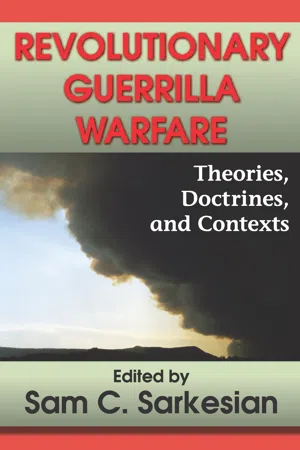
'Revolution' is a word that causes fear in some, exhilaration in others, and confusion in most. Originally used to describe a restoration, it eventually came to mean a sweeping, sudden attack on an existing order. Human history has borne witness to a variety of national and social revolutions - population revolution, revolution of ideas, technological revolution, and revolution in education. Simultaneously, there has been a proliferation of literature on revolution, armed struggle, and violence aimed at unseating policies and leadership of governments and societies.Revolutionary struggles are more than simply armed internal conflict; they involve the essence of the political system. The desire to make such phenomena understandable often leads to oversimplification. Attempts to encompass their multi-dimensional nature, on the other hand, can become immersed in complexities, ambiguities, and misinterpretations. The perspective of this classic volume, available in paperback for the first time, is that revolution is here to stay. Guerrilla warfare, according to Sarkesian, is a particularly useful strategy for the weak, the frustrated, the alienated, and seekers of power against existing regimes. The collected works in this volume examine the social roots of revolution, development of strategy and tactics, practice in city and countryside, dilemmas of attackers and defenders.The actors and thinkers collected and analyzed here range from leading political analysts, anthropologists, sociologists, historians, and officials as well as practitioners of guerrilla warfare. This core text with primary sources in the area of war, revolution, and insurgence develops an understanding of revolution, traces the growth of guerilla doctrine, and studies the specifics of revolutionary and counterrevolutionary guerilla warfare.
Revolutionary Guerrilla Warfare:
by An introduction by Sam C. Sarkesian
1
“Revolution” is a word that causes fear in some, exhiliration in others, and confusion in most. Originally used to describe a restoration, it eventually came to mean a sweeping, sudden attack upon an existing order. From the time of the rebellion of the American colonies against England in the 18th century, and especially after the revolution in France, the word has suggested not only violence but also great scope and importance. Since the late 19th century, its meaning has expanded to include far reaching change, such as social revolution, Industrial Revolution, revolution of rising expectations, etc., even if not primarily violent. Revolution is now regarded as a complex, multidimensional phenomenon deeply originating in social systems ; it cannot be realistically studied apart from the systems and environments from which it evolves.
The purpose of this introduction is to identify the main characteristics of revolution and the guerilla warfare it generates, and suggest an explanatory framework embodying the results of the analysis. Our concern with revolutionary guerrilla warfare stems primarily from its frequency and importance, and from the probability that this type of warfare will be the characteristic form of armed conflict in developing systems.
The recent study of revolution as a special class of phenomena began with historian Crane Brinton’s Anatomy of Revolution, first published in 1938 and often revised and reprinted. This highly original comparative work stimulated the study of revolutions as a subject in its own right within the various academic fields. Studies in particular disciplines, however, have tended to reflect the biases of those disciplines, as well as those of the individual scholar. The historian is likely to use the great revolutions of the past as criteria for the study of all revolutions. The sociologist is likely to focus on social class and order; the psychologist, on the sense of grievance; while the political scientist tends to direct his attention to power and force in the framework of institutions. Aside from the disciplinary orientation, there is a problem of scope. While some scholars prefer a narrow definition of revolution, restricting its application to civil disorders and violent upheaval, others are inclined to accept a looser definition which encompases basic change in general. Some recent works are eclectic in nature and borrow from the broad range of the social sciences. The behavioralist approach, emphasizing the revolutionary mentality and a quasi-economic model which suggests that revolutions stem from perceived economic deprivation, has a greater empirical bent than other theories. Currently, much work is going into efforts to develop cross-national analyses of revolution. Finally, there are ideological interpretations representing all shades of political outlook.
Any one-dimensional explanation of revolutions would presuppose unambiguous and clearly differentiated political, social, and economic systems, hardly a realistic expectation. The substantive issues of revolutions are often in themselves difficult enough to identify precisely. As an initial step, however, revolutions can be usefully viewed as struggles at points on a continuum, from the threshold of violence (such as sit-ins and demonstrations) to total civil war. In between are a variety of revolutionary conflicts conducted with varying degrees of intensity, differing in scope and in the character of the participants.
Recognizing the difficulties of generalizing, there are nevertheless common environmental characteristics in post-World War II revolutionary movements. Most of them have developed in peasant societies undergoing the tensions and strains of modernization. Elites have been at the forefront of these political and social movements: that is, the educated from “higher” social classes generally articulate grievances and ideals and become the leaders and organizers. It is this combination of elite alienation and leadership, peasant awakening and mobilization, and organizational and ideological cohesion that is at the base of most successful revolutionary movements. Revolutionary guerrilla warfare, as will be demonstrated later, is particularly suited to peasant societies. This is not to ignore, however, the outbreaks of urban guerrilla warfare in certain areas of the world; although even in some of these the urban populations involved include heavy recent arrivals from the countryside.
Admittedly social upheaval can threaten any society with serious unsolved problems, but most developed countries in our time have shown a relatively low propensity for revolutionary armed struggle. On the other hand, it can be argued that the revolutions of the twentieth century hold more contrasts than similarities to the classic earlier revolutions. This is not to suggest that historical “maps” do not identify certain common characteristics of revolution. However, the environment of the contemporary emerging nations makes them distinct from the revolutionary societies of terminal Czarist Russia, Bourbon France, or colonial America. The peasant-based revolutionary impulse in a colonial framework, stimulated by modernization and new ideology, developed a high propensity for guerrilla warfare.
Mao Tse-tung provided the first systematic analysis of this type of warfare. Although he is usually identified with peasant war, his earlier experience included urban uprising, first in united front with and then in opposition to the Kuomintang led by Chiang Kai-shek in the China of the 1920s. Mao’s approach does not absolutely rule out the strategy of a quick overthrow of the government by the urban masses, which assumes that once the government machinery is captured or dismantled the revolution can work from the cities outward to complete control of the countryside. But this strategy is characteristic of the Russian strategy rather than the Maoist. The Maoist model eschews urban areas, stressing the mobilization of the peasantry; revolution in the countryside is to envelope and engulf the cities. This scheme follows the classic strategy of the Chinese game of “wei-ch’i”.1 It is based on the premise that the strongest area of government is the city and the weakest, the countryside. Maoist logic dictates that the enemy should be attacked at his weakest point first.
Mao’s principles developed out of his experience of the failure of urban uprising in the 1920s. In the next decade he perceived the crucial weakness of the Kuomintang, and later the invading Japanese, in the countryside. The antagonists’ control of the cities and the major lines of communications and their weak presence elsewhere became the keys to Maoist strategy. The revolutionary forces worked to mobilize the peasants and control the countryside, confining the enemy to the towns and cities and narrowing its access to population and resources. Limited in its movements and denied the foodstuffs and manpower of the rural areas, the government could be starved into surrender or destroyed by a final military offensive.
Guerrilla warfare, colonial as well as purely internal, is armed struggle between pre-existing and challenging political systems. Such wars are primarily socio-political in nature, and although armed conflict is important and may determine the outcome, the “politics” of the conflict are the fundamental causes and determinants. The probability and intensity of revolutionary guerrilla warfare are directly correlated to political instability and social frustration, which in turn are largely determined by the rate of modernization and development. Even in the exceptional cases of its outbreak in developed countries, it is most likely to originate in underdeveloped sectors of the socioeconomic order. The propensity for revolutionary war increases as grievances become less susceptible to resolution within the existing political system. The Maoist model, with its emphasis on the role of the peasantry in the successive stages of revolution, has been the most relevant guide to this phenomenon.
2
Recent years have brought a plethora of writings on unconventional wars, ranging from purely military studies at the level of the smallest troop units to the analysis of nation-building. Useful as they have been, they reveal a lack of agreement on basic definitions and terminology.2 Revolutionary war, civil war, internal war, insurgency, resistance movements, guerrilla war, wars of national liberation, stability operations, internal defense, counter-insurgency—these are but a few examples of the proliferating terminology.3 To appreciate the confusion it may be useful to cite some examples.
According to a standard reference work, civil war
… is conflict within a society resulting from an attempt to seize or maintain power and sumbols of legitimacy by extralegal means. It is civil because civilians are engaged in it. It is war because violence is applied by both sides. Civil war is intrasocietal and may take place within a group, some parts of which either desire to maintain or wish ot initiate separate ethnic and/or polticial identity or wish to change the government.4
The Law of Land Warfare, an official U.S. Army document, simply terms civil war an “armed conflict not of an international character occurring in the territory of one of the High Contracting Parties.”5 In another instance, it is defined as a “military conflict between two or more approximately equal governments for sovereignty over people and territory native to both. Civil War is also distinguished from insurrection. The latter is characterized as a struggle from the bottom up—an uprising of a more or less politically unorganized group against an established authority. Civil War is horizontal, insurrection is vertical.” 6
Guerrilla warfare has been defined by Osanka as follows:
In modern times, the objectives of guerrilla warfare have been more political than military. Since the end of World War II there have been at least ten revolutionary wars using guerrilla warfare as the principle means of violence … The most adequate descriptive term would seem to be ‘revolutionary guerrilla warfare.’ It is revolutionary in that it is used as a means of acquiring national power for the purpose of altering or completely changing the social and political structure of a nation. It is guerrilla warfare in that its participating advocates of change are indigenous civilians waging a small war utilizing principles learned from guerrilla history. 7
Pike, in contrast, emphasizes external sources of support:
Revolutionary guerrilla warfare should not be confused with older concepts of a similar nature, such as irregular troops in wartime disrupting the enemy’s rear, or with civil war, which is between two groups in the same nation (revolutionary warfare is not indigenous), rebellion (militant opposition to authority with the issue quickly settled), revolution (successful rebellion), bandit warfare (plunder as a way of life), or partisan warfare (armed fighting by light troops) .… Revolutionary guerrilla warfare as practised in Vietnam was a way of life. Its aim was to establish a totally new social order, thus differing from insurgencies whose objective is either statehood or change of government .… It was an imported product, revolution from the outside; its stock in trade, the grievance, was often artificially created ; its goal of liberation, a deception. 8
The term “unconventional warfare,” which is commonly used in United States Army doctrine, can also be confusing. In an official Department of the Army publication it is defined as including “the interrelated fields of guerrilla warfare, evasion and escape, and resistance. Such operations are conducted in enemy-held or controlled territory and are planned and executed to take advantage of or stimulate resistance movements or insurgency against hostile governments or forces.”9 The same publication defines guerrilla warfare as “the conduct of combat operations inside a country in an enemy or enemy-held territory on a military or paramilitary basis by units organized from predominantly indigenous personnel,” with the primary aim being to “weaken the established government.”10
The Department of the Army defines insurgency as
a condition of subversive political activity, civil rebellion, revolt, or insurrection against a duly constituted government or occupying power wherein irregular forces are formed and engage in actions, which may include guerrilla warfare, that are designed to weaken and overthrow the government or occupying power. 11
Schuman offers definitions by stages, proposing that the term “insurrection” be applied to armed violence in “initial stages of movements of opposition to government.” The terms “rebellion” and “revolution,” he continues, should be employed only when a “substantial portion of the armed forces of the established government” must be used in defense. “In this sense an insurrection may be thought of as an incipient rebellion or revolution still localized and limited to securing modifications of governmental policy or personnel and not yet a serious threat to the state or the government in power.”12
The problem of definition is suggested in an analysis of the war in Vietnam. A noted British authority writes:
The point to be stressed is that the war has always remained basically an insurgency, boosted by infiltration and aided, to a certain but limited extent, by both invasion and raids .… People’s Revolutionary War is therefore by nature a civil war of a very sophisticated type and using highly refined techniques to seize power and take over a country. The significant feature of it, which needs to be recognized, is its immunity to the application of power.13
Despite the ambiguities, some characteristics are common to all these efforts: the use of force; the objective of changing the composition of government; revolutionary goals; organization; and the fact that the participants are apt to appear to be civilians and avoid conventional battle tactics. Unconventional warfare may include the entire range of activities from sabotage and ambush to operations involving organized units on a large scale, employing tactics of dispersion, rapid assembly, surprise attack, and dispersion. But the decisive element is the departure from the use of always visibly distinguishable combatants in formal battle order. Thus, we come to our working definition:
Revolutionary guerrilla warfare is the forcible attempt by a politically organized group to gain control or change the structure and/or policies of the government, using unconventional warfare integrated with political and social mobilization, resting on the premise that the people are both the targets and the actors.
We may note that the tactics of guerrilla warfare might be used to achieve limited, short-term goals; but the success of such tactics could lead to the adoption of guerrilla warfare for the purpose of seizing power.
Revo...
Table of contents
- Cover Page
- Title Page
- Copyright Page
- Contents
- Preface
- Contributors
- Acknowledgments
- Chapter I Revolutionary Guerrilla Warfare: An introduction
- Chapter II Revolution
- Chapter III Revolutionary Guerrilla Warfare: The Development of Doctrine
- Chapter IV Modern Revolutionary Guerrilla Warfare in Macro-View: Causes and Contexts
- Chapter V Modern Revolutionary Guerrilla Warfare: Some Micro-Views
- Chapter VI Urban Guerrilla Warfare
- Chapter VII The Problems of the Defenders
- Chapter VIII Sources for the Study of Revolutionary Guerrilla Warfare
Trusted by 375,005 students
Access to over 1.5 million titles for a fair monthly price.
Study more efficiently using our study tools.
Frequently asked questions
Yes, you can cancel anytime from the Subscription tab in your account settings on the Perlego website. Your subscription will stay active until the end of your current billing period. Learn how to cancel your subscription
No, books cannot be downloaded as external files, such as PDFs, for use outside of Perlego. However, you can download books within the Perlego app for offline reading on mobile or tablet. Learn how to download books offline
Perlego offers two plans: Essential and Complete
- Essential is ideal for learners and professionals who enjoy exploring a wide range of subjects. Access the Essential Library with 800,000+ trusted titles and best-sellers across business, personal growth, and the humanities. Includes unlimited reading time and Standard Read Aloud voice.
- Complete: Perfect for advanced learners and researchers needing full, unrestricted access. Unlock 1.5M+ books across hundreds of subjects, including academic and specialized titles. The Complete Plan also includes advanced features like Premium Read Aloud and Research Assistant.
We are an online textbook subscription service, where you can get access to an entire online library for less than the price of a single book per month. With over 1.5 million books across 990+ topics, we’ve got you covered! Learn about our mission
Look out for the read-aloud symbol on your next book to see if you can listen to it. The read-aloud tool reads text aloud for you, highlighting the text as it is being read. You can pause it, speed it up and slow it down. Learn more about Read Aloud
Yes! You can use the Perlego app on both iOS and Android devices to read anytime, anywhere — even offline. Perfect for commutes or when you’re on the go.
Please note we cannot support devices running on iOS 13 and Android 7 or earlier. Learn more about using the app
Please note we cannot support devices running on iOS 13 and Android 7 or earlier. Learn more about using the app
Yes, you can access Revolutionary Guerrilla Warfare by Sam C. Sarkesian in PDF and/or ePUB format, as well as other popular books in History & Military & Maritime History. We have over 1.5 million books available in our catalogue for you to explore.