eBook - ePub
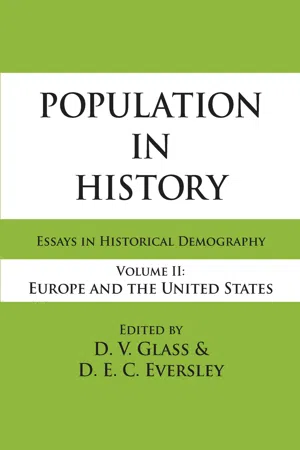
Population in History
Essays in Historical Demography, Volume II: Europe and United States
- 278 pages
- English
- ePUB (mobile friendly)
- Available on iOS & Android
eBook - ePub
Population in History
Essays in Historical Demography, Volume II: Europe and United States
About this book
This large-scale comparative endeavor, complete in two volumes, reflects increasing concern with the population factor in economic and social change worldwide. Demographers, on their side, have been focusing on history. In response to this, Population in History represents the work of two practitioners that have begun to work together, using their combined approaches in an attempt to assess and account for population growth experienced by the West since the seventeenth century.There is a long record of interest in the history of population. But the interest now displayed is likely to be both more persistent and far more fruitful in its consequences. New studies have been initiated in many countries. And because the studies are more informed and systematic than many of those of earlier periods, they are already provoking the further spread of research. A much more positive part is now also being played by national and international associations of historians and demographers. It is not unlikely that, within the next fifteen or twenty years, the main outlines of population change in the seventeenth and eighteenth centuries will be firmly established for much of Europe.Previous research has tended to appear in specialist journals and academic publications. This volume is intended to provide a more easily accessible publication. It has been thought appropriate to include some earlier work, both because of its intrinsic interest and because it provided the background and part of the stimulus to the later research. Of the twenty-seven contributions to this outstanding volume, seven are unabridged reprints of earlier work; the remaining contributions are either entirely new or represent substantial revisions of work published elsewhere.
Information
27
The Growth of Population in America, 1700-1860
J. POTTER
IN sharp contrast with the vigour of the debate over the causes of the increase of the English population during the eighteenth and early nineteenth centuries, the amount of attention devoted to demographic problems in American historical writing is small. Either from excessive confidence in the soundness of accepted views or from despair at the enormity of the task of re-appraisal, the general historian has tended to treat American population statistics as known, uncontroversial and not requiring explanation. Most economic history textbooks, for example, merely give the decennial population figures starting with the Census of 1790 with little or no discussion of their implications.1
Yet the subject is of great interest in itself and is essential to the interpretation of American social and economic history. For non-Americans, to whom this chapter is primarily addressed, it can have important bearing on their own attempts to interpret the European, and especially the English, data. Above all perhaps America offers a yardstick against which the significance of the English figures may be measured. Between 1700 and 1860 the rate of population growth in America is usually supposed to have been about 34 per cent per decade, i.e. about twice the English rate. There is surely a danger in analysing the English data of explaining too much. Is it not important to ask occasionally not why the English population grew so fast during this period, but why it did not grow faster, why it grew at a particular rate, why its rate of growth did not approximate more closely to the American rate?
It is worth while to start with a reminder of the weight Malthus himself attached to the American evidence. He frequently referred to the greater speed of American population growth, ‘a rapidity of increase, probably without parallel in history’.2 Indeed, it was directly from America that he deduced his demo-graphic law, in the second chapter of the first edition of his Essay on Population:
‘In the United States of America, where the means of subsistence have been more ample, the manners of the people more pure, and consequently the checks to early marriage fewer, than in any of the modern states of Europe, the population has been found to double itself in twenty-five years.
This ratio of increase, though short of the utmost power of population, yet as the result of actual experience, we will take as our rule; and say,
That population, when unchecked, goes on doubling itself every twenty-five years, or increases in a geometrical ratio.’3
Malthus had no doubts about the reasons for this unique American experience. It arose from a combination of favourable circumstances, but above all from the abundance of land and the absence of political, social or institutional obstacles to its alienation and cultivation. The further west one looked, the greater the speed of population growth. In the back settlements, where the settlers devoted themselves solely to agriculture, the population had been known to double itself in as little as fifteen years. And to this observation, Malthus added a footnote containing the second part of his law:
In instances of this kind, the powers of the earth appear to be fully equal to answer all the demands for food that can be made upon it by man. But we should be led into an error, if we were thence to suppose that population and food ever really increase in the same ratio. The one is still a geometrical and the other an arithmetical ratio, that is, one increases by multiplication, and the other by addition….4
The time would nevertheless come, Malthus went on, when all the fertile land would be occupied, even in America. Then any further increase in food production would depend ‘upon the amelioration of the land already in posses-sion’.5
Malthus went on to ask why a given number of emigrants, living in the American environment, produced a greater number of descendants than a similar number remaining behind in Great Britain. Why did not ‘an equal number produce an equal increase, in the same time’? His answer remained the same as before: the ‘great and obvious cause· of the slower growth in Britain was ‘the want of room and food, or, in other words, misery’.6 The same could also be said of parts of Europe.7 Certainly in America free institutions had done much to promote industry, happiness, and population growth. But ‘even civil liberty, all powerful as it is, will not create fresh land’. 8 The worst effects of land hunger would be alleviated in America through the absence of primogeniture9 and through the relatively equal spread of property, the possession of land being in itself a source of happiness; but these circumstances, ‘though they may alleviate, can never remove the pressure of want’.10
Malthus repeated these views in the subsequent versions of the Essay, adding fresh documentation. In the edition of 1826, the sixth and the last to appear during his lifetime, he made use of the American Fourth Census of 1820.11 The USA had ‘millions and millions of acres of fine land·; in England the only land remaining to cultivation was comparatively barren. The argument was thus unchanged. The American population was growing by the postulated geometrical progression; this represented the rate of increase to be expected under conditions of land abundance, until such time as all the good land would have been occupied and only marginal soils would remain.
Despite the confidence of Malthus’s assertions about the size and the rate of growth of the American population in the eighteenth century, and the subsequent general acceptance of those assertions, the facts are by no means certain. For decades after 1790, when the decennial Censuses begin, the informa-tion available is far from complete. Until well into the nineteenth century, the difficulties of deriving and interpreting historical demographic statistics for America are immense.
The first problem arises simply from deficiencies in the data. These short-comings are due at least in part to the fact that the population was widely dispersed over a vast area; as late as 1870 the highest population density in any single state was that of Rhode Island with 200 persons per square mile (compared with 389 persons per square mile in England and Wales in 1871); only four states out of 38 in that Census had a density of over 100 (cf. Scotland in 1851 with a density of 96). Correspondingly, the urban population remained small; in 1870 roughly 10 million out of a total population of 40 million lived in places of over 2,500 inhabitants. The second problem is that all aggregate figures contain an important component of immigrants; in each Census between 1860 and 1920, foreign-born residents amounted fairly co...
Table of contents
- Cover Page
- Title Page
- Copyright Page
- Preface
- Acknowledgements
- Contents
- PART III Europe and the United States
- 17 Land and Population in Ireland 1780-1845
- 18 The Population of France in the Eighteenth Century
- 19 Recent Theories and Research in French Population Between 1500 and 1700
- 20 The General Development of the Population of France Since the Eighteenth Century
- 21 Demographic Crisis in France from the Sixteenth to the Eighteenth Century
- 22 Two Essays on Population in Eighteenth-Century Scandinavia
- 23 Finland’s Population Movement in the Eighteenth Century
- 24 Four Centuries of Italian Demographic Development
- 25 The Population of Barmen Before and During the Period of Industrialization
- 26 The Demographic Development of Flanders in the Eighteenth Century
- 27 The Growth of Population in America, 1700-1860
- NOTES ON CONTRIBUTORS
Trusted by 375,005 students
Access to over 1.5 million titles for a fair monthly price.
Study more efficiently using our study tools.
Frequently asked questions
Yes, you can cancel anytime from the Subscription tab in your account settings on the Perlego website. Your subscription will stay active until the end of your current billing period. Learn how to cancel your subscription
No, books cannot be downloaded as external files, such as PDFs, for use outside of Perlego. However, you can download books within the Perlego app for offline reading on mobile or tablet. Learn how to download books offline
Perlego offers two plans: Essential and Complete
- Essential is ideal for learners and professionals who enjoy exploring a wide range of subjects. Access the Essential Library with 800,000+ trusted titles and best-sellers across business, personal growth, and the humanities. Includes unlimited reading time and Standard Read Aloud voice.
- Complete: Perfect for advanced learners and researchers needing full, unrestricted access. Unlock 1.5M+ books across hundreds of subjects, including academic and specialized titles. The Complete Plan also includes advanced features like Premium Read Aloud and Research Assistant.
We are an online textbook subscription service, where you can get access to an entire online library for less than the price of a single book per month. With over 1.5 million books across 990+ topics, we’ve got you covered! Learn about our mission
Look out for the read-aloud symbol on your next book to see if you can listen to it. The read-aloud tool reads text aloud for you, highlighting the text as it is being read. You can pause it, speed it up and slow it down. Learn more about Read Aloud
Yes! You can use the Perlego app on both iOS and Android devices to read anytime, anywhere — even offline. Perfect for commutes or when you’re on the go.
Please note we cannot support devices running on iOS 13 and Android 7 or earlier. Learn more about using the app
Please note we cannot support devices running on iOS 13 and Android 7 or earlier. Learn more about using the app
Yes, you can access Population in History by D.E.C. Eversley in PDF and/or ePUB format, as well as other popular books in Social Sciences & Social History. We have over 1.5 million books available in our catalogue for you to explore.