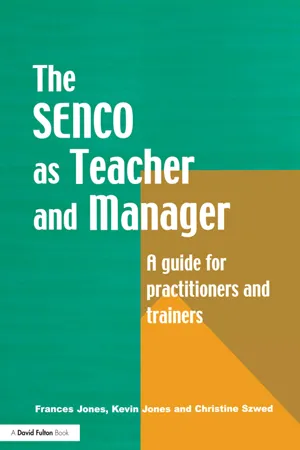
eBook - ePub
The Special Needs Coordinator as Teacher and Manager
A Guide for Practitioners and Trainers
- 133 pages
- English
- ePUB (mobile friendly)
- Available on iOS & Android
eBook - ePub
The Special Needs Coordinator as Teacher and Manager
A Guide for Practitioners and Trainers
About this book
This text reflects the shift in the SENCO's role from SEN teacher to manager. Written within the context of the most recent government initiatives, it can be used by both special-needs coordinators and by special-educational-needs trainers and advisory staff. In two parts, it explores the range of skills required for the role of special needs coordinator and offers information and advice to develop those skills. Practical activities enable the user to monitor and evaluate special-needs provision in their own school and to implement a structured process of change in partnership with all those involved in meeting special educational needs.
Information
Topic
EducationSubtopic
Education GeneralPART ONE
Managing learning
Perceptions of special needs have changed rapidly since the Warnock Report (DES 1978). Internationally there is a significant move towards the inclusion of all children within a mainstream setting as an undeniable right. This carries great implications for staff in mainstream schools who, until recently, often regarded provision for ‘special needs’ as the province of an identified member of staff who often taught the ‘special needs’ population separately. The 1993 Education Act (DFE) placed that responsibility firmly within the whole-school and the whole staff, giving governors responsibility for the special needs policy and for monitoring its effectiveness. Each school was required to have a designated teacher to act as a SENCO (Special Educational Needs Coordinator) to coordinate whole-school policy and to ensure that children with special needs were taught appropriately across the whole curriculum. The Code of Practice for the Identification and Assessment of Special Educational Needs (DFE 1994) contributed the concept of the ‘Individual Education Plan’ (IEP) which, while outlining individual needs, required management throughout the whole curriculum. Thus, the SENCO role extended beyond teaching to the management of special educational needs (SEN) provision throughout the school.
The first part of this book therefore examines appropriate teaching strategies to meet individual and, at the same time, corporate needs against the fast-changing demands of the inclusive agenda with its concomitant implications for teachers’ professional development. It explores the complexities of the SENCO’s role and responsibilities in relation to those of the teaching and support staff and, in examining a range of learning styles, questions established teaching methods and reflects upon opportunities to develop fresh approaches in order to meet diverse needs within the classroom. Part One concludes with Chapter 4 which focuses on literacy and approaches available to teachers in meeting the needs of children within the literacy hour.
Chapter 1
The role of the SENCO
Defining special educational needs has always been an area of contention as there is a powerful argument that we all have special needs of one form or another and that many children will experience some form of special educational need in some subject area at some point in their schooling/education. In any consideration of the role of the SENCO, therefore, the concept, context and nature of special educational needs should be closely examined.
The concept of special need carries a fake objectivity, for one of the main, indeed almost overwhelming difficulties is to decide whose needs are special and what ‘special’ means.
(DES 1978, Warnock Report, para. 372)
Warnock envisaged special needs as something a child might have in certain circumstances with certain learning tasks. The concept is fluid, implying that anyone may experience difficulties at some point rather than needs which are owned by a fixed and identifiable group who are in some way different from the majority.
It is clear that, as we move into the twenty-first century with its emphasis on inclusive schooling, the issue of special educational needs has to be considered within the context of changing attitudes and ideologies. It is the intention in this chapter to examine the concept of special educational needs and to consider the range of factors which cause successes and difficulties in learning, while analysing the complementary roles of class/subject teachers and the SENCO. There will also be a consideration of recent legislation and guidance concerning the implementation of the Code of Practice for the Identification and Assessment of Special Educational Needs (DFE 1994), the SENCO standards and the revised National Curriculum.
Defining special educational needs
 | Activity 1.1 (see p. 102) Perceptions of special educational needs |
According to the Code of Practice for the Identification and Assessment of Special Educational Needs (DFE 1994, Section 156) a child has special educational needs if he or she has a learning difficulty which calls for special educational provision to be made for him or her.
A child has a learning difficulty if he or she:
(a) has a significantly greater difficulty in learning than the majority of children of the same age;
(b) has a disability which either prevents or hinders the child from making use of educational facilities of a kind provided for children of the same age in schools within the area of the local education authority;
(c) is under the age of five and falls within the definition at (a) or (b) above or would do if special educational provision was not made for the child.
A child must not be regarded as having a learning difficulty solely because the language, or form of language, of the home is different from the language in which he or she is or will be taught.
Special educational provision means:
(a) for a child over two, educational provision which is additional to, or otherwise different from, the educational provision made generally for children of the child’s age in maintained schools, other than special schools, in the area;
(b) for a child under two, educational provision of any kind.
This definition can apply to learners with:
• a language difficulty;
• a general learning difficulty;
• a specific learning difficulty;
• a physical disability;
• a medically diagnosed condition with educational implications;
• a visual impairment;
• a hearing impairment;
• an emotional/behavioural difficulty;
• a combination of two or more of the above.
(Hereford and Worcester Council 1994, p. 4)
The SEN threshold statement accompanying the revised draft Code of Practice (DfEE 2000) and the QCA Inclusion Statement in Curriculum 2000 (QCA 2000) mirror the specialist standards (TTA 1999), identifying four broader areas to consider:
• Communication and interaction
• Cognition and learning
• Behaviour, emotional and social development
• Sensory and physical.
Under the 1994 Code definition, ‘special’ educational needs are relative to the quality of educational provision which is provided for all children within a particular classroom or a particular school. In some classrooms, in which teachers successfully provide for the diverse needs of pupils through good differentiated teaching, children will not require as much ‘additional’ or ‘different’ provision as their peers who are taught in less favourable circumstances. Thus, it is possible for a pupil to have ‘special educational needs’ in some educational settings and not others.
The meaning of the word ‘special’
The prominence of the word ‘special’ at the beginning of the term ‘special educational needs’ can have an important influence upon the way in which many teachers, parents and other professionals think about pupils’ educational requirements. Many people consider the child’s ‘special’ requirements without adequately relating the word to the other components of the term, i.e. ‘educational needs’. Some (e.g. Jones 1992) argue that more appropriate forms of educational provision are more likely to be provided if the words are considered in reverse order (i.e. Needs – Educational – Special), whereby:
Needs | – refers to the learner’s all-round needs for security, safety, compassion, to be listened to, a sense of wellbeing and achievement; |
Educational | – refers to the learner’s rights of access to the breadth and depth of the curriculum; |
Special | – refers to any special arrangements which must be made in order to ensure that the learner’s ‘allround’ and ‘educational’ needs are met. |
Assessing and providing for special educational needs – whose responsibility?
| Activity 1.2 (see p. 103) Identifying the ‘special’ in special educational needs |
Learning and behaviour difficulties are rarely attributable to single, uncomplicated causes. They are usually the result of a complex interaction of different factors, some of which are easily visible, while others are hidden within the setting in which they occur. If professionals merely seek to identify and respond to the causes which, to them, are most visible, they will, at best, produce only temporary solutions to problems (Jones and Charlton 1996). They should be aware of the fact that others (especially pupils and parents) can often throw light upon other causal factors which have an important influence upon learning.
Academic and social learning are affected by a range of factors, some of which reside within the child, while others can be traced to aspects of the curriculum, or related to conditions within the learning environment (Jones and Charlton 1996). A failure to consider adequately any one of these areas, or the interaction between them, is to risk overlooking the very heart of what affects learning for a particular child.
Given the range of factors which can contribute to the learning difficulties which pupils encounter, we need to consider who is best placed to assess and plan responses to a particular pupil’s special educational needs.
| Activity 1.3 (see p. 104) Assessing a pupil’s special educational needs – who can contribute? |
As Jones et al. (1996, p. 129) state,
The class/subject teacher is in regular contact with the child, has in-depth knowledge of the planned curriculum and can make changes to the learning environment. They are in the best position to coordinate the planning process. However, while some teachers have the necessary training and experience to carry out this task, others lack the knowledge, experience, or the appropriate attitudes to plan suitable support for pupils who encounter learning and/or behaviour difficulties. The SEN Code of Practice (DFE 1994) sensibly recognises that while the majority of class/subject teachers should be able to determine and provide for the teaching and learning needs of pupils who encounter mild difficulties, many will need to work closely with colleagues and other professionals when assessing and providing for the additional needs of pupils who encounter more serious difficulties.
The Inclu...
Table of contents
- Cover
- Title Page
- Copyright Page
- Table of Contents
- Foreword
- The authors
- Acknowledgements
- Introduction and ways of using the book
- PART ONE: Managing learning
- PART TWO: Managing people
- Appendices
- Bibliography
- Activities (also available electronically from www.fultonpublishers.co.uk)
- Index
Trusted by 375,005 students
Access to over 1.5 million titles for a fair monthly price.
Study more efficiently using our study tools.
Frequently asked questions
Yes, you can cancel anytime from the Subscription tab in your account settings on the Perlego website. Your subscription will stay active until the end of your current billing period. Learn how to cancel your subscription
No, books cannot be downloaded as external files, such as PDFs, for use outside of Perlego. However, you can download books within the Perlego app for offline reading on mobile or tablet. Learn how to download books offline
Perlego offers two plans: Essential and Complete
- Essential is ideal for learners and professionals who enjoy exploring a wide range of subjects. Access the Essential Library with 800,000+ trusted titles and best-sellers across business, personal growth, and the humanities. Includes unlimited reading time and Standard Read Aloud voice.
- Complete: Perfect for advanced learners and researchers needing full, unrestricted access. Unlock 1.5M+ books across hundreds of subjects, including academic and specialized titles. The Complete Plan also includes advanced features like Premium Read Aloud and Research Assistant.
We are an online textbook subscription service, where you can get access to an entire online library for less than the price of a single book per month. With over 1.5 million books across 990+ topics, we’ve got you covered! Learn about our mission
Look out for the read-aloud symbol on your next book to see if you can listen to it. The read-aloud tool reads text aloud for you, highlighting the text as it is being read. You can pause it, speed it up and slow it down. Learn more about Read Aloud
Yes! You can use the Perlego app on both iOS and Android devices to read anytime, anywhere — even offline. Perfect for commutes or when you’re on the go.
Please note we cannot support devices running on iOS 13 and Android 7 or earlier. Learn more about using the app
Please note we cannot support devices running on iOS 13 and Android 7 or earlier. Learn more about using the app
Yes, you can access The Special Needs Coordinator as Teacher and Manager by Frances Jones,Kevin Jones,Christine Szwed in PDF and/or ePUB format, as well as other popular books in Education & Education General. We have over 1.5 million books available in our catalogue for you to explore.