- 410 pages
- English
- ePUB (mobile friendly)
- Available on iOS & Android
eBook - ePub
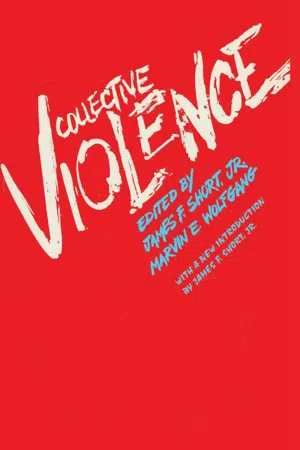
Collective Violence
About this book
Collective violence has played an important role throughout American history, though we have typically denied it. But it is not enough to repress violence or to suppress our knowledge of it. We must understand the phenomenon, and to do this, we must learn what violent groups are trying to say. Th at some choose violence tells us something about the perpetrators, inevitably, about ourselves and the society we have built.
Information
Part I
Introduction and Overview
1
Perspectives on Collective Violence
James F. Short, Jr. is professor of Sociology and director of the Social Research Center at Washington State University. He served as co-director of Research for the National Commission on the Causes and Prevention of Violence. He was dean of the Graduate School at Washington State University, 1964-1968, and has taught at the University of Chicago and the University of Hawaii. He has written or edited numerous books and articles, including Suicide and Homicide (with A. F. Henry), Group Process and Gang Delinquency (with F. L. Strodtbeck), and The Social Fabric of the Metropolis. In 1969 he was the recipient of a National Institute of Mental Health Special Fellowship and was a Fellow at the Center for Advanced Study in the Behavioral Sciences at Stanford, California.
Marvin E. Wolfgang is professor and chairman of the Department of Sociology, University of Pennsylvania. He was co-director of Research of the National Commission on the Causes and Prevention of Violence, and is a member of the Commission on Obscenity and Pornography and of the American Bar Association Commission on Correctional Facilities and Services. He has authored and edited numerous books and articles, among which are The Subculture of Violence (with F. Ferracuti), Crime and Culture, and Delinquency: Selected Studies (with T. Sellin). He was twice a Guggenheim Fellow, and was elected a Fellow of Churchill College in 1969 during his year as visiting professor at the Institute of Criminology, University of Cambridge.
THERE seems to be no end to the many books, articles, conferences, speeches, and commissions which have analyzed, diagnosed, counselled, prescribed, or proscribed concerning violence. Violence is clearly a major social problem. Crimes of violence, riots in urban ghettos, political assassinations, and campus violence have been much responsible for the appointment of four recent national commissions: The President’s Commission on Law Enforcement and Administration of Justice (1965), the National Advisory Commission on Civil Disorders (1967), the National Commission on the Causes and Prevention of Violence (1968), and —six months after the last had submitted its final report to the President (and with no public recognition of what that commission had said on the subject)— the President’s Commission on Campus Disorder (1970). These commissions have engaged the efforts of many of the nation’s most distinguished citizens and scholars. The volume of their reports has been prodigious and the flow of analysis, commentary, and rhetoric concerning their recommendations equally so.
Yet the problems remain. Why ? Is it simply a matter of inaction, of a failure to heed the voices of reason, the recommendations of study teams ? Confessing to an “increasing sense of ‘commission frustration,’” Federal District Judge A. Leon Higginbotham, at the close of the Violence Commission’s deliberations called for “a national moratorium on any additional temporary study commissions to probe the causes of racism, or poverty, or crime, or the urban crisis . . . (and) the prompt implementation of . . . (the) many valuable recommendations” of “the great commissions of recent years.”1 Judge Higginbotham doubtless echoes the sentiments of many.
It is the essence of social problems, however, that people disagree about the character, causes, and cures of situations defined as problematic. It is not enough that many people find a situation distressing. Probably few would disagree about the desirability of eliminating, or at least bringing under better social control, violent crime, urban riots, and assassinations. Even those who see in such phenomena progress toward the causes they espouse hope for the control of violence once their objectives are achieved. Violence is not in this sense problematic. What is problematic is the diagnosis of violence, its causes, its justification, and its remedies. For despite (in part, because of) the efforts of study teams and commissions, journalists, commentators, and scholars of many persuasions, disagreement surrounds these issues. Even when data and theory agreeably converge on the “root causes”—for example, on the importance of racism and poverty for understanding and controlling crime and the urban crisis—there is still much disagreement about the “root causes” of racism and poverty, in turn, and about what should be done about these phenomena.
The emergence of a social problem is an important but little understood process. One important aspect of this process—the emergence at the community level of local conditions as social problems—is examined in Chapter 22, by Peter H. Rossi and Richard A. Berk. The conditions studied have to do with retail practices by ghetto merchants, and with police practices. As social problems, they become exploitation by merchants and police brutality. Rossi and Berk present an all-too-rare analysis of this kind of transformation, the nature of which we will discuss at a later point in this chapter.
More knowledge of these processes is very much needed. Some problems, such as war and crime, appear to have an almost universal and timeless quality, yet what is considered problematic even with respect to war and crime varies considerably from time to time and place to place. When does military action of one country against another constitute war, for example, and what types of actions are permissible ? When and how does protest become revolt? What roles are played by law enforcement agents and agencies in these matters, and how do they contribute to the very behavior they are ostensibly designed to eliminate? Perhaps one of the more significant issues concerning national study commissions is whether such groups can bring themselves fully to explore and report on the role of government in perpetrating and perpetuating the violence and other social problems they wish to deter. Can or will a national advisory commission objectively examine the premises which give legitimacy to the political and economic system to which it is responsible ? And to their consequences, including possible contributions to the very problems which are the subject of investigation? National commissions dealing with crime, urban disorder, and violence have faced particularly difficult problems of this sort, despite the dedication and excellence of commissioners, staff, and consultants and the generally high quality of their work.2
Thus, the Crime Commission virtually ignored the influence of the economically powerful in defining the nature of crime in our society, and in making and implementing laws for its control. The National Advisory Commission on Civil Disorders (the Kerner Commission) labeled as a “root cause” of ghetto riots “white racism,” but failed to explore the implications for its continuance in the traditions and practices of the Congress of the United States, through seniority privileges and other means by which vested interests are protected. The Violence Commission called for a reordering of national priorities, but stopped short of full exploration of the implications for violence at home of the war in Indo-China, pleading instead for commitments to solve domestic problems “as soon as resources are available.”
A complete analysis of these matters is beyond the scope of this paper and of this volume, which is devoted to the illumination of selected aspects of collective violence—with regard to which, it must be said, many conceptual problems and questions of fact remain. We neither celebrate a feast nor herald the millennium. Instead, we turn to basics in the quest for knowledge—to fundamental questions of theory, fact, and interpretation, to analysis in greater depth of data collected in the course of commission investigations, and to new investigations. These are luxuries rarely permitted in the pressure cooker atmosphere of commission studies, deliberations, and press releases.
This volume builds on—in fact, it assumes—the efforts of national commissions and other scholarly work. Many of the authors have been associated in one or more capacities with one or more of the recent national commissions most directly relevant to our concerns, and some in advisory capacities to other levels of government and to private groups, such as the National Council on Crime and Delinquency. Several of the theoretical views discussed and the studies presented had their origins in the work of such groups.
Issues and Perspectives
The volume is divided into five parts. In this beginning chapter we present an overview of the book and in some measure bring together many of the issues and perspectives and data of the chapters that follow. No attempt is made either to synthesize all the findings or to derive an overarching and complete theory. But in these chapters there are many points in common which provide a guide to better understanding and toward solving the problems which lead to collective violence. From these points, propositional statements are formed which may eventually lead to important theory.
Part II examines basic and in some instances competing theoretical issues in the explanation of collective violence. Part III begins with comparative data on modern nation states, and continues with several examples of the comparative study of violence by anthropologists. Part IV focuses on the United States, from a variety of disciplinary perspectives and on several issues, notably political violence, the Vietnam War, violence among youth (particularly campus violence), problems of the ghettos, police violence. Part V discusses nonviolent alternatives to the solution of social problems and the usefulness of commission studies in this respect.
The seven chapters of Part II begin with Allen D. Grimshaw’s review of scholarly concern with collective violence, particularly psychological and sociological theories of social conflict. He concludes that superordinate/sub-ordinate relationships based on social categories are inherently unstable and that social violence is very likely to occur when accommodative structures lose their viability. Why they do so is the subject of several of the chapters that follow. Briefly stated, both theory and data suggest that when the assumptions underlying these relationships cease to be accepted and when their challenge by other than violent means is unsuccessful, the likelihood of collective violence is enhanced. Other factors enter in, and the form of violence (whether riots or rebellion, for example) is also problematic. It is with such matters that much of the remainder of the volume is concerned.
Chapters 3, 4, and 5 focus on “collective behavior” theories of violence. Although his title is deceptively narrow— treating of “issueless riots”—Gary Marx addresses theories of this genre at a most fundamental level, arguing that failure to make distinctions among riots based upon “their relation to ideology, social movements, and social change” is responsible for much confusion about the meaning and significance of riots.
Elliott Currie and Jerome H. Skolnick critically assess current theories of collective behavior, focusing on what they interpret to be “the anti-democratic biases in ‘crowd’ theory,” particularly the implication that collective behavior is in some sense “irrational” behavior. A more detailed critique of one of the major representatives of collective behavior theory, Neil J. Smelser, follows, together with the suggestion that the perspective elaborated in The Politics of Protest offers an alternative and more valid interpretation of recent phenomena of collective violence. Smelser’s rejoinder to the Currie/Skolnick paper, and his critique of the position set forth in The Politics of Protest, concludes this exchange.
H. L. Neiburg’s discussion (chapter 6) of “rituals of conflict” leads to the suggestion that these positions may not be as far apart as they first appear. Neiburg reviews the psychiatric, ethological, anthropological, and sociological literature concerning the importance of ritual in much behavior, and particularly that having to do with its political significance. He then analyzes the “Woodstock nation,” campus demonstrations, and a variety of other forms of youthful behavior from the point of view of the symbolic significance of the behavior for its participants. The analysis is directed to non-political as well as political aspects of behavior, and of the issues to which it is related. Neiburg suggests that much political behavior has become ritualized, and that such ritualization is functional for several reasons—it is “a low-risk energy-conserving method of experimentation, learning, social choice, and consensus building.” Some of the extreme forms of behavior engaged in by youth protesters, he argues, stem from the fact that the young, in contrast to the Blacks, are not a constituency. Such behavior represents “not principled testing of authority, but rather catharsis, trauma, and action for its own sake or for solidifying a remnant of a faction by high-risk commitments.”
In the final analysis, Neiburg concludes, “There is a self-limiting quality in ritual rebellion and high-intensity tactics of protest. It is impossible to sustain the level of excitement.” Whether or not this proves to be the case among the young, however, will depend upon the success or failure of young people in creating and sustaining the necessary ideological and structural elements which will carry beyond protest into effective social—and probably political—action. This, in turn, will depend upon a number of elements, some of which we turn to presently.
The theme for much of the book—to the extent that there is one—is set by these chapters. It is that collective violence in this country and elsewhere in the world has political implications.3 There is evidence that it has become increasingly political in focus and that it is likely to become more so. In attempting to resolve “The Paradox of American Violence” (Chapter 16), for example, historian Hugh Davis Graham concludes that “our capitalistic, federal structure has historically pitted our racial, ethnic, and economic groups against one another rather than against the state and its vital institutions.” Expansion of the power of the federal government during the depression of the 1930’s and following World War II appears to have altered this process fundamentally, as groups have come increasingly to look to government in search of redress of grievances from many sources. As a result, social conflicts have come to be identified with the political processes through which government, and particularly the federal government, operates.
In a related development, there is evidence of the increased politicization of deviant behavior in general, as the social roots and implications of labeling as deviant, groups and behavior which are different from that approved by a majority (or a powerful minority) of citizens have come under scrutiny. At the same time (and in part as a result of such study?) groups labeled as deviant have come to view their problems in ...
Table of contents
- Cover Page
- Title Page
- Copyright Page
- Contents
- Introduction To The Transaction Edition
- Preface
- Part I Introduction And Overview
- Part II Theoretical Issues
- Part III Comparative Perspectives
- Part IV Dimensions Of Collective Violence In The United States
- Part V In Search Of Alternatives
- Indexes
Trusted by 375,005 students
Access to over 1.5 million titles for a fair monthly price.
Study more efficiently using our study tools.
Frequently asked questions
Yes, you can cancel anytime from the Subscription tab in your account settings on the Perlego website. Your subscription will stay active until the end of your current billing period. Learn how to cancel your subscription
No, books cannot be downloaded as external files, such as PDFs, for use outside of Perlego. However, you can download books within the Perlego app for offline reading on mobile or tablet. Learn how to download books offline
Perlego offers two plans: Essential and Complete
- Essential is ideal for learners and professionals who enjoy exploring a wide range of subjects. Access the Essential Library with 800,000+ trusted titles and best-sellers across business, personal growth, and the humanities. Includes unlimited reading time and Standard Read Aloud voice.
- Complete: Perfect for advanced learners and researchers needing full, unrestricted access. Unlock 1.5M+ books across hundreds of subjects, including academic and specialized titles. The Complete Plan also includes advanced features like Premium Read Aloud and Research Assistant.
We are an online textbook subscription service, where you can get access to an entire online library for less than the price of a single book per month. With over 1.5 million books across 990+ topics, we’ve got you covered! Learn about our mission
Look out for the read-aloud symbol on your next book to see if you can listen to it. The read-aloud tool reads text aloud for you, highlighting the text as it is being read. You can pause it, speed it up and slow it down. Learn more about Read Aloud
Yes! You can use the Perlego app on both iOS and Android devices to read anytime, anywhere — even offline. Perfect for commutes or when you’re on the go.
Please note we cannot support devices running on iOS 13 and Android 7 or earlier. Learn more about using the app
Please note we cannot support devices running on iOS 13 and Android 7 or earlier. Learn more about using the app
Yes, you can access Collective Violence by James F., Jr. Short,Marvin E. Wolfgang in PDF and/or ePUB format, as well as other popular books in Social Sciences & Criminology. We have over 1.5 million books available in our catalogue for you to explore.