eBook - ePub
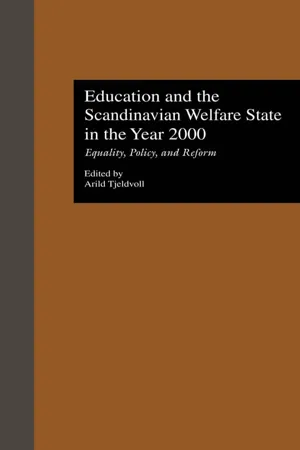
Education and the Scandinavian Welfare State in the Year 2000
Equality, Policy, and Reform
- 380 pages
- English
- ePUB (mobile friendly)
- Available on iOS & Android
eBook - ePub
Education and the Scandinavian Welfare State in the Year 2000
Equality, Policy, and Reform
About this book
This significant contribution to comparative education presents an authoritative discussion of the recent changes in Denmark, Finland, Iceland, Norway and Sweden. The implementation of a democratic educational policy in Scandinavia has been affected by the dominance of the Protestant Church, mass immigration from Third World nations, a growing belief in rugged individualism, newfound respect for privatization and the market economy, and the increasing unemployment of the technical revolution. Education has been unable to adapt rapidly enough to meet the changing needs of this transformed Scandinavia. In this comprehensive collection of articles, contributors present their findings, thoughts and concerns for the Scandinavia of both the 90s and the future.
Information
Topic
EducationSubtopic
Education GeneralPart I
The Scandinavian Setting
CHAPTER 1
Quality of Equality? Scandinavian Education Towards the Year 20001
INTRODUCTION
Social development of the countries in the Scandinavian region in our century has had a number of common features. Foremost among these is the Scandinavian model of the welfare state. Common for these countries—Denmark, Finland, Iceland, Norway, and Sweden—is that they all, by the 1970s, had developed a state organization characterized by a considerable degree of social justice. The ideal of a democratic society had been attempted and realized by means of an overall social policy, aiming at creating optimal equity of life conditions for all social groups, identified by social background, gender, ethnicity, and/or geographical location. The main implementing mandator of this policy has been an alliance of the Social Democratic Party (Labor) and its Siamese twin—the dominating and socialist-oriented trade union. Through their joint action, these two organizations have advanced what has been termed the Labor Movement.
From being politically more or less revolutionary in the first half of the century, the Movement advanced gradually towards parliamentarism and took over political power after general elections. However, the overall aim continued to be the equalization of social class differences. As part of the struggle for social justice based on socialist principles, the educational policy was chosen as a particularly important social change agent (Slagstad 1994). In line with progressive education traditions, equal access to education was both seen as a democratic right for the single individual as well as a tool for making the society more democratic collectively. By the 1970s, all citizens of Scandinavia were legally obliged to participate in a basic comprehensive education of nine years. They were also given the right to go on voluntarily to secondary and higher education. All education was free of tuition fees, and paid by the state or the municipalities. This education policy attained, especially after World War II, a high degree of consensus among the political parties on all principles of equal education for all. By the end of the 1970s most aims of this democratic education policy were achieved in all the Scandinavian countries.
During the 1980s this model faced several challenges. Even though access to schooling had been made steadily more democratic, the content of the junior secondary school remained dominated by academics and was considered difficult by many students. Difficulties in mastering the content of school subjects, coupled with a situation of growing unemployment in which the amount of education seemed not to be a guarantee for having a job after graduation, appear to have negatively influenced the motivation of students. The teaching profession also faced challenges. The recruitment pool and the social status of teachers seemed to have decreased relative to earlier times. A growing number of parents and leading employer organizations started increasingly to question the quality of teaching and the school’s productivity.
With this sketch of Scandinavian educational policies as a backdrop, the intention of this chapter is to highlight some essential aspects of the Scandinavian model as it developed itself in the 1980s. Some reflections will be made on how the new ideological signals and international educational trends started affecting this model in the beginning of the 1990s.
THE SCANDINAVIAN EDUCATION MODEL
Various obstacles needed to be overcome by the different Scandinavian countries in order to provide equal education for all citizens. As an illustration, in the case of Norway, whose citizens live spread along fjords, in passes between mountains, or on islands, it has become necessary to have many small schools with, often, very few students (Lauglo 1995). Such a solution certainly imposes high costs on public education systems. Thus, having at the same time the ambition of offering equally good teaching under equal teaching conditions in all schools, the Scandinavian public school had to become expensive.
In the three first quarters of this century, the teachers held a strong position and high social status in these countries. In regard to social background, salaries, and social status as seen by others and by themselves, Scandinavian teachers, including those working in the primary schools, ranked highest compared with similar groups in other West European and North American countries (Aubert 1956). Without going deeply into the historical background, it suffices here to mention that Scandinavian teachers have had very strong trade unions, which have been successful in their negotiations for attaining higher salaries and reducing the number of working hours. They have also been members of important commissions that dealt with educational reform questions. The teachers’ unions seemed to have worked consciously towards the criteria demanded for an occupation to become a full profession (Wilenski 1964–65).
The educational systems of the Scandinavian countries have, in general, been strongly centralist regarding curriculum, examination and governance. However, it should be noted that Denmark has been a little bit different. The lesser degree of centralism and the greater local pluralism in this country may be due to the previous position and policies of the Lutheran Church. Historically, the State Lutheran Church has had the main responsibility for and control over the educational system in the Scandinavian countries. When theological disputes within the Church developed and created threats to its unity, this problem was solved differently in Denmark as compared to the other countries. The Danish Church solved the problems by rather liberally accepting a more open institution, where different “decentralized” interpretations of Scripture were allowed. In Sweden, however, and in Norway, disputes were solved by segregating from the main church different “free churches.” Thus, the State Church continued to significantly influence the education sector. When the strong Labor Movement developed and established clear goals for educating the whole population, it became natural for this new political power in Sweden as well as in Norway to inherit the centralist role of the Lutheran State Church.
The rather strong centralism is expressed in a national curriculum for the primary and secondary school. Even though the national curricula in Scandinavia are always the product of political compromises and designed as “frame plans” expected to be further elaborated and given locally distinct form and content, they are fairly clear in their overall aims, rooted in the legal acts for the different levels of schooling. The specific subjects’ goals and content have been very distinct, taking often a more governing role for the implementation than the overall aims. The significant position of the traditional subjects has been consolidated by a centrally designed and operated examination, normally closely following the goal and content of the traditional subjects. In the implementation of the educational reform policies, the overall aims and the subjects’ goals have come to send different messages to the schools: while the aims stress democratic values, student-centered teaching and less evaluation as control, the subjects’ goals favor a traditional academic content, which means, implicitly, traditional pedagogy.
Until the 1980s, administration was centralist. The ministry of education had governed by means of centrally formulated regulations. Compliance with these rules was controlled by a state representative on the county level. Formally, school boards at the municipality level have had some influence on the implementation of the national educational policy. However, due to the centralization of the national curriculum, planning, examinations, and the fact that the state has covered the main part of the local budgets, local influence has been rather symbolic. As an instrument of goal-directed socialization, the Scandinavian comprehensive school has been more of a centralist nature. To some degree the Danish version can be seen as deviating from this pattern.
Modern Scandinavian schooling mainly represents the same curriculum tradition as previously administered by the Church. Progressivism, socialist-inspired efforts towards justice and democratization, implied mainly that traditional schooling should now be regarded as attainable by all members of the society. Looking, however, at the overall aims, especially of the primary and lower secondary schools, it is obvious that the progressivists intend a more profound change, i.e., towards greater democracy. Not only access to the traditional institution but also a democratic change in direction of content, methods, and forms of evaluation are the aims.
A democratically organized school has been seen as a means for achieving the optimal self-realization of the individual, as well as of specific social groups, and for further democratization of the whole society. From the beginning of the 1980s, this intention has been reinforced because of the substantial immigration from Third World countries and from South/East Europe.
An example of how far this progressivism has developed is found in Norway’s National Curriculum of 1987. Here it is stated as an overall principle that in the practical work of the classroom, teaching/learning activities shall always have the specific socio-cultural and academic characteristics of the single student as their point of departure—a distinctly student-centered pedagogy (Norwegian Ministry of Education 1987). During the 1970s the “modus operandi” among educationalists was towards a “problem-oriented and project work-pedagogy” (Illeris 1981). These principles were seen as the basis for creating a motivating environment towards what is considered traditional as well as critical knowledge and creating favorable conditions for instilling democratic values and skills. Group work was expected to be a more efficient form of organizing the students and it was, therefore, seen as an important part of a pedagogy with democratic and humanistic educational aims.
The Scandinavian education model at the beginning of the 1980s can be seen as characterized by a considerable degree of general political consensus on the comprehensive school principle. Also, it seems fair to say that a majority of the population prefers humanistic and progressivist pedagogy to the traditional teacher-centered teaching. The radical political critique of the 1960s and 1970s of an academically and traditional knowledge-oriented pedagogy (and, therefore, of a school reproducing social inequalities) had gained significant ground in the national curricula and within the teaching profession. The critique had a considerable impact on the theory and practice of teachers.
There is then a dualism in this model which has on one side a traditional liberal arts curriculum with traditional examinations and a centralist governance but, on the other side, a radical, humanistic and process-oriented understanding of what constitutes a valid school. In Denmark, however, this dualism has been more noticeable than in the other Scandinavian countries. The specific Danish traditionalism may also have been reinforced when the country joined the European Union (EU) in 1972. Even though it is always stressed by the EU that all member countries have absolute independence in their education policies, the Danish membership may very well, indirectly, have brought the country closer to the more academic and conservative continental tradition of what is considered “proper schooling.”
In contrast to the public humanistic and democratic image of Scandinavian education defended at the beginning of the 1980s, there is a stronger demand for a more academic type of education from certain groups of parents and students who have been expressing discontent with the quality of the schools. However, the society is confronted with the reality that a larger amount of education is no longer any safe guarantee of finding a position in an ever-shrinking job market which also requires a higher level of intellectual skills. From the conservatives and the extreme right-wing activists one hears an increasingly more distinct critique of the Scandinavian model. It is accused of being too process oriented, too concerned about equality, and not concerned enough about basic knowledge and competition. It is also seen as too expensive. Even though enrollments have been decreasing, the number of teachers has not followed the same curve, implying that more teachers are doing less work than before. The teachers trade unions are seen as having too much power, even to some degree, illegitimate power, both in negotiations over teachers’ salaries and over educational policies. If one takes a look outside the Scandinavian scene, it is not difficult to discover what might have reinforced the critique of the humanistic and democratic Scandinavian model.
INTERNATIONAL IDEOLOGICAL CHANGES
The external ideological pressure on Scandinavia may be exemplified by two important documents. One is the American study A Nation at Risk, from 1983 (Rydin 1991) and the other is the English document 1988 Educational Reform Act (Todd 1991). In the United States the lack of quality in the decentralized American education model was seen as seriously threatening the nation’s international competitive force and, by that, jeopardizing the position of a superpower. Similarly, Mrs. Thatcher’s re-evaluation of the English decentralized, and teacher-dominated system, found that the system was not a valid means for producing the necessary competence to enable the country to fulfill its ambitions in the international economic competition.
After the fall of the Berlin Wall and all the “velvet revolutions” in East/Central Europe, a clear market economy, based on classical liberalist philosophy and political conservatism, replaced Marxist and socialist collective thinking all over this part of Europe (Tjeldvoll 1992). In Russia, the change was seen as logical, not in the direction of some sort of a Scandinavian-style capitalist planned economy and social democracy but as a turn to what the former communist leaders had once labeled their enemy’s form of economy—wild capitalism. Many people in the East naturally thought that when communism was gone, the alternative had to be the opposite—”wild capitalism and rugged individualism”—the model of the formerly described enemy.
A substantial part of the ideological house cleaning in East/Central Europe was related to the reformulation of education policies. Education had been seen by whose predecessors as an extremely important means in the struggle to change society. The people that took over power thought similarly. A re-socialization of the teaching profession was seen as an urgent step.
In East/Central Europe one finds both “a return to the past,” meaning that the classic liberal education subjects have been brought back to their former position and an early organizational streaming, or differentiation, of the students is again seen as functional. At the same time there is a distinct progressivist American influence—social studies on human rights and student-centered teaching are now introduced in the East as part of the Western cultural support to the new democracies. This rapid shaping of a “neo-conservative educational paradigm” (Kozma 1992) in its geographical neighborhood, has probably influenced the general climate of educational policy making in Scandinavia. The influence of this new paradigm may have been reinforced by an intense and increasing discussion in the region, excluding Denmark, about whether or not to join the European Union.
In summarizing the characteristics of the change process of educational ideology gaining momentum at the beginning of the 1990s, one might claim that a change is taking place, moving from the socio-political and economic ideas of Karl Marx to those of Adam Smith. There is also a change from solitary collective to individual competition as the primary frame of reference for the political power’s analysis of social problems, policy formulation, and policy implementation. In the field of educatio...
Table of contents
- Cover
- Half Title
- Title Page
- Copyright Page
- Table of Contents
- Series Editor’s Foreword
- Preface
- Introduction
- Part I: The Scandinavian Setting
- Part II: Reforms of the 1990s
- Part III: The Future
- Contributors
- Index
Trusted by 375,005 students
Access to over 1.5 million titles for a fair monthly price.
Study more efficiently using our study tools.
Frequently asked questions
Yes, you can cancel anytime from the Subscription tab in your account settings on the Perlego website. Your subscription will stay active until the end of your current billing period. Learn how to cancel your subscription
No, books cannot be downloaded as external files, such as PDFs, for use outside of Perlego. However, you can download books within the Perlego app for offline reading on mobile or tablet. Learn how to download books offline
Perlego offers two plans: Essential and Complete
- Essential is ideal for learners and professionals who enjoy exploring a wide range of subjects. Access the Essential Library with 800,000+ trusted titles and best-sellers across business, personal growth, and the humanities. Includes unlimited reading time and Standard Read Aloud voice.
- Complete: Perfect for advanced learners and researchers needing full, unrestricted access. Unlock 1.5M+ books across hundreds of subjects, including academic and specialized titles. The Complete Plan also includes advanced features like Premium Read Aloud and Research Assistant.
We are an online textbook subscription service, where you can get access to an entire online library for less than the price of a single book per month. With over 1.5 million books across 990+ topics, we’ve got you covered! Learn about our mission
Look out for the read-aloud symbol on your next book to see if you can listen to it. The read-aloud tool reads text aloud for you, highlighting the text as it is being read. You can pause it, speed it up and slow it down. Learn more about Read Aloud
Yes! You can use the Perlego app on both iOS and Android devices to read anytime, anywhere — even offline. Perfect for commutes or when you’re on the go.
Please note we cannot support devices running on iOS 13 and Android 7 or earlier. Learn more about using the app
Please note we cannot support devices running on iOS 13 and Android 7 or earlier. Learn more about using the app
Yes, you can access Education and the Scandinavian Welfare State in the Year 2000 by Arild Tjeldvoll in PDF and/or ePUB format, as well as other popular books in Education & Education General. We have over 1.5 million books available in our catalogue for you to explore.