eBook - ePub
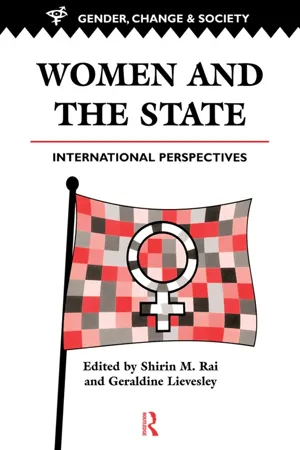
Women And The State
International Perspectives
- 182 pages
- English
- ePUB (mobile friendly)
- Available on iOS & Android
eBook - ePub
About this book
Offering a wide-ranging selection of case studies, this book evaluates women's political, social and economic involvement in Third World countries. It explores both specific experiences of women as well as common themes such as identity, empowerment and the conflict between tradition and modernity.
Information
Chapter 1
Women and the State in the Third World: Some Issues for Debate
This chapter examines the debates on the state within the feminist literature. It stresses the importance of bringing the state back in to any discussion of women’s lives in the Third World. I use the term ‘the state’ not as signifying a unity of structure and power. The state is used here as a shorthand term to describe a network of power relations existing in cooperation and also in tension. I do not regard these relations as based on a reductionist explanation of socio-economic systems but rather situate these power relations within a grid which is composed of economic, political, legal and cultural forms all interacting on, with and against each other. Such an approach allows us to examine the state within the context of social relations which are affected by systems of power, and which affect these systems through the struggles against these systems. Further, such an approach allows a space within which to give importance to the ‘form’ that states take in different historical contexts. One such historical context is that of colonialism, which has marked the development of Third World states. While accepting that the Third World encompasses countries with very different social, historical and economic traditions, this chapter raises some issues about the post-colonial states as they have emerged from struggle against imperialisms and colonial rule. The Indian colonial and post-colonial experiences form the basis of some general observations, firstly on the importance of the post-colonial state as a conceptual and political category for Third World women and secondly on the implications of this understanding for the strategies available to women in their struggle against and negotiations with post-colonial states.
I will begin by examining some recent interventions in feminist state theory. I argue that Western feminist state theory has largely ignored the experience of Third World women under the post-colonial state. The assumptions made are West-centred but the theorizing takes on a universalizing language. Similarly, theories of the ‘developmental state’ (as opposed to ‘theories of development’ in general) have developed in gender-blind and sometimes Orientalist ways (Joseph, 1993, p. 26), and therefore ignore the particular relationship that women in the Third World find themselves in vis-à-vis the post-colonial state. Both tend to overlook the processes of state and class formations in the Third World, and therefore the relations of exploitation operating in the economic and the socio-political terrain. This further leads to assumptions about the nature of struggle and the strategies that can be included or are to be excluded from the ambit of struggle. There is now a growing literature on women and the state in the Third World, which seeks to challenge the universalizing language of the Western feminist and developmental state discourses about women, the state, and struggle. I will argue that what we need is a continuing and more focused debate about women and the post-colonial state as Third World women come to experience not only national but international economic and political power in the era of economic restructuring and institutional (rather than necessarily political) democratization. Such a focus will also allow us to examine the growing and diverse arenas of women’s political activities which include not only opposition but negotiation, not only struggle but also strategic bargaining in spaces that are intersections of the private and the public spheres.
Western Feminist Interventions in State Theory
The state, as a concept and as a network of power relations, evokes deep suspicion, anger, fear, and hostility among feminists. This suspicion of the state has more recently been supported by poststructuralist explanations of power. Indeed, since the 1970s, the concept of the state has been so reduced in status that its very existence has been brought into question. ‘Where the concept remains in everyday use, it is used descriptively, mostly by the “practitioners” of social policy and social welfare’ (Pringle and Watson, 1992, pp. 54–5). However, during the 1970s and 1980s there was also a growing sense of the power of the state as the welfare state became more important in the lives of individuals – regulating, defining, providing and monitoring. Women began to enter the arena of local politics and legal disputes in order to represent their own interests (Pringle and Watson, 1992).
There have developed in Western feminist theory two very different approaches to the question of the state. Historically, both have roots in the experience of women’s movements in different contexts. In countries with strong class affiliations and a tradition of class-based political action like Britain, feminist writing was dominated by the Marxist analysis of the state as an oppressive instrument of the ruling (capitalist) class. Marxist feminists added the ‘woman question’ to the class question in capitalist societies by emphasizing the role of the state as a mediator between the two different but complementary systems of patriarchy and capitalism (Wilson, 1977; Eisenstein, 1979). In countries with a strong tradition of welfare state politics, there has been less resistance to dealing with the state. In Australia and Scandinavia for example, a positive value has been place on state intervention, and the state has been more clearly seen as an arena for bargaining among interests (see Hernes, 1987). Women’s interests have been regarded as one among others, and feminists have insisted that they must be articulated within that space. Not only has the question of interest articulation been seen in a positive light, but also that of participation in state functioning. The ‘femocrat’ is the creature of this strategy of influencing the state in the interests of women by infiltrating it (see Franzway et al., 1989). Though the Marxist feminist and the institution-based approaches took very different views of the state, both acknowledged the state as a reference point in feminist politics. Both also spoke of the state in institutional and functionalist terms. In sum, both took the state seriously.
The other Western feminist approach towards the state has been inspired by poststructuralism. Within this category too there are differences. Some would regard politics as a ‘set of debates and struggles over meaning’, and the state as ‘erratic and disconnected rather than contradictory’. They would point out that what ‘intentionality there is comes from the success with which various groupings are able to articulate their interests and hegemonize their claims: it is always likely to be partial and temporary’ (Pringle and Watson, 1992, pp. 61, 63). Further, poststructuralist feminists would argue that the focus of our analysis of public power should not be an impossible unity of the state, but micro-level organizations and institutions that affect individual lives daily. Unlike the Marxist feminists, they do not see the state, in its dispersed sense, as simply reflecting and bolstering gender inequalities, but consider that ‘through its practices, [it] plays an important part in constituting them; simultaneously, gender practices become institutionalized in historically specific state forms. It is a two way street.’ (Pringle and Watson, 1992, p. 64). A more radical feminist response to the issue of the state asks the question ‘whether the state is a specifically problematic instrument or arena of feminist political change’ (Brown, 1992, p. 8). This poses the dilemma that the poststructuralist feminists discussed above have not acknowledged in full. ‘If the institutions, practices, and discourses of the state are as inextricably, however differently, bound up with the prerogatives of manhood in a male-dominated society … what are the implications for feminist politics?’ (ibid.). The answer given to this question by postmodern feminists would be to suggest that for women to ‘be “protected” by the very power whose violation one fears perpetuates the specific modality of dependence and powerlessness marking much of women’s experience across widely diverse cultures and epochs’ (ibid., p. 9). The state in this analysis is a regulating, constraining, structuring network of power, and interaction with it can only have one outcome – the production of ‘regulated, subordinated, and disciplined state subjects’ (see also Smart, 1989 and 1992; Allen, 1990).
These debates among Western feminists are on-going. What is particular about this debate, and unsurprising, is that it has focused almost exclusively on Western state formations and processes. While some postmodern feminists do point to how the ‘process of decentering and diversifying politics has helped increase the visibility of historically marginalised interests and perspectives, for example, feminist, postcolonial and “Third World” interests’ (Weedon, 1993), questions such as whether the post-colonial state poses any particular problems for women, whether Third World women can relate such a West-centred debate to their own lives, and whether an analysis of Third World states by feminists might throw up questions for feminists theorizing and debating the state, have not been asked. Are there any particular features of the post-colonial state that challenge or problematize Western perspectives of the state? Which of these features need to be taken into account by Third World women when they consider their own relationship with the state?
The Colonial State and its Legacy
We cannot understand the various constituting power relationships of the post-colonial state without reflecting on the legacy of colonialism in the Third World. This legacy has been material, cultural and political. The relationship between the colonial powers and the colonies, while based on economic exploitation of one by the other, encompassed a complex set of changing relationships.
The colonial powers’ bargaining with important political groups within colonial societies as well as the introduction of new socio-economic arrangements brought about different results for men and women. The process of privatization that took place during colonial rule is a case in point (see Agarwal, 1992). With increasing control over common land, the colonial state was able to refashion the relationship of men and women to natural resources. Needed to supply the demands of the British colonial navy, for example, the monopolization of forest resources led to significant deforestation in India. The commercialization of agriculture as a means of extraction of economic surplus also led to a curtailment of the customary rights of local populations to common lands. Given the greater dependence of women on the forests as well as on common grazing areas and village wells, the impact on the quality of their lives and on their economic positioning within the community was significantly affected (Agarwal, 1992). However, the colonial powers refashioned gender relations within colonized countries through the exercise of not only material but also discursive power.
The colonial interventions in the traditional systems of economic production were paralleled by reinterpreting and reinventing the social and political histories of the colonized countries as means of supporting a modernizing ideology which at the same time delegitimized the traditional societies that were now subjugated.
Perhaps one of the most important aspects of any relationship that is defined by a significant imbalance of power is how the narrative of the one is given legitimacy over the narrative of the other. This is the case not only when the more powerful is defining itself, but also when it is defining the other. (Liddle and Rai, 1992)
The image of the colonized societies created in the Orientalist discourse was a complex one. On the one hand there was a recognition of ‘lost glory’ of past civilizations, on the other hand the image of barbarity and decline. While explaining the fall of ancient cultures this discourse also legitimized colonial rule within the framework of modernity. Exoticism and degradation – both are images that we recognize today as signifying the Third World – were used as explanatory and legitimizing devises to construct a hegemonic discourse that was rooted in the Western philosophical and historical traditions of the Enlightenment.
Orientalist discourse used highly emotive images of social evils to mark the colonized societies as barbaric and in need of the civilizing hand of the colonizing powers. In creating this discourse women’s bodies were particularly important – in sati, child marriage, footbinding, clitoridectomy – as symbolic of the condition of the societies in which they live. On the one hand, we find a construction of colonial women as ‘naturally’ libidinous and out of control (as opposed to the placid and controlled Victorian woman), on the other, they are victims of a vicious, though male population, needing the protection of the civilizing colonial state. Not only were women’s bodies symbolic in this discourse, men too were normalized as either effeminate or ‘martial’ – products of social practices that impacted on the genetic pool of a whole population.
The nature of colonial interventions was, however, not uniform. Concerns of administrative and political control, developing of an infrastructural network supporting economic extraction as well as suppressing opposition to colonial rule, bargainings with traditional authority structures, and the strength of local and national oppositional movements, meant that colonial states intervened in socio-economic systems of their colonies in unsystematic ways. Not always were laws made to reflect the dominant power relations in the colonial countries. For example, in India, the matrilineal traditions that were widely prevalent in some southern states were abolished through the imposition of patriarchal legal arrangements that had their basis in English property law. While matriliny was deemed ‘immoral’ the colonial government continued to accept the Muslim practice of polygamy.
Another feature of colonial intervention was an attempt to simplify traditional social and economic arrangements in order to be able to introduce new rules and regulations and laws that were needed to formalize their power relationships as well as support the need for surplus extraction. The complex and different socio-economic arrangements got in the way of the standardization of procedures required for administration. This simplification of traditional social codes also allowed the colonial powers to reproduce hegemonic discourses and give them legal force. This process of simplification in India, for example, privileged the social practices of the educated, upper-caste Brahmins, which were codified in laws governing all Hindus in India, while practices of marriage, property rights, access to social spaces etc. varied enormously from one caste to the other, one state to the other. ‘Official discourse … had palpable material consequences, of which the constitution of personal law from [dominant] religious texts is perhaps most significant from the point of view of women’ (Mani, 1989, p. 91).
The Nationalist Discourse: Ideological Foundations of the Post-Colonial States
The nationalist opposition to colonialism was mounted largely within the modernizing parameters that were privileged by the colonists. However, as Sarkar has pointed out, colonial subjugation produced not a ‘full-blooded bourgeois modernity’ but a ‘weak and distorted caricature’ (Sarkar, 1975). In this context Mani’s work on debates on sati in colonial India is valuable. She contends that the conception of tradition that the modernizing nationalists attacked and the traditionalists defended is one ‘that is specifically “colonial”’ (Mani, 1989, p. 89). This implies the normalizing of the colonial modernist and Orientalist discourse within the indigenous elites who were to take over the reins of power upon decolonization.
If the colonial powers used women’s bodies as sym...
Table of contents
- Cover
- Half Title
- Title Page
- Copyright Page
- Contents
- Acknowledgments
- Introduction
- Chapter 1 Women and the State in the Third World: Some Issues for Debate
- Chapter 2 Should Women Give Up on the State? – The African Experience
- Chapter 3 Stages of Growth? – Women Dealing with the State and Each Other in Peru
- Chapter 4 State-Building in the Absence of State Structures: Palestinian Women in the Occupied Territories and Shi'i Women in Lebanon
- Chapter 5 En-Gendering the Nation-State: Women, Patriarchy and Politics in Algeria
- Chapter 6 Democratization, Feminism and the State in Chile: The Establishment of SERNAM
- Chapter 7 Dis/Organizing Gender: Women Development Agents in State and NGO Poverty-Reduction Programmes in Bangladesh
- Chapter 8 Working from Within: Women and the State in the Development of the Courtyard Economy in Rural China
- Chapter 9 Women, Migration and the State
- Notes on Contributors
- Index
Trusted by 375,005 students
Access to over 1.5 million titles for a fair monthly price.
Study more efficiently using our study tools.
Frequently asked questions
Yes, you can cancel anytime from the Subscription tab in your account settings on the Perlego website. Your subscription will stay active until the end of your current billing period. Learn how to cancel your subscription
No, books cannot be downloaded as external files, such as PDFs, for use outside of Perlego. However, you can download books within the Perlego app for offline reading on mobile or tablet. Learn how to download books offline
Perlego offers two plans: Essential and Complete
- Essential is ideal for learners and professionals who enjoy exploring a wide range of subjects. Access the Essential Library with 800,000+ trusted titles and best-sellers across business, personal growth, and the humanities. Includes unlimited reading time and Standard Read Aloud voice.
- Complete: Perfect for advanced learners and researchers needing full, unrestricted access. Unlock 1.5M+ books across hundreds of subjects, including academic and specialized titles. The Complete Plan also includes advanced features like Premium Read Aloud and Research Assistant.
We are an online textbook subscription service, where you can get access to an entire online library for less than the price of a single book per month. With over 1.5 million books across 990+ topics, we’ve got you covered! Learn about our mission
Look out for the read-aloud symbol on your next book to see if you can listen to it. The read-aloud tool reads text aloud for you, highlighting the text as it is being read. You can pause it, speed it up and slow it down. Learn more about Read Aloud
Yes! You can use the Perlego app on both iOS and Android devices to read anytime, anywhere — even offline. Perfect for commutes or when you’re on the go.
Please note we cannot support devices running on iOS 13 and Android 7 or earlier. Learn more about using the app
Please note we cannot support devices running on iOS 13 and Android 7 or earlier. Learn more about using the app
Yes, you can access Women And The State by Shirin Rai,Geraldine Lievesley,Shirin M. Rai in PDF and/or ePUB format, as well as other popular books in Politik & Internationale Beziehungen & Politik. We have over 1.5 million books available in our catalogue for you to explore.