- 390 pages
- English
- ePUB (mobile friendly)
- Available on iOS & Android
eBook - ePub
About this book
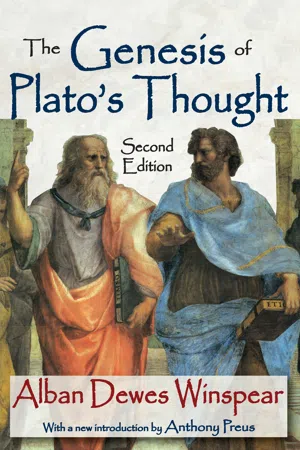
It is often said that to understand Plato we must understand his times. Many readers who might accept without question this saying of historical criticism may still wonder why we should think it necessary to begin our enquiry as far back as Homer and beyond. In the case of Plato there is an even greater need to pursue the argument back to the very beginnings of the historical period in which he lived and worked.It is quite impossible to understand the genesis of Plato's ideas without understanding the profound change that Greek society underwent in the post-Homeric period that preceded him. This change in social structure created a mercantile, progressive Greek society, one which laid the foundations for all the subsequent history of Europe and the West. The Genesis of Plato's Thought is particularly highly regarded because it departs vigorously from the traditional abstract, static view of Plato's thought.Winspear's volume on Plato's thought traces, in a realistic fashion, the deep-reaching social and economic roots of Plato's concept of the state and society. Winspear believes that nowhere can the social roots of philosophy be more sharply seen and more firmly apprehended than when one is dealing with the origins of Western philosophy among the Greeks. His book contains the body of information which any reader should have if they wish to approach Plato as a historical figure. To make the book useful to a wide circle of readers, brief biographical identifications for the various important figures of Greek life are introduced in the text.
Information
Part One
The Approach to Plato
1
From Oriental to Occidental Society
To understand Plato we must understand his times. Many readers who will accept without question this dictum of historical criticism may wonder why we should think it necessary to begin our enquiry as far back as Homer and beyond. It would be almost as though we were to say that in order to understand John Dewey one must first make a careful study of the Italian Renaissance. Even this latter judgment is not entirely absurd. In the last analysis any historical figure can not be isolated from the total context of ideas and forces that have gone into his making. But in the case of Plato there is an even greater need to pursue the argument back into the very beginnings of the historical period. And it is quite impossible to understand the genesis of Plato’s ideas without understanding the profound change that Greek society underwent in the post-Homeric period. It is, in brief, the change in social structure which created mercantile, progressive Greek society and laid the foundations for all the subsequent history of Europe and the West.
The unified tribal order represented in its latest stage in the Homeric poems broke up under the influence of changing technical and economic organization; great inequalities appeared in the possession of property; there were consequent clashes of political factions, and a new form of political organization arose—the city-state. Too many of our historians have treated this period under the influence of the prejudice that all historical evolution proceeds in an unbroken series of gradual and imperceptible changes—that nature and history do nothing “in a leap.” (Nihil per saltum facit natura.) In our view it is impossible to appreciate fully the development of Greek thought without understanding how thoroughgoing and revolutionary was the change that came over Greek society in this period. For most of the leading ideas of Plato make their appearance, at least in embryonic form, in the changing relations of man to his environment as shown in the transition from the tribe to the state. To this process we must devote considerable attention before we even approach Plato’s philosophy.
Let us first then characterize, though very briefly, the social organization of an Oriental type which lies in the dim and shadowy background of Greek thinking. Civilization seems to have developed first in the great river valleys of the world—the Ganges, the Tigris and Euphrates, and the Nile. (We can here disregard Aztec culture, where another factor was operative.) This early development, we can suppose, was due to one major factor—the availability of water for purposes of cultivation. More concretely, in these favored regions, man early in his career learned to control the water supply either by means of a system of irrigation or else by a system of conservation. This factor was of decisive importance for social organization. It meant, in the first place, that everyone who took part in the processes of primary production, namely agriculture, must be a member of the communal society, alert and responsive to its sanctions. The whole system of control of the water supply, its use as needed for cultivation, was much too delicate to be entrusted to slave labor. Slaves, as we shall see in a few moments, were used for quite different purposes. Moreover such a system of agriculture made necessary a directing group—we might even describe them as a bureaucracy if that word had not come to acquire so many invidious connotations. These men were needed to co-ordinate the work of communal production and to ensure exactitude in the carrying out of assigned tasks. Moreover these men had to develop certain bodies of knowledge. They had to know something of weather and the seasons; they had to develop astronomical investigation. They had to manage the distribution of the land; this led them to discoveries in the science of geometry and mathematics. At first these technicians, directors, and research workers seem to have been elected from the tribe. But as it became necessary to provide this group of people with sustenance, though they took little or no part in direct production, as, in other words, they had to live from a tribute paid in kind, they naturally hardened into a caste, one degree removed from the work of primary production.
It is important for the technique of analysis that we shall use in this book to notice that this “bureaucracy” of technical and intellectual workers was in no sense parasitic. On its stability and continuity depended the very life of the community. And yet it was necessary to invoke sanctions for their privileged position. And this was the social function of ancient religion in Oriental society. Arguing from the analogy of Polynesia, Prof. Karl H. Niebyl suggests that primitive taboos and totem cults, originally developed to safeguard biological reproduction, became a system of sanctions to safeguard the executive and directive tasks of society. The guarantor of procreative relations—the mater familias in primitive agricultural societies, the pater familias in early hunting societies, became divorced from their particular representatives in a concrete human individual just as the need for stability and continuity in “executive” functions became divorced from actual production. Hence arose ancestor cults, and, as society matured, a deity, who became the responsible executive in charge of the direction of communal affairs. Hence, too, the need to develop magnificent cult objects for the greater glory of the directing priesthood. For the construction of these cult objects, temples, say, or pyramids, slaves were used. And this is the social function of slavery in society of an Oriental type. The children of Israel in their Egyptian captivity, let us remember, were set to work collecting straw and making bricks under the lash of an Egyptian taskmaster. Slavery in such a society could not, let us repeat, be used in the actual labor of production, which required a high degree of social responsibility in all who took part in the work. Carelessness or malice could do profound social harm, and every worker on the land must be included within the sanctions of the tribe. This will explain why, in the famous code of Hammurabi, a provision was made for the instant freeing without compensation of a slave, who by accident was sold back to his native land and tribe.
The point is quite central for the developing theme of this book. We shall observe later that in Greek society and the classical world generally, slaves were used for a very different purpose:—they took part in production, on the land, in mine and workshop. We can, therefore, hold that classical society was based on slave labor. By this we do not mean that all who worked in the production of goods in such a society were slaves. We mean rather to contrast classical society with Oriental society, which had not yet developed to the point where slaves could be used for productive purposes and, say, modern society based on the free laborer and the machine. To this point we shall return in a few moments.
As Oriental society succeeded in solving its primary problems, as agriculture became efficient and the bureaucracy entrenched, we find a relative and temporary pressure of population, a need to expand, to bring into cultivation all possible irrigable land. The tendency to expansion and a kind of mobility within Oriental society was enhanced by two other factors. One was the growth of the semi-independent farm unit, a development which was encouraged by the bureaucracy in order to make more simple and efficient the collection of tribute in kind. The semi-independent farm made possible the use of metal tools and permitted the domestication of animals. At this point there emerges the development of husbandry as a derivative of the agricultural life of the river-valley cultures. Animals were exchanged for the food surplus which these cultures were beginning to develop. But husbandry presupposed a continuity of food supply, and this could not be found within any single oasis. As a consequence the family units engaged in husbandry began a regular series of migrations from oasis to oasis. At this point contact between the river-valley cultures became established and an exchange of products on the basis of barter became possible.
The bureaucracy and priesthoods, by now thoroughly congealed into a caste, thus found a usefulness for surplus tribute. As the volume of this tribute gradually outdistanced the consuming power of the officialdom, there developed the increasing exchange of unconsumed surpluses and the consequent pressure to have exportable produce replace goods for home consumption. But this pressure in turn increased the exploitation of those engaged in agricultural work. This pressure, however, had to reach a limit, for the productive capacity of the peasants was objectively limited by the available water supply. Here then, we can suppose, was the fundamental factor which broke up the relative stability of Oriental society and forced the great period of migrations which characterized the second millennium before Christ. But let us notice that Oriental trade, which fostered the increasing importance of crafts and handi-craft articles and tended to undermine agricultural production and create a relative shortage of food, was not yet a function of society that had released itself from communal relations. Trade or barter was still the prerogative of the priesthood and the bureaucracy.
Into the details of the migrations we need not enter. We shall see later that the entrance of the Greeks into the Hellenic peninsula laid the basis for two quite different types of historical development which we shall describe, roughly, as the Spartan and the Athenian. Moreover, the period of migrations increased immeasurably (as we shall see) the importance of the military leader and laid the basis for a specialization of function as between priest and “king.” Increasingly the relative scarcity of foodstuffs gave rise to piracy as well as barter, and certain well-defined “trade routes” begin to appear—particularly the Black Sea. This development is reflected in literature in the famous voyage of the Argonauts and the quest for the Golden Fleece, i.e., wheat. This is, in spite of the golden aura of its literary and mythological setting, simply trade in the form of piracy—a direct outgrowth of this relative scarcity of foodstuffs.
As the migrant Greeks settled in their new homeland, conditions were ripe for a new and profoundly important advance.
One was the increasing importance of the vine and olive tree in the “economic” life of these peoples. Perhaps the development of cults and worships to which we have already referred was an important factor in this situation. Oil too, as we shall observe, was important for the toilet of the body and the manufacture of clothes. The use of wine may have been fostered by the relative scarcity of drinking water in Greece. At all events, the culture of the vine and olive became increasingly important in Homeric and post-Homeric times.
Other factors conditioned the development of Grecian economic life—the small size of the valleys and the difficulty of resuming agricultural production on the large scale of the river valleys. What is more, the climate of the Aegean was more suitable for agriculture, rainfall was fairly abundant, and there was no need, therefore, to depend on elaborate techniques of irrigation.
All this meant one thing. Agricultural production took an entirely new form, and the use of slaves in production became possible for the first time. This tremendous advance quite revolutionized the basis of society, broke up once and for all the gentile structure, differentiated agriculture from trade, and led to the “progressive” society of Greek antiquity. Nonetheless, slavery was slow to develop, and it took several centuries for the implications of these new institutions to work themselves out.
The reader may forgive this rather breathless survey of a great deal of social development. For an understanding of these factors is entirely necessary in order to comprehend the life and thought of classical Greece.1 We can now examine the transition from Oriental to Occidental society in some detail.
For the society of the Homeric period we have the evidence of Homer’s poems, now abundantly supported by the findings of archaeology. And within the structure of the two poems we are able to trace several important social advances which rest in turn on technical improvements, as well as the more fundamental development of the institution of slavery. First, then, in our brief examination of Homeric society let us notice that slavery in the period under review seems to have played an increasing role in economic and social organization. There is much more mention of slaves in the Odyssey than in the Iliad. But even here their numbers are not large. Alcinoüs and Odysseus each boast of fifty2 (and this may be a poetical round number), but these are female slaves and do not figure much in primary production. They weave and tend the loom, and “work at the mill” (grinding grain), but these household tasks are the economic tasks of that day. There is no example of either of the words used in Greek for slave—doulos or andrapodon. Male captives seem to have been for the most part slain; women were taken “to walk to and fro before the loom and tend the couch.” Slavery is still patriarchal slavery, and the kind of social organization that bases itself on slave labor is still in the mists of the future. Moreover, relations between slave and master (or mistress) seem to have been close and cordial. Nausicaä, the king’s daughter, washes the linen together with her handmaidens; then they bathe, anoint themselves, and play with a ball together, almost as equals. The scene is one of great charm with not a hint of the more brutal and oppressive slavery of a later day. Patroclus, when entertaining one of the heroes, gives commands to his companions (presumably free) equally with the domestic slaves.3 Achilles does likewise when the aged Priam comes to visit him.4 The handmaidens of Andromache are addressed by the complimentary title “fair-tressed maidens.”5 Moreover the...
Table of contents
- Cover Page
- Half title
- Title Page
- Copyright Page
- Contents
- Introduction to the Transaction Edition The Genesis of Winspear’s Thought
- Preface
- PART ONE The Approach to Plato
- 1 From Oriental to Occidental Society
- 2 The Spiritual Revolution
- 3 The Great Age of Athenian Democracy
- 4 The Conservative Philosophy
- 5 The Progressive Philosophy
- 6 The Life of Plato
- PART TWO The Republic of Plato
- 7 The Argument with Thrasymachus— What Is Justice?
- 8 The Social Contract Theory of the Origin of the State
- 9 The Sociology and Psychology of the Platonic Virtues
- 10 The Education of the “Guards”
- 11 How the “Guards” Were to Live
- 12 The Philosophy of Plato
- 13 The Academy and the Later Dialogues
- Suggested Reading
- List of Abbreviations
- Footnotes
- Index
Trusted by 375,005 students
Access to over 1.5 million titles for a fair monthly price.
Study more efficiently using our study tools.
Frequently asked questions
Yes, you can cancel anytime from the Subscription tab in your account settings on the Perlego website. Your subscription will stay active until the end of your current billing period. Learn how to cancel your subscription
No, books cannot be downloaded as external files, such as PDFs, for use outside of Perlego. However, you can download books within the Perlego app for offline reading on mobile or tablet. Learn how to download books offline
Perlego offers two plans: Essential and Complete
- Essential is ideal for learners and professionals who enjoy exploring a wide range of subjects. Access the Essential Library with 800,000+ trusted titles and best-sellers across business, personal growth, and the humanities. Includes unlimited reading time and Standard Read Aloud voice.
- Complete: Perfect for advanced learners and researchers needing full, unrestricted access. Unlock 1.5M+ books across hundreds of subjects, including academic and specialized titles. The Complete Plan also includes advanced features like Premium Read Aloud and Research Assistant.
We are an online textbook subscription service, where you can get access to an entire online library for less than the price of a single book per month. With over 1.5 million books across 990+ topics, we’ve got you covered! Learn about our mission
Look out for the read-aloud symbol on your next book to see if you can listen to it. The read-aloud tool reads text aloud for you, highlighting the text as it is being read. You can pause it, speed it up and slow it down. Learn more about Read Aloud
Yes! You can use the Perlego app on both iOS and Android devices to read anytime, anywhere — even offline. Perfect for commutes or when you’re on the go.
Please note we cannot support devices running on iOS 13 and Android 7 or earlier. Learn more about using the app
Please note we cannot support devices running on iOS 13 and Android 7 or earlier. Learn more about using the app
Yes, you can access The Genesis of Plato's Thought by Alban Winspear, Russell Tuttle in PDF and/or ePUB format, as well as other popular books in Philosophy & Ancient & Classical Philosophy. We have over 1.5 million books available in our catalogue for you to explore.