![]()
Bird 2
Adult-led focus activities
1 Observation
When birds begin life, they cannot fly. They hatch from an egg and have to be fed by their parents for a number of weeks before they are strong enough to test their wings and fly on their own. In the first activity, the children are given the opportunity to observe birds in flight as they arrive to eat and drink in the setting outdoor area, or in an aviary. It is unlikely that the children will be able to view baby birds emerging from their nest at very close quarters, as they might frighten the parent birds and cause them to abandon their young, but video clips from nature programmes, such as those broadcast by David Attenborough for the BBC with hidden cameras, can show the process very clearly and safely. The BBC often has a webcam link, where birds can be observed at various stages of development (see Websites on page 31).
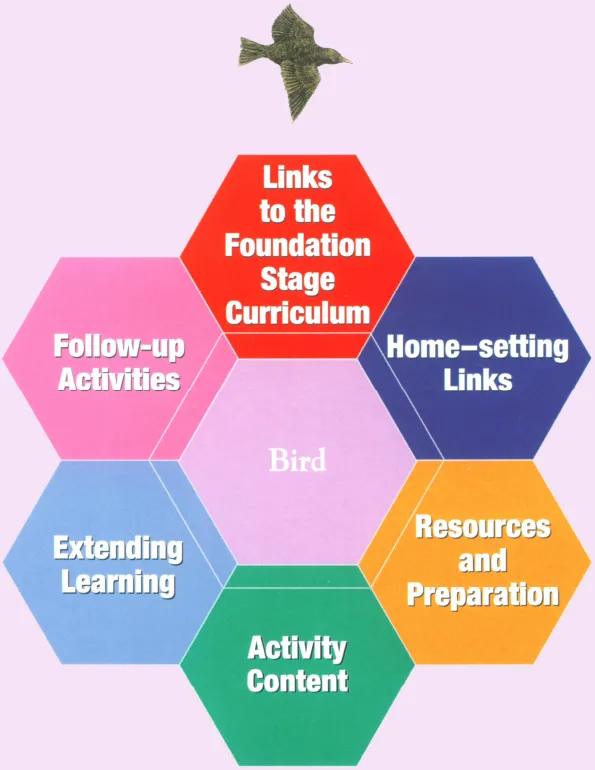
Links to the Foundation Stage Curriculum KUW | Look closely at similarities, differences, patterns and change. |
PSE | Maintain attention, concentrate, and sit quietly when appropriate. |
Adult:child ratio 1:3 for garden observation; 1:2 for an aviary visit; 1:8 for a video clip
A video player and a nature video clip
A bird table and a birdbath
A caged bird, for example a budgerigar, a mynah bird or a parrot
Binoculars Magnifying glasses
A small, handheld tape recorder
Paper with writing and colouring implements
Arrange for a visit to a local aviary after making a preliminary visit to inspect the facilities and to find out if there are any appropriate activities already provided for your age group. If not, devise some of your own before the main trip.
Arrange a date for a visit and make the booking with the aviary and your transport providers.
(a) Write letters to the parents and carers about the trip to make it clear what is happening and what is needed in terms of funds, food and offers of support on the trip.
(b) Let the parents and carers know about the bird topic from the beginning and encourage them to take the children to the library to look for books about birds, or to contribute any from home. A parent or carer might be willing to bring their caged bird into the setting to show the children and to answer their questions about the care of the bird.
(c) Ask parents and carers to encourage the children to keep a diary to record sightings of birds in their garden, or in the park. The record can be pictorial and/or have a written description, which the adults and children can create together.
Establish a bird table, or a feeding station, and a birdbath in a quiet corner of the setting outdoor area, where the birds can be as safe from predators as possible. Be careful if ...