- 285 pages
- English
- ePUB (mobile friendly)
- Available on iOS & Android
eBook - ePub
About this book
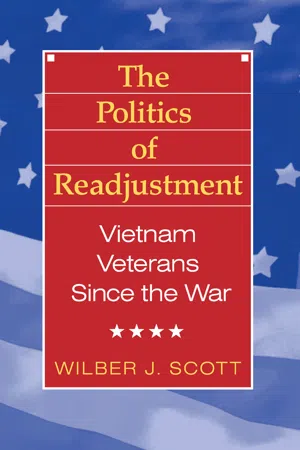
Veterans of all wars face a demanding task in readjusting to civilian life. Vietnam veterans have borne an additional burden, having returned from a controversial war that ended in defeat for the United States and South Vietnam. To address this situation, leaders among the Vietnam veterans and their allies formed organizations of their own to articulate their problems and extract concessions from a reluctant Congress, Federal agencies, and courts.Scott, a former infantry platoon leader in Vietnam, describes the major social movements among his fellow veterans during the period of 196 to 1990 in a lively narrative, combining personal interviews with documentary and press records. Included in the book are the 'sociological stories' of protests against the war in Operations RAW and Dewey Canyon III: the successful effort to place post-traumatic stress disorder (PTSD) in the Diagnostic and Statistical Manual, Third Edition (DSM-III), of the American Psychiatric Association; the building of the National Vietnam Veterans Memorial in Washington, D.C., despite fierce opposition; and the long-running controversy over the herbicide Agent Orange. In the last chapter the author details the sociological thinking that informs his stories, and develops the implications for understanding social movements in general and veterans' issues in particular.
1
Expended brass
“As far as they were concerned, we were expended brass and not even worth picking up.”
Bill Crandell, Vietnam veteran
The first American combat troops splashed ashore in Danang, South Vietnam, on March 8, 1965. The 3,500 troops of the 3rd Marine Regiment, 3rd Marine Division who landed that day had a limited mission: to defend the American airfield there from Viet Cong insurgents. Gradually their mission expanded to defensive patrolling and then to taking the offensive. Correspondingly, the numbers of Marine, Army, Navy, and Air Force personnel swelled to 184,300 by the end of the year. The number of American military personnel in South Vietnam reached a high of 543,000 in April, 1969. Pockets of opposition within the United States to the war effort already existed before the Marines landed, and as American military involvement in South Vietnam increased, so did protest against the war.
On April 15, 1967, a crowd estimated at 100,000 to 125,000 people marched from Central Park to the United Nations Building to demand an end to American military operations in Vietnam.1 American troop strength by this time stood at about 410,000; approximately 8,000 U.S. military personnel had died in the line of duty. There already were more than 500,000 Vietnam veterans who had served with military units in South Vietnam and now were back in the United States. Protest organizers invited twenty Vietnam veterans to lead the parade. The veterans accepted and carried a banner which read, “Vietnam Veterans Against the War.” Following the march, six of them formed an organization by that name. Rather than the traditional veterans’ issues of compensation and treatment for wounds, their principal bone of contention was the war itself. Vietnam Veterans Against the War (VVAW) demanded an immediate withdrawal of all American troops from Vietnam; they wanted to “bring their brothers home.” They became the first group of American veterans to formally and publicly oppose the war in which they fought while it was still in progress.
In this chapter, I describe the rise and functional demise of VVAW between 1969 and 1972, examine in detail how the “atrocity problem” became the key issue that mobilized VVAW during that time, and comment on the special character of “the Vietnam experience.” Vietnam was the first war brought into American living rooms by televised news. Though geographically distant, Americans had a startlingly frank and intimate look at life in the combat zone. Images of Vietnam as “the dirty war” were inescapable; they tainted American involvement in Vietnam with moral ambiguity. Robbed of his “just cause” by rancorous debate over the rightness of American policy, and by the anarchic climate of the counterculture and antiwar movements, even the most gung-ho G.I. found it difficult to successfully present himself as an all-American youth serving God and country.
The story about VVAW raises and examines questions about what war is like. At issue were competing versions of what kinds of violence were justifiable in Vietnam as a matter of policy, and of the extent to which U.S. troops had committed atrocities—acts of violence against enemy soldiers and civilians that were unacceptable under the Military Code of Conduct. In one view, atrocities occurred rarely and American policy was sound; the rare atrocity was the work of the occasional “bad apple” who slipped through preinduction screening or who violated regulations. According to the other view, atrocities were both frequent and the direct result of American military policy. The two versions symbolized more generally how factions of the American public viewed the war.
Early Organizing Efforts
By November, 1967, VVAW’s six founders had raised $4,000 and increased their ranks to forty. VVAW placed ads in the New York Times and eventually in national magazines such as New Republic and Playboy. During 1968, the New York City group grew to about 300 members, set up a permanent office, and held regional meetings in other parts of the country.
Sociologist Charles Moskos, Jr., and later military analyst Thomas Thayer, have assessed the tempo of the Vietnam War and divided it into segments.2 Both describe the years from 1965 to 1967 as a period of relative optimism among those who served and of cautious, qualified support for the war among most segments of the American public. The turning point, they agree, occurred in 1968 with the Tet Offensive. In late January and early February of that year, the North Vietnamese Army and the indigenous Viet Cong of the South mounted a coordinated, country-wide attack against cities and United States military installations in South Vietnam. The strength and scope of the attack dismayed many Americans who heretofore had supported the war effort. In the months before the Tet Offensive, American military leaders had claimed that the Communists were on the verge of defeat and that the end of the war was in sight. The Offensive seemed to show otherwise. 1968 and 1969 thus were years of growing disillusionment with the war among substantial numbers of Americans and of increasingly strident protests against it.
Bill Crandell was one of those dismayed Americans. Crandell had served in Vietnam in 1966 and 1967 as an infantry lieutenant with the 199th Light Infantry Brigade. He had volunteered to go to Vietnam but returned disillusioned. The South Vietnamese, he observed, were reluctant warriors, as if the war were an American problem rather than their own. On his return, he enrolled as a graduate student in political science at Ohio State University in search of answers to questions about U.S. involvement in Southeast Asia. Whatever the initial logic for sending combat troops, Crandell reached the conclusion that the U.S. now should withdraw them. Shortly after the Tet Offensive, he became a regional coordinator of antiwar protest activity for VVAW. Crandell explains:
Tet was a real changing point for me, because [General] Westmoreland said it was a great American victory. And the premise of . . . the pacification program was that we were going to demonstrate to the Vietnamese people that we could protect them from terrorists. . . . [Tet] demonstrated that we couldn’t protect any place, including the American embassy. . . .
It just seemed to me that . . . the people in charge of the war didn’t have any idea what it was about, and we were going to lose. If we were going to lose, everybody who died from that point on was going to die for nothing! And then the hard part for me was, if that was true, then everybody who had already died had died for nothing! And once I faced that ... [I said], I got friends over there! I’ve got to get them home!3
On March 31, 1968, President Lyndon B. Johnson stunned his close advisors and a national television audience by announcing that he would not seek re-election in the upcoming presidential contest. The war had become too controversial. On May 12, 1968, American and North Vietnamese representatives initiated peace talks in Paris. (Viet Cong representatives joined the talks on November 1, and South Vietnam ended its boycott of them on November 26.) According to Jan Crumb, one of VVAW’s six founders, these developments “almost killed us [as an organization] because everybody thought the war would end.”4 The talks, however, continued intermittently for almost four years. All the while, intense bursts of warfare continued as the participants jockeyed for advantage in negotiating a settlement.
Protests against the war received a renewed impetus in the fall of 1969. On September 16, the Associated Press broke a story about an event quickly tabbed the “My Lai Massacre.” Eighteen months earlier on March 16, 1968, C Company, of the 1st Battalion, 20th Infantry, Americal (23rd Infantry) Division, had embarked on a search and destroy sweep of a Viet Cong stronghold, My Lai (1), a subhamlet of the village of My Lai. C Company had been in this area before and had taken casualties there. The company mistakenly entered My Lai (4), another of the subhamlets. Anticipating a fight and expecting to take more casualties, they went in firing. The military-age males had deserted the subhamlet, and C Company killed more than four hundred women, children, and old men. Troops on the scene and their superiors hushed up the story until a soldier-photographer, who had accompanied the unit on the mission, returned stateside and sold the pictures he had taken to media sources.
Emerging Ties with the Psychiatric Community
Sarah Haley, fresh with a master’s degree in social work, began work for the Boston Veterans Administration (VA) Hospital in September of 1969. Her father had served in North Africa during the Second World War as a special agent for the Overseas Secret Service. As a young girl, she had heard stories about war and atrocities from her troubled father as he drank to forget them. Her first contact with a Vietnam combat veteran took place that first morning at work in Boston. As part of the customary intake process, Haley interviewed a new patient who was very anxious and agitated. The veteran told her that his company in Vietnam one day had killed women and children at a village called My Lai. He himself had not fired any shots. Afterwards, several members of his platoon who had participated in the slaughter threatened to kill him if he told anyone about what had happened, even if they had to hunt him down back in the States. One of them said that he might kill him someday just to make sure that he never blew the whistle.
A few days before coming to the VA Hospital, the veteran had become unraveled. He was easily startled, felt terrified, had fearsome nightmares, and was unable to sleep well. He complained hysterically that one of his war buddies was out to kill him, but had no physical evidence to prove it. Although Haley became aware of the breaking My Lai news story only later, she accepted the veteran’s account at face value that morning. However, the other staff seemed unmoved by the substance of his story. Haley recounts that afternoon’s staff meeting:
The staff assembled to discuss all the information and reach a diagnosis and treatment plan. When we met, the intake log already had a diagnosis filled in: paranoid schizophrenic. I voiced concern. The staff told me that the patient was obviously delusional, obviously in full-blown psychosis. I argued that there were no other signs of this if one took his story seriously.
I was laughed out of the room. I was told that it was my first day and just didn’t understand how things worked. ... I was aghast. These professionals denied the reality of combat! This clouded their clinical judgment. They were calling reality insanity . . . ! I knew from my father’s stories that [this man was] not crazy. . . . That encounter became typical.5
In Haley’s judgment, two misconceptions clouded her fellow professionals’ view of combat. One stemmed from idealistic notions of America at war: American troops fought valiantly and did not commit atrocities. The second had its genesis in the conventional practice of psychiatry: mental health professionals across the country assessed disturbed Vietnam veterans using a diagnostic nomenclature which con-tained no specific entries for war-related trauma. As a result, VA physicians usually did not collect military histories as part of the diagnostic workup. Many of them thought that Vietnam veterans who were agitated by their war experiences, or who talked about them, suffered from a neurosis or psychosis whose origin and dynamics lay outside the realm of combat.
The backdrop for both of these sentiments was the Second World War. According to Haley, the comparison between World War II and the Vietnam War affected the way many mental health professionals viewed Vietnam veterans who sought help for serious readjustment problems. Haley recalls:
There was a bias toward Vietnam veterans, especially after the My Lai massacre broke. It was so much easier to blame the . . . [Vietnam] veteran ..., to romanticize . . . World War II veterans, and . . . [say] they were cut from sterner stuff. . . . Clinicians reflected the ambivance about the war, I mean, they really weren’t any different than the regular population. The majority of clinicians at the VA were in one way or another very intimately connected with World War II. . . . They had this sort of noble view of World War II as a glorious fight against Satanic enemies and that the World War II veterans were as pure as the driven snow. . . . [Also] we had antiwar clinicians in my agency who didn’t want to talk with Vietnam veterans because they were baby killers who should have known better and not have gone in the first place.6
In November, 1969, psychiatrist Robert Litton, an ardent opponent of the war, read an account of My Lai in the New York Times while on an airplane en route to the University of Toronto for a speaking engagement. Through Sarah Haley, he later would meet the veteran who had been at My Lai but had not participated in the killing and would write extensively about the implications of the veteran’s experience. Lifton had served during the Korean War as a military psychiatrist and was well known in academic circles for his research on survivorship among Hiroshima victims. Upset now by the My Lai story, he vowed to intensify his public protests against the war. He deviated from his prepared topic in Toronto and discussed instead the My Lai story. On December 15, his statement, “Why Civilians Are War Victims,” appeared in U.S. News and World Report, and on January 27, 1970, he testified before Senator Alan Cranston’s subcommittee on the psychological effects of the Vietnam war on veterans.7
Lifton argued that incidents such as those at My Lai, inevitable in any war, were especially endemic in the Vietnam War: the same psychological processes—dehumanization of the enemy and psychic numbing— that allow combat troops to carry out their mission of killing combined with features of the Vietnam war to produce a high likelihood of atrocities. He urged readers and committee members to place a good portion of the blame for atrocities in Vietnam on the war itself and upon themselves for allowing the war to continue. For Lifton, the policy implications were clear: atrocities would occur so long as American military involvement continued; hence, the U.S. should end its involvement immediately.
On April 29, 1970, the United States and South Vietnamese military embarked upon a major offensive into Cambodia against North Vietnamese and Viet Cong positions. Within days, college campuses across the United States exploded with protest, and on May 4, Ohio National Guardsmen fired into a crowd of antiwar demonstrators at Kent State University, killing four students and wounding nine others. Previously, fellow psychiatrist Chaim Shatan had arranged for Lifton to speak at New York University. They agreed now to change the topic to the Cambodian invasion and Kent State killings, and plastered posters around New York City announcing the talk. This advertising attracted many...
Table of contents
- Cover Page
- Title Page
- Copyright
- Dedication
- Contents
- Foreword by John Sibley Butler
- Introduction
- 1 Expended Brass
- 2 Post-Vietnam Syndrome
- 3 Horse Trading
- 4 “Only we can prevent forest”
- 5 Politics 101
- 6 Opening Up The Earth
- 7 Better settled than tried
- 8 Benefit Of The Doubt
- 9 Toward a sociology of veterans’ issues
- Bibliography
- Index
Trusted by 375,005 students
Access to over 1.5 million titles for a fair monthly price.
Study more efficiently using our study tools.
Frequently asked questions
Yes, you can cancel anytime from the Subscription tab in your account settings on the Perlego website. Your subscription will stay active until the end of your current billing period. Learn how to cancel your subscription
No, books cannot be downloaded as external files, such as PDFs, for use outside of Perlego. However, you can download books within the Perlego app for offline reading on mobile or tablet. Learn how to download books offline
Perlego offers two plans: Essential and Complete
- Essential is ideal for learners and professionals who enjoy exploring a wide range of subjects. Access the Essential Library with 800,000+ trusted titles and best-sellers across business, personal growth, and the humanities. Includes unlimited reading time and Standard Read Aloud voice.
- Complete: Perfect for advanced learners and researchers needing full, unrestricted access. Unlock 1.5M+ books across hundreds of subjects, including academic and specialized titles. The Complete Plan also includes advanced features like Premium Read Aloud and Research Assistant.
We are an online textbook subscription service, where you can get access to an entire online library for less than the price of a single book per month. With over 1.5 million books across 990+ topics, we’ve got you covered! Learn about our mission
Look out for the read-aloud symbol on your next book to see if you can listen to it. The read-aloud tool reads text aloud for you, highlighting the text as it is being read. You can pause it, speed it up and slow it down. Learn more about Read Aloud
Yes! You can use the Perlego app on both iOS and Android devices to read anytime, anywhere — even offline. Perfect for commutes or when you’re on the go.
Please note we cannot support devices running on iOS 13 and Android 7 or earlier. Learn more about using the app
Please note we cannot support devices running on iOS 13 and Android 7 or earlier. Learn more about using the app
Yes, you can access The Politics of Readjustment by Wilbur Scott in PDF and/or ePUB format, as well as other popular books in History & North American History. We have over 1.5 million books available in our catalogue for you to explore.