- 236 pages
- English
- ePUB (mobile friendly)
- Available on iOS & Android
eBook - ePub
About this book
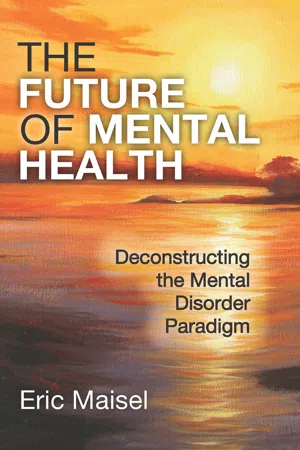
The Future of Mental Health drills to the heart of the current mental health crisis, where hundreds of millions of individuals worldwide receive unwarranted "mental disorder diagnoses." It paints a picture of how mental health providers can improve their practices to better serve individuals in distress and outlines necessary steps for a mental health revolution. Eric Maisel's goal is to inject more human interaction into the therapeutic process.Maisel powerfully deconstructs the "mental disorder" paradigm that is the foundation of current mental health practices. The author presents a revolutionary alternative, a "human experience" paradigm. He sheds a bright light on the differences between so-called "psychiatric medication" and mere chemicals with powerful effects, explains why the DSM-5 is silent on causes, silent on treatment, and wedded to illegitimate "symptom pictures." Maisel describes powerful helping alternatives like communities of care, and explains why one day "human experience specialists" may replace current mental health professionals.An important book for both service providers and service users, The Future of Mental Health brilliantly unmasks current mental health practices and goes an important step further: it describes what we are obliged to do in order to secure better mental health services and better mental health for everyone.
Information
1
Our Human Experience
In our current environment, where the answer to every life difficulty is a mental disorder label and a pill instead of wise counsel, your mental health is at greater risk than ever. And your mental health matters! How much joy and pleasure can you get out of life, how well can you manifest your life purposes, and how likely is it that life will feel meaningful to you if you are stewing, despairing, seething, or worrying? Your mental health is precious! And while life comes with real difficulties that threaten that mental health, you aren’t left stranded without answers or resources. There is help.
Woven into the following discussion is a picture of a worldview that includes the dangers of accepting the current mental health labeling system, the help currently available, what future help might look like, and what it means to be human. It is a worldview that may liberate and motivate you. You will relearn many things that you already know: that life is difficult, that emotional distress is inevitable, and that personality is a mix of the intractable and the improvable. By the end of our discussion, I hope that you will experience a breath of fresh air.
You may also be interested in the new profession that I describe in these pages: human experience specialist. This profession does not currently exist and quite possibly never will—unless, of course, you and others see to its creation. The headline is that this book may help you both personally and professionally. It may help you professionally especially if you are already a therapist, counselor, social worker, or other front line worker who would like to shift your focus from “diagnosing and treating mental disorders” to something more human and helpful.
Let’s begin in what may seem like too obvious a way: by reminding ourselves that human beings have human experiences. On the face of it this sounds ludicrous. Who doesn’t know this? You know exactly what it feels like to be rejected, to hate your job, to need to divorce your mate, to feel suddenly overwhelmed by some trifle. You know what it’s like to have tax season arrive again, to worry about that spot on your skin, to not like what your son just said to you, to not much like your own personality. Why would I need to remind you that human beings have human experiences?
Well, you need reminding because the mental health establishment is vehemently opposed to this view. Since you are bombarded and affected by the view that there is some lovely, unreal, pain-free state called “normal” and scores of “mental disorders” that blow in through the open window to threaten that fictional “normal”—a view promoted on every talk show and in every advertisement for so-called psychiatric medication—you may actually have lost your natural understanding that life is life.
Tens of millions of people have indeed lost this natural understanding, including the millions of parents of children who, at the first sign that their child is having a difficult time, willingly—even instantly— adopt the perspective that they have a “little patient” in the house. This movement from the reality of human experience to the unreality of “a mental disorder for every difficulty” has been fast-tracked to gospel—and you may have become one of its unwitting victims and co-conspirators. Let us start there, by reminding ourselves what life is like. Let’s get our hands dirty in the human experience.
Holding Her Breath
During World War II, sixty million people died, more than 2.5 percent of the world’s population. The Soviet Union alone lost between eighteen and twenty-four million lives. Germany lost between seven and nine million, upwards of 10 percent of its population. Europe’s Jewish population was reduced by between five and six million, or 55 percent of European Jewry. A country like Portugal lost “only” fifty thousand souls, but those fifty thousand amounted to 10 percent of the Portuguese population.
Forget for a second about who was in the right and who was in the wrong. Rather, imagine a German youth of eighteen, a Russian youth of eighteen, a British youth of eighteen, an American Jewish youth of eighteen, a French youth of eighteen, a Japanese youth of eighteen. Think of the parents of each of these young men, parents, say, between forty and forty-five years old. Think of their grandparents. Think of their sisters, their younger brothers—think about everyone affected by that calamity.
To say that the “mental health” of all of these people was affected by the fact of a world conflagration is to make a bad joke. Affected, indeed! It may have been the defining, pressing, most important matter on their radar, completely altering their lives and producing year upon year of unbearable stress. The whole world’s population was “motivated” in drastically new ways—and unmotivated as well. How motivated would you have been to open up your grocery store each morning if you had to sell to your Nazis oppressors? How motivated would you have been to get out of bed if your city was under siege?
Psychology posits many “theories of motivation.” These include an instinct theory of motivation (e.g., birds migrating), an incentive theory of motivation (e.g., external rewards), a drive theory of motivation (e.g., drink water when thirsty), an arousal theory of motivation (e.g., cure boredom with an action movie), a humanistic theory of motivation (e.g., self-actualization), and more. To vote for any one of these—or some combination of them, or all of them in the aggregate—is to make a fundamental mistake.
The mistake is the way that these theories exclude the human experience. We aren’t machines functioning or not functioning in mechanical ways. We are human beings who think, feel, live, and organize our experiences in existential and psychological ways. The problem isn’t that all of these theories have nothing to say. The problem is that this way of thinking prevents us from understanding human beings. The human being is almost always lost when a theory is proposed, whether that theory is psychoanalytic, cognitive-behavioral, or, as in the “mental disorder” model, pseudo-medical.
Think of the mother of that young soldier. It doesn’t matter whether he is German, Russian, French, British, or Japanese. Her son goes off to war, and he has, say, a 20 or 30 percent chance of dying. For the years that he is away, she is fundamentally not motivated at all, though, of course, she still drinks water when she is thirsty, plays the lottery in the hopes of a windfall, and shows up at work to receive her paycheck.
She is “motivated” in all the textbook ways—she gets to work, she buys lottery tickets, she drinks water, she has sex—but her reality is that she is holding her breath. If you ask her why she is having headaches, stomachaches, sleep problems, an inability to orgasm, and sudden crying fits, she may well tell you, “I am waiting for my son to come home.” Should we really stand for a psychiatrist answering this with, “I have a pill for that mental disorder!”? Should we really stand for a psychotherapist exclaiming, “Oedipal issues!”? We should not. Our new helper of the future, our new human experience specialist, would begin by replying simply and humanly, “I know.”
Our new helper would say to her, “I understand. I know that you are holding your breath, and I know why you are holding your breath. I want to make the following couple of suggestions, neither of which will fundamentally change your situation. Your fundamental situation is that you are waiting, that you are holding your breath, and that you are scared to death. I completely understand. But I do have a couple of suggestions to make. Shall we look at them?”
This isn’t psychiatry or psychotherapy, it isn’t mentoring, coaching, or counseling, and it isn’t friendship. It requires a new category of helper, a person not bound to establish goals and cheerlead like a coach; not bound, like mental health counselors, psychologists, and psychotherapists, to buy our current “diagnosing and treating of mental disorders” model; not bound, like a psychiatrist, to dispense pills; not bound, like a cleric, to lecture about what gods demand; not bound to ignore a human being’s real, pressing, and defining experiences and circumstances. There would be no “diagnosing” and no “treating.” Instead, there would be a human interaction in the context of calamity.
And who isn’t in the middle of calamity? Forget about world wars. What is it like for the quarter million women diagnosed with breast cancer each year and the one in eight women threatened by it? What is it like for a gay youth in a fundamentalist town? What is it like for a workingman or workingwoman living in a tract home in Ft. Worth, Queens, or Dayton? What is it like for a writer with no publisher, a painter with no gallery, a musician with no gigs? What is it like for an obese man or woman with no sex life? What is it like for the millions who hate their jobs, the millions with no job, the millions who cringe when their mate enters the room, or the millions who have aged into invisibility?
Despite all of this mental stress, distress, and misery, we are supposed to stand “mentally healthy,” as if life were a lark and as if sweet smiles were not only our birthright, but also our obligation. Why should we be smiling? Why should we be “mentally healthy,” whatever that phrase is supposed to mean? For the whole history of our species, until very recently, even your drinking water could kill you. In our age of good drinking water—which is only a reality for a small percentage of our species—we have had world wars and nuclear weapons to contend with. And what is life like for someone living under a dictator, where you can vanish for speaking? And how pleasant, for that matter, is your own seething mind, packed with worries, regrets, resentments, and to-do lists? Why should you be mentally healthy?
Nevertheless, you are supposed to keep smiling. You are supposed to stay positive. No matter that every human right must continually be fought for. No matter that in this modern age of plenty, which advertising tells us comes with beautiful homes, beautiful cars, and beautiful bodies, insomnia is epidemic, obesity is epidemic, sadness is epidemic, and meaninglessness is epidemic. You must not notice the machinations of the powerful. None of that should affect your mental health. You must not notice your aging, your illnesses, or your mortality. None of that should affect your mental health. You may not even look in the mirror and announce that you might strive to be a better person. No, none of that!
Against this backdrop of great difficulty; stresses to our system; dangers as real as wars, famines, and pestilences; and a mind that races of its own accord and seethes over injustices and indignities, has grown a mental health establishment that takes none of that into account. It acts as if our baseline is “mental health” and that deviations from that unreal, made-up baseline are “mental disorders” or “mental diseases.” It calls the warehousing of distressed and difficult people, people who are no picnic and who are having no picnic, the “institutionalization of the mentally ill.” Its psychiatrists spend fifteen minutes with patients, not exploring human matters but prescribing and regulating chemicals. That is where we are today.
That establishment creates countless labels for human distress, individual differences, natural reactions to painful stressors, and socially unacceptable behavior, and it announces that this hungry, sad boy has a “clinical depression,” as if something blew in the window and into his brain. It says that this unhappy, bitterly unfulfilled woman has a “clinical depression,” as if her husband despising her wasn’t as real as bricks. It says that this arthritic old man whom his children have long since stopped visiting has a “clinical depression,” as if it were really a lark to sit in a wheelchair in the corridor of a nursing home from morning till night.
It takes no account of the extent to which human beings fail and how much failing hurts. For every PGA champion there are thousands of golf pros and would-be golf pros chastising themselves for not playing well enough, down on themselves for their lack of talent, their lack of discipline, and their lack of success. For every NBA star there are millions of young men completely thwarted in their dreams of rising out of the hell of tenements, drugs, gangs, and violence, and who at some very early age throw in the towel and live a life of menace. For every country western singer who wins multiple Grammys there are legions of waitresses in dives all across America singing along to the music they wish they were singing on The Voice as they wipe up coffee spills and scrape dried eggs off table tops. We fixate on that PGA champion, that NBA star, and that celebrity singer—each of whom, by the way, is having his or her own meltdown, as any tabloid will tell you—and not on the “boring” ordinary people with failed dreams and bad lives who are supposed to keep smiling.
Ignoring our species’ continuous history of difficulty and ongoing difficulties, difficulties that can be increased any day of the week by a new war, a new plague, a new drought, a glacial winter, or just the continuous barking of a neighbor’s dog, the mental health establishment, with your willing participation, has contrived to make all of these difficulties “abnormal” and, as a result, profitable to them. When you get very sad because life feels horrible or very anxious because everything, from your bills to your mate, feels threatening, they tell you that you have a “mental disorder.” Either you nod your head in agreement and accept their pills and their “expert talk,” or you announce your defiant disagreement and . . . then what? If you do not accept the mental health establishment’s way of viewing your pain, and if that pain remains, what will you do then?
In addition to the genuine help currently available, which we will discuss, it would be wonderful if in the future you could speak with a new type of professional: a human experience specialist. Countless psychotherapists, violating the letter of their license and not at all happy “diagnosing and treating mental disorders,” already function as human experience specialists—and could be converted over to this new category easily, so ready are they to be untethered from the current untenable system. This is, of course, what psychotherapy should have been all along—a human experience specialty—rather than a pseudo-medical profession where even master’s level professionals assert that they have “patients.”
Right now, change is tremendously difficult. Just follow the money. Follow the prestige, the power, the insider connections, the holding of hands, and the washing of hands. Follow the intense ties throughout the establishment in all of its colorful garb: pharmaceutical companies, academics, hospitals, HMOs, mental institution executives, courts, expert classes, jailers, the advertising industry, politicians, bureaucracies, talk show hosts. A great many people are invested in taking money from you—and taking your very freedom—the second you complain of some difficulty. Against this reality, it is hard to propose that human experience start to count for something.
Let me add that the practice of prescribing psychiatric medication should not completely vanish. There is a profound difference between chemicals with powerful effects, which is what psychiatrists prescribe, and psychiatric medication, which is what they claim to be prescribing. The rationale for calling them “medicine” presumes the presence of diseases and disorders that have never been proven to exist. They were created around committee tables and ought to be disbelieved. However, some sufferers may want the effects of these chemicals, and for that reason psychiatrists would still be needed. We’ll return to this important question of which parts of the current mental health system are worth keeping. For now, let me repeat that if we forget that human beings have human experiences, we do so at our own peril.
Genuine Not Knowing
The reality of the human experience is known to each of us, just so long as we don’t forget it. What we don’t understand is man himself. Man is the elephant in the room. We don’t really understand why he so easily goes off to war—a good war, a bad war, any war. We don’t really understand why he can’t stop smoking cigarettes even though his life depends on him stopping. We don’t really understand why, having been beaten as a child and pledging with all his heart not to beat his own children, he nevertheless does so. We just don’t understand the why of human beings.
We don’t know to what extent man comes with a blueprint, what exactly to make of the idea of “genetic predispositions,” or why a cloud passing in front of the sun can make him feel so very sad. What we don’t know is vastly greater than what we do know. It is very hard for people to accept the truth that we don’t know what we need to know about man—and that quite possibly we will never know what we need to know. It may prove easier to learn about the distant reaches of the universe, the beginning of time, and the inside of atoms than about what makes man tick. This is a hard truth to swallow.
But we must start there, announcing how little we know. Our “mental health experts” aren’t very expert. Neither past nor current thinkers and practitioners know what is going on “inside” human beings. Brain scans will never get at why an environmental activist pickets against nuclear energy one year and then sees it as man’s best hope for clean energy the next. There is no brain scan, present or future, that can paint a picture of personality, consciousness, or the internal conversations that human beings hold. One of the calamities of the current system is the way in which a show of knowing is made.
Let me hasten to add that the critics of the current system do not know what is going on “inside” any better than do the established “experts.” The critics likewise have only their own ungrounded opinions. For instance, Thomas Szasz, a well-known opponent of contemporary psychiatric practices, proposed that what we are seeing with disturbed people are not symptoms of illness but human beings angling for what they want via playacting. Szasz observed that as soon as a particular game became socially unacceptable—say, for women to act “hysterically”—that “mental illness” simply vanished. When fainting fell out of fashion, women simply stopped fainting. Szasz’s ideas are provocative and interesting, but who can really say? And how could we ever really know?
R. D. Laing, another critic of the current system, portrayed “mental disorders” rather more as breakthroughs than breakdowns: episodes of a kind of battle for health, clarity, and spiritual relief that required a self-directed plunge into darkness. Jung held a rather similar view. There are countless pictures one can paint as to what human beings look to be experiencing, feel compelled to do, or seem to will into existence. You can say anything about a human being without needing any proof—you can say that he is being bad, that he is being willful, that he is on a journey of transformation, that he has a genetic predisposition, that he has a complex, that he has an illness. In the absence of knowing, nothing is easier than saying.
These are our starting points: the reality of human experience and the reality of our not knowing. Take a vulnerable child—that is, any child—thrust that child into the hardness of life, add some extra difficulty for good measure, and then let that child burn with its billions of neurons ablaze ...
Table of contents
- Cover
- Title Page
- Copyright Page
- Dedication
- Contents
- Introduction
- 1 Our Human Experience
- 2 The Naturalness of Distress
- 3 Jettisoning Normal
- 4 Rethinking Diagnosis
- 5 What Shall We Call You?
- 6 The Mental Disorder Labeling Fraud
- 7 Chemicals versus Medication
- 8 On Meds
- 9 On Cause and Effect
- 10 Life Purpose, Meaning, and Value
- 11 Setting the Bar
- 12 The Human Experience Specialist
- 13 Twelve Shifts for Professionals
- 14 Institutions and Communities of Care
- 15 The “Mental Disorders” of Childhood
- 16 Understanding “Madness”
- 17 Alternatives to Diagnosis
- 18 The Brooklyn Project
- 19 Twenty Keys to a Mental Health Revolution
- 20 The Future of Your Mental Health
- Suggested Reading
- Index
Trusted by 375,005 students
Access to over 1.5 million titles for a fair monthly price.
Study more efficiently using our study tools.
Frequently asked questions
Yes, you can cancel anytime from the Subscription tab in your account settings on the Perlego website. Your subscription will stay active until the end of your current billing period. Learn how to cancel your subscription
No, books cannot be downloaded as external files, such as PDFs, for use outside of Perlego. However, you can download books within the Perlego app for offline reading on mobile or tablet. Learn how to download books offline
Perlego offers two plans: Essential and Complete
- Essential is ideal for learners and professionals who enjoy exploring a wide range of subjects. Access the Essential Library with 800,000+ trusted titles and best-sellers across business, personal growth, and the humanities. Includes unlimited reading time and Standard Read Aloud voice.
- Complete: Perfect for advanced learners and researchers needing full, unrestricted access. Unlock 1.5M+ books across hundreds of subjects, including academic and specialized titles. The Complete Plan also includes advanced features like Premium Read Aloud and Research Assistant.
We are an online textbook subscription service, where you can get access to an entire online library for less than the price of a single book per month. With over 1.5 million books across 990+ topics, we’ve got you covered! Learn about our mission
Look out for the read-aloud symbol on your next book to see if you can listen to it. The read-aloud tool reads text aloud for you, highlighting the text as it is being read. You can pause it, speed it up and slow it down. Learn more about Read Aloud
Yes! You can use the Perlego app on both iOS and Android devices to read anytime, anywhere — even offline. Perfect for commutes or when you’re on the go.
Please note we cannot support devices running on iOS 13 and Android 7 or earlier. Learn more about using the app
Please note we cannot support devices running on iOS 13 and Android 7 or earlier. Learn more about using the app
Yes, you can access The Future of Mental Health by Eric Maisel in PDF and/or ePUB format, as well as other popular books in Psychology & Psychiatry & Mental Health. We have over 1.5 million books available in our catalogue for you to explore.