- 138 pages
- English
- ePUB (mobile friendly)
- Available on iOS & Android
eBook - ePub
The Age of Television
About this book
Having spent most of his career working with the British Broadcasting Corporation (BBC), Martin Esslin appraises American TV with the eyes of both a detached outsider and a concerned insider. "American popular culture," writes Esslin, "has become the popular culture of the world at large. American television is thus more than a purely social phenomenon. It fascinates and in some instances frightens the whole world." The Age of Television discusses television as an essentially dramatic form of communication, pointing to the strengths and weaknesses that spring from its character. It explores its impact on generations destined to grow up under its influence, with such questions as how TV turns reality into fiction, and fiction into reality. Esslin considers the long-term effects of television on our abilities to reason, to read, to create. He asks if current programming on American television constitutes what we want and deserve, and asks what we would change, if we could. These are but a handful of the questions Esslin probes in this penetrating analysis of contemporary television and its impact on our lives. In his new introduction, Esslin discusses changes in the media over the last two decades. He explores the increasing number of television stations available, the rise of "boutique" channels concentrating on news, sports, or film, and the relationship between television and other forms of electronic media such as video games and the Internet. Finally, he considers the effect of these developments on our ability to concentrate, our sensitivity to violence, and even our artistic taste. Most compelling of all is his final question: Can the Age of Television, with all its dangers, yet become a golden age of cultural growth? Martin Esslin is professor emeritus of drama at Stanford University. His numerous critical works include: Brecht-The Man and his Work, The Theatre of the Absurd, An Anatomy of Drama, and Artaud. He cur
Information
1
The Drama Explosion
WALK THROUGH A SUBURBAN STREET in any developed country of the world, when the night is warm and the windows are open: in house after house you will see, shining through, the bluish flicker from a television screen. What would a visitor from a previous generation emerging from a time machine make of it—a whole population, locked in the contemplation of flickering images for hours on end, in passive receptivity, as though spellbound? Writing before the advent of television, Aldous Huxley imagined in Brave New World (1932) a dystopia of future populations drugged into acquiescence with tranquilizing pills. Huxley was not far off the mark, deficient only in the technological component of his prophetic vision. In an important sense his brave new world is with us: it is called "the age of television."
There can be no doubt that television has brought about a major revolution in the development of man's life-styles, culture, and social habits. We tend to think of revolutions as political events, violent overthrows of existing systems of government. But compared with technological and economic revolutions, which steal upon us almost unobserved, political revolutions have a far less profound impact. Upheavals like the Russian Revolution or the overthrow of the Shah in Iran leave much of the fabric of living unaffected; even political life often reverts to a pattern not far different from that under the previous regime. The taming of fire, on the other hand, or the invention of the wheel, Gutenberg's introduction of printing with movable type, or the coming of the steam engine and the age of rail transport have had deep and lasting effects on human life and thought. They have fundamentally altered mankind's way of perceiving reality.
On one level or another we are all aware that the coming of the television age, which can be dated roughly from 1950, marked just such a revolutionary turning point. But though the all-pervasive nature of the medium and its possible effects on manners and morals are debated constantly, the full implications of the change in human habits and modes of perception brought about by TV do not seem to have yet penetrated our consciousness.
As is so often the case with revolutionary developments in technology, television when it was first introduced was regarded as no more than a new toy, a minor innovation in the art of popular entertainment not deserving to be taken seriously. This attitude has persisted long after television has become a ubiquitous, highly influential element of our social, cultural, and intellectual environment. Most people spend a significant part of their leisure time in front of the television: it supplies most of their news of the world; it shapes their political attitudes and decisions; and it decisively affects their living styles through the goods it entices them to acquire. Yet few serious attempts have been made to analyze the essential character of this technological innovation and to evaluate what its long-term effects on society might be.
Innumerable and laborious attempts have been made by specialists—psychologists, sociologists, market researchers— to define and even to quantify particular aspects of the impact of television. Such investigations tend to use methods of public opinion or market research designed to produce clear-cut, measurable results on specific points: the effects of a particular advertising campaign, the public's response to a new type of packaging. When these methods have been extended to larger and more complex areas, the findings have proved more questionable and less conclusive. The multi-volume reports of British, Canadian, and American parliamentary and congressional commissions investigating matters like TV violence and pornography molder unread and unheeded on library shelves without having illuminated such vexing questions as whether sex on television increases or reduces the incidence of rape or whether violence on the screen leads to more or less violent crime in real life.
The Medium and the Messages
Of the attempts made to evaluate the impact of television from the broadest possible point of view, none has been more daring and intriguing than that undertaken by the late Canadian critic and media scholar Marshall McLuhan, whose pronouncements are usually encapsulated in the slogan from his book Understanding Media: "The medium is the message."
What does this axiom mean? Essentially this: television and radio have brought about a fundamental change in the way we perceive the world; they have extended the range of our sensual apparatus by enabling us to see and hear things happening at the other end of the world. Whereas most of the information we received hitherto came to us via the printed page, in words and still pictures, we now hear our leaders discuss their political agenda and see their faces while they do so. Listening to a speech in the presence of the orator gives us a completely different feeling than does a solitary reading of the same text, when we are locked into our own private consciousness. In the spiral of historic development, McLuhan says, we have returned—on a different and higher level—to a situation similar to that of tribal societies whose members could all congregate in the center of the village to listen to their leaders, priests, or shamans. In that respect we are now members of what he calls the "global village." The age of civilization based on reading, on a written literature, is over. In our new era of oral communication, the linear, discursive mode of thought is going to be replaced, McLuhan maintains, by a primarily image-oriented type of perception and thinking.
Undoubtedly this is an insight of the utmost importance. At the same time it is sweepingly overstated in the understandable excitement of its author's prophetic fervor and, because it is so generalized, is too lofty to have had a practical impact on our everyday attitudes and practices. Hence, nothing seems to have been done to translate this important insight into any kind of concrete social action. The medium is indeed the message, but only in the widest possible sense, on a long-term secular time scale, from the perspective of a historian whose eye spans the millennia. The coming of television has deeply changed a culture based on the concentrated, solitary, attentive habit of reading and has largely replaced it with a new way of perceiving reality, a new mode of thought—more relaxed, diffuse, multidimensional, and immediate. This change in the structure of human perception and modes of thought will lead to fundamentally different attitudes toward the world, society, and culture. An understanding of this development on its long-term, macroscopic scale is essential. But by implying that the innumerable subsidiary influences, the multiple localized messages carried by the medium—the news, the stories of daytime serials, the product information in the commercials—are of negligible importance compared to the "basic," universal message, McLuhan discourages further thought about how to deal with the effects of television on a more mundane level.
An awareness of McLuhan's insight must underlie all attempts to adjust our ways of thinking, our institutions, and our social habits to the television age. But just as our awareness that the telephone has radically affected our lives does not diminish the importance of the details of a particular telephone call—a change in the arrival time of an expected visitor, for instance—it is not sufficient simply to accept the credo "The medium is the message" and ignore the innumerable other "messages" that are carried by television.
In the operation of any communications medium there is always a hierarchy of message conveyors. For example, in telegraphy there is the wire or wavelength, the Morse code (or some other code that might be used), the language in which the message is conveyed, and only then the explicit meaning of the message. On top of that, there are still a multitude of implicit messages, including the symbolic meaning and the emotional impact of the communication.
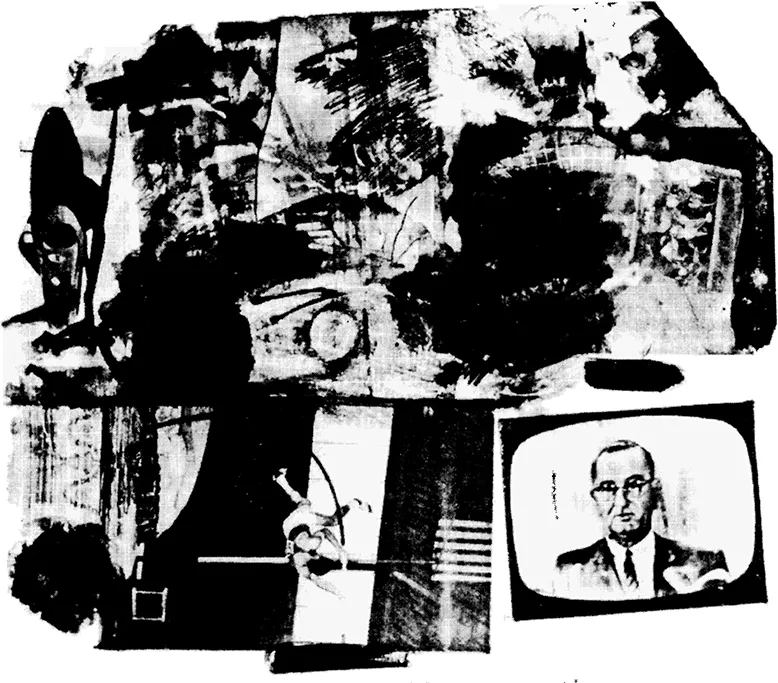
Mark postscript to 34 Drawings for Dante's Inferno by Robert Rauschenberg. 1964. Collection, The Museum of Modern Art, New York.
The hierarchy of messages and message conveyors in television requires a similar sort of analysis. At one end is TV's most generalized aspect, the nature of the process of communication itself. That is the end of the spectrum McLuhan is concerned with. For him the main message is: time and space have been abolished; we can all be present at the same event; our eyes and ears have immensely increased their powers; we have to see the world differently—think in a new way! At the other end we have the specific data imparted at the level of, say, a news report or commercial—an announcement that a certain make of car is now available at reduced prices. But between the most general and the most particular messages and message conveyors is an intermediate level of communication of the utmost importance, namely the "language" in which the message is conveyed (the word language here is used, in the vocabulary of modern linguistics, in its sense of langue as opposed to parole)—more precisely, the nature, structure, and grammar of that language.
The Language of Television
It is my contention, the contention of this book, that we can gain considerable insight into the nature of the television medium, and a better understanding of its operation, if we recognize that the "language" in question is in fact one that has a tradition as old as civilization itself; that a great deal of thought has already been invested in the unraveling of the intricacies of its grammar and syntax; that we already possess something like a valid terminology and tested critical strategies to approach it, as well as effective tools to analyze its psychology and impact. It is, in fact, my contention that the language of television is none other than that of drama; that television—as indeed the cinema, with which it has much in common—is, in its essence, a dramatic medium; and that looking at TV from the point of view and with the analytical tools of dramatic criticism and theory might contribute to a better understanding of its nature and many aspects of its psychological, social, and cultural impact, both in the short term and on a long-term, macroscopic time scale.
On the most obvious level television is a dramatic medium simply because a large proportion of the material it transmits is in the form of traditional drama, consisting of fictional material mimetically represented by actors and employing plot, dialogue, character, gesture, costume—the whole panoply of dramatic means of expression. According to one of the leading statistical summaries of the television market in the United States, The Media Book, no less than 59 percent of the average American adult male's viewing time in 1976-77 was devoted to material in explicitly dramatic form—serials, movies, and prime-time network shows. The corresponding figure for the average American female was even higher: at least 63 percent of the time she spent watching television was devoted to shows in explicitly dramatic form. According to the 1980 edition of The Media Book, in the spring of 1979 American men on the average watched television for over 21 hours each week, while the average American woman's viewing time reached just over 25 hours a week. The time devoted by the average American adult male to watching dramatic material on television thus amounts to over 12 hours per week, while the average American woman sees almost 16 hours of drama on television each week. That means that the average American adult sees the equivalent of five to six full-length stage plays a week!
A hundred years ago even the most assiduous theatergoer would not have seen more than one play a week over a given year, and only a small proportion of the population of the Western world lived in cities that had permanent theaters. Most people lived in areas visited only sporadically, if at all, by touring companies and thus hardly ever saw a play. Today the average American is exposed to as much drama in a week as the most zealous theater buff of the past century would have seen in several months!
The sheer volume of material broadcast in explicitly and traditionally dramatic form is in itself sufficient to establish television as a dramatic medium. But that, to me, is only the most obvious and superficial aspect of the matter. It is my contention in this book that whatever else it might present to its viewers, television as such displays the basic characteristics of the dramatic mode of communication—and thought, for drama is also a method of thinking, of experiencing the world and reasoning about it. After all, much of our thinking consists in devising scenarios for different situations and decisions—which is using drama as a form of thought.
But, one might object, drama is fiction, and much that is seen on television is real—the transmission of actual events. Well, yes and no. The dividing line between reality and art, between nature and its artistic representation, has ever been a tenuous one. When in 1917 the French avant-garde painter Marcel Duchamp submitted a urinal to be displayed in an art exhibition in New York, he drew attention to a phenomenon of basic importance: once an object, man-made or natural, is taken out of its ordinary context and put onto a pedestal or into a frame, it is made to say, "Look at me; I am here to be observed!" and immediately that object acquires some characteristics of a work of art. In its new context the urinal is seen as a form, a three-dimensional shape rather than as an object of daily use. Its significance is transformed by the act of showing it off.
The function of the stage in the theater is analogous to that of the pedestal or the frame in an art museum. If a cat walks onto the stage by accident during a performance, it automatically becomes a performer and will be perceived by the audience as having some sort of significance in the play—it may get laughs or even applause—for anything that appears on a stage proclaims that it is on display, meant to be seen, meant to fill some role or have some function within a fictional context. An ordinary chair on a stage, used in a performance of Hamlet, becomes an object of fiction; it plays the part of a chair in medieval, fictional Elsinore. In the same manner the man who plays Hamlet becomes the fictional prince of medieval Denmark while also remaining his real self and being observed and admired by the audience as himself, the star. And, likewise, the newscaster who reads the evening news becomes, simply by appearing in the framed square of the television screen, a performer on a stage, an actor.
The TV screen is both a frame, like Duchamp's pedestal, and a stage. Even when the news an announcer reads has been forgotten, the character he creates, his TV personality, will remain in the viewer's memory. The news changes from night to night, but the character of the newscaster persists in the public eye and the public imagination.
The information the newscaster transmits would appear to be the least fictional, least dramatized element on television, and yet most events that can be reported on the news are to some degree staged. Whatever reality they possess, in the sense that they actually happened, is most likely to have been filtered through various stages of a process of presentation. Moreover, the version of such events that an audience views on TV news is rarely transmitted live; it is first selectively framed, then filmed or videotaped, and finally edited in a manner that tends once more to emphasize the event's dramatic qualities. Similar considerations apply to other "real" events broadcast on television. The politician's speech and the interview or press conference with a public figure are also, inevitably, framed, stage-managed, and manipulated. The face of the great man or woman has been made up, the background chosen or designed, the clothes carefully selected, and what is televised will have been either edited on film or videotape or, if live, dramatically structured by the use of close-ups, long-shots, and reaction shots of the guest and interviewers. The final result is a dramatic performance, which moreover, filmed or videotaped, is infinitely repeatable.
This repeatability is a no less fundamental aspect of the theater—and all drama. Real events happen only once and are irreversible and unrepeatable; drama looks like a real event but can be repeated at will. Plays can have long runs or can be revived from a script. As most of television is recorded, most things seen on TV can be rerun. By the time a news event has been taped, edited, and shown several times, it has acquired the characteristics of a dramatic performa...
Table of contents
- Cover Page
- Half Title
- Title
- Copyright
- Introduction to the Transaction Edition
- A Personal Preface
- 1 The Drama Explosion
- 2 Drama as Communication
- 3 Fiction into Reality
- 4 Reality into Fiction
- 5 The Long-term Effects of Television
- 6 Problems of Control
- 7 The Challenge of the Future
- Reader's Guide
- About the Author
- Credits
- Index
Trusted by 375,005 students
Access to over 1.5 million titles for a fair monthly price.
Study more efficiently using our study tools.
Frequently asked questions
Yes, you can cancel anytime from the Subscription tab in your account settings on the Perlego website. Your subscription will stay active until the end of your current billing period. Learn how to cancel your subscription
No, books cannot be downloaded as external files, such as PDFs, for use outside of Perlego. However, you can download books within the Perlego app for offline reading on mobile or tablet. Learn how to download books offline
Perlego offers two plans: Essential and Complete
- Essential is ideal for learners and professionals who enjoy exploring a wide range of subjects. Access the Essential Library with 800,000+ trusted titles and best-sellers across business, personal growth, and the humanities. Includes unlimited reading time and Standard Read Aloud voice.
- Complete: Perfect for advanced learners and researchers needing full, unrestricted access. Unlock 1.5M+ books across hundreds of subjects, including academic and specialized titles. The Complete Plan also includes advanced features like Premium Read Aloud and Research Assistant.
We are an online textbook subscription service, where you can get access to an entire online library for less than the price of a single book per month. With over 1.5 million books across 990+ topics, we’ve got you covered! Learn about our mission
Look out for the read-aloud symbol on your next book to see if you can listen to it. The read-aloud tool reads text aloud for you, highlighting the text as it is being read. You can pause it, speed it up and slow it down. Learn more about Read Aloud
Yes! You can use the Perlego app on both iOS and Android devices to read anytime, anywhere — even offline. Perfect for commutes or when you’re on the go.
Please note we cannot support devices running on iOS 13 and Android 7 or earlier. Learn more about using the app
Please note we cannot support devices running on iOS 13 and Android 7 or earlier. Learn more about using the app
Yes, you can access The Age of Television by Martin Esslin in PDF and/or ePUB format, as well as other popular books in Media & Performing Arts & Television History & Criticism. We have over 1.5 million books available in our catalogue for you to explore.