- 250 pages
- English
- ePUB (mobile friendly)
- Available on iOS & Android
eBook - ePub
About this book
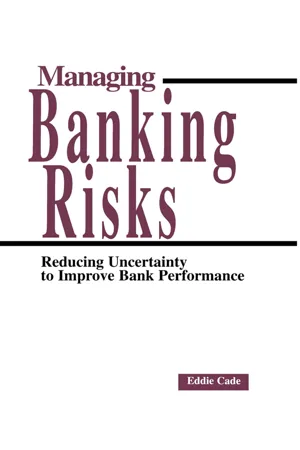
Banking and financial services are some of the fastest-growing industries in the world's developed countries. As growth is spurred on by huge demand for new and improved services, bankers face the daunting and difficult challenges of reducing risks and uncertainty at a time of unprecedented innovation and prosperity. Managing Banking Risks fills a gap in banking literature by providing a professional and sophisticated risk planner--for bank directors, executives, and managers at every operational level. This important work covers the full range of banking risks that operation managers and executives need to understand--from liquidity risk to price risk to operating risk.
Chapter One
Risk and reward
This chapter provides a grounding for the rest of the book, outlining:
- A banker's definition of risk.
- A statistical framework for assessing risk.
- A discipline for measuring return on economic risk capital.
- Market-based criteria for a minimum required rate of return.
Banks are highly geared financial risk-takers. When things go awry the results can be spectacular. In 1987 Merrill Lynch lost $377 million through trading mortgage-backed securities in an innovative form. In 1989 the junk bond market collapsed, and with it the fortunes of Drexel Burnham Lambert. In 1989 also, Midland Bank lost a reported £116 million by guessing wrong on interest rate movements.
In 1991 Bank of New England made massive bad debt provisions, suffered a run on deposits and had to be supported by government to the tune of some $2 billion. In 1992 Barclays Bank provided £2.5 billion for bad and doubtful debts and declared the first loss in its history. In 1993 Crédit Lyonnais succumbed to similar troubles and registered a net loss of FFr6.9 billion (say £834 million), precipitating a state rescue package of FFr44.9 billion: this proved to be merely the prelude to a further and much larger bail-out in 1995. In their financial year to March 1996, the major Japanese banks wrote off a total of some ¥6000 billion (say £36.5 billion) of bad debts accumulated from the preceding boom years.
In 1995 Barings, London's oldest merchant bank, was brought down by losses of £830 million on a speculative proprietary position in Nikkei 225 stock index futures. In the same year, Bankers Trust was sued by two dissatisfied customers for sums totalling $200 million in respect of disastrous swap contracts which the bank had arranged for them: these claims were settled for lesser amounts out of court.
Meanwhile, over a period of years, London banks have been counting the cost of marketing what turned out to be unenforceable interest rate swap contracts to local authorities with defective contractual powers; and police and public prosecutors have continued to unravel the skeins of massive internal fraud at the defunct Bank of Credit and Commerce International.
These are just a few examples from a long list of prominent accidents and failures in risk management, a science replete with hindsight but less endowed with foresight or consensus on preventive measures. Risk management scandals in banking are more reliable than buses: you can be sure that there will be another one along in a little while. But first things first: what exactly is 'risk'?
1.1 A definition of risk
This is a happy hunting ground for linguistic philosophers, mathematicians and actuaries, and we have to accept that no single definition of 'risk' will serve all purposes. Dictionaries, and much of common parlance, dwell on jeopardy, potential loss and disaster, whereas a business perspective needs to be more balanced. Business perspectives in turn differ, so that it is unsafe to apply insurance industry terminology, for example, to banking.
A suitable definition of risk in banking is: exposure to uncertainty of outcome.
Exposure, often omitted from risk definitions, denotes a position or a stake in the outcome, without which our interest is merely academic - we are not at risk, any more than is a racegoer who has refrained from placing a bet.
An outcome is the consequence of a particular course of action. How and when we can recognise an 'outcome' will become clearer as we examine the various categories of risk in banking.
Uncertainty can be reflected in the volatility of potential outcomes plotted on a probability distribution curve, for which the normal measure of dispersion would be either the variance or the standard deviation. The wider the standard deviation, the greater the volatility; and thus, in theory, the uncertainty and the risk. 'Volatility' is the term in common currency, but it is perhaps too closely associated with a complacent belief that past fluctuations are the full key to future uncertainty: some experts therefore prefer to use the near-synonym 'variability' to revive the frisson of unpredictability.
The standard deviation shows the dispersion of values (in this case potential outcomes) around the arithmetic mean outcome (often called the 'expected outcome'). The appendix to this chapter explains and illustrates the methodology, which can be studied in greater depth in suitable textbooks on statistics, and can of course be streamlined by the use of a scientific calculator or a purpose-written computer program.
If deviation from the expected is the determinant of risk, and volatility or variability (encapsulated within standard deviations) is an index of 'how risky?', it follows that an expected outcome, no matter how dire, is not a risk. An adverse expected outcome (representing, say, normal bad debt experience) must be counted as a cost of doing the business, justifiable only within the context of the reward otherwise earned (and therefore the net return). The bank should position itself to accommodate the expected outcome within profits and provisions, leaving equity capital as the final shock-absorber for the unforeseen catastrophe.
1.2 A statistical definition of risk?
The attractions of this established mathematical approach are obvious. It offers a quantified picture of our risk, and a basis for decisions on altering the profile, engaging in or disengaging from exposures, hedging the risk, seeking commensurate rewards, setting prudent provisions for inevitable losses and planning capital adequacy geared to riskiness; in short, for managing our risk at a global portfolio level.
Not surprisingly, some commentators adopt volatility, conveyed in the standard deviation, as their definition of 'risk'. There are, however, a number of objections to doing so. In the first place, such confident analysis of potential outcomes is practicable only in trading and portfolio applications where there is a reliable historical database (granted that its use is modified if appropriate by expectations of changing outlook). In other words, it is a counsel of perfection still ahead of its time in many areas of operation.
Secondly, the use of the variance or the standard deviation as a principal measure of portfolio risk is only valid if 'skewness' of potential outcomes is not a problem - which it so often is in real life.
The statistical methodology is also open to outright challenge on the ground that it relies on the future resembling the past. This resurrects the age-old conundrum of induction (learning from experience), a principle which the greatest philosophical minds have struggled in vain to validate, but which in practice is the foundation of all rational thought, education and conduct. The objection, taken to its ultimate conclusion, can only win a Pyrrhic victory by disqualifying all history (statistical or otherwise) as 'bunk' (to quote Henry Ford). Most of us prefer to give some value to past experience, as a useful though not infallible guide.
A modified challenge, however, might target not induction (the learning principle) itself, but simply the degree of reliance on historical statistics of volatility - e.g. contending that such a record cannot capture the modern accelerating pace of change. This line of argument is not without validity, as mentioned earlier: risk implies the capacity to surprise. But pushed too far, the criticism effectively rules out the established body of portfolio management theory and practice, whilst leaving us short of sensible alternatives. However, far from denying the claims of volatility (or variability), it reaffirms them in its own way.
A more direct objection to volatility as the definition of risk is that a concept (such as risk) should not be confused with the means of measuring its dimensions, 'Distance' is not a synonym for 'miles', for example, and in the same vein it is worth preserving the full 'future unknown' flavour of 'uncertainty' as distinct from the statistical terms by which we seek to capture it.
To put this in another way, the problem of risk is not volatility per se but rather the uncertainty of the potential outcomes as reflected in that pattern of volatility. In other contexts, it is possible to imagine patterns of volatility that are quite predictable: e.g. climatic fluctuations in some countries. Conversely, a lack of volatility in outcomes might just catch everybody by surprise.
To discard volatility as itself the definition of risk is not to reject modern science, but to reassert the claims of experience, pragmatism, and indeed residual ignorance alongside it.
For our purposes, then, risk is exposure to uncertainty of outcome.
1.3 It is not always risk of loss
If a risk crystallises, in the shape of an outcome which deviates from the expected, that outcome is not necessarily a loss: in some circumstances it may be a gain. So-called 'pure' (or 'static') risk does extend only downside from the expected outcome (i.e. represents a possible loss), but 'speculative' (or 'dynamic') risk can produce either a better or a worse result (a profit or a loss). We shall see examples of both types, one-way and two-way, when we come to examine the broad classifications of banking risks in the next chapter. Regrettably, there is no known type of risk that is upside only.
1.4 What to do about risk
Several different courses of action are open to a banker faced with a particular source of risk:
- Avoid it, if in prospect.
- Accept and retain it on an economically justifiable basis.
- Increase, reduce or eliminate it by executive actions.
- Reduce it by diversification within a portfolio of risks.
- Hedge it artificially - i.e. counterbalance and neutralise it, to degree, by the use of derivative instruments.
- Liquidate it by transfer without recourse to another party.
Which of these solutions is appropriate depends on the type of risk and the particular circumstances, as we shall see from many examples in the remainder of this book. The sections of this chapter that follow deal with the subject of reward, based on the assumption that some risk is retained. Risk is to be respected but not shunned. No enterprise can achieve anything without engaging in risk, and the business of banking is characterised by the way in which it underpins the financial risks of the community - too often, it must be admitted, at an inadequate rate of return.
1.5 Reward for risk
The proposal thus far is that risk is found in deviation from the expected, and that risk (equity) capital exists as the final shock-absorber for the unexpected outcome that cannot be accommodated within the buffer of provisions and profits. It follows that the amount of capital in a banking business should bear a rational quantitative relationship to the amount of risk being ran. Capital adequacy requirements will be discussed in Chapter 3 on Solvency Risk: suffice it to say here that there is regulatory capital (a blunt instrument historically) and there is economic capital (the unofficial computation which attempts to adjust for risk).
According to the theory of expected utility maximisation, decision-makers seek a trade-off between the probability-weighted risks of an activity and the rewards to be gained from that activity. In banking, the reward for risk is the 'premium layer' of the return on the equity capital allocated to the risk. We shall first look at each of these components separately.
1.6 The return
The return is the net result of all direct and indirect revenues less attributable costs: a sophisticated incremental accounting and costing system is therefore essential. Costing is a vexed subject capable of halting management accounting progress in any bank for a prolonged period. Amongst the controversial aspects are transfer pricing (payment for procurement of funding) and transfer charging (payment for other services rendered) between different divisions or units within the bank. Leaving those aside, management accounting at division or business unit level ought to be relatively straightforward. Bigger problems arise when it comes to allocating notional costs to customer relationships and new business; yet no bank which is serious about the risk/reward trade-off dare shirk the task.
Another debate which has proved particularly intractable is that of fully-absorbed versus marginal costing. Fully-absorbed (all-inclusive) costing applies (with some qualifications) at business unit level, but it distorts the economics of a new business opportunity to the point where it may be wrongly turned away. Marginal costing, by contrast, assumes that a large proportion of the bank's central costs are 'sunk' and will not be affected by any new piece of business taken on. This approach can be perverted to such a degree that it puts out an indiscriminate 'welcome' mat for all new business because it is deemed 'cost-free'. Worse still, it can generate pernicious business volume imperatives in order to cover an imagined megalith of 'sunk costs'.
Dogmatic adherence to either extreme (fully-absorbed or marginal costing) is a vice, and it may be that the deadlock has to be broken by redefining the dichotomy as being between, say, 'fixed' and 'variable' costs, with new business bearing a realistic allocation of the latter.
The advent of hard-nosed 'performance-related pay' (PRP) schemes in these formative times puts extra pressure on people's objectivity, adding to the temptation to skew the measurement system in their favour. In an ideal world, the measurement of organisational performance would be well established and validated before the introduction of PRP into this numbers-driven framework.
At any rate, these battles are too important to be left to the accountants and the business developers alone. The bank's chief executive will need to follow the arguments closely and step in to deliver conclusive rulings when the occasion demands. There are no 'right answers' to some of these questions, only what is right for the organisation concerned.
1.7 Expected loss
Finally, a reminder that, under the philosophy of 'risk' expounded thus far, the expected outcome is not a risk: any expected loss (or conceivably gain) must therefore be included in the costs (or revenues) that go to make up the calculation of the expected return on the activity. This implies that risky assets (and derivatives) must in some sense be 'marked to market', or at least revalued according to best judgement. Whilst marking to market is an essential discipline in modern banking, it is not quite the panacea it is sometimes held out to be: when it is not violating respectable accounting standards, there are still problems over the depth of trading underlying alleged market prices - most notably in the secondary market for distressed debt. Too often the exercise will produce frivolous or...
Table of contents
- Cover
- Title
- Copyright
- Dedication
- Contents
- Foreword
- Preface
- Acknowledgements
- 1 Risk and reward
- 2 What are the banking risks?
- 3 Solvency risk
- 4 Liquidity risk
- 5 Credit risk: policy overview
- 6 Credit risk: analysing the portfolio
- 7 Credit risk: changing the portfolio
- 8 Interest rate risk: structural exposure
- 9 Interest rate risk: trading exposure
- 10 A Price risks
- 11 Operating risks
- 12 Conclusion: organising risk management
- Bibliography and further reading
- Glossary of financial terms
- Index
Trusted by 375,005 students
Access to over 1.5 million titles for a fair monthly price.
Study more efficiently using our study tools.
Frequently asked questions
Yes, you can cancel anytime from the Subscription tab in your account settings on the Perlego website. Your subscription will stay active until the end of your current billing period. Learn how to cancel your subscription
No, books cannot be downloaded as external files, such as PDFs, for use outside of Perlego. However, you can download books within the Perlego app for offline reading on mobile or tablet. Learn how to download books offline
Perlego offers two plans: Essential and Complete
- Essential is ideal for learners and professionals who enjoy exploring a wide range of subjects. Access the Essential Library with 800,000+ trusted titles and best-sellers across business, personal growth, and the humanities. Includes unlimited reading time and Standard Read Aloud voice.
- Complete: Perfect for advanced learners and researchers needing full, unrestricted access. Unlock 1.5M+ books across hundreds of subjects, including academic and specialized titles. The Complete Plan also includes advanced features like Premium Read Aloud and Research Assistant.
We are an online textbook subscription service, where you can get access to an entire online library for less than the price of a single book per month. With over 1.5 million books across 990+ topics, we’ve got you covered! Learn about our mission
Look out for the read-aloud symbol on your next book to see if you can listen to it. The read-aloud tool reads text aloud for you, highlighting the text as it is being read. You can pause it, speed it up and slow it down. Learn more about Read Aloud
Yes! You can use the Perlego app on both iOS and Android devices to read anytime, anywhere — even offline. Perfect for commutes or when you’re on the go.
Please note we cannot support devices running on iOS 13 and Android 7 or earlier. Learn more about using the app
Please note we cannot support devices running on iOS 13 and Android 7 or earlier. Learn more about using the app
Yes, you can access Managing Banking Risks by Eddie Cade in PDF and/or ePUB format, as well as other popular books in Economics & Business General. We have over 1.5 million books available in our catalogue for you to explore.