- 76 pages
- English
- ePUB (mobile friendly)
- Available on iOS & Android
eBook - ePub
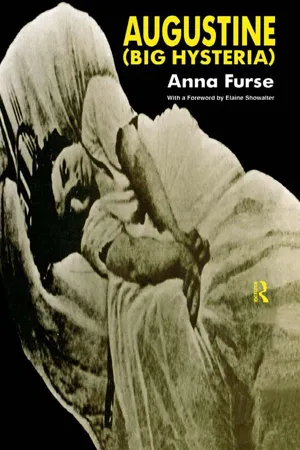
Augustine (Big Hysteria)
About this book
First Published in 1997. Contemporary Theatre Studies is a book series of special interest to everyone involved in theatre. It consists of monographs on influential figures, studies of movements and ideas in theatre, as well as primary material consisting of theatre-related documents, performing editions of plays in English, and English translations of plays from various vital theatre traditions worldwide. Augustine (Big Hysteria) by Anna Furse, first produced in Plymouth in1991, is one of the most important plays in the new feminist theatre of hysteria.
Information
AUGUSTINE (BIG HYSTERIA)
The hysteric, whose body is transformed into a theatre for forgotten scenes, relives the past, bearing witness to a lost childhood that survives in suffering… For the hysteric does not write, does not produce, does nothing – nothing other than making things circulate without inscribing them. The result: the clandestine sorceress was burned by the thousands; the deceitful and triumphant hysteric has disappeared. But the master is there. He is the one who stays on permanently. He publishes writings.
Hélène Cixous (La Jeune Née)
I want to attempt a terrific feminine. The cry of claims, of trampled down rebellion, of steeled anguish at war.
The lamentation of an opened abyss, as it were; the wounded earth cries out and voices are raised, deep as the bottomless pit, these are the depths of the abyss crying out.
Neuter. FEMININE. Masculine.
Antonin Artaud (Seraphin’s Theatre)
It all goes back to remembering…
Sigmund Freud
The real AUGUSTINE was admitted to the Salpêtrière in October 1875 and escaped, dressed as a man, on 9 September 1880. All her clinical records end here and nobody knows what happened to her.
FREUD spent six months at the Salpêtrière, as a young neuropathologist, on a travel bursary from October 1885 to March 1886.
I have chosen to imagine an overlap between AUGUSTINE and FREUD both under the influence of CHARCOT. It was CHARCOT’s work on hysteria and hypnosis which had a decisive influence on FREUD’s career. Within a year of returning to Vienna, he began to use hypnosis in his private practice. Psychoanalysis was born.
All the clinical data in the play is, to the best of my knowledge, accurate. It derives from medical records at the Charcot library in Paris. This includes AUGUSTINE’s case history, and CHARCOT’s lectures on hysteria as well as his hypnosis demonstrations. AUGUSTINE’s utterance, or at least some of it, survives at the Hospital Library and I have used her voice sometimes verbatim but mostly fictionalised.
The photographs used in the production can be obtained via the Salpêtrière Hospital.
A.F.
CHARACTERS | |
AUGUSTINE | A young woman 15–20 years old. Long dark hair. A child-woman. Part of her extremely advanced for her age and time, the other in suspended childhood. |
THE VIOLINIST | Her double. |
PROFESSOR JEAN-MARTIN CHARCOT | Late 50s/early 60s. Distinguished-looking: high forehead, strong dark features, thick set eyebrows, prominent nose. Silvery hair down to his collar, swept off his face. Witty, arrogant, eccentric, brilliant. A charming showman who breeds both love and contempt around him. |
THE YOUNG FREUD | Bearded. Scholarly. Nervous. Ambitious. In some conflict about his feelings for Charcot, e.g. awe and jealousy. Gives off a sense of preoccupation, of some private scheming at work in his mind. Heavy cough and runny nose from cigars and cocaine. |
THE ACTION TAKES PLACE AT THE SALPÊTRIÈRE HOSPITAL IN PARIS DURING THE EARLY 1880s.
The audience enter to a subtle, almost subliminal soundtrack; a mix of violin, laughter and chatter, pepperings of applause, the sound of a woman crying, rainfall. The whole soundscape should enter and leave the audiences’s consciousness like sounds brought on a wind, ghostly gusts. Gloomy light. Moonlight through a large window. Pale walls. A single institutional hospital bed of the late 19th century: an iron four-poster with calico white curtaining hanging from it. This creates a kind of booth, a small mobile stage, and, as now, a screen for slide projections. At this time, projected onto the bed-screen is the photo of Augustine in her ‘normal state’: her head resting on her right hand, she is a gentle-looking girl, still with puppy fat, her hair pulled off her face and coiled, a buttoned dark dress with white collar and bow at the neck. She is the picture of demure, compliant femininity. Only her eyes, which look out at us, betray both intelligence and pain. They do not smile with her mouth. (NB. THIS WILL BE A DOCUMENTARY PHOTOGRAPH AS WILL ALL OTHERS IN THE PLAY.) As the houselights fade, all lights on stage darken except for the slide image which thus glows stronger. The soundtrack is now a girl child’s voice singing, falteringly, the tune of a German children’s song:
Ach, du liebe Augustine, Augustine, Augustine,
Ach, du liebe Augustine, alles ist hin.
Oh, ma belle Augustine, Augustine, Augustine,
Oh, ma belle Augustine, tout est cassé.
Oh, my pretty Augustine, Augustine, Augustine,
Oh, my pretty Augustine, everything’s cracked.
Eyes are cracked, head is cracked, hand is cracked, heart is cracked,
Oh, my pretty Augustine, everything’s cracked.
The effect of this tune is haunting, desolate. By the end of the first verse, the bed and the image projected on it begins to shake violently. The sounds of the actress causing this begin to scream out, throttled gasps to yells and finally to speech. This is accompanied by a live, but as yet invisible VIOLINIST playing.
AUGUSTINE: Oh, there’s something pulling my fingers, pulling my tongue, there’s something in my throat… MAMAN!!!!!!!! (She weeps.) My neck, oh, my neck, my neck hurts, I can’t, can’t breathe… MAMAN!!!!
Slide image and voice cut suddenly. We are momentarily drowned by a burst of applause and laughter on a soundtrack as lights cut to ‘amphitheatre’: where we discover PROFESSOR CHARCOT, in a state of animation, merry, bouncing on his heels. He is in the middle of a lecture. Acknowledging the laughter he has provoked, he addresses us as if we were his audience at the Hospital. Paternal familiarity and great oratorial charm. He is enjoying his effect on his audience and the opportunity to prove something before them:
CHARCOT: Let me answer your question, Monsieur, by way of a poetic metaphor for this… asylum… this citta dolorosa of 5000. Our living museum of suffering, was as you may know, at the time of Louis XIII, a saltpetre store. Hence “La Salpêtrière”. Now, saltpetre, Messieurs, makes gunpowder, and gunpowder makes explosions. (He acts out a big explosion with his arms.) So in this… arsenal of women… with their earth-shattering energies, I, and my colleagues, are simply seeking to defuse our human powder kegs. Your question also raises the issue of whether or not hysteria is an incurable mystery. Now all diseases come from Nature and Nature is most certainly Divine. Severe cold, heat, wet, the restlessness of winds, all play their part in weakening the human body. There’s no need to ascribe a special divinity to one disease over another. Each has a nature, power and intrigue of its own; none is hopeless or incapable of treatment, HYSTERIA INCLUDED! But firstly, WHAT IS HYSTERIA? We must begin by exploring the territory of the hysterical body, then, like cartographers, we must chart it, map out its contours, possess its enigmas…
A doctor (FREUD) has brought AUGUSTINE in to the amphitheatre. He stands solicitously near her, a nervous, shy young intern. She is in an absolutely ‘normal’ state, dressed in the same dress as in her portrait photograph. She looks at CHARCOT and at the audience with interest, and a sense of willingness to be there, ‘on stage’.
CHARCOT: HYSTERIA… HYSTERO… WOMB!
He moves his hand generally over AUGUSTINE’s womb area, like a TV weather-reporter. She watches his hand near her body, fascinated.
Until most recently we doctors thought the womb to be a dancer, or an animal, crouching, leaping round the body and trying to strangle the hysteric by getting stuck in her throat. So sneezing was prescribed as a cure for hysterical attacks, and even labour pains! (A very French handgesture – ‘bof’.) This of course is nonsense! The UTERUS IS NOT AN ACROBAT! No, we must seek answers elsewhere. So, if I use methods which may seem to belong more to the fields of art and literature, to the poet rather than the scientist, let me simply say this: I am a visionary! Mine is a SCIENCE of looking (and I know those artists amongst you, will vouch for the deep revelations the mind’s eye can bring forth); art has as its basis, observation, experience, and reasoning. My method is a form of vivisection if you like – and these slices of life conjure answers BEFORE MY VERY EYES! And I repeat, nothing, but nothing is incurable… Not even this apparently elusive disease, subject of my Tuesday Lessons. In a moment, I will make pain palpable to you. I’ll make you recognise all its characteristics. I set before you a case of Grande Hystérie! Time will tell if she will be a Classic example! Doctor?!
Turns to AUGUSTINE. Looks intently at her.
FREUD: Mile Augustine Dubois, Professeur.
CHARCOT: Thank you. So, Messieurs… by way of demonstrating my own empirical methods, you will now witness a typical diagnostic encounter between myself and a new patient about whom I know nothing … yet!
CHARCOT stares at AUGUSTINE for a very long time. He walks around her as though she were a sculpture. He pats his fingers on his lips, breathes loudly and occasionally blows out through his fingers. She watches him, curious. She watches him watching her. She is aware of the audience and ‘performs’ this encounter for them. She is almost amused by him, although as the silence continues she bites her lip, impatient for this scrutiny to end. This too she signals to the audience. It does, abruptly with a question from behind her which makes her jump.
CHARCOT: How old are you?
AUGUSTINE: 15 and a half years, Monsieur le Professeur.
CHARCOT nods to audience, as though he expected this answer. Reads from notes handed to him by FREUD.
CHARCOT: Mother, 41 years, domestic servant, in good health, Father, 45 years, sober… seven children, the eldest being Louise – Augustine – born at full term, breastfed till nine months, sent to relatives in Bordeaux until the age of 6(1/2). From 6(1/2) to 13 was with nuns in Ferté-sous-Jouarre. There she was put “in the slammer”, because she got bored of reading The Lives of Saints in the refectory. Sometimes, the sisters would administer corporal punishment, slaps…
AUGUSTINE: Oh I often deserved it…
CHARCOT: (A bit surprised at her interruption.) She has a bright, capricious, wilful disposition and is too outspoken for her age. She is intelligent. Has learnt to read, write and sew. Works as a laundrymaid in the same househo...
Table of contents
- Cover
- Half Title
- Title Page
- Copyright Page
- Dedication
- CONTENTS
- Introduction to the Series
- Acknowledgements
- List of Plates
- Foreword
- Introduction
- Augustine (Big Hysteria)
Trusted by 375,005 students
Access to over 1.5 million titles for a fair monthly price.
Study more efficiently using our study tools.
Frequently asked questions
Yes, you can cancel anytime from the Subscription tab in your account settings on the Perlego website. Your subscription will stay active until the end of your current billing period. Learn how to cancel your subscription
No, books cannot be downloaded as external files, such as PDFs, for use outside of Perlego. However, you can download books within the Perlego app for offline reading on mobile or tablet. Learn how to download books offline
Perlego offers two plans: Essential and Complete
- Essential is ideal for learners and professionals who enjoy exploring a wide range of subjects. Access the Essential Library with 800,000+ trusted titles and best-sellers across business, personal growth, and the humanities. Includes unlimited reading time and Standard Read Aloud voice.
- Complete: Perfect for advanced learners and researchers needing full, unrestricted access. Unlock 1.5M+ books across hundreds of subjects, including academic and specialized titles. The Complete Plan also includes advanced features like Premium Read Aloud and Research Assistant.
We are an online textbook subscription service, where you can get access to an entire online library for less than the price of a single book per month. With over 1.5 million books across 990+ topics, we’ve got you covered! Learn about our mission
Look out for the read-aloud symbol on your next book to see if you can listen to it. The read-aloud tool reads text aloud for you, highlighting the text as it is being read. You can pause it, speed it up and slow it down. Learn more about Read Aloud
Yes! You can use the Perlego app on both iOS and Android devices to read anytime, anywhere — even offline. Perfect for commutes or when you’re on the go.
Please note we cannot support devices running on iOS 13 and Android 7 or earlier. Learn more about using the app
Please note we cannot support devices running on iOS 13 and Android 7 or earlier. Learn more about using the app
Yes, you can access Augustine (Big Hysteria) by Anna Furse in PDF and/or ePUB format, as well as other popular books in Media & Performing Arts & Drama. We have over 1.5 million books available in our catalogue for you to explore.