- 288 pages
- English
- ePUB (mobile friendly)
- Available on iOS & Android
eBook - ePub
About this book
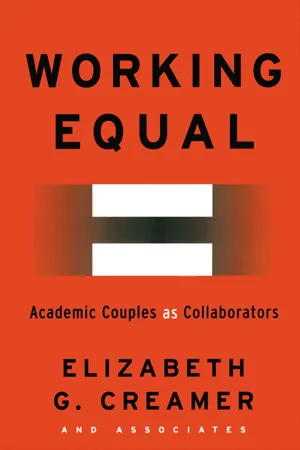
Working Equal exposes the myth of heroic individualism that is central to contemporary western thought. With more than 35% of full-time faculty with a spouse or partner in the same profession, dual career couples are a growing presence in higher education in the U.S.. This compelling and innovative volume examines and testifies to the contribution of intimate and familial relationships to artistic, literary, and scientific accomplishment. An original study of a growing phenomena in higher education, Working Equal presents a new and invaluable portrait of contemporary faculty life.
Information
1
Introduction
I think that it is not so much quantity. That isn’t the case. I probably would have published just as much. I think it has made me more innovative. It has made it easier for me to continue to grow and to step outside a conventional data analysis paradigm that I would use from my discipline. -Woman, Professor, Sociologist
Parallel to the dramatic growth in the presence of dual-career couples in most sectors of employment in the United States is the emergence of dual-career academic couples in higher education since the 1970s. Academic partners are a subset of dual-career couples who are in the same profession, if not necessarily in the same type of position, in the same academic field or working at the same institution. Although among faculty women are less likely than men to be married,1 a significant number of both men and women faculty have a spouse or partner who is also an academic. In 1988, more than one-third of men and 40 percent women faculty and administrators had a spouse or partner who is also in higher education.2 Marianne Ferber’s and Jane Loeb’s Academic Couples: Problems and Promises (1997) is the first book to mark this growing trend.3
Faculty productivity is a term that encompasses teaching, service, and outreach. Scholarly or research productivity refers to a wide range of activities that advance knowledge and contribute to the arts.4 Scholarly publications, particularly those that appear in prestigious outlets such as refereed journals and university presses, are central to the faculty reward structure. Kathryn Ward and Linda Grant reflect on the centrality of publications in the academic reward structure when they observe:
Given current social relationships and American universities, publication not only makes or breaks individual academic careers, but it also creates and re-creates the content of academic disciplines. The study of academic publication processes therefore belongs at the center, rather than the periphery of contemporary scholarly research, particularly research aimed at illuminating equity issues.5
Studying the lives of academic couples makes clear that personal relationships and the social and material conditions in the domestic setting also impact scholarly productivity.6
Working Equal is about academic couples who have collaborated together in the production of scholarship.7 My interest in the topic emerged from interviews I conducted between 1992 and 1996 with highly productive women scholars. During these interviews, I was surprised by how often faculty women introduced the role of a spouse, including as a collaborator, as one of the factors that contributed to their ability to be productive as a scholar.
As the book’s title suggests, I grew to consider many of these contemporary partnerships to be egalitarian in character. The egalitarianism was evident in the interchangeable, non-sex-based8 roles assumed in collaborative projects, in expressions of mutuality, and in comparable priority awarded to each member’s professional goals. It was often articulated in a shared worldview. These couples challenge the assumption that family responsibilities interfere with career achievement.
The information presented in Working Equal came from a number of sources. Each of the women in the partnerships presented in the case narratives responded to a national survey about collaboration, including with a spouse or partner, that I conducted in 1996. They were among a carefully selected matched sample of 750 senior faculty at research universities targeted to identify prolific scholarly writers. I conducted individual interviews with 14 of the 28 prolific survey respondents who had coauthored with a spouse, with the spouse or partner of seven of them, as well as with twelve additional faculty who were identified through a snowball sampling technique. From this sample of 33 academics, I wrote case narratives for four couples, selecting three to present in this book. A description of how the case narratives were constructed is presented in the next chapter.
A detailed description of the characteristics of the survey respondents and interview participants is presented in Appendices A, B, and C. The data presented in the appendices support a central point reiterated throughout this volume: that point is that while the faculty members presented in the case narratives may in some ways be exceptional, they are not isolated examples. It is my argument that scholarly collaboration is not unusual among academic couples. I believe that as the number of women receiving advanced degrees continues to expand, even in academic areas where they have been historically absent, the familial arrangements I depict in the case narratives will become even more prevalent than they are now.
At least one member of each of the academic pairs I studied qualified as a prolific scholarly writer by virtue of the number of publications produced over the course of a career.9 Prolific scholars are a small group of senior scholars, generally located at research universities, who have sustained an interest in research and publication over decades. Because they produce a disproportionate percentage of the publications in a field,10 they are major actors in shaping the dominant theoretical and methodological paradigms in an academic field. Historically, women have been woefully underrepresented among the ranks of the prolific.11 Examining the daily lives of highly productive and prolific women writers provides an opportunity to scrutinize the material and social conditions that have historically blocked women from entry to this elite group.
A by-product of any study of prolific scholars is that the publication level required serves to delineate a population that is both elite and relatively homogenous.12 For decades, this population has been almost exclusively white men in the senior ranks of faculty at research universities, whose experiences are not representative of faculty as a whole. The painfully small numbers of nonwhites among senior faculty at research universities and the criterion I used for publication level severely limited the number of minority faculty members who qualified to participate in the study. Although only heterosexual pairs who are domestic partners are presented in the case narratives, it not my intention to reify heterosexual relationships or to suggest that there is anything sacrosanct about the heterosexual bond in terms of productivity or creativity. Findings that same-sex couples are more likely than heterosexual couples to have egalitarian relationships13 suggests, on the contrary, that relationships with mutual career benefit are even more likely among this population.
An unanticipated consequence of studying academic couples who have collaborated together is that it shifts the focus of study from conventional work settings to the household. Rather than professional conferences or campus offices, laboratories, or conference rooms, these couples described the work-related activities they accomplished in their home. One of the ways members of the faculty couples who participated in this research project accommodated a strong commitment to a personal relationship and a demanding career was by relocating the setting of some of their work to the home and by collaborating with a partner on scholarly projects. Advances in technology are part of the changing nature of workplace that have offered some faculty more freedom to accomplish their work away from the traditional work setting.14
Analysis of how members of these couples manage to sustain productivity suggests, as did Arlie Hochschild in her book The Time Bind,15 that social change is not necessarily occurring because the workplace is being fundamentally redesigned to accommodate the needs of dual-career couples. The experiences of faculty couples in this study suggest that the more profound social change that is occurring is reengineering the nature of family life to accommodate the demands of two members with a comparable commitment to career success.
Contribution to the Literature
Coauthorship is the most frequent topic of research about collaboration.16 Dickens and Sagaria (1997) identified intimate collaborators as one of four relationship patterns among coauthors, observing that this collaborative pattern “has been invisible and undocumented in published work.”17 These relationships are characterized by both emotional and intellectual intimacy.18 When the family is analyzed as a collaborative unit, married couples are only one of many possible configurations. Studying the personal element of collaborative relationships adds consideration of the affective dimension that has been inaccessible by traditional quantitative research methods.19
The literature about couples crosses a number of disciplines, including family studies, sociology, the history of science, and humanities. Historical biographies of couples use personal papers, diaries, correspondence, and the recollections of friends and relatives to re-create the contribution of personal, familial, and collegial relationships to the creative process. Authors of these works generally present them as a challenge to cultural Western myths about singular achievement, heroic individualism, and solitary genius and the implicit assumption that these are largely male qualities. Individual accomplishments are contextualized to recognize the social nature of creativity and achievement and the support supplied by significant others and a community of colleagues.
Intimate domestic partners are sometimes part of the social and material conditions that enable or constrain the creative or intellectual life. Varying by personality and context, partners have played a wide range of roles that contribute to productivity: muse, patron, audience, publicist or promoter, protector, foil, editor, archivist, coproducer, and nurturer or enabler. An influential spouse can provide access to intellectual circles not historically open to women, particularly unmarried women.20 A spouse or partner can provide a readily accessible source of community for academics who are otherwise isolated from like-minded colleagues because of their race, sexual orientation, gender, or the marginalization of their scholarly interests.
Several portraits in the literature explore the relationships of visual artists, such as the painters Diego River and Frida Kahlo21 or Georgia O’Keeffe and Alfred Stieglitz,22 or of writers, such as George Eliot and George Henry Lewes.23 Couples are more likely to be studied for their reciprocal influence on the content of each other’s work than for actually coproducing work. Scientists, such as academics in a variety of fields in the social sciences and the physical and biological sciences, offer the opportunity to explore examples of couples who have jointly produced work.
The benefits of heterosexual life partnerships are most frequently presented in the literature as one-sided rather than reciprocal. Paralleling the implicit assumption of a hierarchical arrangement within heterosexual relationships, one spouse is usually cast in a supporting role as the nurturer or enabler who helps to create an environment that is conducive to the partner’s work. This is the case, for example, in the narrative portraits of the relationship of five Victorian couples presented in Phyllis Rose’s 1984 work, Parallel Lives. Most typically, it is the male who is portrayed as benefiting from the invisible labor of a spouse or partner and the woman who is cast in the role of invisible “other.”24 Less frequently, a woman might be the beneficiary of collaboration with a partner through role reversal. Rose illustrates this pattern through a description of the relationship between the poet Elizabeth Barrett and her husband Robert Browning. This pattern is also manifested, according to Rose, in some same-sex relationships among historically prominent figures, such as the wifelike role assumed by Alice B. Toklas in relation to Gertrude Stein.25
Marriage among scientists has been of interest to feminist historians of science because it has been a vehicle some women have employed to gain access to scientific careers.26 Perhaps to compensate for the social stigma of deviating from conventional norms of femininity, a very high proportion of women scientists in such fields as physics and biochemistry have a spouse who is also a scientist.27 Pnina Abir-Am and Dorinda Outram argue that while the exclusion of women from science is not an intentional strategy, it is a by-product of exclusion of the domestic arena. They note that the literature has: “totally overlooked the possibility that the gender structure of modern science, with its massive underrepresentation of women, comes not so much from the exclusion of women from science, but rather from the exclusion of the domestic realm from science, and the incidental concomitant exclusion of women.”28
Through the early 1900s, most scientific work was done at home ...
Table of contents
- Cover
- Half Title
- Title Page
- Copyright Page
- Table of Contents
- Preface
- 1. Introduction
- Part 1 The Case Narratives
- Part 2 The Social Nature of Faculty Scholarship
- Part 3 Implications for Couples and the Academic Workplace
- Appendices
- Notes
- References
- Contributors
- Index
Trusted by 375,005 students
Access to over 1.5 million titles for a fair monthly price.
Study more efficiently using our study tools.
Frequently asked questions
Yes, you can cancel anytime from the Subscription tab in your account settings on the Perlego website. Your subscription will stay active until the end of your current billing period. Learn how to cancel your subscription
No, books cannot be downloaded as external files, such as PDFs, for use outside of Perlego. However, you can download books within the Perlego app for offline reading on mobile or tablet. Learn how to download books offline
Perlego offers two plans: Essential and Complete
- Essential is ideal for learners and professionals who enjoy exploring a wide range of subjects. Access the Essential Library with 800,000+ trusted titles and best-sellers across business, personal growth, and the humanities. Includes unlimited reading time and Standard Read Aloud voice.
- Complete: Perfect for advanced learners and researchers needing full, unrestricted access. Unlock 1.5M+ books across hundreds of subjects, including academic and specialized titles. The Complete Plan also includes advanced features like Premium Read Aloud and Research Assistant.
We are an online textbook subscription service, where you can get access to an entire online library for less than the price of a single book per month. With over 1.5 million books across 990+ topics, we’ve got you covered! Learn about our mission
Look out for the read-aloud symbol on your next book to see if you can listen to it. The read-aloud tool reads text aloud for you, highlighting the text as it is being read. You can pause it, speed it up and slow it down. Learn more about Read Aloud
Yes! You can use the Perlego app on both iOS and Android devices to read anytime, anywhere — even offline. Perfect for commutes or when you’re on the go.
Please note we cannot support devices running on iOS 13 and Android 7 or earlier. Learn more about using the app
Please note we cannot support devices running on iOS 13 and Android 7 or earlier. Learn more about using the app
Yes, you can access Working Equal by Elizabeth Creamer in PDF and/or ePUB format, as well as other popular books in Education & Education General. We have over 1.5 million books available in our catalogue for you to explore.