eBook - ePub
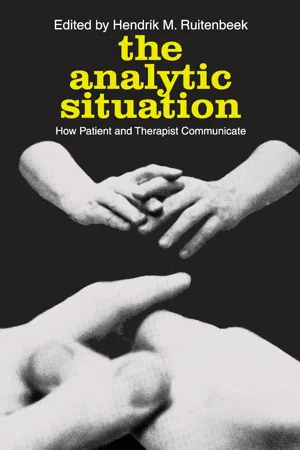
The Analytic Situation
How Patient and Therapist Communicate
- 222 pages
- English
- ePUB (mobile friendly)
- Available on iOS & Android
eBook - ePub
About this book
Significant as has been the role of psychoanalysis and psychotherapy in contemporary culture and society, its importance continues to grow at an accelerating rate as more specific, focused, and involving forms of therapy are devised. The contributions of eminent practitioners that make up this volume deal with specific types of occurrences in the confrontation between patient and therapist, such as silence, crying, sleeping, touching, use of first names, gifts, note taking, termination, etc. The views expressed here demonstrate how the rigidity of early psychoanalytic theory has yielded to fundamental changes in the handling of the analytic situation; numerous new schools of thought have arisen in attempts to give deeper fulfillment to the needs of patient, analyst, and society. The persuasions of these new schools--Gestaltist, existentialist, neo-Freudian, behavioralist, ego psychologist, rational-emotive, encounter, and many others--underlie the material presented here.Impulsiveness and originality mark all of these departures from orthodoxy. The therapist, becoming more open and more manifestly responsive in his interaction with the patient, is clearly shifting his role from that of an objective listener and interpreter to that of an overt participant in therapy. These trends are further intensified by the fact that the practice of psychotherapy is now carried on, by a vast number of clinical psychologists, personality psychologists, social psychologists, and social workers who have taken up psychotherapy as a professional activity in urban mental health clinics and in a variety of settings outside the major American metropolitan areas.The Analytic Situation provides informative, revealing reading for everyone involved in the psychotherapeutic process. It also offers provocative insights to students and therapists in training.
Information
1
The Origins of Transference
Melanie Klein
In his Fragment of an Analysis of a Case of Hysteria Freud defines the transference situation in the following way:
What are transferences? They are new editions or facsimiles of the tendencies and phantasies which are aroused and made conscious during the progress of the analysis; but they have this peculiarity, which is characteristic for their species, that they replace some earlier person by the person of the physician. To put it another way: a whole series of psychological experiences are revived, not as belonging to the past, but as applying to the physician at the present moment.
In some form or other transference operates throughout life and influences all human relations, but here I am only concerned with the manifestations of transference in psychoanalysis. It is characteristic of psycho-analytic procedure that, as it begins to open up roads into the patient’s unconscious, his past (in its conscious and unconscious aspects) is gradually being revived. Thereby his urge to transfer his early experiences, object-relations and emotions, is reinforced and they come to focus on the psycho-analyst; this implies that the patient deals with the conflicts and anxieties which have been reactivated, by making use of the same mechanisms and defences as in earlier situations.
It follows that the deeper we are able to penetrate into the unconscious and the further back we can take the analysis, the greater will be our understanding of the transference. Therefore a brief summary of my conclusions about the earliest stages of development is relevant to my topic.
The first form of anxiety is of a persecutory nature. The working of the death instinct within–which according to Freud is directed against the organism–gives rise to the fear of annihilation, and this is the primordial cause of persecutory anxiety. Furthermore, from the beginning of post-natal life (I am not concerned here with pre-natal processes) destructive impulses against, the object stir up fear of retaliation. These persecutory feelings from inner sources are intensified by painful external experiences, for, from the earliest days onwards, frustration and discomfort arouse in the infant the feeling that he is being attacked by hostile forces. Therefore the sensations experienced by the infant at birth and the difficulties of adapting himself to entirely new conditions give rise to persecutory anxiety. The comfort and care given after birth, particularly the first feeding experiences, are felt to come from good forces. In speaking of “forces” I am using a rather adult word for what the young infant dimly conceives of as objects, either good or bad. The infant directs his feelings of gratification and love towards the “good” breast, and his destructive impulses and feelings of persecution towards what he feels to be frustrating, i.e. the “bad” breast. At this stage splitting processes are at their height, and love and hatred as well as the good and bad aspects of the breast are largely kept apart from one another. The infant’s relative security is based on turning the good object into an ideal one as a protection against the dangerous and persecuting object. These processes–that is to say splitting, denial, omnipotence and idealization–are prevalent during the first three or four months of life (which I termed the “paranoid-schizoid position”). In these ways at a very early stage persecutory anxiety and its corollary, idealization, fundamentally influence object relations.
The primal processes of projection and introjection, being inextricably linked with the infant’s emotions and anxieties, initiate object-relations; by projecting, i.e. deflecting libido and aggression on to the mother’s breast, the basis for object-relations is established; by introjecting the object, first of all the breast, relations to internal objects come into being. My use of the term “object-relations” is based on my contention that the infant has from the beginning of post-natal life a relation to the mother (although focusing primarily on her breast) which is imbued with the fundamental elements of an object-relation, i.e. love, hatred, phantasies, anxieties, and defences.1
In my view–as I have explained in detail on other occasions–the introjection of the breast is the beginning of superego formation which extends over years. We have grounds for assuming that from the first feeding experience onwards the infant introjects the breast in its various aspects. The core of the superego is thus the mother’s breast, both good and bad. Owing to the simultaneous operation of introjection and projection, relations to external and internal objects interact. The father too, who soon plays a role in the child’s life, early on becomes part of the infant’s internal world. It is characteristic of the infant’s emotional life that there are rapid fluctuations between love and hate; between external and internal situations; between perception of reality and the phantasies relating to it; and, accordingly, an interplay between persecutory anxiety and Idealization–both referring to internal and external objects; the idealized object being a corollary of the persecutory, extremely bad one.
The ego’s growing capacity for integration and synthesis leads more and more, even during these first few months, to states in which love and hatred, and correspondingly the good and bad aspects of objects, are being synthesized; and this gives rise to the second form of anxiety–depressive anxiety–for the infant’s aggressive impulses and desires towards the bad breast (mother) are now felt to be a danger to the good breast (mother) as well. In the second quarter of the first year these emotions are reinforced, because at this stage the infant increasingly perceives and introjects the mother as a person. Depressive anxiety is intensified, for the infant feels he has destroyed or is destroying a whole object by his greed and uncontrollable agression. Moreover, owing to the growing synthesis of his emotions, he now feels that these destructive impulses are directed against a loved person. Similar processes operate in relation to the father and other members of the family These anxieties and corresponding defences constitute the “depressive position,” which comes to a head about the middle of the first year and whose essence is the anxiety and guilt relating to the destruction and loss of the loved internal and external objects.
It is at this stage, and bound up with the depressive position, that the Oedipus complex sets in. Anxiety and guilt add a powerful impetus towards the beginning of the Oedipus complex. For anxiety and guilt increase the need to externalize (project) bad figures and to internalize (introject) good ones; to attach desires, love, feelings of guilt, and reparative tendencies to some objects, and hate and anxiety to others: to find representatives for internal figures in the external world. It Is, however, not only the search for new objects which dominates the infant’s needs, but also the drive towards new aims: away from the breast towards the penis, i.e. from oral desires towards genital ones. Many factors contribute to these developments: the forward drive of the libido, the growing integration of the ego, physical and mental skills and progressive adaptation to the external world. These trends are bound up with the process of symbol formation, which enables the infant to transfer not only Interest, but also emotions and phantasies, anxiety and guilt, from one object to another.
The processes I have described are linked with another fundamental phenomenon governing mental life. I believe that the pressure exerted by the earliest anxiety situations is one of the factors which bring about the repetition compulsion. I shall return to this hypothesis at a later point.
Some of my conclusions about the earliest stages of Infancy are a continuation of Freud’s discoveries; on certain points, however, divergencies have arisen, one of which is very relevant to my present topic. I am referring to my contention that object-relations are operative from the beginning of post-natal life.
For many years I have held the view that auto-erotism and narcissism are in the young infant contemporaneous with the first relation to objects–external and Internalized. I shall briefly restate my hypothesis: auto-erotism and narcissism include the love for and relation with the internalized good object which in phantasy forms part of the loved body and self. It is to this internalized object that in auto-erotic gratification and narcissistic states a withdrawal takes place. Concurrently, from birth onwards, a relation to objects, primarily the mother (her breast) Is present. This hypothesis contradicts Freud’s concept of auto-erotic and narcissistic stages which preclude an object-relation However, the difference between Freud’s view and my own is less wide than appears at first sight, since Freud’s statements on this issue are not unequivocal. In various contexts he explicitly and implicitly expressed opinions which suggested a relation to an object, the mother’s breast, preceding auto-erotism and narcissism. One reference must suffice; in the first of two Encyclopaedia articles,2 Freud said:
In the first instance the oral component instinct finds satisfaction by attaching itself to the sating of the desire for nourishment; and its object is the mother’s breast. It thee detaches Itself, becomes independent and at the same time auto-erotic, that is, it finds an object in the child’s own body.
Freud’s use of the term object is here somewhat different from my use of this term, for he is referring to the object of an instinctual aim, while I mean, in addition to this, an object-relation involving the infant’s emotions, phantasies, anxieties, and defences. Nevertheless, in the sentence referred to, Freud clearly speaks of a libidinal attachment to an object, the mother’s breast, which precedes autoerotism and narcissism.
In this context I wish to remind you also of Freud’s findings about early identifications. In The Ego and the Id,3 speaking of abandoned object cathexes, he said; the effects of the first identification in earliest childhood will be profound and lasting. This leads us back to the origin of the ego-ideal. . . Freud then defines the first and most important identifications which lie hidden behind the ego-ideal as the identification with the father, or with the parents, and places them, as he expresses it, in the “pre-history of every person.” These formulations come close to what I described as the first introjected objects, for by definition identifications are the result of intro-jection. From the statement I have just discussed and the passage quoted from the Encyclopaedia article it can be deduced that Freud, although he did not pursue this line of thought further, did assume that in earliest infancy both an object and introjective processes play a part.
That is to say, as regards auto-erotism and narcissism we meet with an inconsistency in Freud’s views. Such inconsistencies which exist on a number of points of theory clearly show, I think, that on these particular issues Freud had not yet arrived at a final decision. In respect of the theory of anxiety he stated this explicitly in Inhibitions, Symptoms and Anxiety.4 His realization that much about the early stages of development was still unknown or obscure to Mm is also exemplified by Ms speaking of the first years of the girl’s life as “. . . lost in a past so dim and shadowy . . . .”5
I do not know Anna Freud’s view about this aspect of Freud’s work. But, as regards the question of auto-erotism and narcissism, she seems only to have taken into account Freud’s conclusion that an auto-erotic and a narcissistic stage precede object-relations, and not to have allowed for the other possibilities-implied in some of Freud’s statements such as the ones I referred to above. This is one of the reasons why the divergence between Anna Freud’s conception and my conception of early infancy is far greater than that between Freud’s views, taken as a whole, and my views. I am stating this because I believe it is essential to clarify the extent and nature of the differences between the two schools of psycho-analytic thought represented by Anna Freud and myself. Such clarification is required in the interests of psycho-analytic training and also because it could help to open up fruitful discussions between psycho-analysts and thereby contribute to a greater general understanding of the fundamental problems of early infancy.
The hypothesis that a stage extending over several months precedes object-relations implies that–except for the libido attached to the infant’s own body–impulses, phantasies, anxieties, and defences either are not present in him, or are not related to an object, that is to say they would operate in vacuo. The analysis of very young children has taught me that there is no instinctual urge, no anxiety situation, no mental process which does not involve objects, external or internal; in other words, object-relations are at the center of emotional life. Furthermore, love and hatred, phantasies, anxieties, and defences are also operative from the beginning and are ab initio indivisibly linked with object-relations. This insight showed me many phenomena in a new light.
I shall now draw the conclusion on which the present paper rests: I hold that transference originates in the same processes which in the earliest stages determine object-relations. Therefore we have to go back again and again in analysis to the fluctuations between objects, loved and hated, external and internal, which dominate early infancy. We can fully appreciate the interconnection between positive and negative transferences only if we explore the early interplay between love and hate, and the vicious circle of aggression, anxieties, feelings of guilt and increased aggression, as well as the various aspects of objects towards whom these conflicting emotions and anxieties are directed. On the other hand, through exploring these early processes I became convinced that the analysis of the negative transference, which had received relatively little attention6 in psycho-analytic technique, is a precondition for analyzing the deeper layers of the mind. The analysis of the negative as well as of the positive transference and of their interconnection is, as I have held’ for many years, an indispensable principle for the treatment of all types of patients, children and adults alike. I have substantiated this view in most of my writings from 1927 onwards.
This approach, which in the past made possible the psychoanalysis of very young children, has in recent years proved extremely fruitful for the analysis of schizophrenic patients. Until about 1920 it was assumed that schizophrenic patients were incapable of forming a transference and therefore could not be psycho-analyzed. Since then the psycho-analysis of schizophrenics has been attempted by various techniques. The most radical change of view in this respect, however, has occurred more recently and is closely connected with the greater knowledge of the mechanisms, anxieties, and defences operative in earliest infancy. Since some of these defences, evolved in primal object-relations against both love and hatred, have been discovered, the fact that schizophrenic patients are capable of developing both a positive and a negative transference has been fully understood; this finding is confirmed if we consistently apply in the treatment of schizophrenic patients7 the principle that it is as necessary to analyze the negative as the positive transference–that in fact the one cannot be analyzed without the other.
Retrospectively it can be seen that these considerable advances in technique are supported in psycho-analytic theory by Freud’s discovery of the Life and Death instincts, which has fundamentally added to the understanding of the origin of ambivalence. Because the Life and Death instincts, and therefore love and hatred, are at bottom in the closest interaction, negative and positive transference are basically interlinked.
The understanding of earliest object-relations and the processes they imply has essentially influenced technique and various angles. It has long been known that the psycho-analyst in the transference situation may stand for mother, father, or other people, that he is also at times playing in the patient’s mind the part of the superego, at other times that of the id or the ego. Our present knowledge enables us to penetrate to the specific details of the various roles allotted by the patient to the analyst. There are in fact very few people in the young infant’s life, but he feels them to be a multitude of objects because they appear to him in different aspects. Accordingly, the analyst may at a given moment represent a part of the self, of the superego or any one of a wide range of internalized figures. Similarly it does not...
Table of contents
- Cover Page
- Title Page
- Copyright Page
- Contents
- Introduction
- 1. The Origins of Transference
- 2. Silence as an Integrative Factor
- 3. Silence as Communication
- 4. On Silence
- 5. What Do I Do When the Patient Cries?
- 6. Patients Who Sleep or Look at the Psychoanalyst During Treatment
- 7. The Use of First Names in Psychotherapy
- 8. The Gift in Therapy
- 9. On Taking Notes
- 10. A Significant Comment Made by Patients When Relating their Dreams
- 11. Setting a Termination Date: An Impetus to Analysis
- 12. Therapeutic Results in Psychoanalytic Treatment Without Fee
- 13. I’m Not Getting Any Better
- 14. The Refusal to Mourn
- 15. The Technique of Employing Doctor-Patient Transactions in Psychoanalysis
- 16. Emotional Engagement of Patient and Analyst
- 17. The Therapeutic Encounter
- 18. The Importance of Flexibility in Psychoanalytic Technique
- 19. The Commitment to Intimacy
- 20. On the Rationale of Touch in Psychotherapy
- 21. To Touch–Or Not To Touch
- 22. Freud As Therapist: Include The Patient In Your World
- 23. Psychotherapy as a Source of the Therapist’s Own Authenticity and Inauthenticity
- Bibliography
- Index
Trusted by 375,005 students
Access to over 1.5 million titles for a fair monthly price.
Study more efficiently using our study tools.
Frequently asked questions
Yes, you can cancel anytime from the Subscription tab in your account settings on the Perlego website. Your subscription will stay active until the end of your current billing period. Learn how to cancel your subscription
No, books cannot be downloaded as external files, such as PDFs, for use outside of Perlego. However, you can download books within the Perlego app for offline reading on mobile or tablet. Learn how to download books offline
Perlego offers two plans: Essential and Complete
- Essential is ideal for learners and professionals who enjoy exploring a wide range of subjects. Access the Essential Library with 800,000+ trusted titles and best-sellers across business, personal growth, and the humanities. Includes unlimited reading time and Standard Read Aloud voice.
- Complete: Perfect for advanced learners and researchers needing full, unrestricted access. Unlock 1.5M+ books across hundreds of subjects, including academic and specialized titles. The Complete Plan also includes advanced features like Premium Read Aloud and Research Assistant.
We are an online textbook subscription service, where you can get access to an entire online library for less than the price of a single book per month. With over 1.5 million books across 990+ topics, we’ve got you covered! Learn about our mission
Look out for the read-aloud symbol on your next book to see if you can listen to it. The read-aloud tool reads text aloud for you, highlighting the text as it is being read. You can pause it, speed it up and slow it down. Learn more about Read Aloud
Yes! You can use the Perlego app on both iOS and Android devices to read anytime, anywhere — even offline. Perfect for commutes or when you’re on the go.
Please note we cannot support devices running on iOS 13 and Android 7 or earlier. Learn more about using the app
Please note we cannot support devices running on iOS 13 and Android 7 or earlier. Learn more about using the app
Yes, you can access The Analytic Situation by Peter F. Drucker,Hendrik M. Ruitenbeek in PDF and/or ePUB format, as well as other popular books in Medicine & Psychiatry & Mental Health. We have over 1.5 million books available in our catalogue for you to explore.