eBook - ePub
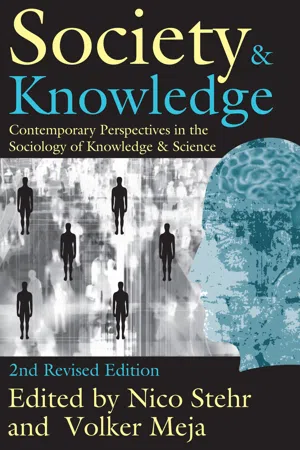
Society and Knowledge
Contemporary Perspectives in the Sociology of Knowledge and Science
- 451 pages
- English
- ePUB (mobile friendly)
- Available on iOS & Android
eBook - ePub
Society and Knowledge
Contemporary Perspectives in the Sociology of Knowledge and Science
About this book
The sociology of knowledge is generally seen as part of the sociology of cultural products. Along with the sociology of science, it explores the social character of science and in particular the social production of scientific knowledge. Knowledge in all its varieties is of crucial importance in social, political, and economic relations in modern society. Yet new realities, the editors argue in their introduction to this second edition, require a new perspective.In the past half century, the social role of knowledge has changed profoundly. The natural attitude toward scientific knowledge in science that assigned a special status to science's knowledge claims has lost its dominance, and the view that all knowledge is socially constructed has gained general acceptance. Science increasingly influences the political agenda in modern societies. Consequently, a new political field has emerged: knowledge politics.These fourteen essays by social scientists, philosophers, and historians cover fundamental issues, theoretical perspectives, knowledge and power, and empirical studies. Eight of the fourteen contributions were part of the first edition of Society and Knowledge, published in 1984, and most of these have been updated and revised for this new edition. Included in this edition are six new contributions by Robert K. Merton, Steve Fuller, Dick Pels, Nico Stehr, Barry Schwartz, and Michael Lynch.This second, revised edition builds on its predecessor in presenting cutting-edge theoretical and empirical efforts to transform the sociology of knowledge. Professionals, policymakers, and graduate students in the fields of sociology, political science, and social science will find this volume of interest and importance.
Information
I
Fundamental Issues
Introduction
The first contribution in this part on fundamental issues is Robert K. Merton’s authoritative essay on “The Sociology of Knowledge” (1945). Merton discusses Karl Mannheim as the major figure among a group of social thinkers whose diverse approaches to the relations between knowledge and society relate to questions and alternative answers that constitute the agenda for the theoretical clarification and empirical research required to build a proper discipline of sociology.
Merton, as well as David Bloor and Michael Mulkay, update the classic debate on the possibility of overcoming the distorting effects of ideology upon thought. They vindicate the central tenet of the sociology of knowledge, to wit: that there is no privileged site of speech but instead a field of perpetual conflict between partial perspectives wherein consciousness is socially rooted yet capable, under special circumstances, of transcending social constraints.
Merton’s “paradigm” for the sociology of knowledge sets out five issues: the existential basis of mental productions, the varieties and aspects of mental productions subject to sociological analysis, the specific relationships between mental productions and their existential basis, the functions of existentially conditioned mental productions, and the conditions under which the imputed relations obtain. Crediting Mannheim with having sketched the broad contours of the sociology of knowledge with remarkable skill and insight, Merton nevertheless finds his theory too loose and burdened with unnecessary philosophical claims. Merton is not persuaded by Mannheim’s speculations about the bearing of the sociology of knowledge on epistemological issues. His procedures and substantial findings, Merton contends, can indeed clarify relations between knowledge and social structure, but only after they have been shorn of their epistemological impedimenta, with their concepts modified by the lessons of empirical inquiry.
David Bloor reexamines the classical claim of Emile Durkheim and Marcel Mauss in Primitive Classification that the classification of things reproduces the classification of men. Such a reexamination is timely since the empirical, theoretical, and logical criticisms of the Durkheim-Mauss thesis continue to be widespread and even now are endorsed by most social scientists. Durkheim and Mauss had argued that the sevenfold classification of space in Zuni cosmology was the outcome of a sevenfold Zuni social organization, in particular of a sevenfold arrangement of Zuni camps. The anthropological evidence for this claim was soon challenged, and the question was raised how this thesis could possibly help in accounting for successful knowledge. It was argued that Durkheim and Mauss’ claim contained inherent logical flaws.
To the list of objections Bloor adds the lack of an adequate and systematic model of the classificatory process itself in the Durkheim-Mauss thesis. Bloor contends, however, that the latter formula may be reconstituted on a new theoretical base by linking it to a general model of classification. He proposes the use of the network model developed by the philosopher of science Mary Hesse. Following an elaboration of this model, first formulated as an analysis of scientific inference, Bloor shows how empirical material from the history of science strongly supports the network model.
Finally, Bloor reexamines the standard objections to the Durkheim-Mauss thesis, and demonstrates how these can be overcome. He argues that Durkheim’s work not only continues to be of central significance for the sociology of knowledge but that the scope of this significance has actually been considerably extended since Durkheim’s work can now be regarded as applying not merely to “primitive” classification but to classificatory processes in general.
Michael Mulkay presents a well-argued defense of the sociology of knowledge against its own inhibitions to treat the exact sciences as topics of sociological investigation rather than as idealized role models. The first section of his essay presents two contrasting sociological perspectives on science: the standard view, which treats science as a special sociological case and regards scientific knowledge as epistemologically unique; and an alternative perspective, which argues that the procedures and conclusions of science are the contingent outcome of interpretive social acts.
Mulkay confronts us squarely with a case of interdisciplinary cultural dependency. There has been a persistent effort on the part of sociologists of knowledge and science in particular, and of sociologists in general, to exempt the “hard” sciences from the taint of sociological determination. This phenomenon is itself a topic for the sociology of knowledge. Perhaps as a result of a deep need to legitimate itself, sociology developed a mythical self-understanding, according to which it appeared as a “young discipline” following the trail blazed by the advanced sciences. This mythical self-understanding led to the fetishism of scientific method and to the “sacralization” of natural science, as if, by following the latter’s recipes, one could earn solid credentials in social science research. Sociologists of knowledge, like Karl Mannheim, sought to contain the self-relativization of thought by restricting epistemological consequences of their approach to domains outside the natural sciences. Sociologists of science, for their part, sought to reconstruct social science after the model of natural science, reinforcing instead of deflating idealized versions of the latter.
Until quite recently, the specialty of sociology of science has been a sort of fan club of natural science. Its basic questions have been: How could this marvel of objectivity that is natural science develop? What are its normative warrants? Under which cultural conditions does it thrive? How are vocations pursued inside its universe? In their search for answers, sociologists of science sought to demonstrate the elective affinities between natural science and the ethos of modernity. Science appeared as an enterprise that was fully rational, correctible, public, nonconstrained, open-ended, liberal, and meritocratic. In short, as a world of truth that was also a world of freedom, reason, and justice. Today we treat this corpus of statements with a sort of bemused and critical distance, as when we sometimes watch old movies. The merit of Mulkay’s paper lies in presenting and synthesizing the reasons for this current skepticism. The standard view of science does not stand serious scrutiny, which has been coming from philosophers, historians, and from scientists themselves. Sociological enthusiasts of the standard view of science — very much like modernizing elites in some underdeveloped countries — are thus left with an obsolete piece of equipment that they had purchased as the latest novelty.
A major question addressed by Mulkay concerns the relationship between knowledge and practical application. Mulkay demonstrates that there is little empirical evidence of any clear or close links between both basic and applied scientific research and the great mass of technical developments. It is consequently hardly possible to maintain that the practical success of a scientific theory validates the theory. Mulkay’s conclusions about the consequences and the status of scientific knowledge support the second sociological perspective on science, which maintains that scientific knowledge is in principle open to sociological analysis because it too is context-dependent, i.e. constituted differently in different social contexts and groups according to varying interests, purposes, conventions, and criteria of adequacy.
1
The Sociology of Knowledge
Robert K. Merton
The last generation has witnessed the emergence of a special field of sociological inquiry: the sociology of knowledge (Wissenssoziologie). The term “knowl-edge” must be interpreted very broadly indeed, since studies in this area have dealt with virtually the entire gamut of cultural products (ideas, ideologies, juristic and ethical beliefs, philosophy, science, technology). But whatever the conception of knowledge, the orientation of this discipline remains largely the same: it is primarily concerned with the relations between knowledge and other existential factors in the society or culture. General and even vague as this formulation of the central purpose may be, a more specific statement will not serve to include the diverse approaches which have been developed.
Manifestly, then, the sociology of knowledge is concerned with problems which have had a long history. So much is this the case, that the discipline has found its first historian, Ernst Grünwald.1 But our primary concern is not with the many antecedents of current theories. There are indeed few present-day observations which have not found previous expression in suggestive aperçus. King Henry IV was being reminded that “Thy wish was father, Harry, to that thought” only a few years before Bacon was writing that “The human understanding is no dry light but receives an infusion from the will and affections; whence proceed sciences which may be called ‘sciences as one would.’ ” And Nietzsche had set down a host of aphorisms on the ways in which needs determined the perspectives through which we interpret the world so that even sense perceptions are permeated with value-preferences. The antecedents of Wissenssoziologie only go to support Whitehead’s observation that “to come very near to a true theory, and to grasp its precise application, are two very different things, as the history of science teaches us. Everything of importance has been said before by somebody who did not discover it.”
The Social Context
Quite apart from its historical and intellectual origins, there is the further question of the basis of contemporary interest in the sociology of knowledge. As is well known, the sociology of knowledge, as a distinct discipline, has been especially cultivated in Germany and France. Only within the last decades, have American sociologists come to devote increasing attention to problems in this area. The growth of publications and, as a decisive test of its academic respectability, the increasing number of doctoral dissertations in the field partly testify to this rise of interest.
An immediate and obviously inadequate explanation of this development would point to the recent transfer of European sociological thought by sociologists who have lately come to this country. To be sure, these scholars were among the culture-bearers of Wissenssoziologie. But this merely provided availability of these conceptions and no more accounts for their actual acceptance than would mere availability in any other instance of culture diffusion. American thought proved receptive to the sociology of knowledge largely because it dealt with problems, concepts, and theories which are increasingly pertinent to our contemporary social situation, because our society has come to have certain characteristics of those European societies in which the discipline was initially developed.
The sociology of knowledge takes on pertinence under a definite complex of social and cultural conditions.2 With increasing social conflict, differences in the values, attitudes and modes of thought of groups develop to the point where the orientation which these groups previously had in common is overshadowed by incompatible differences. Not only do there develop distinct universes of discourse, but the existence of any one universe challenges the validity and legitimacy of the others. The co-existence of these conflicting perspectives and interpretations within the same society leads to an active and reciprocal distrust between groups. Within a context of distrust, one no longer inquires into the content of beliefs and assertions to determine whether they are valid or not, one no longer confronts the assertions with relevant evidence, but introduces an entirely new question: how does it happen that these views are maintained? Thought becomes functionalized; it is interpreted in terms of its psychological or economic or social or racial sources and functions. In general, this type of functionalizing occurs when statements are doubted, when they appear so palpably implausible or absurd or biased that one need no longer examine the evidence for or against the statement but only the grounds for its being asserted at all.3 Such alien statements are “explained by” or “imputed to” special interests, unwitting motives, distorted perspectives, social position, etc. In folk thought, this involves reciprocal attacks on the integrity of opponents; in more systematic thought, it leads to reciprocal ideological analyses. On both levels, it feeds upon and nourishes collective insecurities.
Within this social context, an array of interpretations of man and culture which share certain common presuppositions finds widespread currency. Not only ideological analysis and Wissenssoziologie, but also psychoanalysis, Marxism, semanticism, propaganda analysis, Paretanism and, to some extent, functional analysis have, despite their other differences, a similar outlook on the role of ideas. On the one hand, there is the realm of verbalization and ideas (ideologies, rationalizations, emotive expressions, distortions, folklore, derivations), all of which are viewed as expressive or derivative or deceptive (of self and others), all of which are functionally related to some substratum. On the other hand are the previously conceived substrata (relations of production, social position, basic impulses, psychological conflict, interests and sentiments, interpersonal relations, and residues). And throughout runs the basic theme of the unwitting determination of ideas by the substrata; the emphasis on the distinction between the real and the illusory, between reality and appearance in the sphere of human thought, belief, and conduct. And whatever the intention of the analysts, their analyses tend to have an acrid quality: they tend to indict, secularize, ironicize, satirize, alienate, devalue the intrinsic content of the avowed belief or point of view. Consider only the overtones of terms chosen in these contexts to refer to beliefs, ideas and thought: vital lies, myths, illusions, derivations, folklore, rationalizations, ideologies, verbal facade, pseudo-reasons, etc.
What these schemes of analysis have in common is the practice of discounting the face value of statements, beliefs, and idea-systems by re-examining them w...
Table of contents
- Cover Page
- Half Title
- Title Page
- Copyright Page
- Table of Contents
- Acknowledgements
- Introduction: The Development of the Sociology of Knowledge and Science
- Part I Fundamental Issues
- Part II Theoretical Perspectives
- Part III Knowledge and Power
- Part IV Empirical Studies
- About the Contributors
- Index
Trusted by 375,005 students
Access to over 1.5 million titles for a fair monthly price.
Study more efficiently using our study tools.
Frequently asked questions
Yes, you can cancel anytime from the Subscription tab in your account settings on the Perlego website. Your subscription will stay active until the end of your current billing period. Learn how to cancel your subscription
No, books cannot be downloaded as external files, such as PDFs, for use outside of Perlego. However, you can download books within the Perlego app for offline reading on mobile or tablet. Learn how to download books offline
Perlego offers two plans: Essential and Complete
- Essential is ideal for learners and professionals who enjoy exploring a wide range of subjects. Access the Essential Library with 800,000+ trusted titles and best-sellers across business, personal growth, and the humanities. Includes unlimited reading time and Standard Read Aloud voice.
- Complete: Perfect for advanced learners and researchers needing full, unrestricted access. Unlock 1.5M+ books across hundreds of subjects, including academic and specialized titles. The Complete Plan also includes advanced features like Premium Read Aloud and Research Assistant.
We are an online textbook subscription service, where you can get access to an entire online library for less than the price of a single book per month. With over 1.5 million books across 990+ topics, we’ve got you covered! Learn about our mission
Look out for the read-aloud symbol on your next book to see if you can listen to it. The read-aloud tool reads text aloud for you, highlighting the text as it is being read. You can pause it, speed it up and slow it down. Learn more about Read Aloud
Yes! You can use the Perlego app on both iOS and Android devices to read anytime, anywhere — even offline. Perfect for commutes or when you’re on the go.
Please note we cannot support devices running on iOS 13 and Android 7 or earlier. Learn more about using the app
Please note we cannot support devices running on iOS 13 and Android 7 or earlier. Learn more about using the app
Yes, you can access Society and Knowledge by Volker Meja,Donald N. Levine, Nico Stehr in PDF and/or ePUB format, as well as other popular books in Social Sciences & Social Philosophy. We have over 1.5 million books available in our catalogue for you to explore.