This popular text shows how teachers can create partnerships with parents and students that facilitate participation in the schools while also validating home culture and family concerns and aspirations. It reflects current research and theory in several areas related to literacy development, including family literacy, bilingual and multicultural education, critical pedagogy, participatory research, cooperative learning, and feminist perspectives. Teachers of students who are immigrants, non-native speakers of English, and members of marginalized groups will find this book especially pertinent.
eBook - ePub
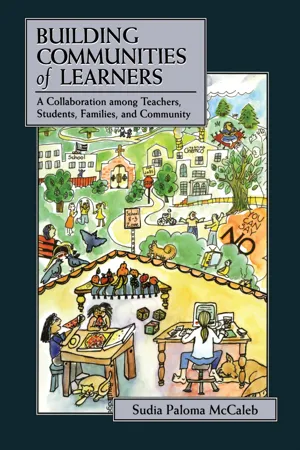
Building Communities of Learners
A Collaboration Among Teachers, Students, Families, and Community
- 212 pages
- English
- ePUB (mobile friendly)
- Available on iOS & Android
eBook - ePub
Building Communities of Learners
A Collaboration Among Teachers, Students, Families, and Community
About this book
Information
Background: A Tapestry of Voices and Ideas
chapter 1
An Overview of Family Involvement in Education and a Rationale for Building Communities of Learners
Family Involvement in Education
The term parental involvement as generally used in American education encompasses a wide variety of approaches or activities through which parents can contribute to the school and their own child's academic progress. Educators have long recognized the important role of parents in the education of their children. The roots of parental involvement go back to a time when most mothers did not work outside the home and were generally available to meet the schedules and needs of the child and school. As early as the eighteenth century, schools distributed pamphlets offering advice to parents on childrearing practices. In the late 1880s national parent educational organizations were established, and by the 1920s and 1930s they had grown to some seventy-five in number. (For an historical review see Brim, 1959.)
Increasing rates of student failure and dropout in the last twenty years have sparked renewed interest in family education and the importance of parental involvement in the child's ability to learn. At the same time, the high influx of immigrants in many areas of the country has sparked educators to rethink some of their old assumptions about "minority" or nondominant cultures and about the ways we educate diverse populations, including how to include these families in the educational process. Although more "culturally sensitive and inclusive" curricula are beginning to be developed and implemented, this effort has been neither swift nor widespread.
Reasons for Lack of Parental Involvement
Internalized Oppression of Nondominant Groups
Traditionally in the United States, students from immigrant cultures or non-English and non-standard-English home environments have not had equal status with students from the dominant culture. The knowledge and cultural practices of their native country or their home have been devalued, since our society, like most advanced industrial societies, views knowledge as a commodity that generally can be gained only through formal schooling.
Most young children, of course, identify strongly with their families. Before attending school, the family is the child's primary reality. When students come from families whose own formal schooling has been minimal or nonexistent, these students' identification with their family reality leads them to quickly begin experiencing the contradictions between their home life and their early schooling experience. These children are immediately struck by the abundance of books in schools. In addition to the teacher's voice, these books appear to be repositories of real knowledge and the fount of real learning. When these children reflect back on their home environments, the contradictions at once become clear: "If there are many books in the school and we have so few or none in our home, that must mean that we do not know anything. Maybe my family doesn't know much, which probably means that I won't ever know much either. Maybe schooling isn't for me. Maybe I am in the wrong place. Maybe I don't belong here."
Obviously, this is a sad and discouraging scenario. When parents believe that they are "ignorant," that they have no knowledge of value to teach or share, this self-image is communicated to the children. Low self-esteem on the part of parents has a profound impact on children. Children who believe they are ignorant, having been told this all their lives, also feel less capable of learning anything new.
On the other hand, many parents deliberately communicate these thoughts to their children during their schooling years as a lesson to motivate and encourage hard work. They explain to their children that they were never given or did not take advantage of educational opportunities in their own lives. Perhaps they were poor and had to work at an early age, or perhaps there were no schools where they lived. For some, institutional racism may have prevented them from getting a good education. In any case, these parents emphasize to their children that they want and expect their lives to be better and that the children must get a good education. The parents don't want the next generation to grow up "ignorant," as they did themselves.
Socioeconomic Conditions and Relationships of Power
In 1991, Dr. John Niemeyer, president emeritus and trustee of Bank Street College of Education in New York City, together with two other educators, published Principals Speak (Greenspan, Niemeyer, & Seeley, 1991). This study helps us understand, on a larger level, why many parents in the United States today generally are not involved in their children's education.
The goal of the study was to present the perspective of school principals, those who generally set the tone and implement parental involvement and family-oriented programs in the school setting. The study was based on interviews with twenty-five principals who were recommended by parents and members of the communities as caring and effective leaders. One reason the researchers originally initiated the research was to explain the lack of parental involvement in the schools. After dialogue with the principals and analysis of their observations, the researchers concluded that inner-city schools, specifically those in New York City, are not structured for partnership with parents. They presented four central reasons for the lack of parental involvement in the public schools. Three of these reasons are valid but the fourth is a misreading of the family reality of most immigrant and poor children, which consists of an extended network of caregivers. This represents not a disintegration, but a reinterpretation of family.
- Transiency. All principals recognized that building relationships of trust and working together take a lot of time and that transiency is a major obstacle to these goals. Many families move frequently, and the children are frequently forced to attend new schools.
- Alienation between home and school. Social class differences are a major factor that separates teachers and administrators from families. These differences are accentuated by racial factors. Some principals emphasized that many parents are young, uneducated, or non-English speaking and are often frightened because of illegal status. Most of the principals concurred, however, that the poor parents in their schools are just as concerned about their children as are any other parents of whatever class or stratum. They want the same things for their children as middleclass parents—a good education, good behavior, and respect for authority. Yet they often have a less clear idea of what good education is or how they can support it. The fact is that "they are in less position to get involved even if they want to" (Greenspan, Niemeyer, & Seeley, 1991, p. 11). Some principals in the study felt that parents don't trust teachers because of their own childhood experiences with schools.
- School-generated problems. Some teachers are insensitive to the needs and problems of students and their families. Students sometimes bring stories home about teacher callousness that cause parents to feel distrustful of the school. One principal pointed out that many teachers are "insecure" in the inner-city schools, and, after a few bad experiences with parents based on misunderstandings, they tend to withdraw their involvement from families.
- Disintegration of the family. Many children are being cared for by adults other than their natural parents. These adults may include grandparents and foster parents.
In inner-city schools, where parental involvement is often crucial to student success, these four obstacles make involvement more difficult.
All the principals in the study agreed that through their behavior and attitudes, teachers play a key role in either facilitating or obstructing good relationships with parents. Several principals also emphasized the need for adequate funding to support parental involvement programs. In analyzing the principals' dialogues, the researchers discovered that even in schools where principals truly believed in some form of parent participation, involvement was much lower than desired. They concluded that the underlying problem is an "interrelated cluster of goals, assumptions, organizational structures, concepts and mindsets underlying public education in the United States." Their view of the underlying educational paradigm is that it does not include partnership with parents. They believe that it actually "mitigates against such partnership" (Greenspan, Niemeyer, & Seeley, 1991, p. 36).
The research team concluded that the basic structure of roles and relationships in public school systems is bureaucratic rather than collaborative. This structure is based on the assumption that the task of providing education to the children has been delegated to the schools and that their role is to "deliver" this education. Ultimately, then, this leaves little room for the role of parents as the first "teachers." The study asserts that supporting and reinforcing these relationships and mindsets is the unspoken and perhaps even unconscious—but nonetheless real— functional assumption of most public school systems: schools are expected to produce "winners and losers."
This becomes a self-fulfilling prophecy for poor ethnic and linguistic minority students and their families as these assumptions are reinforced through testing, tracing, and accountability practices. Greenspan, Niemeyer, and Seeley maintain that a new model of partnership must be created in which parents are seen as a "resource instead of a nuisance." As it becomes clear that the structure of schooling in this country is of a top-down bureaucratic nature, the struggle to make the educative process a collaborative one becomes greater.
Cummins (1989) corroborates these findings. He proposes that real changes in schools will begin to take place only when the relationships of power begin to change, that is, when the voices of parents and the community are heard and the direction of the schools reflects the values of all. Throughout this book, we will see examples of how classroom teachers can invite parents to become educational resources. Accordingly, specific strategies will be discussed.
False Premises Underlying Family Education Programs
Under the direction of Elsa Auerbach in 1990, the English Family Literacy Project at the University of Massachusetts studied the most common approaches and models for family education programs and revealed what they saw as their underlying "hidden assumptions." These assumptions were examined in light of more recent research focusing on crosscultural family literacy practices. The project suggests that programs based on stereotypes or false premises will not likely produce desirable results and may in fact have a detrimental effect on the students and their families.
Auerbach (1990) observes that many of the existing family education programs follow a "transmission of school practices model" (p. 17} in which knowledge is transmitted from teachers to children and from the schools to parents to children. The following practices were noted as the most prevalent in these transmission model programs.
- Giving parents guidelines, materials, and training to carry out school-like activities in the home.
- Training parents in effective parenting.
- Teaching parents about the culture of American schooling.
- Developing parent language and literacy through skills, grammar, and behavioral approaches.
All the programs reviewed by the English Family Literacy Project appeared to begin with the notion that there is something wrong or lacking in the family. Because educators know what parents should be doing, their job is to help parents change their ways of relating to their children and to teach them the skills needed for school-related literacy tasks. These experts begin by developing the curriculum and the practices themselves. Parents are taught to accommodate to the schools, but the schools are not expected to accommodate to the families' cultural diversity or lived reality.
After the researchers examined evidence of what actually happens in families of different class and cultural backgrounds, they concluded that this transmission of school practices is rooted in six assumptions. Based on counterevidence that emerged from their research, they view these assumptions as questionable.
Assumption 1: Home Contexts: Ethnic and linguistic minority families do not engage in literacy practices at home.
Counter evidence: Across classes and cultures, literacy is used in a wide variety of ways. It would be productive for schools to learn about the home practices of their students so they might build on the home experience. This approach is preferable to assuming inadequacies and trying to change the home practices to resemble those of school sites. Program designs could allow and include community culture to inform literacy practices. As support for this view Auerbach cites Chall and Snow (1982); Delgado-Gaitan (1987); Diaz, Moll, and Mehan (1986); Goldenberg (1984); and Taylor and Dorsey-Gaines (1988).
All the research found that even in family situations of extreme poverty, homes were rich in print material and engaged in literacy activities of many kinds on a daily basis. Parents desired to support literacy development in any way possible and frequently provided rewards for doing well in school. Immigrants were strongly aware that education was crucial to success in their new country.
Diaz, Moll, and Mehan (1986) found that the source of linguisticminority-student problems was not language but the failure of schools and instruction to be organized in such a way as to build on the student's home and community resources and native-language abilities.
Assumption 2: Parental Roles: The success of literate children is due to parent-to-child literacy instruction and transfer of skills.
Counter evidence: Research on immigrant families indicates a complex system of family interaction wherein mutual support is given as individual family members need to adjust to cultural and language differences in their own lives. In most cases the children begin to acquire English skills through the schools and through contact with other children. Thus, they become interpreters of the outside world for adult members of the family. It may be more beneficial for schools to focus on shared literacy where teaching and learning are valued and encouraged in both directions. Assumption 2 is neither accurate nor realistic because it does not reflect the reality of the family relationship. Auerbach supports her argument with findings from the research of Delgado-Gaitan (1987); Diaz, Moll, and Mehan (1986); and Tizard, Schofield, and Hewison (1982).
Assumption 3: Family Contexts of Successful Readers: Successful readers come from home environments where parents replicate school-like tasks.
Counterevidence: There is no evidence that any single form of home literacy practice determines successful literacy development. In particular, there is no evidence that direct parental instruction to children in school-like literacy tasks accounts for school success. Studies show that a wide range of experiences and factors characterize the homes of successful readers. The most important aspect seems to be that children engage on a regular daily basis in activities integrated in socially significant ways. Auerbach points to Taylor and DorseyGaines's (1988) study in which they observe that literacy events may even be occurring "at the very margins of awareness" rather than being consciously structured as specific and isolated activities. These may include family outings, a visit to the clinic, or a game of cards. It may be more productive for schools to support a variety of literacy practices and experiences that would take on significance in addressing the day-to-day concerns of the students and their families.
Assumption 4: Language Use in the Home: Children of families who do not speak the dominant language (English) at home are at a disadvantage.
Counterevidence: Research indicates that emphasizing the use of English in a home where English is not the first language may actually be detrimental to both the student and the family in general. Most important is the quality of interaction and the meaning and understanding being developed between family members. To support this view, Auerbach turns to the work of Cummins (1981) which emphasizes the importance of primary language development in the home. A strong foundation in one's native language builds a strong base for acquiring a second language. Schools would be wise to support maintenance of the student's home language because emphasizing English exclusively may undermine the development of proficiency in either the mother language or English.
Assumption 5: School versus Home Factors: The schools are doing an adequate job of teaching children, and more school-like tasks need to be done at home. It is the home that is the root cause of literacy problems.
Counter evidence: There is growing evidence that an isolated skills approach to the development of literacy (emphasizing worksheets, phonics, spelling, etc.) may actually inhibit the process. Auerbach believes that it would be a mistake for schools to insist that families attempt to duplicate in their homes what the schools are already doing. Parents should be encouraged to take a holistic approach to literacy at home and even to advocate, challenge, or change what they may see as unacceptable school programs or lack of support for students. Auerbach cites the Harvard Families and Literacy Study (Chall & Snow, 1982), which reveals that the teacher's percepti...
Table of contents
- Cover
- Title
- Copyright
- Dedication
- Foreword
- Preface
- Contents
- Part 1 BACKGROUND: A TAPESTRY OF VOICES AND IDEAS
- Part 2 INITIATING HOME AND SCHOOL PARTNERSHIPS
- Part 3 TELLING OUR STORIES
- Part 4 GENERATING NEW IDEAS: EMPOWERMENT THROUGH DIALOGUE AND THE CREATION OF BOOKS
- Part 5 EXEMPLARY PROGRAMS FOR BUILDING COMMUNITIES OF LEARNERS
- Conclusion
- Afterword
- References
- Index
Trusted by 375,005 students
Access to over 1.5 million titles for a fair monthly price.
Study more efficiently using our study tools.
Frequently asked questions
Yes, you can cancel anytime from the Subscription tab in your account settings on the Perlego website. Your subscription will stay active until the end of your current billing period. Learn how to cancel your subscription
No, books cannot be downloaded as external files, such as PDFs, for use outside of Perlego. However, you can download books within the Perlego app for offline reading on mobile or tablet. Learn how to download books offline
Perlego offers two plans: Essential and Complete
- Essential is ideal for learners and professionals who enjoy exploring a wide range of subjects. Access the Essential Library with 800,000+ trusted titles and best-sellers across business, personal growth, and the humanities. Includes unlimited reading time and Standard Read Aloud voice.
- Complete: Perfect for advanced learners and researchers needing full, unrestricted access. Unlock 1.5M+ books across hundreds of subjects, including academic and specialized titles. The Complete Plan also includes advanced features like Premium Read Aloud and Research Assistant.
We are an online textbook subscription service, where you can get access to an entire online library for less than the price of a single book per month. With over 1.5 million books across 990+ topics, we’ve got you covered! Learn about our mission
Look out for the read-aloud symbol on your next book to see if you can listen to it. The read-aloud tool reads text aloud for you, highlighting the text as it is being read. You can pause it, speed it up and slow it down. Learn more about Read Aloud
Yes! You can use the Perlego app on both iOS and Android devices to read anytime, anywhere — even offline. Perfect for commutes or when you’re on the go.
Please note we cannot support devices running on iOS 13 and Android 7 or earlier. Learn more about using the app
Please note we cannot support devices running on iOS 13 and Android 7 or earlier. Learn more about using the app
Yes, you can access Building Communities of Learners by Sudia Paloma McCaleb in PDF and/or ePUB format, as well as other popular books in Education & Education General. We have over 1.5 million books available in our catalogue for you to explore.