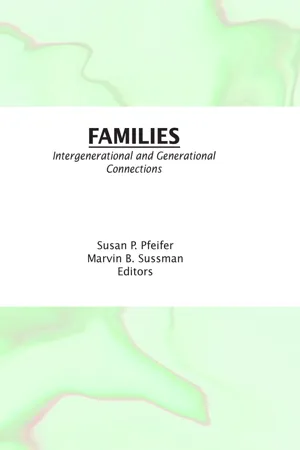
This special volume is devoted to the synthesis and review of theoretical and conceptual approaches associated with familial and non-familial connections across the life span. An important book as society "returns to the family," it compares and contrasts different disciplinary perspectives associated with intergenerational relationships. Because intergenerational relationships have been the focus of research in many disciplines, various perspectives have emerged about kin and non-kin connections. Renewed interest in families and familial connections is due largely to events and situations occurring in complex, modernized societies which place the intergenerational nexus on center stage. The leading researchers represented in this outstanding book provide rare opportunity for the scholarly comparison of the various perspectives in the broader spectrum of family relations.Families: Intergenerational and Generational Connecting is a significant addition to the body of research on family connections. The three major areas of generational and intergenerational connections include theoretical and conceptual perspectives, connections within the family, and connections outside the family. As the use of families as support networks for individual members increases, this timely book will be an invaluable aid to educators, students, and researchers concerned about families and familial and non-familial relationships. Counselors and therapists will value this enlightening book with its diverse theoretical and conceptual perspectives on kinship, intergenerational solidarity and relations, social supports, and cross-national perspectives on family connections.
- 402 pages
- English
- ePUB (mobile friendly)
- Available on iOS & Android
eBook - ePub
About this book
Information
Subtopic
Health Care DeliveryIndex
Social SciencesTHEORETICAL AND CONCEPTUAL PERSPECTIVES
Reflections on Intergenerational and Kin Connections
Intergenerational connections and interpersonal relationships, especially in the later years of life and the life cycle, is a “hot” issue for study by social scientists. It is so much in the forefront as an area for research that in the last few years innumerable conferences have been held on this theme, e.g., the Gerontological Society of America, November, 1990. Also U.S. Government agencies such as the Administration on Aging and the National Institute on Aging have issued calls for proposals on intergenerational phenomena with the promise of adequate funding for the winning applications.
Why, one may ask, is this largely unheralded issue gaining increasing attention not only from researchers but from governmental legislators, administrators, and policy makers? To begin the explanation I will take a step back into history. In part, it is my own history.
Intergenerational relations can best be understood within the context of social structures and modernization theories in vogue since the beginning of the twentieth century. The essential idea was that the family had to and did change from a multi-generational unit to a nuclear form. A large- became a small-sized unit, best suited to meet the normative demands of an emergent complex, occupationally differentiated, urban society. The economy based on the technology of the interchangeable part viewed labor as a commodity to be fitted into the industrial process. Hence, labor, vis-à-vis, small-size families were most suited for movement from one place of work to another. Thus, “the long arm of the job,” as noted by Robert Lynd, going to the place where work could be found, characterized this new industrial age. The ease for small- compared to large-size families to move and the higher cost of housing and other amenities in urban contrasted to rural societies was believed to favor the nuclear family of procreation. This family consisted of husband and wife, usually the latter being the homemaker, and former, the breadwinner, living with their issue in a dwelling unit apart from either set of parents.
The ideology of twentieth century political, social, and economic systems embraced achievement and opportunity. Advancement in any of society’s social systems would be based on merit. Large family and kin units with their endemic filial responsibilities were viewed as too demanding and cumbersome in the struggle for upward social and economic status. Individuation over group, smallness over largeness, became manifest in belief and practice. The large-size family, multi-generational and with bilateral kin or extended kin groups as units of being and analysis, were relegated to the museum of ancient history.
Another notion exacerbating the philosophy of the modernization of the family was the increasing dependence of the family on institutions and organizations usually large in size and bureaucratic in structure. W.F. Ogburn’s classic analysis of the changing functions of the family, how other institutions, e.g., schools and factories, took over traditional family functions added to this dependency notion. Portrayed was the helplessness of the family, living in isolation and bereft of relationships and exchanges of help, and care with kin family members.
In review, the social and political theorists of the first half of this century postulated that the family was shorn of its functions or at best shared them with large scale systems, e.g., socialization of children with the schools. This was a consequence of industrialization, occupational specialization, and urbanization. Dependency upon the economic system determined where individuals would work and live, a readiness and expectation to move became part of the cultural baggage of the “new” family. The consequences, it was believed, resulted in a weak, isolated, fractured, and dependent family system.
An opportunity arose to challenge this mind set of family diminution in size and importance in modern, complex societies. The result was a doctoral dissertation I completed at Yale University in 1951, entitled, “Intergenerational Continuity: A Study of Factors which Affect Relations between Families at Generational Levels.” Serendipity played a role in selecting this topic for research. A proposal to study group formation and interaction of ethnic adolescents in New Haven, Connecticut was rejected for being too psychological in theory and substance. A paragraph in Reuben Hall’s and Willard Waller’s family text indicated that family connections, generational ties and supports remained largely unstudied. I took up the challenge in the 1950-1951 study. Intensive interviews were conducted with parents of 97 middle-class, white, protestant families whose children had married and left home. One hundred ninety-five parent-child relationships comprised the final sample. The findings indicated
… the continuity of intergenerational family relationships tends to increase when marriage partners share similarity of background, observe the traditional conventions regarding courtship and the marriage ceremony, have been raised to be family-minded and self reliant, continue in moderation a pattern of economic help and service with their parents, and live in the same or nearby community as the elders. (Sussman, 1951)
Subsequent studies and reviews of intergenerational relationships established their viability as units of activity and family continuity (Sussman, 1953; Sussman & Burchinal, 1963; Litwak & Szelenyi, 1969; Farber, 1973; Schneider, 1980; Sweetser, 1963; Troll et al., 1979). Throughout the decades of the 60s and 70s, a plethora of research sustained the view that family members did not sever connections with their children, parents, or kin in their new urban environments. While there was a reduction in the number of generations living within a household, the structural properties of kinships were evident. Most individuals, culturally imprinted with the values and ideologies of service, respect, and honor to members of their families and kin, continued in this kin network mode, even though they could opt out of this commitment. Engaging family and kin members is voluntary and not legally binding.
The plethora of studies examining the notion of kin structure and intergenerational functioning in the urban environment led to an outcry that sufficient work had been done to now probe more deeply into this phenomena (Sussman, 1965). Investigations were now needed on the meaning and significance of activities and relationships of intergenerational and kin connections. How did such connections and activities fit in or collide with families of orientation and procreation? What were their relationships with larger groups such as organizations and institutions whose normative demands were expected to be met? Studies on inheritance, caregiving, support of nuclear families in need of help, family businesses, single parents, divorced families, economic maintenance, and linkages with bureaucratic organizations are examples of in-depth investigations on the relevance, importance, and meaning of these networks in the everyday lives of individuals.
For the most part, these studies were completed by social scientists who identified themselves as family or marriage experts. A few individuals from mainstream sociological theory and organizational analysis whose curiosity was piqued, if they did not research the topic, at least examined the evidence and did commentary. The point is that the myth of institutional domination over smaller units like families and kin networks in complex societies was so encrusted in the ideologies and phenomenologies of social science that this myth was accorded reality. Evidence to the contrary; that which is believed, is the truth.
During the 1980s, there is increased interest in studying kin networks, particularly the intergenerational connection. This concern of social scientists is not an outcome of their conceptual transformation, discarding an old for a new myth and concomitant realities. It is due largely to events and situations occurring in complex societies which place the intergenerational nexus on center stage.
The first of these is the curtailment of federal and state expenditures for health care of the general population, and services for the elderly. With few exceptions most leaders of highly industrialized societies, especially the United States, believe that they have reached the absorptive capacity in regard to state expenditures and continued investments in institutions for the care of its citizens. They are looking to families to provide substantial caretaking activities and, in some instances, the major burden of long-term care. Since 1980, and during the Reagan Presidency, the “return to the family” and its reinvigoration became a national goal helped along by a reduction in financial support of health and welfare programs. This diminution of third party transfers on a national scale led to increased interest in generational transfers within families. The concern is with the potential supports and transfer of resources from parents to children and children to parents over different periods of the life course. Also, the role of sibs and bilateral kin such as uncles, aunts, and cousins are being viewed as potential players in support networks of family members.
Reduction in the amount of funds for human services is juxtaposed with a radically altered demographic profile. This portraiture suggests that during this decade and well into the 21st century, there will be a tremendous increase in the prevalence of surviving older adults over retirement age, with a dramatic increase in the number of persons over age 85. Decreasing morbidity because of technical advances in medicine, improved nutrition, and increased concern to improve or maintain mental and physical well-being has resulted in these improved survival rates.
The increasing incidence and prevalence of older adults has the potential of increasing the current burdens of families whose members usually associated with caretaking are in competitive jobs or careers in the work force. There is also an increasing number of four and five generation families and it is becoming not unusual for the generation of middle-aged parents to care for their parents and young children. Sixty-year-olds caring for an 85-year-old parent, their divorced daughter, and two very young grandchildren is becoming a normal scenario.
The lowered fertility rate of the baby boom generation may provide a critical situation for individuals reaching their golden years in the 2010-2020 period. Many may be in search of a relative. The potential paucity of blood or marriage relatives may result in family formations varied from existing structures but still providing family-like responses (Marciano, 1988; Sussman & Pfeifer, 1987).
Older adults are forming morally armed constituencies; formidable lobbies who also engage in varied service activities for its members. The American Association for Retired Persons, with over 25 million members, is one such example. Generational conflict or harmonious relationships and activities between the generations is dependent on how these elder organizations use their newly acquired power.
Attention is now being directed by researchers to internal family distributions, inter vivos transfers, and bequests through inheritance (Cates & Sussman, 1982; IRS, 1990). These family transfers are becoming increasingly important in determining generational continuity, its symbolic and mythic components, and its potential for negotiating caretaking arrangements for older members. A hypothesis is that there will be more openness regarding the contests of wills and their intended economic transfers as older adults arrange with children or grandchildren for their care when they are no longer independent. Under the aegis of distributive justice one expects that the designated caretaker will receive a larger share of the inheritance and in most situations such distributions will be approved by other heirs and legatees who stand to benefit under conditions of testacy or intestacy.
The consequences of birthquaking research on generational and kin family relationships remains problematic. Policy makers, governmental administrators, practitioners, and researchers share a common interest in such undertakings. However, each group has an approach in consonance with their special interest, ideology, and mandate.
Various perceptions of reality remain and an integrated holistic view and solution may never be in the offing. Movement to closure, to a policy and practice, cost effective, and beneficial to all individu...
Table of contents
- Cover
- Half Title
- Title Page
- Copyright Page
- Table of Contents
- Theoretical and Conceptual Perspectives
- Generational and Intergenerational Connections Within the Family and the Community
Trusted by 375,005 students
Access to over 1.5 million titles for a fair monthly price.
Study more efficiently using our study tools.
Frequently asked questions
Yes, you can cancel anytime from the Subscription tab in your account settings on the Perlego website. Your subscription will stay active until the end of your current billing period. Learn how to cancel your subscription
No, books cannot be downloaded as external files, such as PDFs, for use outside of Perlego. However, you can download books within the Perlego app for offline reading on mobile or tablet. Learn how to download books offline
We are an online textbook subscription service, where you can get access to an entire online library for less than the price of a single book per month. With over 1.5 million books across 990+ topics, we’ve got you covered! Learn about our mission
Look out for the read-aloud symbol on your next book to see if you can listen to it. The read-aloud tool reads text aloud for you, highlighting the text as it is being read. You can pause it, speed it up and slow it down. Learn more about Read Aloud
Yes! You can use the Perlego app on both iOS and Android devices to read anytime, anywhere — even offline. Perfect for commutes or when you’re on the go.
Please note we cannot support devices running on iOS 13 and Android 7 or earlier. Learn more about using the app
Please note we cannot support devices running on iOS 13 and Android 7 or earlier. Learn more about using the app
Yes, you can access Families by Susan K Pfeifer,Marvin B Sussman in PDF and/or ePUB format, as well as other popular books in Social Sciences & Health Care Delivery. We have over 1.5 million books available in our catalogue for you to explore.