- 130 pages
- English
- ePUB (mobile friendly)
- Available on iOS & Android
eBook - ePub
About this book
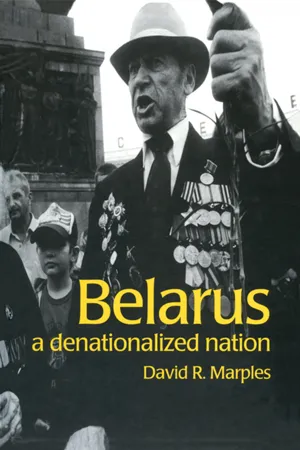
In any assessment and understanding of Belarus, the key questions to address include; why has Belarus apparently rejected independence under its first president Alyaksandr Lukashenka, and sought a union with Russia? Why has the government rejected democracy, infringed on the human rights of its citizens and fundamentally altered its constitution in favour of presidential authority? Has the country made any progress toward market reforms? How have Russia and the West responded to the actions of Belarus? And what is the future likely to hold for its ten million citizens? The author's conclusions are optimistic. Belarus, he believes, will survive into the twenty-first century, but as a Eurasian rather than a European state.
Trusted by 375,005 students
Access to over 1.5 million titles for a fair monthly price.
Study more efficiently using our study tools.
Information
Subtopic
Comparative PoliticsIndex
HistoryChapter 1
History of Belarus to 1985
From Earliest Times to 1917
The early history of Belarus is steeped in controversy. Belarusian scholars rightly note that the country has a history dating back to ancient times, but there is today no consensus on the origins of the Belarusian state. The three tribes from which the Belarusians are believed to have derived were the Krivichi, Dregovichi, and Radimichi, who lived first on the Dvina River and later in the vicinity of the Pripyat and Sozh rivers. The medieval period of Belarusian history dates from the rule of Prince Rahvalod over the Polatsk principality in 980. In the late 10th century, Polatsk was annexed by Vladimir, the ruler of Kievan Rus’, who killed the Polatsk prince and married his daughter, Rahneda. At least three principalities existed on what is today ethnically Belarusian territory: that of Smolensk; Polatsk-Vitsebsk; and Turau-Pinsk. Belarusian territory was left relatively unscathed by the Mongol invasions which destroyed Kievan Rus’ and the city of Kiev (Kyiv) itself in 1240.
When the Rahvalod dynasty ended in the 14th century, Belarusian territory became part of the Grand Duchy of Lithuania with the capital at Vilna (Vilnius), a state in which Slavs heavily outnumbered the Lithuanians, retained privileges, and in which state business was conducted in the Belarusian language. By the 16th century a distinctive culture had begun to emerge, symbolized by the translation of the Bible into the Belarusian language by Frantsishak Skaryna in 1517. In 1569, however, the Grand Duchy formed a political union with Poland at the Union of Lublin forming the Rzecz Pospolita, and the sovereign of Poland was also the Grand Duke of the Lithuanian kingdom. In this period, Belarusians faced pressure from the Poles to convert from Orthodoxy to Roman Catholicism. The union lasted until the late 18th century, by which time the lands of Belarus had fallen under the control of the Russian Empire as a result of the partitions of Poland that took place in 1772,1793, and 1795.
The Russian Empire period has been widely perceived as one of repression of cultural and political initiatives on Belarusian territory. In 1839, the Uniate (Greek Catholic) Church in the Polatsk region was dissolved and the former Statute of the Duchy of Lithuania dating to 1588 was prohibited. In 1863 a young Belarusian Kastus Kalinouski played a prominent role in the widespread Polish uprising against Russia, and was publicly executed after his capture in March 1864. Belarusian culture made great strides in the 19th century and it was during this period that the concept of a Belarusian nation first truly emerged. The vast majority of ethnic Belarusians were villagers at the turn of the century. Though industrial development had progressed rapidly in the late 19th century, Belarus lagged behind most territories of the Russian Empire in this respect. The major Belarusian centers, such as Vilna, Minsk, Homel and Mahileu, contained Jewish majorities, with Poles and Russians as the largest minorities in urban area.
The Revolution Period
In 1905, Belarusians were permitted to publish newspapers and books in their native language, and national activities became more widespread. The most prominent publication was Nash a Niva (Our Cornfield), run by the brothers Lutskevich, which became the main Belarusian cultural publication in Vilna until 1915. Overall in the period 1905-1914, a national cultural revival occurred though it was not on a sufficient scale to serve as the basis for state independence from Russia. Though Belarusian territories were to play a part in the revolutionary upheavals of 1905 and 1917, and indeed to witness the declaration of an independent state in the spring of 1918, it is far-fetched to declare that these lands were prepared in any way to form a national state based either on historical precedent or linguistic foundations. Demographically, ethnic Belarusians lived in the countryside rather than the towns.
This situation has been described in detail by the American scholar Steven Guthier, who notes that in 1897,98% of Belarusians lived in rural areas or in settlements with a population of less than 2,000.1 An estimated 92% of Belarusians made their livelihood from agriculture, forestry, hunting and fishing. Within the middle and trading classes, Belarusian representation was extremely weak. Belarusians were rarely to be found among the educated stratum. The vast majority were peasants, predominantly illiterate and occupied in small-scale agricultural pursuits that could barely guarantee subsistence. Indeed if one looks at the major cities in Belarusian territories in the 1897 census, the percentage of Yiddish speakers is the most remarkable phenomenon (Vilna, 40%; Minsk, 51.2%; Vitsebsk, 50.8%; Homel, 55.4%; Babruisk, 60.2%, Pinsk, 73.9%).2
Clearly Belarusians lacked an urban base from which to launch a claim to statehood. This factor was particularly significant because the Bolshevik Revolution was very much an urban phenomenon. Marxist parties were beginning to develop in Belarus by the late 19th century. Indeed, much has been made of the fact that the Russian Social Democratic Workers’ Party held its founding congress in Minsk in 1898, though this was not an event regarded as particularly significant at that time. Alongside the RSDWP was the autonomous Jewish Bund. Together they participated in strike actions in Minsk. In 1902 the Belarusian Revolutionary Party was founded, renamed the Belarusian Socialist Hramada (BSH) in 1903. Thus several marxist groups and cultural-educational organizations were beginning to emerge on Belarusian territory.3
The Socialist Hramada had branches in Vilna and St. Petersburg in addition to that in Minsk, and it gained in influence during the February Revolution of 1917, which ended tsarist rule in Belarus. According to one observer, this revolution changed the situation of the Belarusian movement, as the Belarusian peasants began to demand their rights. Simultaneously the Belarusian intelligentsia began to formulate a political program and were particularly active in Minsk. In the summer of 1917 a Belarusian Communist Party emerged from the ranks of the Socialist Hramada, as did a Belarusian Social Democratic Party. Most of the activists of this wing remained in Poland, and it sought autonomous status for Belarus within the confines of a restored Polish state.4 Much of this activity occurred in a volatile urban environment, but because of the demographic nature of Belarusian territories it did not and could not have involved the majority of Belarusians. There were also significant divisions within the urban Belarusian groups.
Though an independent Belarusian state was declared on 25 March 1918, this state was formed under occupation by the Central Powers and indeed negated by the Treaty of Brest Litovsk signed earlier in the same month between the Central Powers and the Bolshevik regime.5 This government restored the white, red, white flag and state emblem of the former Grand Duchy of Lithuania (a knight on horseback, a symbol that was to give offense to the first elected president of independent Belarus, Alyaksandr Lukashenka, in 1994). Yet it lacked the means to survive. It was a product of World War I rather than the Russian Revolution and died an inevitable death with the practical application of the results of the Treaty of Brest-Litovsk, the reestablishment of an independent Polish state, and the defeat of the Central Powers in November 1918.
The situation at the end of the First World War was fluid. Two great empires had collapsed—the Russian and the Austro-Hungarian—and however unsatisfactory the peace treaties that were signed in Paris and Riga (at least from the Belarusian perspective), several new nations had emerged in central and eastern Europe (the three Baltic states, Czechoslovakia, and Yugoslavia). In theory Belarus could have been another. Though it was arguably unprepared for statehood, the same could be said of Estonia, Latvia, and Lithuania. Yet the smaller Baltic states received independence and Belarus did not. Hence, runs one argument, the Western allies must bear the brunt of the blame for their failure to support Belarusian national aspirations and for their polonocentric policies.6
All these statements may be true. Certainly the formation of some nations rather than others appears to be arbitrary. Belarus, however, had neither clearly demarcated borders, nor a conception of its past and present national status. What had occurred in March 1918 was not an accident but it was premature. The first steps toward national self-assertion had been taken, but no more than that. Whether or not the BNR could have developed a nation state at this time may always be a moot point. Under the circumstances of 1918, such a state could not have survived for long and its existence was not accepted by the majority of the population living on those territories that today comprise Belarus. We have already noted that the Belarusian elite was a small and persecuted minority, that few Belarusians lived in the cities, and the national past could only be reconstructed through what can best be described as “historical leaps” over centuries of uncertain existence. The progress of Belarusian culture in itself is not an indicator of readiness for or capability of statehood. In 1918, Belarus did not yet have the prerequisites of national statehood. Poland did.
Who then proclaimed independence for Belarus in March 1918? The process was complex. On 19 March, on the initiative of the Belarusian Socialist Hramada, the Council (Rada) of the BNR became a temporary parliament, and all laws issued required the Rada’s approval. Most of the Rada members belonged to the BSH party and there were around seventy members altogether. On 24 March, the Rada adopted its third constitutional charter with the participation of the Belarusian Council of Vilna. The Vilna group had initially proclaimed a separate Belarusian-Lithuanian state on 17 December 1917 but now decided to join with the “independentists” of Minsk and separate from Russia. The decision to declare independence followed a BSH proposal for such a move and a noisy and acrimonious 10-hour debate on the night of 24-25 March. Though a majority were in favor, the Jewish Bund was opposed, and many voters decided to abstain, including the United Jewish Socialist Party and the Social Revolutionary Party. Neither the Germans nor the Bolsheviks supported the newly declared state, and indeed the Second Congress of the Soviets of the western province on 14 April denounced the Rada as a counter-revolutionary organ that had been founded by anti-Soviet activists.7
Without German support the new state was doomed from the outset. The Vilna Council also continued to exist with its own agenda even after independence had been claimed. The BSH disintegrated, with many of its left-wing adherents deserting the government which by then had associated its interests exclusively with those of the German army: “only under the protection of the German Reich can our country anticipate happiness in the future.”8 The association with German militarism alienated many socialists. It also served to bolster support for the Bolsheviks and weakened the government in the eyes of the public as being incapable of standing alone against its enemies. The present Lukashenka regime in Belarus has even manipulated this association with the Germans to discredit parties such as the BPF which still recognize the validity of the 25 March declaration. However, despite the weaknesses of the campaign for national statehood in 1918, the brief declaration and indeed establishment of independence was to set an important precedent for the promoters of Belarusian culture and self-assertion in the Soviet era.
Formation of the BSSR
The BSSR was first proclaimed on 1 January 1919 in the city of Smolensk by D. Zhylunovich, Chairman of the “Provisional Worker-Peasant Government” of Belarus. The Manifesto, published two days later in the newspaper Zvyazda, declared that all power was in the hands solely of the Soviet workers, peasants, batraks (the poorest peasant stratum) and Red Army deputies.9 The capital of this tiny Soviet republic was the city of Minsk, a city then far from secure from invasion. Five days later, Vilna, the cultural center of historic Belarus, was occupied by the Red Army. On 2-3 February, the First All-Belarusian Congress of workers, peasants, and Red Army deputies was held. It approved the issuance of the first Constitution of the BSSR, established the flag and symbols of the republic, and elected a Central Executive Committee. Progress was threatened, however, by the incursions of the Polish army, which occupied the city of Brest-Litovsk on 19 February. In February-March 1919 therefore, the Soviet authorities decided to join together the Lithuanian and Belarusian republics into an entity termed “Lit-Bel.” On 4-6 March in Vilna, the Communist Parties of Lithuania, Western Belarus and Soviet Belarus held a united congress. Subsequently the “Lit-Bel” regime operated in the city of Minsk from the end of April to mid-July 1919.10
The Polish-Soviet war put an end to the “Lit-Bel” government and Minsk itself was occupied by the Polish army for almost a year, from August 1919 to July 1920. Once the territories had been reoccupied by the Red Army, a new Soviet republic of Belarus was proclaimed on 31 July. The borders of the BSSR could not be resolved until the formal Soviet-Polish peace treaty at Riga on 18 March 1921. The treaty, from th...
Table of contents
- Cover
- Title
- Copyright
- Dedication
- TABLE OF CONTENTS
- Chronology
- Preface
- Map of Belarus
- 1 History of Belarus to 1985
- 2 The Economy: 1986-1996
- 3 Perestroyka and Independence, 1985-1993
- 4 A New Presidency, June 1994-Spring 1996
- 5 Lukashenka’s Consolidation of Power
- 6 Relations with Russia
- Bibliography
- Index
Frequently asked questions
Yes, you can cancel anytime from the Subscription tab in your account settings on the Perlego website. Your subscription will stay active until the end of your current billing period. Learn how to cancel your subscription
No, books cannot be downloaded as external files, such as PDFs, for use outside of Perlego. However, you can download books within the Perlego app for offline reading on mobile or tablet. Learn how to download books offline
Perlego offers two plans: Essential and Complete
- Essential is ideal for learners and professionals who enjoy exploring a wide range of subjects. Access the Essential Library with 800,000+ trusted titles and best-sellers across business, personal growth, and the humanities. Includes unlimited reading time and Standard Read Aloud voice.
- Complete: Perfect for advanced learners and researchers needing full, unrestricted access. Unlock 1.5M+ books across hundreds of subjects, including academic and specialized titles. The Complete Plan also includes advanced features like Premium Read Aloud and Research Assistant.
We are an online textbook subscription service, where you can get access to an entire online library for less than the price of a single book per month. With over 1.5 million books across 990+ topics, we’ve got you covered! Learn about our mission
Look out for the read-aloud symbol on your next book to see if you can listen to it. The read-aloud tool reads text aloud for you, highlighting the text as it is being read. You can pause it, speed it up and slow it down. Learn more about Read Aloud
Yes! You can use the Perlego app on both iOS and Android devices to read anytime, anywhere — even offline. Perfect for commutes or when you’re on the go.
Please note we cannot support devices running on iOS 13 and Android 7 or earlier. Learn more about using the app
Please note we cannot support devices running on iOS 13 and Android 7 or earlier. Learn more about using the app
Yes, you can access Belarus by David Marples in PDF and/or ePUB format, as well as other popular books in History & Comparative Politics. We have over 1.5 million books available in our catalogue for you to explore.