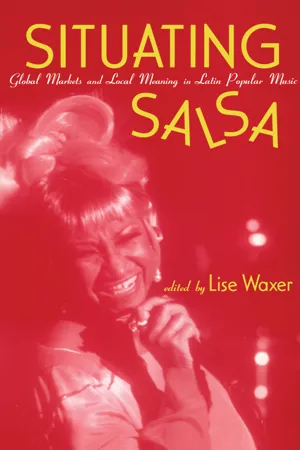
Situating Salsa offers the first comprehensive consideration of salsa music and its social impact, in its multiple transnational contexts.
- 350 pages
- English
- ePUB (mobile friendly)
- Available on iOS & Android
eBook - ePub
About this book
Information
Locating Salsa
Chapter 1
Situating Salsa: Latin Music at the Crossroads
Lise Waxer
"Echale Salsita." Put a little sauce on it. When Cuban composer Ignacio Piñeiro wrote this song for his Septeto Nacional in 1933, little did he know that he was setting the precedent for use of a term that would later be synonymous with an internationally popular Latin sound. Salsa, with its roots in the Cuban and Puerto Rican cultural diaspora to New York City, has now grown into a global musical phenomenon with audiences and practitioners ranging from Tokyo to Dakar. Today's salsa market offers Latin dance lessons, several Internet websites, touring dance competitions sponsored by Bacardi rum, and even "salsa cruises" with nightly performances by leading stars.
In Spanish, "salsa" literally means "sauce," with a culinary metaphor that evokes images of a spicy concoction—somewhat mirroring the music's own hybrid origins and infectious appeal. As the authors in this volume discuss, salsa means many things to many people, but a basic part of its attraction has been its ability to make people move together—to dance. Here, everyday troubles are forgotten in the "everynight life" of dancing bodies (Fraser Delgado and Muñoz 1997). The social interaction of salsa dance is mirrored and reinforced by the dynamic exchanges of the musicians themselves. For those of us who find our way into salsa as listeners, following the complex polyrhythmic conversations of salsa performance can be as exhilarating as getting down on the dance floor. For many of its new audiences, salsa is also a gateway to the cultural Other, a fascinating and often exotic world where new selves find liberation from cultural strictures.
Salsa developed in the Latino barrios of New York City during the 1960s and '70s. Based largely on Cuban forms of the 1930s, '40s and '50s, salsa also incorporated Puerto Rican elements and influences from North American jazz and rock. Salsa's Cuban and Puerto Rican antecedents were themselves a fusion of African and European elements1 (see Alén 1984, Echevarría Alvarado 1984, and Dufrasne-González 1994 for more information on these forms). Cuban musicians in the first half of this century frequently used to say "toca con salsa!" (roughly, "hit it!" or "swing it!") when the excitement and energy of the music began to rise. This metaphor was inferred by Ignacio Piñeiro in his famous composition "Échale salsita." Many observers agree that a Venezuelan radio disc jockey, Phidias Danilo Escalona, was among the first to use the term "salsa" to denote Latin dance music in the early 1960s (Rondon 1980:33), although New York publisher Izzy Sanabría claims to have coined the name himself, at the end of the decade (Roberts 1979:187). Certainly, by the early 1970s, salsa had become the standard term of reference throughout Latin America, owing in large part to its use by Fania Records as a commercial label with which to market this music.
Given that the New York community in which salsa developed was strongly Puerto Rican, during the 1960s and '70s salsa became a potent emblem of Puerto Rican identity both for islanders and for those living in the mainland United States (Duany 1984; Padilla 1990), helping underpin nationalist sentiment against the specter of U.S. colonial domination. The use of the ten-stringed Puerto Rican cuatro, an icon of island culture, by Willie Colón and the Fania All-Stars during the early 1970s further underscored salsa's Puerto Rican affiliations.2 The music's own interracial heritage was mirrored by the strong interethnic participation that marked the New York scene, with Jewish and African-American musicians performing in several bands. Jewish pianist Larry Harlow even became an important bandleader and producer in the New York scene. During this same period, salsa music also spread to other parts of Latin America, especially Venezuela, Panama, and Colombia— countries with close geographic and economic ties to the Caribbean. Significantly, salsa's lyrics reflected the experiences of the Latino and Latin American black and mixed-race working class, and—in distinction to its Cuban antecedents—songs mirrored the violence and discontent of the inner city. When salsa's exuberant beat and social message caught on with Latin American leftist intellectuals from the middle and upper-middle classes in the 1970s, salsa music shed its lower-class associations to establish a devoted following not only across national boundaries, but across social ones. By the 1980s, salsa was firmly entrenched as a transnational musical genre, with followers throughout the Americas and also in Europe, Africa, and Japan.
Salsa's complex history and international spread have given rise to much debate about its genesis and legitimacy as a musical category. Cuban specialists and musicians, in particular, have long contested the use of the term, claiming that salsa is nothing more than "Cuban music in new clothes." Marisol Berríos-Miranda and other authors in this volume, however, demonstrate that there are significant stylistic and ideological distinctions that mark salsa as a musical style distinct from its Cuban ancestors. Even a casual listening to salsa from the 1960s and '70s (e.g., Eddie Palmieri) and its Cuban antecedents from the 1940s and '50s (e.g., Arsenio Rodríguez) provides empirical grounds for distinguishing between the two. While the rhythms and forms are the same (e.g., son, guaracha, mambo, cba-cha-chá and bolero), the stylistic treatment is quite different. Salsa uses more percussion and larger horn sections than its Cuban antecedents.3 The arrangements are more aggressive, and in the classic salsa dura ["hard/heavy" salsa] from the 1960s and '70s, the lyrics refer to a social and cultural milieu different from that of Cuba.
"Salsa" is a term that overlaps significantly with an earlier catchall, "Latin music." The very fluidity of the label "salsa" mirrors that of its predecessor. "Latin music" was a term applied primarily to Cuban and Puerto Rican dance genres in the 1930s, '40s and '50s, although it was occasionally used to denote other Latin American styles such as Argentine tango and Brazilian samba and bossa nova. Similarly, while salsa is generally understood to refer to popular dance styles with a Cuban and Puerto Rican musical base, other Caribbean styles, such as the Dominican merengue and Colombian curnbia have sometimes—and incorrectly—been thrown into this category, usually by outsiders to these traditions (see, e.g., Manuel 1988:46). As I argue elsewhere, the ambiguity of the term "Latin music" reflects its shifting, transnational character. While the term "Latin" tends to collapse difference in a way that can perpetuate oppressive stereotypes, such as the notion that Latins are all the same, it does point to a notion of Latin popular music as a stylistic complex that cannot be reduced to one specific location (Waxer 1994:140). Latin music and salsa, despite their clear reference to Cuban/Puerto Rican-based styles, have evolved into a musical expression with multiple sites of articulation. Salsa's transcendence of geographic and cultural boundaries has been central to its affective power—its capacity to literally move thousands of people. In a recent essay, Mayra Santos Febres refers to this process as "translocation"— the emergence of a globalized musical community from among its different locales of production and reception (1997).
Despite the fluid and rather slippery usage of the term, "salsa" clearly refers to much more than a specific musical form. Willie Colón notes, "Salsa is not a rhythm, it's a concept" (1999). Angel Quintero Rivera and Luis Álvarez similarly observe that salsa is a "way of making music" (1990). For this reason, some writers choose to capitalize the word as "Salsa," to emphasize its importance and its distinction from mere "salsa." In this volume, Wilson Valentín (chapter 7), Tite Curet Alonso (chapter 8) and Medardo Arias Satizábal (chapter 11) maintain this emphasis. Our volume does not pretend to resolve the debates concerning salsa's exact origins, or to fix its specific taxonomic location in the terrain of Latin American popular music. Rather, it is concerned with situating salsa as a musical style, wherein—as Colón and Quintero and Alvarez suggest—a social and cultural way of looking at the world (concept) is welded to praxis (making) through the creation and reception of musical sound. Style, in other words, becomes intrinsically bound up with larger social values, beliefs, and practices, not only reflecting but actively shaping human experience (Turino 1989; Keil 1985; Feld 1988; Meintjes 1990). Importantly, style and meaning are contingent to local historical processes. We cannot assume that salsa sounds the same or means the same thing everywhere it is played. The diverse and nuanced cases presented by the authors in this book clearly demonstrate that salsa's multiple transnational contexts have given rise to a number of different practices in salsa performance and salsa consumption.
This volume contains recently published and original new research on salsa and salsa-related styles (such as son, boogaloo, Latin jazz, and timba, or "Cuban salsa"), in global perspective. Our aim is to enlarge the scope of salsa research, which has concentrated primarily on salsa's Afro-Cuban roots and its New York and Puerto Rican creators. In her landmark study Listening to Salsa (1998), Frances Aparicio discusses the need to understand salsa as an emergent musical style whose meaning is being renegotiated by production and consumption in several different parts of the world. Indeed, the chapter in which she analyzes this issue is also titled "Situating Salsa" and serves as a point of departure for this anthology. By including chapters that explore salsa's adoption and localization not only in other Latin American countries (Colombia, Venezuela) and Latino communities in North America, but also in England and Japan, we have attempted to provide a truly international purview of contemporary salsa.
A central theme of this anthology concerns local-global links in Latin American and Caribbean popular music, exploring the constant circulation of people, ideas, sounds, and musical commodities among salsa's transnational sites. Although the Puerto Rico-New York-Cuba nexus remains a central axis for the creation and commercial production of salsa, the music's strong reception in several other global sites points to a dynamic process of globalization and relocalization that greatly expands salsa's popular significance. Several of these chapters examine the ways in which multinational economic flows and structures of power actually play out and are felt in people's daily lives. As Patria Román-Velásquez points out in her essay on salsa in London (chapter 12), "the local is treated not as self-contained and bounded, but understood in terms of its interaction with global processes." This observation is underscored by Shuhei Hosokawa, who notes "that the global and local cannot be considered as a pair of opposites but rather as an interwoven nexus shaped by the contours of history" (chapter 13).
The collection marks an overdue musicological nod in the direction of Latin American and U.S. Latino cultural studies. Much of the current literature in this field has been concerned with nonmusical expressive forms, such as literature, the plastic arts, and theater (García Canclini 1989, Rowe and Schelling 1991). Even the provocative and influential recent anthology Everynigbt Life: Culture and Dance in Latino/a America (Fraser Delgado and Muñoz 1997) does little to address specific musical concerns, leaving readers with little sense of how salsa—as sound and not only movement—operates in everyday experience and cultural performance. Being a hybrid musical expression, salsa has much to teach us about the dialectic between tradition and modernity in Latin America, and the effects of social diaspora and culture industries in overlapping and expanding contexts. It is also a tremendous laboratory in which to examine the role of musical expression in shaping individual subjectivities and social identities. For example, as Marisol Berríos-Miranda discusses in "Is Salsa a Musical Genre?" (chapter 2), the ways in which salsa represents national identity for Puerto Rican listeners are marked through subtle but essential variations in rhythmic phrasing and ensemble playing that differentiates Puerto Rican salsa from its Cuban antecedents—elements usually overlooked in most writing on salsa. In another case, as I discuss in "Llegó la Salsa" (chapter 10), for Venezuelan and Colombian listeners salsa has marked a cosmopolitan sensibility that ties local performers and audiences to the sphere of transnational culture, becoming a vehicle for them to "be in the world" when barriers of class and race prevent them from accessing elite forms of cosmopolitan culture.
Spurred by increased transport and communications links, mass media, and transnational economic flows, the rapid diffusion and relocalization of salsa points to important cultural processes of our times. Paralleling other styles such as rock and reggae, salsa's transnational popularity clearly illustrates the mechanics of hybridization and globalization that characterize popular culture in the twentieth century. Significantly, salsa has provided an alternative transnational popular style to the hegemony of U.S./British rock music and its ass...
Table of contents
- Cover
- Title
- Copyright
- Dedication
- Contents
- List of Illustrations
- Preface
- PART I: LOCATING SALSA
- PART II: PERSONALIZING SALSA
- PART III: RELOCATING SALSA
- Glossary
- Contributors
- Index
Trusted by 375,005 students
Access to over 1.5 million titles for a fair monthly price.
Study more efficiently using our study tools.
Frequently asked questions
Yes, you can cancel anytime from the Subscription tab in your account settings on the Perlego website. Your subscription will stay active until the end of your current billing period. Learn how to cancel your subscription
No, books cannot be downloaded as external files, such as PDFs, for use outside of Perlego. However, you can download books within the Perlego app for offline reading on mobile or tablet. Learn how to download books offline
We are an online textbook subscription service, where you can get access to an entire online library for less than the price of a single book per month. With over 1.5 million books across 990+ topics, we’ve got you covered! Learn about our mission
Look out for the read-aloud symbol on your next book to see if you can listen to it. The read-aloud tool reads text aloud for you, highlighting the text as it is being read. You can pause it, speed it up and slow it down. Learn more about Read Aloud
Yes! You can use the Perlego app on both iOS and Android devices to read anytime, anywhere — even offline. Perfect for commutes or when you’re on the go.
Please note we cannot support devices running on iOS 13 and Android 7 or earlier. Learn more about using the app
Please note we cannot support devices running on iOS 13 and Android 7 or earlier. Learn more about using the app
Yes, you can access Situating Salsa by Lise Waxer in PDF and/or ePUB format, as well as other popular books in Media & Performing Arts & Ethnomusicology. We have over 1.5 million books available in our catalogue for you to explore.