eBook - ePub
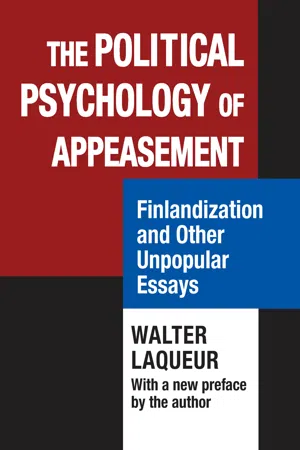
The Political Psychology of Appeasement
Finlandization and Other Unpopular Essays
- 282 pages
- English
- ePUB (mobile friendly)
- Available on iOS & Android
eBook - ePub
About this book
First published in the 1980s, The Political Psychology of Appeasement contains some of the most influential political journalism of the 1970s. The author, a leading contemporary historian and commentator on international affairs, provides an incisive critique of the weaknesses and inconsistencies of U.S. foreign policy in the 1970s as well as a diagnosis of the malaise of Western Europe.Laqueur's essays range from the subject of Finlandization to the problems of peace in the Middle East and the origins of political terrorism. To each of these areas he brings a deep and compassionate sensibility, the knowledge of a professional historian, and the sharp eye of an experienced journalist. Not only is Laqueur a global thinker, but his thought is undergirded by the experiences of world travel and an intimate knowledge of world leaders.Most of this book's essays are pessimistic because the author addresses his topics bluntly and pragmatically. Many of Laqueur's predictions have been borne out by subsequent events. As he ruefully says in his original preface, there is nothing so conducive to lack of popularity than to be right prematurely. Made timeless by their insightful honesty, his essays teach us about the art of political appeasement and prediction in the modern geopolitical landscape.
Information
Finlandizationn
I
My Finnish Adventures: An Introduction
Habent sua fata libelli—the reprint of a chapter from a book of mine on the subject of Finlandization became the focus of a heated controversy inside Finland in 1978 and of polemics which still continue. The drawbacks of polemics are well known. There is always the tendency to magnify the bones of contention, to score debating points, and above all, perhaps be side-tracked: polemics frequently create more heat than light. But they also have their advantages, for they tend to bring out some of the issues that have been swept under the carpet. It can hardly be denied that whatever their other merits, some of the world’s greatest under-the-carpet-sweepers reside at present in Helsinki.
My essay discussed with some sympathy the difficult dilemma facing contemporary Finland—to combine neutrality with a special relationship vis-à-vis the Soviet Union and the price that has to be paid for the preservation of freedom inside Finland. Among the questions asked in this article were whether collaboration with the Soviet Union had gone beyond the inexorable necessities of Finland’s geographical location, a small country bordering on a superpower, whether Finnish neutrality was moral and ideological as well as political, and whether the special relationship was likely to become a general pattern in Europe as indeed it has been frequently suggested by Soviet leaders. The term “Finlandization” has been offensive to most Finns and it is difficult not to sympathize with them. There is always an element of distortion when a geographical term is used to describe a political phenomenon and a good case can perhaps be made to eliminate it from our vocabulary. But a change in our dictionary will hardly affect the realities of world power. There will still be the desire on the part of weaker nations to accommodate their powerful neighbors, sometimes far beyond objective needs. Sometimes such accomodation will also involve domestic “adjustment,” such as the need to behave “responsibly” (i.e., with self censorship) and the election to high office only of candidates that are trusted by the powerful neighbors. Such practices have, of course, been known since time immemorial. What is new is the smoke screen of political make believe, the pretense of equality between states. When the Romans established their client states they did not bother about appearances, whereas in modern international relations a spade has always to be called an agricultural implement. Those who do not observe this elementary rule are violating basic standards of politeness like the child in Andersen’s story about the Emperor’s new clothes. Hence the anger expressed by Mr. Kekkonen, the Finnish president, and his political friends on yet another essay about Finlandization, a subject they believed to be safely buried—or at least swept under the carpet. Thus the search began for its author: was he influential or just a light-weight maverick? Why should a foreigner reveal such an unhealthy interest in Finnish affairs? Perhaps he did not exist at all, perhaps he was a second “Komissarov”? (A few years earlier a book had been published in the Soviet Union which greatly displeased most Finns because it argued that the Soviet Union had the right to interfere in Finnish affairs to a much larger extent than they always argued. Upon closer investigation it appeared that Comerade Komissarov did not exist, but was the pen name of one, or more, Soviet officials.)
Once it had been established that Mr. Laqueur did exist, and that it was not a pseudonym for either Mr. Brzezinski or Mr. Kissinger, the line taken by one part of the Finnish press was that while the author of the notorious article had shown less than complete familiarity as far as the intricacies of Finnish domestic affairs were concerned, he still had touched upon some very real and painful problems, and that little was to be gained by claiming that these problems did not exist. For there has been of late, for the first time in many years, outspoken concern from almost all the parts of the political spectre inside Finland about the slow, almost imperceptible but still very real retreat from independence—not just in foreign affairs but also on the domestic front. To provide but a few examples: Kyosti Skyttä, who bitterly attacked my Finlandization article, had himself previously compared contemporary Finland (“Kekkolandia”) with Wilhelmian Germany; Professor Ilkka Heiskanen defined Finland as “autocratic”; Professor Veli Menkoski wrote about Finland as a “non democracy”; Professor Osmo Jussila said that Finland is on its way to a “kind of monarchy”; Sakari Talvitie wrote in “Kanava” that “not only politicians but newspapermen too” try to “hear even the faintest whisper from inside the Soviet embassy”; and Tor Högnäs, a Swede and one of the very few foreign correspondents permanently stationed in Helsinki, noted that “A strange fear is spreading . . . anxiety and prostration towards the Soviets are very much in evidence.”
The picture that emerged was not compatible with the official version and it may have been also for this reason that the Finlandization article became the focus of so much attention. The counterattack, in many dozens of articles, claimed firstly that any attempt to invoke the spectre of Finlandization could only be based on the political doctrine of the extreme right. The logic is curious, for if criticism of the Soviet Union (or its absence) is made the yardstick, the Chinese suddenly move to the extreme right whereas Mr. G. Kennan becomes the spokesman of the far left. But there are, or course, mitigating circumstances; the asinine concept that a critical attitude towards the Soviet Union has to be equated with a right wing philosophy can be found equally often in the writings of American columnists and editorialists. For this reason, if for no other, one should not be too hard about some of the Finns. Next, the task became more delicate: It was claimed at one and the same time that the foreign author was totally ignorant—and that he knew suspiciously much about Finland. His ignorance was attested by an obliging American professor who had published a book on recent Finnish history. The syndrome is well known among area specialists, though in the past it has been associated mostly with Third World countries. The expert has been to Ruritania and he wants again to go there in future, nor does he want to find any doors closed to him. The least he can do is to extend a little help to the people whose hospitality he has enjoyed only yesterday—sapienti sat.
The obverse argument is more interesting, but also more disquieting. For if the critic of Finlandization is so well informed and if he derives his information not from official American sources, surely he must have some people inside Finland aiding and abetting his evil designs, people befouling their own nest, besmirching the good name of Finland (one recalls having heard this tune before!) by supplying him with translations from the Finnish press. Who are these men (or women)? A search is started, the guessing game spills over into the columns of the Finnish press, names are bandied about, pictures are published, rumors appear, ridiculous and quite untrue. But what if they were true? Is it implied that the translation of articles from newspapers not easily obtainable abroad is a crime against the state or, at the very least, unpatriotic behavior? And so the search for motives continues. The author is interviewed by leading Finnish newspapers and each time his “Jewish connections” are more or less subtly mentioned and not just once, in case that some of the inattentive readers may have missed the point. Perhaps this is just a case of Israeli retaliation for some Finnish votes in the U.N. Poor author, it will never be believed in Turku and Tampere that he has not the faintest idea how the Finns voted in the United Nations or whether they voted at all. One writer dismissed the tiresome search for motives: probably the author of the notorious article just wanted to earn a few dollars . . . At last an expert who really knows the United States, who remembers how eagerly American editors look forward to publishing articles about Finland, and what huge sums they will shower on those willing to write on this subject, and how the reading public in America waits with bated breath for every new comment on a speech by Virolainen, and Björklund and all the others . . .
The debate on Finlandization triggered off by my article is probably drawing to its close. At a safe distance it has been the source of some amusement, but for those more exposed to the icy winds it has been, and will be, no laughing matter. As an editor of the London Times recently (November 3) noted following a visit to Helsinki: “President Kekkonen has created a situation where the Russian question unnecessarily dominates Finnish politics. The president is said to regard support for this Russian policy as a permanent litmus test of peoples political reliability in every other sphere.” And, this, the writer concludes, is what Finlandization is all about. President Kekkonen is now eighty and may soon retire. With all his insistence on the special relationship with the Soviet Union, with all the concessions, necessary and unnecessary, made in foreign politics and on the domestic scene, it is also true that he has been a very stubborn man. But a certain pattern has been established under his rule, and the system will be tested under his successor; it can only be hoped that one’s worst fears will not come true.
The real significance is, of course, in Finland’s role as a model. We may want to banish “Finlandization” from our vocabulary but this does not change the fact that the Russians have behaved during the last year almost with contempt vis-à-vis the Europeans. Norwegian rights in the North Sea have been disregarded, Germany has been admonished on a variety of subjects, Britain has been warned of the horrible consequences of the sale of some Harrier aircraft to China. (Before that the new British ambassador was kept waiting for seven months until Mr. Gromyko could spare half an hour for meeting him for the first time.) British newspapers have complained that the Soviet leaders would not have behaved in such a peremptory way to the last of their satellites. But why blame the Soviet leaders? There must have been, after all, some reason that led them to believe that Western Europe would on its free will accept the kind of relationship which exists between Finland and the Soviet Union. The Finns, unlike the Europeans, have been acting from a position of weakness; their only fault is to have contributed to the general obfuscation about the real state of affairs, belittling the extent of Soviet indirect intervention. This from the Finnish point of view is psychologically only too understandable, but the consequences as can now be seen, have been unfortunate. And the “friends of Finland” who, acting no doubt from the best motives, wish to perpetuate this obfuscation have a great deal to answer for.1
II
The Specter of Finlandization
The term “Finlandization”—meaning that process or state of affairs in which, under the cloak of maintaining friendly relations with the Soviet Union, the sovereignty of a country becomes reduced—has entered the political dictionary despite the protests of Helsinki, Helsinki’s Western well-wishers, the Russians, and some American neo isolationists. There is an element of injustice whenever geographical terms acquire a political meaning—not everything in Byzantium was Byzantine, not everything in the Levant was Levantine, not everyone in Shanghai is shanghaied, and if the Balkans were balkanized, it was largely the fault of outside powers. “Finlandization,” in any case, is here to stay: it has become the subject of articles, books, and even doctoral dissertations.
Though the term is of recent date, its origins are by no means certain. The phenomenon was allegedly first described in 1953 by the Austrian Foreign Minister Karl Gruber, warning his government not to follow the Finnish example. He did not, however, actually coin the term. Professor Richard Lowenthal said in a 1974 interview with Time magazine that he may have been the first to use the term sometime in 1966, when the Warsaw Pact countries, at their meeting in Bucharest, suggested the dissolution of all military blocs. Subsequently, the term was used by Pierre Hassner, myself, and many other writers.
To speak of Finlandization is, of course, considered highly offensive and detrimental to national prestige in Finland itself. But outside observers too have warned against the use of the term. Some have argued that it conveys a false picture of Finland’s real situation. Others have maintained that Finland is a unique case, and to apply the term to other countries is misleading. Still others have claimed that the process of Finlandization is not something to be decried but is rather a positive phenomenon, worthy of emulation. And lastly, a few optimists have expressed the belief that Western Europe, at all events, so far has little to fear from Finlandization, certainly less than do Russia’s East European satellites.
Coming to grips with the phenomenon of Finlandization is made all the more difficult by the circumstance that so little is known in the West about Finland itself, and hence about exactly what sort of example it offers to other nations. There is no systematic press coverage from Helsinki and the existing scholarly literature in languages other than Finnish is not extensive; it is also not altogether reliable, because the self-censorship practiced inside Finland has infected Western publications on that country.2
Finland, which gained independence in 1917, was attacked by the Soviet Union in 1939 and defeated after stubborn resistance. It had to cede part of its territory. To regain what it had lost, Finland joined Germany in the attack on Russia in June 1941; in 1944 it made a separate peace with the Soviet Union and turned against the German army.
Stalin could have annexed Finland in 1944–45, but he preferred not to do so. There were several possible reasons for this magnanimity. The war, after all, had not yet ended, and the annexation of Finland at this date would have precipitated a conflict with the West. Strategically, moreover, Finland was less important than other territories annexed by the Russians. Then, too, the Russians had a healthy respect for the Finns, who had stubbornly fought for their freedom for a long time and who would have been more difficult to digest than, for instance, the Latvians and the Estonians. Nor is it unthinkable that Stalin wanted to keep Finland as a showcase for Russia’s benevolent intentions toward the rest of the world.
Whatever the reason, Finland did not become a Soviet republic. But a price had to be paid, and continues to be paid to this very day.
What is that price? Finland, first of all, is a neutral country, but not vis-à-vis the Soviet Union, toward which it has special obligations. It must not oppose any major Soviet foreign-policy initiative or enter into any commitments without Soviet approval, and it is expected to give active support to some aspects of Soviet foreign policy.
Secondly, Finland is permitted to have an army, but only within the limits set by the Soviet Union.
Thirdly, only those political parties approved by the Soviet Union can participate in the government, and the same applies a fortiori to the president and prime minister. There is no censorship by the Soviets, but the Finns are supposed to exert self-censorship. Communist participation in the government is not absolutely required, but Finnish statesmen are informally required to make frequent declarations stressing their friendly and mutually beneficial relations with the Soviet Union.
Fourthly, Finland is expected to have close commercial relations with the Communist bloc, but in this respect there are no hard and fast rules, and pressure has been more sporadic than in other fields—perhaps in view of Finland’s limited importance as a trading partner and COMECON’s limited capacity for supplying consumer goods.
Lastly, it is part of the whole process to deny its very existence. Only ignorant or malicious foreign observers, the Finns are expected to say, would find anything ominous or even out of the ordinary in Finland’s relations with the Soviet Union.
To begin with the issue of neutrality, this is perhaps the least important aspect of the Finnish predicament (although it has been discussed endlessly). According to the Soviet-Finnish Treaty of 1948 and subsequent agreements, Finland has certain definitive commitments to the Soviet Union. It is true that Finnish spokesmen, such as Max Jakobson, have argued that the treaty does not bind Finland to anything beyond the defense of its own territory. Unfortunately, this interpretation has not been accepted by the Russians— Mr. Jakobson’s book on the subject was bitterly attacked in the Soviet press— and given the facts of political and military power, it is the Soviet interpretation that counts. (When Mr. Jakobson was a candidate for the post of Secretary General of the UN some years ago, the Soviet Union vetoed his appointment; that he is of Jewish origin probably did not help, but the decisive consideration was no doubt that he was not thought to be politically “safe.” That is, he was suspected of taking neutrality seriously.) The frequent claims of Finland’s President Kekkonen that “all great powers have explicitly recognized Finnish neutrality” are a statement of intent, not of fact.
What is more significant than neutrality is the issue of freedom, which is of immediate practical relevance to the political, social, and cultural life of the Finnish people. Compared with Russia’s East European satellites, Finland is both independent and free. It has many political parties (ten), and many (too many) elections. Its institutions are democratic, its constitution is scrupulously observed. There are no arbitrary arrests; in fact, no one ever has been sent to prison for political reasons. Finns can freely travel abroad. The larger part of the Finnish economy is not nationalized. There is a vigorous cultural life, and Soviet influence on it is certainly not overwhelming. Foreign books and newspapers are widely available. Finland, in short, enjoys the same freedoms as the Western nations.
But there is another side to the picture, less visible but always present, which is a consequence of the Kekkonen “line” that Finland’s survival can be assured only by maintaining Soviet trust. To provide but a few examples: when the United Nations voted for the withdrawal of Soviet troops from Hungary after the Soviet invasion in 1956, the Finnish government did not join the majority but insisted that it was up to the governments of the Soviet Union and Hungary to reach an agreement. When Kekkonen visited Prague one year after the Soviet invasion of 1968, he admonished his hosts to behave in such a way as not to give rise to conflicts. Foreign Minister Leskinen, speaking in 1971, said that the handling of the Czechoslovak crisis by the Warsaw Pact and by NATO was a “triumph of European understanding.” And so forth.
If Soviet confidence could be retained at the price of foreign political concessions alone, the cost for Finland might be bearable; it would be understandable, in any case, in view of Finland’s geographical position. But according to the Kekkonen line, it is also imperative that Finnish political leaders, parties, the media, and individual citizens all behave “responsibly”; otherwise they will endanger the very survival of the country. To act “responsibly” means to refrain from doing anything the Russians may not like, and this involves not only self-censorship but also the need to antici...
Table of contents
- Cover Page
- Title Page
- Copyright Page
- Contents
- Preface to the Paperback Edition
- Acknowledgments
- Preface
- Europe
- Finlandizationn
- The Fall of Europe?
- “Eurocommunism” and Its Friends
- Russia Beyond Brezhnev
- Essays in Futurism
- Six Scenarios for 1980
- The Next Ten Years
- Terrorism
- Karl Heinzen and the Origins of Modern Terrorism
- The Futility of Terrorism
- Second Thoughts on Terrorism
- World Affairs and U.S. Foreign Policy
- The Psychology of Appeasement
- The World and President Carter
- America and the World: The Next Four Years, Confronting the Problems
- The Issue of Human Rights
- Third World Fantasies
- Fascism —The Second Coming
- Peace in the Middle East
- Peace With Egypt?
- Is Peace Possible in the Middle East?
- Is Peace Still Possible in the Middle East?: The View from Tel Aviv
- Judaica
- The World of Mr. Begin
- Hannah Arendt in Jerusalem—The Controversy Revisited
Trusted by 375,005 students
Access to over 1.5 million titles for a fair monthly price.
Study more efficiently using our study tools.
Frequently asked questions
Yes, you can cancel anytime from the Subscription tab in your account settings on the Perlego website. Your subscription will stay active until the end of your current billing period. Learn how to cancel your subscription
No, books cannot be downloaded as external files, such as PDFs, for use outside of Perlego. However, you can download books within the Perlego app for offline reading on mobile or tablet. Learn how to download books offline
Perlego offers two plans: Essential and Complete
- Essential is ideal for learners and professionals who enjoy exploring a wide range of subjects. Access the Essential Library with 800,000+ trusted titles and best-sellers across business, personal growth, and the humanities. Includes unlimited reading time and Standard Read Aloud voice.
- Complete: Perfect for advanced learners and researchers needing full, unrestricted access. Unlock 1.5M+ books across hundreds of subjects, including academic and specialized titles. The Complete Plan also includes advanced features like Premium Read Aloud and Research Assistant.
We are an online textbook subscription service, where you can get access to an entire online library for less than the price of a single book per month. With over 1.5 million books across 990+ topics, we’ve got you covered! Learn about our mission
Look out for the read-aloud symbol on your next book to see if you can listen to it. The read-aloud tool reads text aloud for you, highlighting the text as it is being read. You can pause it, speed it up and slow it down. Learn more about Read Aloud
Yes! You can use the Perlego app on both iOS and Android devices to read anytime, anywhere — even offline. Perfect for commutes or when you’re on the go.
Please note we cannot support devices running on iOS 13 and Android 7 or earlier. Learn more about using the app
Please note we cannot support devices running on iOS 13 and Android 7 or earlier. Learn more about using the app
Yes, you can access The Political Psychology of Appeasement by Walter Laqueur in PDF and/or ePUB format, as well as other popular books in Politics & International Relations & Diplomacy & Treaties. We have over 1.5 million books available in our catalogue for you to explore.